
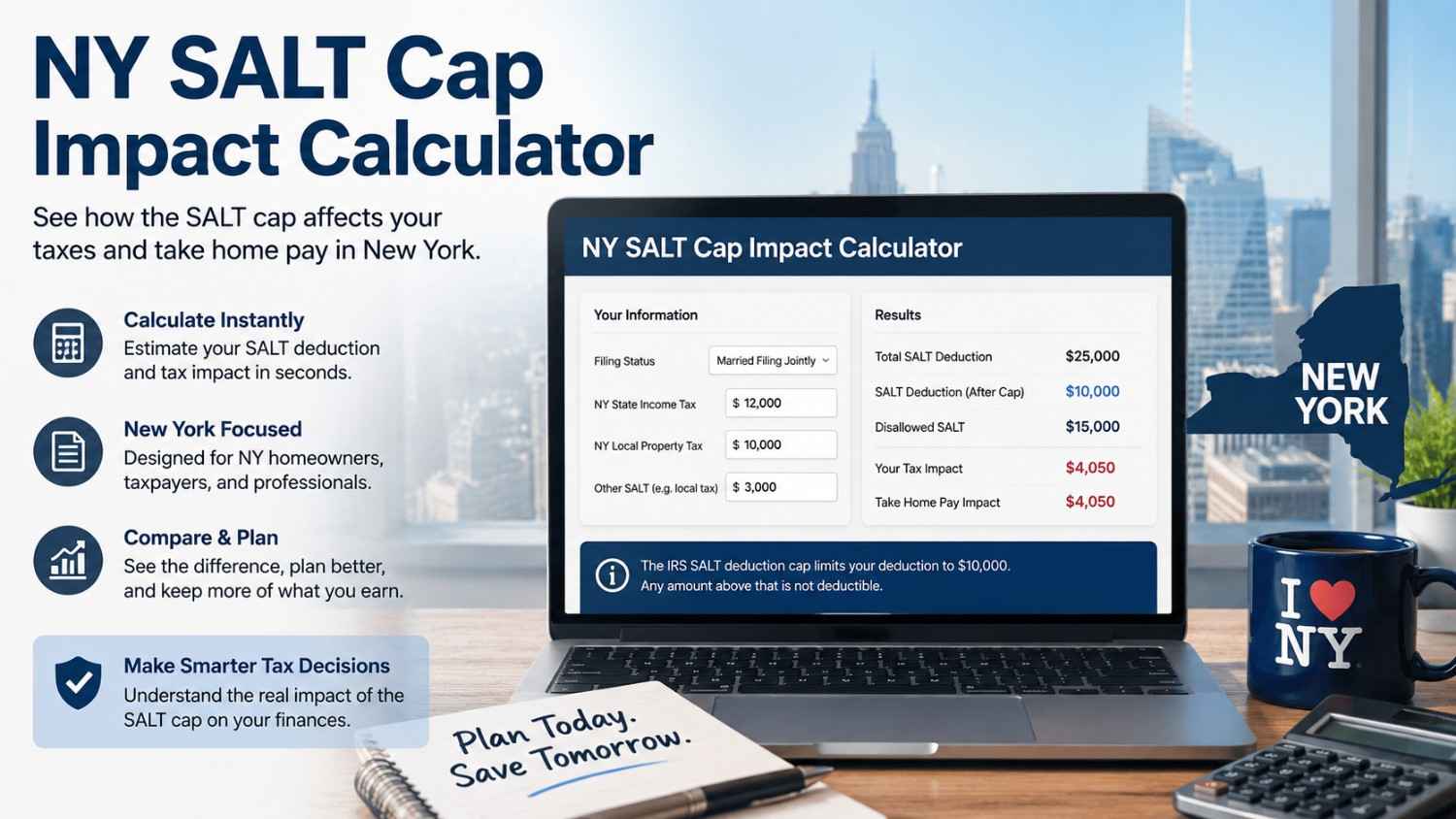
NY SALT Cap Impact Calculator
See exactly how much extra federal tax you pay because of the $10,000 SALT deduction cap — and how much New York residents lose compared to what they could deduct without the limit.
Your SALT Cap Tax Impact
—| Component | Without Cap (Full Deduction) | With $10K Cap (Current Law) |
|---|
What This Means For You
—
What Exactly Is the SALT Cap and Why Does It Hurt New Yorkers?
The SALT deduction allows taxpayers to deduct state and local taxes (income taxes, property taxes, and sales taxes) from their federal taxable income. Before 2018, there was no limit on this deduction — if you paid $25,000 in New York State and City taxes plus $10,000 in property taxes, you deducted the full $35,000 on your federal return. The Tax Cuts and Jobs Act of 2017 (TCJA) changed this by capping the SALT deduction at $10,000 per return ($5,000 for married filing separately). This means that regardless of how much you actually pay in state and local taxes, you can only deduct $10,000 on your federal return.
New York is the most impacted state in the country by the SALT cap, and the damage is not evenly distributed — it falls disproportionately on high-tax areas within New York, particularly New York City and its suburbs, where residents pay three layers of income tax (federal, state, and city/local) plus some of the highest property taxes in the nation. A single person earning $200,000 in Manhattan might pay $14,000 in NY State tax, $5,500 in NYC tax, and $8,000 in property tax — $27,500 in total SALT. Under the old rules, they’d deduct the full $27,500. Under the current cap, they deduct only $10,000, losing $17,500 in deductions. At a 24% marginal federal rate, that’s $4,200 in extra federal tax — money that goes to the IRS solely because of the SALT cap.
The SALT cap is scheduled to expire at the end of 2025. If Congress does not extend it, the full SALT deduction returns in 2026, and New York taxpayers would see immediate and significant federal tax relief. If Congress extends the cap (which many observers consider likely), the extra tax burden continues indefinitely. This calculator shows you exactly what’s at stake for your specific situation — the dollar amount of the “hidden tax” that the SALT cap imposes on you as a New York resident.
Why the SALT Cap Is a Hidden Tax That Most New Yorkers Don’t Fully See
The SALT cap doesn’t appear on your paycheck. It doesn’t show up as a line item on your W-2. There’s no bill, no notice, and no invoice that says “SALT Cap Surcharge: $4,200.” Instead, it silently increases your federal tax liability by reducing your deductions, and most New Yorkers only discover the impact when they sit down with their CPA at tax time and see that their state and local taxes barely reduced their federal bill. This invisibility is what makes the SALT cap particularly insidious — it’s a massive transfer of wealth from high-tax states like New York to the federal government, but it’s camouflaged within the complexity of the tax code.
Thousands Per Year in Hidden Tax
Most affected NY taxpayers lose $3,000-$10,000+ per year in federal tax savings that they would have had without the cap. This is real money that could be saved, invested, or spent locally.
Property Tax Makes It Worse
NY has the 7th highest property taxes in the US. A $12,000 property tax bill eats up the entire $10,000 cap by itself, leaving zero room for income tax deductions.
Worse at Higher Incomes
The SALT cap hits harder at higher incomes because you pay more state/local tax (which gets capped) AND you’re in a higher federal bracket (so the lost deduction costs more per dollar).
Expiring in 2025 — Or Not
The cap expires Dec 31, 2025. If it expires, NY taxpayers get instant relief. If extended, the pain continues. This calculator shows exactly what’s at stake either way.
The interaction between the SALT cap and the standard deduction creates an additional layer of complexity that many New Yorkers miss. The TCJA nearly doubled the standard deduction (to $13,850 for single filers and $27,700 for married filing jointly in 2024), which means many taxpayers who used to itemize now take the standard deduction instead — and when you take the standard deduction, the SALT cap is irrelevant because you’re not deducting SALT at all. However, for New York homeowners in NYC or its high-property-tax suburbs, itemizing often still makes sense even with the cap, because your SALT plus mortgage interest plus charitable contributions exceed the standard deduction. In that scenario, the SALT cap bites hard — you’re itemizing specifically because your SALT is high, but the cap prevents you from deducting most of it.
The geographic concentration of SALT cap pain within New York is striking. According to IRS data, the average SALT deduction for New York taxpayers before the cap was approximately $22,000 — meaning the average New Yorker lost about $12,000 in SALT deductions when the cap took effect. In Manhattan, the average pre-cap SALT deduction exceeded $30,000, and in some Westchester and Nassau County communities with high property taxes, it was even higher. These are the communities where the SALT cap functions as an invisible additional federal tax of $3,000-$8,000+ per year on top of what residents would otherwise pay.
How to Use This Calculator (Takes 15 Seconds)
Enter Your Income
Input your federal taxable income BEFORE the SALT deduction. This is your gross income minus non-SALT deductions (mortgage interest, charitable contributions, etc.).
Enter Your SALT Taxes
Enter the exact amounts from your tax return: NY State income tax, NYC/Yonkers local tax, property tax, and any other state/local taxes you paid.
Select Itemization Status
Choose whether you itemize deductions or take the standard deduction. If you take the standard deduction, the SALT cap doesn’t affect you (but you’re also not benefiting from your SALT at all).
See the Full Impact
The calculator shows a before/after comparison, the dollar amount of extra federal tax, your lost monthly take-home pay, and the “hidden tax rate” imposed by the cap.
SALT Cap Impact by Income Level: What New Yorkers Actually Lose
The table below shows the estimated SALT cap impact for typical New York taxpayers at different income levels, assuming NYC residency, standard property tax for their income bracket, and the deduction structure that applies at each level. These are estimates based on typical New York tax profiles — your actual numbers will depend on your specific deductions and circumstances.
| Income | Typical Total SALT | Deduction Lost | Extra Federal Tax (24% Bracket) | Extra Federal Tax (32% Bracket) |
|---|---|---|---|---|
| $100,000 | $10,500 | $500 | $120 | $160 |
| $150,000 | $16,000 | $6,000 | $1,440 | $1,920 |
| $200,000 | $22,000 | $12,000 | $2,880 | $3,840 |
| $300,000 | $32,000 | $22,000 | $5,280 | $7,040 |
| $500,000 | $52,000 | $42,000 | $10,080 | $13,440 |
| $750,000 | $78,000 | $68,000 | $16,320 | $21,760 |
| $1,000,000 | $105,000 | $95,000 | $22,800 | $30,400 |
Notice how the impact accelerates at higher incomes. At $100,000, the SALT cap costs you only $120-$160 per year — annoying but not life-changing. At $500,000, it costs $10,000-$13,440 — enough to fund a vacation, a home improvement project, or a year of retirement contributions. At $1,000,000, the lost deduction exceeds $22,000 — more than many Americans earn in a year. This accelerating impact is why the SALT cap is often described as a “tax on high-tax states” — it doesn’t affect low-tax states (where total SALT is often under $10,000 anyway) but extracts significant additional revenue from New York, California, New Jersey, Connecticut, and Illinois.
How the SALT Cap Affects Different Parts of New York Differently
New York is not monolithic when it comes to the SALT cap. The impact varies dramatically between New York City, its suburbs, and upstate New York — and understanding these differences is important for knowing how hard the cap hits you relative to other New Yorkers.
- New York City (5 Boroughs): NYC residents are hit hardest because they pay three layers of income tax (federal, state at 8.82%, and city at 3.876%) PLUS some of the highest property taxes in the country for the small apartment sizes typical of the city. A Manhattan resident in a $1.2 million co-op might pay $14,000 in state tax, $5,500 in city tax, and $9,000 in property tax — $28,500 total SALT, of which $18,500 is lost to the cap. At a 32% marginal federal rate, that’s $5,920 in extra federal tax. The city’s high cost of living means this $5,920 has a larger real impact on quality of life than the same dollar amount would have in a lower-cost area.
- Long Island (Nassau and Suffolk Counties): Long Island has some of the highest property taxes in the United States — frequently $10,000-$18,000+ for a single-family home. These high property taxes alone can consume the entire $10,000 SALT cap, leaving zero room for deducting state income tax (which is also high because Long Island incomes tend to be above the state average). A family in Nassau County with a $15,000 property tax bill and $12,000 in state income tax has $27,000 in SALT — $17,000 of which is lost to the cap. The property tax concentration makes Long Island one of the most SALT-cap-impacted areas in the country, even though it doesn’t have the city income tax.
- Westchester County: Similar to Long Island — very high property taxes ($12,000-$20,000 for a typical single-family home) combined with high incomes and high state tax. Westchester residents are among the most vocal advocates for SALT cap relief because the math is particularly brutal there: a $16,000 property tax bill plus $15,000 in state tax equals $31,000 in SALT, of which $21,000 is lost. At a 35% marginal federal rate, that’s $7,350 in extra federal tax.
- Upstate New York (Buffalo, Rochester, Syracuse, Albany): Upstate residents pay the same 8.82% state income tax rate but generally have much lower property taxes and lower incomes than downstate residents. A Rochester resident earning $90,000 might pay $6,000 in state tax and $4,000 in property tax — $10,000 total SALT, which exactly hits the cap. They lose nothing to the SALT cap because their total SALT doesn’t exceed $10,000. This is why the SALT cap is often described as a “downstate problem” — upstate New Yorkers are much less affected because their lower property taxes keep them under or near the cap threshold.
The 2025 SALT Cap Expiration: What Happens Next
The $10,000 SALT cap was enacted as part of the Tax Cuts and Jobs Act of 2017, which used budget reconciliation procedures that limit the duration of certain provisions to 10 years. The SALT cap is currently scheduled to expire on December 31, 2025. If it expires, the SALT deduction reverts to its pre-2018 form — unlimited, with no dollar cap. For New York taxpayers, this would represent one of the largest tax cuts in state history, even though it wouldn’t be a New York law — it would be a federal law change that disproportionately benefits New York.
- If the cap expires: New York taxpayers who itemize would immediately regain the ability to deduct their full state and local taxes. A NYC resident currently losing $18,500 in SALT deductions would save approximately $4,440-$6,475 in federal taxes (at 24-35% marginal rates) starting in the 2026 tax year. For a household losing $30,000 in deductions, the savings would be $7,200-$10,500. The total impact across New York State would be $12-15 billion per year in restored federal deductions — money that stays in New York instead of going to Washington.
- If the cap is extended: Most tax policy observers consider it more likely than not that Congress will extend the SALT cap in some form, because allowing it to expire would reduce federal revenue by approximately $80-100 billion over 10 years, and the Republican caucus that passed the TCJA is generally reluctant to allow any of its provisions to expire. However, the extension could come with modifications: a higher cap ($15,000 or $20,000 have been discussed), an income phase-out that restores the full deduction for lower-income taxpayers, or a negotiated compromise that pairs SALT relief with other tax changes.
- The SALT deduction workaround (pass-through entity tax): Several states, including New York, have created a workaround for the SALT cap through their pass-through entity tax (PTET) election. Under NY’s PTET, partnerships and S-Corps can elect to pay state income tax at the entity level, and the partners/shareholders treat their share of that entity-level tax as a business expense on their federal return — effectively bypassing the $10,000 individual SALT cap. This has provided meaningful relief for many New York business owners, but it doesn’t help W-2 employees, sole proprietors (in most cases), or individuals whose SALT primarily consists of property tax. The calculator doesn’t model the PTET election because it applies at the entity level, not the individual level.
What This Calculator Can’t Do
- It doesn’t replace tax software: This calculator provides an estimate of the SALT cap’s impact on your federal tax liability. It doesn’t calculate your complete federal or state tax return. Use it for planning and understanding, not for filing.
- It uses a single marginal rate: The calculator applies your marginal federal tax rate to the entire lost deduction. In reality, the lost SALT deduction might span multiple federal brackets, which would slightly change the exact dollar amount. For most taxpayers, the single-rate approximation is within 1-3% of the actual impact.
- It doesn’t model the PTET election: New York’s pass-through entity tax provides an alternative path to deducting SALT that bypasses the individual cap. If you’re a partner in a partnership or an S-Corp shareholder that made the PTET election, your actual SALT cap impact may be lower than this calculator shows.
- It doesn’t consider AMT interactions: The Alternative Minimum Tax (AMT) has its own rules for SALT deductions that can further limit the benefit in certain high-income scenarios. The calculator uses the regular tax system, which is correct for most taxpayers under the post-TCJA AMT rules, but very high-income taxpayers may need an AMT analysis.
- Standard deduction vs. itemization is your call: The calculator shows the SALT cap impact IF you itemize. If your total itemized deductions (SALT + mortgage interest + charity) are less than the standard deduction ($13,850 single / $27,700 MFJ in 2024), you should take the standard deduction — and the SALT cap is irrelevant to you. The calculator flags this but doesn’t force you into either option.
What Happens With Your Information
Nothing — your income, tax amounts, filing status, and all other inputs are processed entirely in your browser. No data is sent to any server. No financial or tax information is stored, logged, or transmitted. No cookies, no tracking. Close the tab and it’s completely gone.
Frequently Asked Questions
No. If you take the standard deduction ($13,850 for single filers, $27,700 for married filing jointly in 2024), you don’t deduct your SALT at all — so the $10,000 cap doesn’t affect you. However, this means you’re also not getting any benefit from the state and local taxes you pay. If your total itemized deductions (SALT + mortgage interest + charitable contributions) exceed the standard deduction, you should itemize — and that’s when the SALT cap starts hurting you. Many New York homeowners with mortgages and moderate-to-high property taxes are still better off itemizing even with the cap, because SALT plus mortgage interest alone often exceeds the standard deduction.
No. If you file as Married Filing Separately, your SALT cap is reduced to $5,000 (half of the $10,000 joint cap). This is a deliberate provision designed to prevent married couples from filing separately to get two $10,000 caps ($20,000 total). In practice, MFS status is almost never beneficial for New Yorkers because NY State tax brackets for MFS are the same as single filer brackets (not half), which means the state tax burden doesn’t split evenly. The MFS SALT cap of $5,000 is even more punitive for New Yorkers than the $10,000 joint cap.
Technically yes — you can choose to deduct either state/local income taxes OR state/local sales taxes (using actual receipts or the IRS sales tax table for your state and income level), but not both. However, for New York City residents, sales tax is almost never the better choice. NYC’s combined sales tax rate is 8.875%, and even a household spending $50,000/year on taxable purchases would only have about $4,437 in deductible sales tax — well under the $10,000 cap. Income tax and property tax in New York are almost always higher than sales tax, so deducting income tax and property tax is the correct choice for virtually every New York taxpayer.
The NY PTET (Pass-Through Entity Tax) is a workaround that allows partnerships and S-Corporations to pay state income tax at the entity level instead of the individual level. The partners/shareholders then deduct their share of the entity-level tax as a business expense on their federal return — and this business expense deduction is NOT subject to the $10,000 SALT cap. For a partner in a Manhattan-based partnership paying $20,000 in NY State tax, the PTET election could allow them to deduct the full $20,000 on their federal return instead of being capped at $10,000 — saving approximately $2,400-$7,000 in federal taxes depending on their bracket. However, PTET doesn’t help W-2 employees, most sole proprietors, or people whose SALT is primarily property tax. The election must be made by the entity, not the individual.
Generally no. Prepaying property tax (paying next year’s property tax in December of this year to deduct it this year) was a common strategy before 2018, but the SALT cap eliminated most of the benefit. If your total SALT already exceeds $10,000, prepaying more property tax just adds to the amount that’s capped — you don’t get any additional federal deduction. The only scenario where prepayment helps is if your total SALT for this year is under $10,000 but prepaying would push it over (which is rare for New York homeowners with typical property tax bills). If the SALT cap expires in 2025 and full deductions return in 2026, prepaying 2026 property tax in December 2025 could be valuable — but that depends on whether the cap actually expires, which is uncertain.
The constitutionality of the SALT cap has been challenged in federal court, with several states (including New York, New Jersey, and Connecticut) arguing that it disproportionately affects high-tax states and violates constitutional principles of federalism. In 2022, a federal district court in New York ruled against the challengers, upholding the cap. The Second Circuit Court of Appeals affirmed this ruling in 2023. The Supreme Court declined to hear the case, leaving the cap in place. For now, the SALT cap is settled law — but it remains a political flashpoint, and a future Supreme Court with a different composition could potentially revisit the issue.