
By Junaidul Islam
Last Updated: October 2026
Buying a home in New York is not simply a matter of taking your annual income and multiplying it by a number. The same salary can support very different home prices depending on where you buy, how much you put down, your existing debt, mortgage rate, property taxes, insurance, HOA or co-op charges, and the cash you need to bring to closing.
That is why a useful New York Home Affordability Calculator should do more than estimate a mortgage payment.
It should help answer a more practical question:
“What home price can I realistically afford without making my monthly budget too tight?”
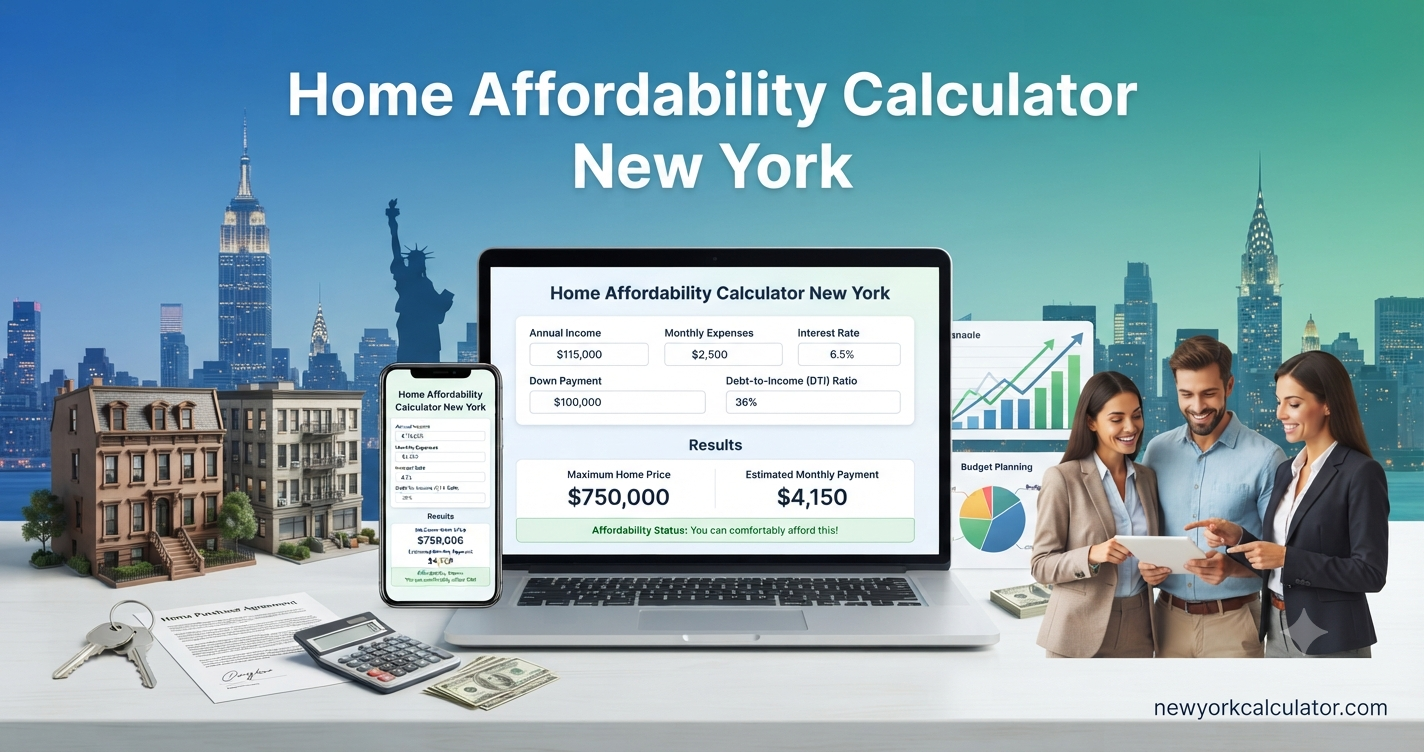
The calculator on this page is designed around that question. It lets you estimate a comfortable home price, a maximum estimated purchase price, monthly housing costs, debt-to-income ratio, down payment, mortgage costs and several New York-specific expenses.
New York Home Affordability Calculator
Estimate your comfortable and maximum home price, monthly housing cost and major New York purchase expenses.
Your Estimated Affordability
Estimated Monthly Cost at Maximum Price
The results are estimates for planning purposes, not a mortgage approval or loan offer. Actual costs can vary by lender, property, county, school district, insurance policy, tax assessment and individual financial circumstances.
What Is a New York Home Affordability Calculator?
A home affordability calculator estimates the purchase price you may be able to handle based on your income, existing debt, down payment and expected housing expenses.
A basic calculator may look at only:
- Annual income
- Down payment
- Mortgage rate
- Loan term
- Monthly debt
A more useful New York calculator should also consider:
- Property taxes
- Homeowners insurance
- PMI
- HOA or condo fees
- Co-op maintenance
- Mortgage recording tax where applicable
- New York-specific closing costs
- STAR benefits
- Credit profile
- Debt-to-income ratio
- Cash available for closing
- Property type
- NYC versus other New York locations
This distinction matters because New York has substantial differences between New York City, Long Island, Westchester, the Hudson Valley and upstate markets.
How Much House Can I Afford in New York?
There is no single income-to-home-price formula that works for every New York buyer.
Two households earning the same $150,000 per year may have completely different affordability because one household has $500 in monthly debt and the other has $2,500.
The amount you can reasonably spend is affected by four major areas:
1. Your income
Start with gross household income rather than take-home pay.
For example, if your household earns:
- $80,000 per year
- $120,000 per year
- $150,000 per year
- $200,000 per year
the calculator can estimate the housing payment that may fit within different affordability limits.
2. Your existing monthly debt
Include recurring debts such as:
- Auto loans
- Student loans
- Credit card minimum payments
- Personal loans
- Child support
- Other qualifying monthly obligations
A buyer with a high income can still have limited housing affordability when existing debt is substantial.
3. Your down payment
A larger down payment reduces the mortgage balance.
That can reduce:
- Principal and interest
- PMI
- Mortgage recording tax in NYC
- Total interest over the life of the loan
It also increases the amount of cash you need before closing.
4. Your local housing costs
This is especially important in New York.
Property taxes can vary significantly from one location to another. SmartAsset's New York mortgage analysis also emphasizes the large county-to-county variation in property taxes.
So a home price that looks affordable using only principal and interest may become much less comfortable after taxes, insurance, HOA or maintenance costs are included.
Why New York Home Affordability Is Different
New York is not one housing market.
Buying a property in Manhattan is very different from buying a house in Buffalo. A Long Island buyer faces different costs from someone shopping in Syracuse or Rochester.
Even within the same metropolitan area, taxes, insurance, school districts, property types and monthly building charges can change the calculation.
This is why I recommend using a New York-specific affordability estimate rather than relying only on a national rule of thumb.
Rocket Mortgage's current New York home-buying guidance also highlights the state's different market conditions and the importance of considering income, savings, debt, credit profile and closing costs when estimating affordability.
The 28/36 Rule: Useful, But Not the Whole Answer
You may have heard of the 28/36 rule.
As a traditional planning guideline:
- Around 28% of gross monthly income goes toward housing costs.
- Around 36% goes toward total recurring debt.
Some lenders may use different underwriting standards depending on loan type, borrower profile and other factors.
For example, if a household earns $150,000 annually:
Gross monthly income = $12,500
A 28% housing guideline would produce:
$12,500 × 28% = $3,500
That does not mean the buyer automatically qualifies for a mortgage with a $3,500 payment.
It is only a budgeting reference.
The actual calculation should account for property taxes, insurance, mortgage insurance, HOA or maintenance charges and existing debt.
That is why the calculator on this page provides more than one affordability result.
Comfortable Home Price vs. Maximum Home Price
One of the biggest mistakes buyers make is treating the maximum amount a lender might approve as the amount they should spend.
Those are not necessarily the same thing.
Maximum estimated home price
This represents a higher-end affordability scenario based on the assumptions entered into the calculator.
Comfortable home price
This is a more conservative planning number intended to leave room in the household budget for things such as:
- Utilities
- Repairs
- Maintenance
- Emergency savings
- Retirement contributions
- Transportation
- Childcare
- Healthcare
- Lifestyle expenses
A home can be technically affordable while still making your monthly life uncomfortable.
For that reason, I recommend looking at the comfortable estimate first, then using the maximum estimate as a comparison.
What Costs Should Be Included in a New York Home Affordability Calculation?
Your mortgage payment is only one part of homeownership.
A realistic monthly estimate may include:
Principal
The portion of the mortgage payment that reduces your loan balance.
Interest
The cost of borrowing the mortgage.
Property taxes
New York property taxes can vary considerably by municipality, county and property.
Homeowners insurance
The insurance premium needed for the property.
PMI
Private mortgage insurance may apply when the down payment is below certain thresholds depending on the loan.
HOA or condo fees
These can materially change affordability.
Co-op maintenance
Co-op buyers should pay particular attention to monthly maintenance because it can contain multiple building-related expenses and may be substantial.
New York Property Taxes Can Change the Answer
A statewide average should never be treated as the exact tax bill for a specific house.
New York's Department of Taxation and Finance explains that property assessments and taxes depend on local assessment and taxing jurisdictions. New-home buyers are advised to investigate the property-specific tax information rather than assume a statewide figure.
That is why the calculator allows the user to work with an estimated property-tax assumption rather than pretending that one statewide rate applies to every property.
For serious purchase planning, replace an estimate with the actual property's latest tax information whenever available.
STAR: A New York Benefit Buyers Should Know About
The School Tax Relief (STAR) program is one of the most important New York-specific items that national affordability calculators often do not explain in detail.
Eligible New York homeowners may receive STAR benefits on their primary residence.
New York currently provides STAR benefits through the STAR credit or, for certain existing recipients, the STAR exemption. The state says eligible STAR credit recipients can receive the benefit by check or direct deposit.
There are also important 2026 changes for Enhanced STAR.
Beginning in 2026, New York says eligible homeowners turning 65 can be automatically upgraded to Enhanced STAR without submitting a new application to the local assessor, provided other eligibility requirements are met.
For the 2026–27 school year, New York lists a Basic STAR base amount of $30,000 and an Enhanced STAR base amount of $88,500 for the exemption calculation. These are not cash payments equal to those amounts; the actual tax savings depend on the applicable rules, school tax rate and local factors.
This is an important distinction.
Do not simply subtract $30,000 or $88,500 from the purchase price.
STAR affects qualifying property-tax obligations, not your mortgage principal.
NYC vs. Other Parts of New York
If you are buying outside New York City, many costs still depend on the county and municipality.
If you are buying in NYC, additional city-specific rules can matter.
The five boroughs are:
- Manhattan
- Brooklyn
- Queens
- The Bronx
- Staten Island
A NYC affordability estimate should therefore consider additional transaction costs that a basic statewide calculator may overlook.
NYC Mortgage Recording Tax
One of the most important NYC-specific costs is the mortgage recording tax.
New York State imposes a mortgage recording tax on mortgages recorded against real property, and NYC also has local mortgage tax rules. The state Department of Taxation and Finance explains that the applicable rate can include state, MCTD and local components depending on where the property is located.
NYC's Department of Finance also confirms that a mortgage recording tax is charged when mortgages on NYC property are recorded and directs users to ACRIS for calculating the applicable tax.
This is why you should not assume that every New York property has the same mortgage recording tax.
What makes NYC different?
For qualifying residential NYC mortgages, commonly cited buyer-side effective rates are approximately:
- 1.80% for loans below $500,000
- 1.925% for loans of $500,000 or more
The exact tax calculation can depend on the property and transaction structure, and the official NYC system should be checked before closing.
Co-op financing also requires special treatment because a co-op transaction is not structured in exactly the same way as a deeded real-property mortgage.
For a planning calculator, these figures should be treated as estimates—not a closing statement.
What Is New York's Mansion Tax?
Despite the name, you do not need to own an actual mansion to encounter the tax.
New York State currently imposes an additional 1% tax on qualifying residential transfers at $1 million or more. In NYC and certain qualifying high-value transactions, the applicable mansion-tax rate can increase under the progressive schedule. New York's Department of Taxation and Finance confirms the $1 million threshold and 1% additional tax, while the expanded NYC schedule reaches 3.9% at $25 million or more.
The commonly used NYC schedule is:
| Residential purchase price | Mansion tax rate |
|---|---|
| $1M–$1.999M | 1.00% |
| $2M–$2.999M | 1.25% |
| $3M–$4.999M | 1.50% |
| $5M–$9.999M | 2.25% |
| $10M–$14.999M | 3.25% |
| $15M–$19.999M | 3.50% |
| $20M–$24.999M | 3.75% |
| $25M+ | 3.90% |
The rate is applied to the applicable consideration under the rules; it is not simply a tax on the amount above $1 million.
For most ordinary New York buyers, this will never be a major part of affordability. But for buyers looking at $1 million-plus properties, it should not be ignored.
New York Closing Costs: The Cash You Need Beyond the Down Payment
A buyer who saves enough for a 20% down payment may still be surprised by the amount of cash required at closing.
Depending on the transaction, you may have costs associated with:
- Attorney
- Title-related services
- Lender fees
- Appraisal
- Inspection
- Recording
- Mortgage-related taxes
- Prepaid interest
- Escrow
- Insurance
- Property taxes
- Mansion tax where applicable
- Other transaction-specific charges
New York's Department of Taxation and Finance specifically identifies real estate transfer tax and mortgage recording tax among the costs buyers should understand around a home purchase.
The exact amount depends heavily on the property and transaction.
So when planning a purchase, ask two separate questions:
How much home can I afford?
and
How much cash do I need to close?
They are not the same question.
Condo vs. Co-op vs. House
New York buyers should not use the same affordability assumptions for every property type.
Single-family or multi-family house
You may need to consider:
- Mortgage
- Property tax
- Homeowners insurance
- Maintenance
- Utilities
- Repairs
Condo
You may have:
- Mortgage
- Property tax
- Insurance
- Common charges
- Possible mortgage recording tax
- Possible mansion tax
Co-op
A co-op can work differently because you purchase shares in the cooperative corporation rather than receiving the same type of deeded ownership as a house or condo.
You may have:
- Mortgage
- Monthly maintenance
- Board requirements
- Cash-reserve requirements
- Building-specific rules
- Purchase-related fees
This is one reason a New York buyer should look beyond the advertised monthly mortgage payment.
PMI and Your Down Payment
A smaller down payment can make buying a home possible sooner, but it may increase the monthly cost.
For example, compare:
5% down
versus
10% down
versus
20% down
The mortgage balance changes, and PMI may also apply depending on the loan.
A 20% down payment is not automatically the best decision for every buyer.
Putting all available cash into the house can leave too little money for:
- Emergency savings
- Repairs
- Closing costs
- Moving expenses
- Furniture
- Unexpected bills
The better question is:
“What down payment gives me a manageable monthly payment while leaving enough cash after closing?”
Credit Score and Mortgage Affordability
Your credit profile can influence the mortgage rate and loan options available to you.
A lower interest rate can increase purchasing power because less of your monthly payment goes toward interest.
For this reason, the calculator allows users to test different interest rates rather than assuming that one mortgage rate applies to every borrower.
Do not interpret the calculator's rate as a lender quote.
Your actual rate may depend on:
- Credit history
- Credit score
- Loan type
- Down payment
- Property type
- Occupancy
- Loan size
- Market conditions
- Lender pricing
How Interest Rates Change Your Buying Power
A small rate difference can have a meaningful effect on monthly payment.
Consider testing your affordability at several rates:
6.0%
6.5%
7.0%
7.5%
This is more useful than looking at a single rate.
If you can comfortably afford a home only at an unusually low rate, you may want to reconsider the purchase price.
A good affordability test asks:
“Would I still be comfortable if the rate or other housing costs were less favorable than expected?”
A Better Way to Calculate Affordability: Stress Testing
I recommend running at least three scenarios.
Conservative scenario
Higher property taxes, higher insurance and a less favorable mortgage rate.
Base scenario
Your best current estimate.
Comfortable scenario
A lower purchase price that leaves more room in the household budget.
This gives you a range rather than a misleading single number.
For example:
Comfortable: $500,000
Base estimate: $575,000
Maximum estimate: $650,000
The $650,000 number does not mean you should spend $650,000.
It simply tells you where the upper boundary may be under the assumptions entered.
How Much Income Do You Need to Buy a $500,000 Home in New York?
There is no universal salary requirement.
The answer depends on:
- Down payment
- Mortgage rate
- Property tax
- Insurance
- PMI
- HOA or maintenance
- Existing debt
- Loan term
For example, two people buying $500,000 homes can have very different income requirements if one puts down 20% and the other puts down 5%.
The same is true for a $750,000 or $1 million property.
That is why a reverse calculation is useful:
Enter the home price
Then calculate:
Estimated income needed
rather than starting with income and guessing the home price.
New York First-Time Homebuyer Assistance
If you are a first-time buyer, do not assume the down payment must come entirely from your own savings.
New York has homebuyer assistance resources, including programs connected with the State of New York Mortgage Agency (SONYMA).
Eligibility varies by:
- Income
- Purchase price
- Location
- First-time buyer status
- Property type
- Occupancy
- Program rules
In NYC, the HomeFirst Down Payment Assistance Program can provide qualified buyers with up to $100,000 toward a down payment or closing costs, subject to eligibility and program requirements. The home must be in one of the five boroughs and must meet the program's rules.
Do not automatically subtract assistance from your required cash without checking the current program terms.
Some assistance is structured as a forgivable loan, deferred loan or another form of financial assistance rather than an unrestricted cash grant.
What the New York Home Affordability Calculator on This Page Does
This calculator is designed to give you a more useful starting point than a simple mortgage-payment calculator.
Depending on the information you enter, it considers:
- Gross annual income
- Monthly debt
- Down payment
- Mortgage rate
- Loan term
- Property taxes
- Homeowners insurance
- HOA/maintenance
- PMI
- Credit profile assumptions
- Location
- Property type
- NYC-specific costs
- STAR credit estimate
- Estimated closing-cost allowance
The result provides:
Comfortable Home Price
A more conservative affordability target.
Maximum Estimated Home Price
A higher affordability ceiling based on the entered assumptions.
Estimated Loan Amount
The approximate mortgage needed.
Monthly Housing Cost
An estimate including major recurring housing expenses.
Estimated DTI
A useful indicator of how much of your income is committed to housing and debt.
Estimated Cash Needed
An estimate of the down payment and selected closing-cost assumptions.
What This Calculator Does Not Know
No online calculator can know everything about a specific property.
For example, it may not know:
- The property's final assessed value
- The exact school-tax bill
- The exact insurance quote
- Building-specific co-op requirements
- Your lender's underwriting decision
- Your final closing statement
- Property defects
- Special assessments
- Building reserves
- Your complete financial profile
Therefore, use the calculator as a planning tool, not a substitute for a lender, attorney, tax professional, insurance professional or real-estate professional.
How to Use the Calculator
Step 1: Enter your gross household income
Use your annual income before taxes.
Step 2: Enter monthly debt
Include recurring debt payments that may affect mortgage qualification.
Step 3: Enter your down payment
You can compare different down-payment percentages.
Step 4: Enter your mortgage rate
Use the rate you believe is realistic for your borrower profile.
Step 5: Select the loan term
A 30-year mortgage generally has a lower monthly payment than a 15-year mortgage, while a 15-year loan can reduce total interest over time.
Step 6: Enter property taxes
If you already have a property in mind, use the property's actual tax information whenever possible.
Step 7: Add insurance
Use a realistic insurance estimate.
Step 8: Add HOA or maintenance
This is particularly important for condos and co-ops.
Step 9: Select NYC or outside NYC
This helps the calculator apply the appropriate planning assumptions.
Step 10: Compare the results
Do not look only at the maximum number.
Compare:
Comfortable price
Base estimate
Maximum estimate
and the cash required.
Example: Why the Maximum Number Can Be Misleading
Imagine a household earning $150,000 annually.
Suppose the calculator estimates that the household could potentially qualify for a $650,000 purchase.
That does not mean $650,000 is automatically the right target.
If the buyer also has:
- $1,500 in monthly debt
- High property taxes
- HOA fees
- Limited emergency savings
- High insurance costs
the comfortable price may be substantially lower.
A responsible buyer should consider the full monthly housing cost—not just the mortgage principal and interest.
New York Home Affordability Checklist
Before making an offer, I would check these numbers:
Income
☐ Gross household income
☐ Stable employment/income
☐ Additional qualifying income
Debt
☐ Auto loans
☐ Student loans
☐ Credit cards
☐ Personal loans
☐ Other recurring obligations
Purchase
☐ Home price
☐ Down payment
☐ Mortgage rate
☐ Loan term
Monthly ownership
☐ Principal
☐ Interest
☐ Property tax
☐ Insurance
☐ PMI
☐ HOA/common charges
☐ Co-op maintenance
☐ Maintenance reserve
Closing
☐ Down payment
☐ Closing costs
☐ Mortgage recording tax if applicable
☐ Mansion tax if applicable
☐ Prepaid taxes/insurance
☐ Attorney/title/lender costs
☐ Emergency reserves after closing
New York benefits
☐ STAR eligibility
☐ SONYMA programs
☐ NYC HomeFirst if applicable
☐ Other local assistance
Frequently Asked Questions
What is the New York Home Affordability Calculator?
It is an online planning tool that estimates how much home you may be able to afford based on income, debt, down payment, mortgage assumptions and housing costs.
How much house can I afford with a $100,000 salary in New York?
There is no single answer. Your existing debt, down payment, mortgage rate, property taxes, insurance and other costs can significantly change the result. Enter your numbers into the calculator instead of relying on an income-only estimate.
How much income do I need to buy a $500,000 house in New York?
It depends on your down payment, mortgage rate, taxes, insurance and other monthly debt. Use the reverse affordability calculation to estimate the income required under your assumptions.
Does New York property tax affect mortgage affordability?
Yes. Property taxes are part of the ongoing cost of owning a home and can materially change the amount of housing payment that fits your budget.
Does STAR reduce my mortgage?
No. STAR is a property-tax benefit for eligible homeowners. It does not reduce the principal balance of your mortgage.
Is STAR available to every New York homeowner?
No. Eligibility requirements apply. The home generally must be your primary residence, and income and other conditions may apply. New York provides current eligibility and registration information through its STAR program resources.
What is the NYC mortgage recording tax?
It is a tax associated with recording a mortgage on qualifying NYC real property. The applicable amount depends on the mortgage and property circumstances. NYC Finance directs buyers to ACRIS for calculating the applicable taxes and fees.
Do all New York homebuyers pay mortgage recording tax?
No. The rules depend on the location, property and transaction structure. Some transactions may be subject to different rules or exemptions.
What is the New York mansion tax?
It is an additional tax on qualifying residential transfers at $1 million or more. In NYC and applicable high-value transactions, the rate increases at higher price levels.
Is a $1 million home automatically unaffordable?
Not necessarily. Affordability depends on income, debt, down payment, interest rate, property taxes, insurance and other costs. However, a qualifying $1 million residential purchase can trigger the New York mansion tax, so buyers should include that cost when planning cash needed at closing.
Is 20% down always the best choice?
No. A 20% down payment can reduce the loan balance and may avoid PMI, but putting too much cash into the property can leave you without an adequate emergency reserve.
Is a co-op more affordable than a condo?
Not necessarily. Co-ops and condos have different ownership structures, fees and qualification requirements. A co-op may have significant monthly maintenance or board-related financial requirements.
Can a calculator tell me whether a lender will approve me?
No. An online calculator provides an estimate. Only a lender can evaluate your complete application and determine whether you qualify for a particular mortgage.
Final Takeaway
The most useful answer to “How much house can I afford in New York?” is not the biggest number a calculator can produce.
It is the price that allows you to buy the home you want while still leaving enough room for taxes, insurance, repairs, savings, debt and the unexpected costs of homeownership.
New York buyers also need to look beyond the mortgage itself. Local property taxes, STAR, NYC mortgage recording tax, mansion tax, closing costs, co-op or condo charges and first-time buyer assistance can all change the real cost of a purchase.
Use the calculator above to build a realistic starting range, then verify the important figures against the actual property, lender, local tax information and current New York rules before making a financial commitment.
Written by Junaidul Islam for NewYorkCalculator.com.
Information note: Tax rules, assistance programs, mortgage rates and local costs can change. The calculator is an educational planning tool and should not be treated as legal, tax, financial or mortgage advice.