
By Junaidul Islam If you freelance in New York, your hourly rate needs to do more than simply replace a paycheck. Your rate has to account for taxes, business expenses, health and retirement costs, unpaid administrative work, time between projects, vacations, and the hours you can realistically bill to clients.
That is why taking an old salary and dividing it by 2,080 working hours can produce a rate that looks reasonable on paper but leaves you underpaid in real life.
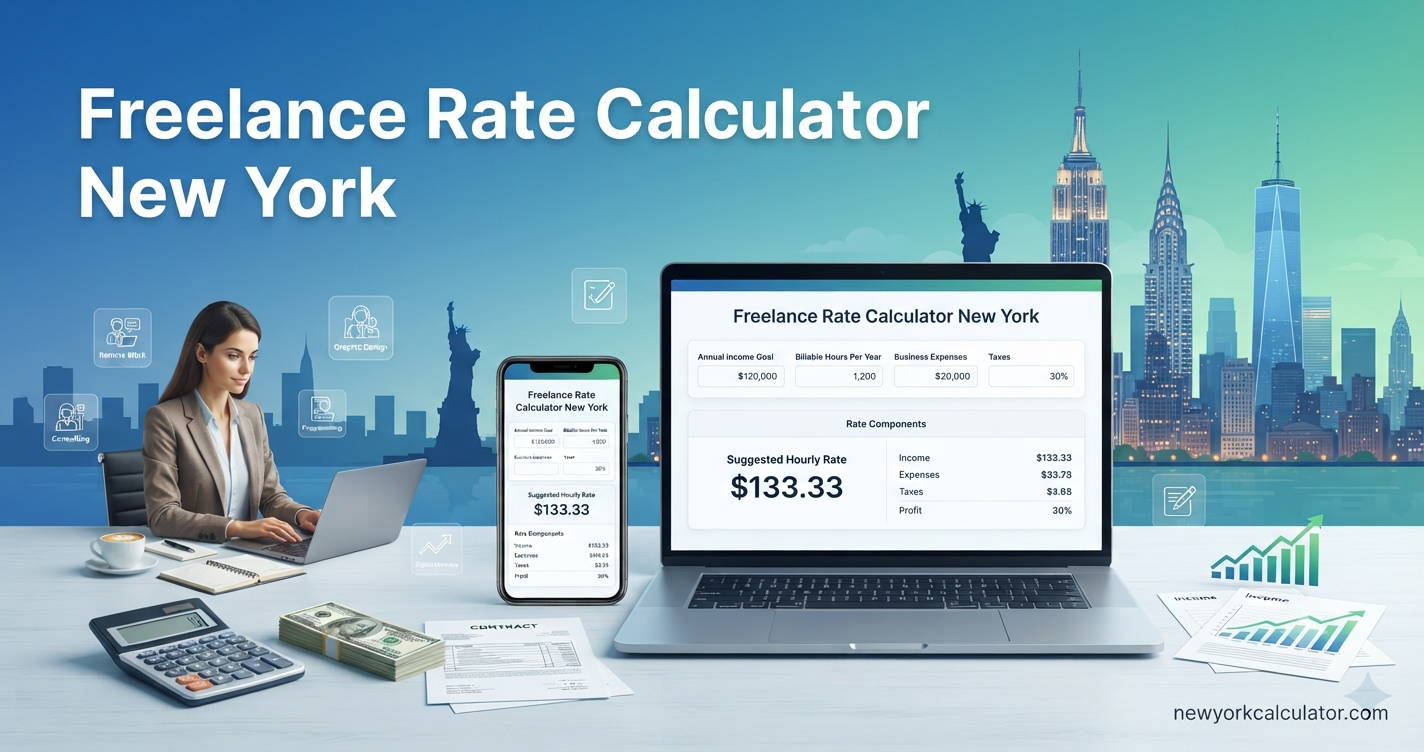
This New York Freelance Rate Calculator is designed to help you work backward from the income you actually want to keep. Enter your target income, expenses, benefits, working schedule, billable percentage, tax reserve and profit buffer to estimate a more sustainable freelance rate.
Calculator note: This tool is designed for planning and pricing estimates. It is not tax, legal, accounting or financial advice. Your actual tax liability can be different depending on your income, deductions, business structure, filing status and other circumstances.
New York Freelance Rate Calculator
Estimate the hourly, day and project rate you may need based on your income goal, expenses, benefits, tax reserve and realistic billable time.
Your Freelance Numbers
What Is a Good Freelance Rate in New York?
There is no single “correct” freelance rate for everyone in New York.
A web developer, graphic designer, consultant, copywriter and photographer can have completely different operating costs and levels of billable work. Even two freelancers doing the same job may need different rates because one has health insurance and retirement costs, while the other may have a much lower overhead.
A better question is:
“What hourly rate do I need to charge to reach my personal income goal after accounting for the real cost of freelancing?”
That is the question this calculator is designed to answer.
Your sustainable rate depends mainly on:
- Your desired take-home income
- Federal and New York taxes
- Self-employment tax
- Business expenses
- Health insurance and other benefits
- Retirement savings
- Working weeks
- Total working hours
- Non-billable time
- Billable hours
- Client acquisition time
- Slow periods between projects
- Profit or safety buffer
- Project scope and risk
Why Salary ÷ 2,080 Is Usually Not Enough
A traditional employee may work approximately 2,080 hours in a 52-week year if you simply multiply 40 hours by 52.
But a freelancer cannot normally invoice every hour.
You may spend part of your week:
- Answering emails
- Writing proposals
- Finding new clients
- Attending sales calls
- Preparing invoices
- Following up on payments
- Doing bookkeeping
- Updating your website
- Marketing your services
- Learning new skills
- Fixing administrative problems
- Handling revisions
- Waiting for the next project
None of those activities necessarily creates a billable client hour.
Suppose you work 40 hours per week but only 25 hours are realistically billable.
That means your rate has to support your income using approximately 25 billable hours—not 40.
This difference is one of the biggest reasons freelancers underprice their services.
The New York Freelance Rate Formula
A practical freelance-rate calculation can be thought of as a reverse budget.
Instead of asking:
“What do other freelancers charge?”
start with:
“How much money do I need to keep, and what does my business need to generate to get me there?”
A simplified planning formula is:
Required Revenue = Target Take-Home + Business Costs + Benefits + Tax Reserve + Business Buffer
Then:
Hourly Rate = Required Revenue ÷ Annual Billable Hours
The important part is calculating annual billable hours realistically.
For example:
40 working hours × 65% billable time × 46 working weeks
= 1,196 billable hours per year
That is dramatically different from assuming 2,080 billable hours.
Your own number may be higher or lower.
New York Freelancers Need to Think About More Than Federal Tax
One of the biggest weaknesses of generic freelance-rate calculators is that they often treat taxes as one simple percentage.
For a New York freelancer, the real situation can involve several layers.
Depending on your circumstances, you may need to consider:
- Federal income tax
- Self-employment tax
- New York State income tax
- New York City personal income tax if applicable
- NYC Unincorporated Business Tax in qualifying situations
- Metropolitan Commuter Transportation Mobility Tax (MCTMT) for qualifying self-employed individuals in the MCTD
The calculator on this page therefore lets you use a tax/set-aside percentage for planning instead of pretending that one universal percentage can accurately predict every freelancer’s tax bill.
For 2026, the IRS lists a $16,100 standard deduction for single filers and married individuals filing separately, $24,150 for heads of household and $32,200 for married couples filing jointly. Federal marginal tax rates continue to range from 10% to 37%, depending on taxable income and filing status.
Those figures are useful context, but they should not be treated as a personalized tax calculation.
New York State Income Tax Matters
New York uses a progressive personal income tax system, meaning the applicable tax burden changes as taxable income increases.
For 2026, New York has also implemented a further rate reduction for certain taxpayers as part of changes affecting the state’s personal income tax structure.
This is another reason a freelancer should be careful about using a flat “New York tax percentage” found on a random website.
Your actual effective tax burden depends on taxable income, filing status, deductions, credits and other factors.
For rate planning, using a reasonable combined tax reserve is often more useful than pretending a freelance calculator can replace a tax return.
What Is MCTMT and Why Should Some New York Freelancers Know About It?
The Metropolitan Commuter Transportation Mobility Tax (MCTMT) is particularly important for some self-employed individuals doing business within the Metropolitan Commuter Transportation District.
The MCTD includes two zones.
Zone 1
Zone 1 includes:
- Manhattan
- Bronx
- Brooklyn
- Queens
- Staten Island
Zone 2
Zone 2 includes:
- Dutchess
- Nassau
- Orange
- Putnam
- Rockland
- Suffolk
- Westchester
For tax years beginning in 2026, New York changed the self-employed MCTMT threshold to $150,000 of net earnings attributable to the applicable zone. The self-employed rate is 0.60% for Zone 1 and 0.34% for Zone 2 when the applicable threshold is exceeded.
This is an important 2026 update because older articles may still show the previous $50,000 threshold.
If you are a self-employed person in the MCTD, do not automatically assume an older MCTMT calculator or article reflects the 2026 rules.
What About NYC’s 4% Unincorporated Business Tax?
Another New York-specific issue is the New York City Unincorporated Business Tax (UBT).
NYC states that a 4% tax rate applies to taxable income allocated to New York City for qualifying unincorporated businesses. The rules also contain exemptions, credits and other details, so not every freelancer should simply add 4% to their overall tax rate.
This can matter for certain:
- Sole proprietors
- Partnerships
- Certain LLC structures
- Other qualifying unincorporated businesses
The calculator on this page treats NYC UBT as an optional planning reserve, rather than claiming that every New York City freelancer owes the tax.
That distinction matters.
Your business structure and tax situation should be reviewed before using a calculator result for an actual tax payment.
NYC Freelancer vs. New York State Freelancer
A freelancer in Manhattan and a freelancer in Buffalo may both live in New York State, but their tax and business circumstances can be different.
Someone operating in New York City may need to consider NYC-specific taxes and substantially different operating costs.
For that reason, your freelance rate should not be based solely on a national average.
Think about your actual situation:
Where do you operate?
- New York City
- MCTD outside NYC
- Other New York State location
What is your business structure?
- Sole proprietor
- LLC
- Partnership
- S corporation
- Other
The correct tax treatment can vary considerably.
Your Health Insurance Is Part of Your Freelance Rate
An employee may receive employer-sponsored health benefits.
A freelancer usually has to arrange and pay for their own coverage.
That means health insurance can become a real business-planning consideration.
Depending on your circumstances, you may also need to plan for:
- Dental coverage
- Vision coverage
- Retirement savings
- Disability coverage
- Professional insurance
- Life insurance
- Paid time off replacement
Instead of hiding these costs inside an arbitrary tax percentage, it is often better to enter them separately into your freelance pricing calculation.
That makes the result easier to understand.
Don’t Forget Retirement Savings
One of the easiest costs to overlook after leaving employment is retirement planning.
An employee may have access to an employer-sponsored retirement plan or employer contributions.
A freelancer has to make their own plan.
If your target is $80,000 of personal income but you also want to put $8,000 per year toward retirement, your business cannot be priced as if $80,000 is the entire target.
The calculator therefore allows benefits and retirement-related costs to be included separately.
This produces a more realistic pricing target.
How Many Hours Should a New York Freelancer Bill?
This depends on your type of work.
A freelancer who has long-term clients and little marketing work may be able to maintain a higher billable percentage.
A freelancer who is constantly searching for clients may have a much lower billable percentage.
For planning purposes, do not automatically enter 40 billable hours per week just because you work 40 hours.
Consider a simple example:
40 total work hours
minus:
- 5 hours marketing
- 3 hours proposals
- 2 hours administration
- 2 hours bookkeeping
- 2 hours client communication that is not billable
That leaves approximately:
26 potentially billable hours
Your actual number will vary.
The important point is to use your own working pattern.
What If You Are a New Freelancer?
New freelancers often have a lower billable percentage because they spend more time finding clients and building their portfolio.
You may also experience:
- Unpaid proposals
- Client interviews
- Networking
- Portfolio development
- Learning
- Unpaid revisions
- Longer gaps between contracts
This does not mean you should permanently charge a low rate.
It means your first pricing model should recognize that client acquisition takes time.
As your pipeline becomes more stable, your billable percentage may improve.
Minimum Rate vs. Recommended Rate
A single number can be misleading.
That is why a useful freelance pricing strategy should have at least two levels.
Minimum Rate
This is the approximate floor required to support your target income based on the assumptions you entered.
Going below this number for too many projects can make your annual income target difficult to reach.
Recommended Rate
This includes a reasonable buffer for uncertainty.
That buffer can help account for:
- Slow months
- Unpaid invoices
- Scope creep
- Unexpected expenses
- Client cancellations
- Time spent replacing clients
Premium Rate
A premium quote may be appropriate for:
- Urgent projects
- Specialized expertise
- Complex technical work
- High-risk projects
- Short deadlines
- Strategic consulting
- High-value business outcomes
Premium pricing should be based on value, expertise and project risk—not simply on adding a random percentage.
How Much Should You Charge for a Project?
Hourly pricing is not always the best way to sell freelance work.
Suppose your recommended rate is:
$100/hour
A client asks for a website redesign.
You estimate:
30 hours
A basic calculation gives:
30 × $100 = $3,000
But a professional project quote should also consider:
- Project management
- Meetings
- Revisions
- Communication
- Risk
- Scope changes
- Payment terms
- Delivery deadline
This is why the calculator includes an optional project-hours input.
Use the calculated hourly figure as a pricing reference, then decide whether hourly, daily or fixed-project pricing makes more sense.
Hourly Rate vs. Day Rate
Some New York clients prefer project or day pricing rather than an hourly rate.
If your target hourly rate is $100 and you have an eight-hour billable day:
$100 × 8 = $800/day
But remember that eight hours of client work is not necessarily the same as an eight-hour working day.
If your actual sustainable billable day is five hours:
$100 × 5 = $500/day
The correct day rate depends on what your market and service model allow you to bill.
How to Compare Freelancing With a Salary
A $75,000 employee salary should not automatically be compared with $75,000 of freelance revenue.
They are not equivalent.
An employee’s compensation may include:
- Health benefits
- Paid vacation
- Paid holidays
- Retirement contributions
- Employer payroll taxes
- Paid training
- Office equipment
- Administrative support
A freelancer may need to fund some of those costs personally.
So if you are leaving an $80,000 job, your freelance revenue target may need to be substantially higher than $80,000.
The right comparison is closer to:
Employee compensation value vs. freelance business revenue after costs
—not simply salary versus invoices.
Example: A New York Freelancer Targeting $100,000
Imagine a freelancer wants to keep approximately:
$100,000 per year
They estimate:
- $12,000 business expenses
- $10,000 benefits/retirement
- 46 working weeks
- 40 hours per week
- 60% billable time
- A tax reserve
- A modest business buffer
The freelancer should not divide $100,000 by 2,080.
Instead, the calculation starts from the actual amount the business must generate and divides it by realistic billable hours.
At:
40 × 60% × 46
the freelancer has:
1,104 billable hours per year
That is the number that matters for pricing—not 2,080.
The final rate will depend on the tax reserve, expenses, benefits and buffer entered into the calculator.
Freelance Rate by Profession
There is no universal New York freelance rate because different services create different value.
For example:
Web Developers
Consider:
- Technical complexity
- Maintenance
- Security
- Hosting
- Integration
- Business impact
Graphic Designers
Consider:
- Creative direction
- Brand value
- Number of concepts
- Revisions
- Licensing
- Usage rights
Copywriters
Consider:
- Research
- Strategy
- SEO
- Interviews
- Editing
- Conversion value
Consultants
Consider:
- Expertise
- Industry knowledge
- Strategic value
- Decision-making impact
- Client outcomes
Photographers and Videographers
Consider:
- Shooting time
- Editing
- Equipment
- Travel
- Licensing
- Usage rights
The calculator should determine your financial floor. Your market positioning and value should then determine where you quote within your practical pricing range.
A Low Hourly Rate Can Become Expensive
A client may prefer a freelancer who charges $60/hour over someone charging $120/hour.
But if the $60 freelancer needs twice as long to complete the project, the client may actually pay more.
For freelancers, this creates another important lesson:
Price is not always the same thing as value.
A highly experienced freelancer who solves a problem quickly may produce a better financial outcome for the client even with a higher hourly rate.
Should You Publish Your Freelance Rate?
Not necessarily.
Some freelancers publish:
Starting at $100/hour
Others prefer:
Custom project pricing
Both approaches can work.
If you publish a rate, consider using a starting price rather than presenting one number as if every project is identical.
For example:
Projects start at $X depending on scope, deadline and complexity.
That leaves room for different project requirements.
How Often Should You Recalculate Your Freelance Rate?
Your rate should not be permanent.
Review it when:
- Your expenses increase
- Your health insurance changes
- Your income goal changes
- You gain significant experience
- Your demand increases
- Your niche changes
- You lose or gain a major client
- Your billable percentage changes
- You move within New York
- Your business structure changes
- Tax rules change
A practical review every six to twelve months can help you avoid using an outdated rate.
2026 New York Freelance Tax Reminder
Tax rules change, and older freelance-rate articles can quickly become outdated.
For 2026, the IRS has published updated federal tax brackets and standard deductions.
New York has also made 2026 changes affecting personal income tax rates, while the MCTMT rules for self-employed individuals changed to a $150,000 threshold beginning in 2026.
NYC’s UBT remains a separate consideration for qualifying unincorporated businesses, with a 4% rate on taxable income allocated to NYC subject to the applicable rules, exemptions and credits.
Because of these changes, freelancers should avoid copying a tax percentage from an old article without checking the current rules.
What This Calculator Does—and Does Not Do
This calculator is designed to answer a business-pricing question:
“What should I charge based on my own income target and business reality?”
It can help estimate:
- Minimum hourly rate
- Recommended hourly rate
- Day rate
- Weekly revenue target
- Monthly revenue target
- Annual revenue requirement
- Annual billable hours
- Project price
- Benefits and business-cost impact
- Profit/safety buffer
- Employee salary comparison
- Optional New York-specific planning adjustments
It does not replace:
- A tax return
- A CPA
- A tax attorney
- An accountant
- Personalized financial advice
The result should be treated as a pricing and planning estimate.
How to Use the New York Freelance Rate Calculator
For the most useful result, gather these numbers first:
- Your desired annual take-home income
- Annual business expenses
- Health insurance or benefits cost
- Retirement contribution goal
- Expected tax/set-aside percentage
- Hours you work each week
- Billable percentage
- Weeks off per year
- Profit or safety buffer
- Current employee salary, if you want a comparison
Then enter the numbers into the calculator.
Do not worry if your first result is higher than the number you expected.
That is often the point of doing the calculation.
A sustainable freelance rate is not necessarily the cheapest rate you can tell a client.
It is the rate that gives your business a realistic chance of paying you properly.
Frequently Asked Questions
What is the average freelance hourly rate in New York?
There is no single reliable rate that applies to every freelancer. Rates vary by profession, experience, specialization, client type, project complexity and whether the freelancer works in NYC or elsewhere in New York.
Your own sustainable rate should start with your costs and income target, then be checked against the market for your specific service.
How do I calculate my freelance hourly rate?
Start with your desired take-home income, add business expenses and benefits, account for taxes and a safety buffer, then divide the required revenue by your realistic annual billable hours.
Is $50 an hour enough for a New York freelancer?
It depends on your expenses, taxes, working schedule and billable hours. For some freelancers it may be workable; for others it may be far too low.
The calculator is more useful than a universal yes-or-no answer because it uses your own numbers.
How many hours can a freelancer realistically bill?
There is no universal number. Many freelancers cannot bill every hour they work because marketing, administration, sales, proposals and other activities take time.
Use your actual historical billable percentage if you have it.
Should freelancers charge hourly or by project?
Both can work. Hourly pricing is straightforward when scope is uncertain. Fixed project pricing can work well when the deliverables and scope are clearly defined.
Should I include health insurance in my freelance rate?
Yes. If you personally pay for health coverage, it is a real cost of being self-employed and should be included in your business planning.
Does NYC have an additional business tax for freelancers?
Some qualifying unincorporated businesses may be subject to NYC’s Unincorporated Business Tax. NYC states that the tax rate is 4% of taxable income allocated to New York City, subject to the applicable rules, exemptions and credits.
What is MCTMT for self-employed people in New York?
MCTMT is a New York tax that can apply to certain self-employed individuals with qualifying net earnings attributable to the Metropolitan Commuter Transportation District. For 2026 and later, the threshold is $150,000, with different rates for Zone 1 and Zone 2.
Should I use my freelance calculator result as my tax bill?
No. The calculator is a business-pricing planning tool. Your actual tax liability depends on your complete financial and tax situation.
How often should I update my freelance rate?
Review your rate whenever your income goal, expenses, benefits, working pattern or tax situation changes. A six-to-twelve-month review is a practical starting point for many freelancers.
Final Takeaway
A freelance rate should be built around the life and business you are actually trying to fund—not around a random number you find online.
For a New York freelancer, the calculation becomes more useful when it recognizes the difference between NYC and the rest of the state, realistic billable hours, business expenses, benefits, taxes, slow periods and the cost of replacing employee compensation.
Use the calculator above as your starting point.
Then compare the result with the rates clients are actually willing to pay for your specific service, experience and level of expertise.
If the number feels higher than your current rate, don’t immediately lower it.
First ask why.
You may discover that your current rate simply does not account for all the hours and costs involved in running your freelance business.
Article reviewed for 2026 planning context: October 2026. Tax rules and thresholds can change; verify your personal situation with a qualified tax professional.