
Written by Junaidul Islam
Last Updated: October 2026
Buying a home in New York is not simply a matter of saving 10% or 20% of the purchase price. The amount you actually need can change significantly depending on where you are buying, the property type, your loan amount, your down payment, mortgage-related taxes, closing costs, and whether you qualify for a down payment assistance program.
That is why a New York Down Payment Calculator should do more than multiply the home price by a percentage.
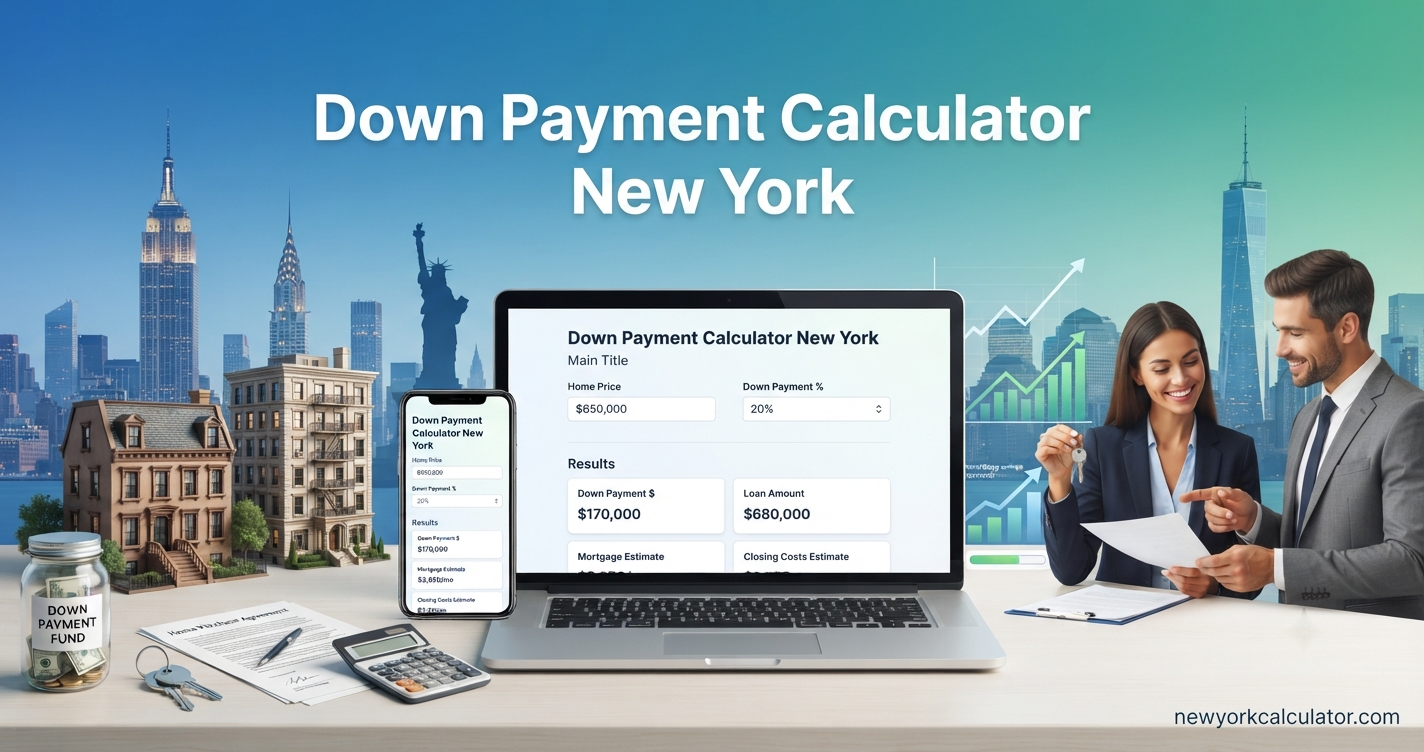
The calculator on this page is designed to help New York buyers estimate their down payment, mortgage amount, monthly principal and interest, estimated mortgage-related costs, potential mansion tax, estimated closing costs and total cash needed at closing.
For NYC buyers, the calculation is especially important because New York City has transaction costs that do not appear in many nationwide down payment calculators. New York’s mortgage recording tax also varies by location, and NYC has its own mortgage recording tax structure.
Important: This calculator is a planning tool, not a lender quote, closing statement, legal opinion or tax advice. Your final costs can vary based on your lender, attorney, title company, property, county, contract and loan program.
New York Down Payment Calculator
Estimate your down payment, mortgage, monthly payment and cash needed to buy a home in New York.
Property & Loan Information
Estimated Cash Needed at Closing
This is an estimate for planning purposes. Your lender, attorney and final closing statement may produce different figures.
Down Payment Comparison
| Down Payment | Cash Down | Mortgage | Monthly P&I | Est. PMI |
|---|
Use the calculator above to enter your expected home price, down payment, interest rate, property type and other costs.
The result can help you answer a more useful question than simply “How much is 20% down?”
“How much money should I realistically have available to buy this New York home?”
That distinction matters.
For example, if you purchase a $600,000 property and put 20% down, your down payment is $120,000. But your total cash requirement may be higher because you may also have closing costs, prepaid expenses, lender charges and other transaction costs.
What Is a Down Payment?
A down payment is the portion of the home’s purchase price that you pay using your own funds rather than borrowing through a mortgage.
For example:
- Home price: $500,000
- 5% down payment: $25,000
- Mortgage: $475,000
The basic formula is:
Down Payment = Home Price × Down Payment Percentage
And:
Mortgage Amount = Home Price − Down Payment
However, this is only the beginning of the calculation.
A New York buyer should also think about the money required for closing and the amount of cash that should remain after the purchase.
How Much Down Payment Do You Need in New York?
There is no single down-payment percentage that applies to every New York buyer.
Your required amount can depend on:
- Loan program
- Lender requirements
- Credit profile
- Debt-to-income ratio
- Property type
- Purchase price
- Whether the property is a primary residence
- Whether the property is a condo, co-op or multi-family home
- Whether you qualify for assistance
Some mortgage programs may allow a relatively small down payment, while other borrowers may choose to put down 10%, 15%, 20% or more.
The important point is that 20% is not automatically the correct amount for every buyer.
Putting less down can preserve cash, but it may increase the loan balance and potentially add mortgage insurance. Putting more down can reduce the loan amount and monthly payment, but it also ties more of your savings to the property.
That is why I recommend comparing several scenarios instead of automatically choosing 20%.
New York Down Payment Examples
Suppose you are considering a $500,000 home.
| Down Payment | Cash Down | Estimated Mortgage |
|---|---|---|
| 3% | $15,000 | $485,000 |
| 5% | $25,000 | $475,000 |
| 10% | $50,000 | $450,000 |
| 15% | $75,000 | $425,000 |
| 20% | $100,000 | $400,000 |
| 25% | $125,000 | $375,000 |
These numbers demonstrate why down payment matters, but they do not represent your complete purchase budget.
The bigger question is what happens after the down payment.
Down Payment Is Not the Same as Cash Needed to Buy a Home
This is one of the most important things New York buyers should understand.
Your total upfront cash can include:
- Down payment
- Mortgage-related costs
- Attorney fees
- Lender fees
- Title-related costs where applicable
- Recording fees
- Prepaid interest
- Escrow or prepaid items
- Property-specific charges
- Applicable transfer-related taxes
- Mansion tax when applicable
- Other transaction expenses
So a useful planning formula is:
Estimated Cash Needed = Down Payment + Estimated Buyer Costs − Credits − Deposits Already Paid
The exact amount depends heavily on the transaction.
That is why a calculator that only tells you “20% = $120,000” is incomplete for a New York buyer.
Why New York Is Different
New York has several real-estate taxes and transaction costs that can make the cash required at closing materially different from the simple down-payment calculation.
The New York State Department of Taxation and Finance explains that New York imposes a mortgage recording tax on mortgages recorded against real property, with additional local taxes possible depending on where the property is located.
New York also imposes a real estate transfer tax, while certain residential purchases of $1 million or more are subject to the additional tax commonly known as the Mansion Tax.
For this reason, a New York calculator needs to distinguish between New York City and locations outside NYC.
NYC vs. New York State: Why Location Matters
If you are buying in Manhattan, Brooklyn, Queens, the Bronx or Staten Island, you are dealing with New York City rules.
Outside NYC, mortgage recording tax rates can vary by county.
The New York State mortgage recording tax tables show different combined rates for different counties. For example, the official rate table includes different rates for counties such as Albany, Rockland, Westchester, Cortland, Chenango and others.
That means a calculator that uses one statewide percentage for every property can produce a misleading estimate.
For serious budgeting, location matters.
What Is Mortgage Recording Tax?
Mortgage recording tax is a tax associated with recording a mortgage on New York real property.
It is based on the amount of mortgage debt rather than simply the home’s purchase price.
For example, if you buy a $700,000 property but finance only $500,000, the mortgage-related tax calculation is connected to the mortgage obligation rather than the entire $700,000 purchase price.
New York State currently describes the basic mortgage recording tax, special additional tax, additional tax and applicable local mortgage taxes in its official guidance.
The exact amount can therefore depend on:
- Location
- Mortgage amount
- Property type
- Applicable local tax
- Whether the transaction falls under a particular statutory treatment
NYC Mortgage Recording Tax
New York City has a particularly important mortgage recording tax structure.
The current official NYS rate table shows:
- 2.05% for NYC mortgages securing less than $500,000
- 2.175% for qualifying residential mortgages of $500,000 or more on one-, two- or three-family homes and individual residential condominium units
- Different treatment can apply to other property categories.
This is one reason the mortgage amount—not just the home price—matters when estimating your New York cash requirement.
For example, increasing your down payment can reduce the mortgage amount and therefore potentially reduce mortgage-related costs.
What Is the NYC Mansion Tax?
The Mansion Tax is one of the costs that surprises buyers who are new to the New York market.
New York State imposes an additional 1% tax on qualifying residential purchases of $1 million or more. In NYC, the overall residential transfer-tax structure includes additional graduated taxes at higher price levels. NYC’s official budget documentation shows residential rates rising through multiple price tiers, with the combined residential transfer-tax rate reaching 5.975% at $25 million or more.
For NYC residential transactions, the mansion-tax-related rates are commonly shown as:
| Purchase Price | Applicable Mansion/Supplemental Rate |
|---|---|
| $1M–$1.999M | 1.00% |
| $2M–$2.999M | 1.25% |
| $3M–$4.999M | 1.50% |
| $5M–$9.999M | 2.25% |
| $10M–$14.999M | 3.25% |
| $15M–$19.999M | 3.50% |
| $20M–$24.999M | 3.75% |
| $25M+ | 3.90% |
NYC’s official tax documentation confirms the graduated residential structure and the 1%–3.9% Mansion Tax range.
Why this matters
The rate can apply to the transaction’s full consideration within the applicable tier, not merely the amount above the threshold.
So a buyer should not look only at the down payment.
A $1 million NYC purchase can create a very different cash requirement from a $999,999 purchase even though the difference in purchase price is only $1.
This is an important reason to understand the complete transaction before making an offer.
Does Every New York Buyer Pay Mansion Tax?
No.
The tax is associated with qualifying residential transactions at or above the applicable threshold.
A buyer purchasing a $700,000 home is not in the $1 million Mansion Tax tier.
A buyer purchasing a qualifying $1.2 million residential property, however, needs to account for the applicable Mansion Tax.
The exact treatment can depend on the nature of the property and transaction, so the final closing statement should always be checked with the professionals handling the transaction.
Condo vs. Co-op: Why the Difference Matters
New York City buyers should never assume that a condo and a co-op have identical closing costs.
A condo purchase and a co-op purchase can have different financing, title and transaction-cost structures.
One particularly important difference is mortgage recording tax.
NYC’s mortgage recording tax applies to qualifying real-property mortgages, while cooperative apartments generally have different treatment because a co-op purchase involves shares in a cooperative corporation rather than a deeded condominium interest. NYC’s Comptroller has specifically noted that mortgage recording tax does not apply to cooperative apartments.
This is why our calculator asks for the property type.
Common property categories include:
- Single-family home
- Multi-family home
- Condo
- Co-op
- Townhouse
Your actual closing statement can contain additional building-specific costs.
How Much Should You Put Down?
There is no universal answer.
A buyer should consider both the mortgage cost and the cash that will remain after closing.
For example, suppose you have $150,000 available.
You could potentially use:
Option A — Larger down payment
$120,000 toward the purchase.
You may have a smaller mortgage, but only $30,000 remains before considering closing expenses.
Option B — Smaller down payment
$75,000 toward the purchase.
You may have a larger mortgage, but substantially more liquid cash remains available.
That remaining money can matter for:
- Emergency reserves
- Repairs
- Furniture
- Moving
- Insurance
- Property taxes
- Unexpected assessments
- Income interruption
- Other household expenses
The cheapest mortgage on paper is not always the safest financial decision.
Is 20% Down Always Better?
Not necessarily.
A larger down payment can reduce:
- Loan balance
- Monthly principal and interest
- Total interest over the life of the loan
- Potential mortgage insurance in applicable loans
But it can also reduce your liquidity.
Consider a buyer choosing between 10% and 20% down.
With 20% down, the buyer may borrow significantly less.
With 10% down, the buyer keeps more cash but may have a higher payment and potentially mortgage insurance.
The correct choice depends on the buyer’s complete financial position—not simply on the percentage.
What Happens If You Put Less Than 20% Down?
Depending on the loan program, a smaller down payment may result in mortgage insurance or another form of additional financing cost.
The exact requirement depends on the loan type and lender.
That means your comparison should include:
Down payment + mortgage amount + monthly payment + mortgage insurance + cash remaining
rather than looking at the down payment alone.
Our calculator lets you enter an estimated PMI percentage so you can model this effect.
Down Payment Assistance in New York
Some buyers may qualify for down payment assistance.
One of the most important programs for eligible NYC first-time buyers is HomeFirst.
According to the NYC Department of Housing Preservation and Development, HomeFirst can provide qualified first-time homebuyers with up to $100,000 toward a down payment or closing costs for an eligible 1–4 family home, condominium or cooperative in one of New York City’s five boroughs.
The current HPD information also states that applicants must meet program requirements, including first-time-buyer status, homebuyer education, income eligibility, required personal contribution and other conditions. The current program information is effective June 1, 2026.
The program’s rules include income and purchase-price limits, and assistance is subject to program conditions.
Therefore:
Do not subtract $100,000 automatically from your calculator result.
Only subtract assistance if you actually qualify and expect to receive it.
How HomeFirst Can Change Your Calculation
Suppose your estimated cash requirement is:
$150,000
If you qualify for $50,000 in assistance, your estimated personal cash requirement could be reduced substantially.
But the actual program structure, required contribution and eligible expenses matter.
For this reason, the calculator includes an optional Assistance/Credits field.
This lets you model a scenario without claiming that you are automatically eligible.
New York State Buyers Should Also Check Other Programs
NYC is not the entire state.
A buyer outside NYC may have access to different state, local or lender-supported assistance programs.
SONYMA, New York State’s housing finance agency, also operates homebuyer programs and down-payment assistance options. Some programs have income, first-time-buyer, property-location and other eligibility requirements.
Assistance programs can change over time, so buyers should verify the current program rules before relying on them in a purchase budget.
How Much Cash Should You Keep After Closing?
This is one of the questions I believe deserves more attention than it receives in many online calculators.
A buyer should not necessarily spend every available dollar on the down payment.
After closing, you may need money for:
- Moving expenses
- Immediate repairs
- Appliances
- Furniture
- Utility deposits
- Insurance
- Property taxes
- Maintenance
- Emergency expenses
- Unexpected building assessments
For a first-time buyer, keeping an emergency reserve can be especially important.
The best down payment is therefore not always the largest possible down payment.
It is the amount that works with your mortgage, monthly budget and financial reserves.
Example: Buying a $500,000 New York Home
Let’s say the purchase price is:
$500,000
You choose:
10% down
Your down payment would be:
$50,000
Estimated mortgage:
$450,000
If your interest rate is 6.5% and the loan term is 30 years, the principal-and-interest payment would be approximately $2,844 per month before property tax, homeowners insurance, HOA fees and mortgage insurance.
That means your actual monthly housing cost could be higher.
This is why a down payment calculator should be connected to a broader monthly-payment calculation.
Example: $750,000 Home With 20% Down
Purchase price:
$750,000
Down payment:
20% = $150,000
Estimated mortgage:
$600,000
If the interest rate is 6.5% for 30 years, principal and interest would be approximately $3,792 per month before property taxes, insurance and HOA/maintenance.
A buyer should then add those recurring costs to estimate the actual monthly housing burden.
Example: $1.2 Million NYC Property
Now consider a $1.2 million NYC residential purchase.
With 20% down:
Down payment = $240,000
Mortgage = $960,000
Because the purchase price exceeds $1 million, the buyer also needs to consider the applicable Mansion Tax.
At the $1 million–$1.999 million tier, the Mansion Tax rate is 1%, meaning a $1.2 million transaction would have a $12,000 Mansion Tax component before considering other transaction costs. NYC’s official tax documentation confirms the applicable tier structure.
And because the mortgage exceeds $500,000, the applicable NYC residential mortgage recording tax rate can also be relevant.
This example demonstrates why:
$240,000 down ≠ total cash required
The buyer needs to budget beyond the down payment.
Why Your Purchase Price Can Affect More Than Your Down Payment
New York has several threshold-based taxes and costs.
For example:
- $999,999
- $1,000,000
- $1,999,999
- $2,000,000
- $4,999,999
- $5,000,000
are not always economically equivalent from a transaction-cost perspective.
Crossing certain thresholds can change applicable tax rates.
That means a buyer should understand the all-in transaction cost, not just negotiate based on the headline purchase price.
This is particularly important in NYC’s higher-priced market.
What Should You Enter Into the New York Down Payment Calculator?
For the most useful estimate, enter:
Home Price
The expected purchase price.
Down Payment
Enter either a percentage or dollar amount.
Interest Rate
Use your lender’s current quote or a realistic planning assumption.
Loan Term
Common options include 15 or 30 years.
Location
Choose NYC or an area outside NYC.
Property Type
Select condo, co-op, house or another applicable category.
Property Tax
Use the actual annual tax bill when available.
Homeowners Insurance
Use your expected annual premium.
HOA/Maintenance
Important for condos and co-ops.
PMI
If applicable, enter your estimated annual PMI rate.
Assistance/Credits
Only include assistance or credits that you reasonably expect to receive.
Contract Deposit
If you have already paid a deposit, include it so you do not accidentally count the same cash twice.
What the Calculator Estimates
The New YorkCalculator.com tool is designed to show:
- Down payment
- Estimated mortgage amount
- Monthly principal and interest
- Estimated PMI
- Property tax
- Home insurance
- HOA/maintenance
- Estimated mortgage recording tax
- Estimated Mansion Tax where applicable
- Estimated other buyer costs
- Estimated cash required
- Less contract deposit
- Less assistance/credits
- Estimated remaining cash
This provides a much more practical picture than a simple percentage calculator.
What the Calculator Does Not Guarantee
No online calculator can know every detail of a real estate transaction.
Your final costs can depend on:
- Lender
- Loan program
- Credit profile
- Property
- County
- Contract
- Attorney
- Title company
- Building
- Co-op board
- Sponsor
- Closing date
- Tax adjustments
- Escrow requirements
- Negotiated credits
Therefore, treat the result as an estimate for planning.
Your lender’s Loan Estimate, attorney’s calculations and final closing statement should take priority over an online calculator.
Common New York Down Payment Mistakes
1. Assuming 20% is mandatory
It is not a universal rule.
2. Forgetting closing costs
Your down payment is only one part of the cash requirement.
3. Ignoring mortgage recording tax
This can be significant on financed NYC purchases.
4. Forgetting Mansion Tax
A qualifying $1 million-plus NYC residential purchase can trigger it.
5. Treating NYC and upstate New York the same
Mortgage recording taxes can differ by locality.
6. Spending every dollar on the down payment
You still need cash after closing.
7. Assuming assistance is guaranteed
Programs have eligibility rules and funding/program conditions.
8. Using an outdated tax rate
New York real estate tax rules can change. Always verify important figures before closing.
Should You Put 5%, 10%, 15% or 20% Down?
A useful approach is to calculate all four.
For example:
Scenario A — 5%
More cash remains available, but the mortgage is larger.
Scenario B — 10%
A middle-ground strategy for some buyers.
Scenario C — 15%
A larger initial investment with a smaller mortgage.
Scenario D — 20%
A significantly lower mortgage balance and potentially no conventional PMI, depending on the loan and lender.
Instead of asking:
“Which percentage is best?”
Ask:
“Which percentage gives me a manageable monthly payment while leaving enough cash for closing and emergencies?”
That is a much better home-buying question.
How Interest Rate Changes Your Down Payment Decision
The interest rate also matters.
A lower rate can reduce the cost of borrowing.
A higher rate increases the monthly payment and total interest.
Suppose two buyers purchase the same $600,000 home.
Buyer A puts 20% down.
Buyer B puts 10% down.
Buyer B keeps more cash, but borrows more.
If rates are high, the additional borrowing can become expensive over many years.
If the buyer has another productive use for the cash, however, retaining liquidity could still make sense.
There is no single strategy that is correct for everyone.
Down Payment vs. Monthly Payment
The relationship is straightforward:
Higher Down Payment → Lower Loan Balance → Lower Principal & Interest
But the relationship is not always enough to determine the best decision.
You should also consider:
- PMI
- Interest rate
- Taxes
- Insurance
- HOA/maintenance
- Cash reserves
- Investment opportunities
- Emergency savings
- Future income
A good calculator should help you compare the entire picture.
What About New Construction?
New-development purchases can have additional considerations.
Depending on the transaction, buyers may encounter:
- Sponsor-related fees
- Sponsor attorney fees
- Transfer-tax arrangements
- Building-related charges
- Additional closing requirements
- Different deposit schedules
Some NYC buyer closing-cost calculators specifically model sponsor sales because the cost structure can differ from a standard resale.
Therefore, if you are buying a new-development property, do not rely on a generic online percentage.
Review the contract and offering documents carefully with your attorney.
A Better Way to Think About Your New York Home Budget
I recommend breaking your home budget into four numbers:
1. Purchase Price
How much the property costs.
2. Down Payment
How much of the purchase price you are paying upfront.
3. Cash to Close
How much money you need to complete the transaction after accounting for applicable costs, deposits and credits.
4. Cash Remaining
How much liquid money you will still have after the purchase.
The fourth number is often ignored.
It should not be.
Frequently Asked Questions
What is the minimum down payment for a house in New York?
There is no single minimum that applies to every buyer. The requirement depends on the mortgage program, lender, property and borrower profile. Some programs can allow low down payments, while others may require more.
Is 20% down required in New York?
No. Twenty percent is a common benchmark, but it is not a universal requirement.
How much is 10% down on a $500,000 house?
10% of $500,000 is $50,000.
How much is 20% down on a $750,000 house?
20% of $750,000 is $150,000.
Does down payment reduce mortgage recording tax?
A larger down payment normally means a smaller mortgage. Because mortgage recording tax is based on the mortgage obligation, reducing the mortgage can reduce the amount subject to that tax. The exact calculation depends on the property and location.
Does NYC have a mortgage recording tax?
Yes. NYC has mortgage recording tax rules in addition to New York State mortgage taxes. The current official rate table provides different combined rates depending on mortgage size and property type.
Does a NYC co-op have mortgage recording tax?
Cooperative apartments generally have different treatment and are not subject to the NYC mortgage recording tax in the same way as deeded real property. Always confirm the treatment for your specific transaction.
When does Mansion Tax apply?
New York State imposes the Mansion Tax on qualifying residential transactions of $1 million or more. NYC has additional graduated tax tiers at higher values.
Can first-time buyers get down payment assistance in NYC?
Some can. NYC’s HomeFirst program provides qualified first-time buyers with up to $100,000 toward a down payment or closing costs, subject to program requirements.
Does HomeFirst automatically give every buyer $100,000?
No. The maximum is not an automatic payment. Buyers must meet eligibility, income, property, financing and other program requirements.
Should I use all my savings for the down payment?
Usually, you should consider keeping an emergency reserve and enough cash for immediate homeownership expenses. The appropriate reserve depends on your financial situation.
Is this calculator an official mortgage quote?
No. It is an educational planning calculator. Your lender and closing professionals provide the authoritative transaction figures.
Final Thoughts
Buying a home in New York requires more than calculating a percentage of the purchase price.
The number that matters is not only:
“How much is my down payment?”
It is:
“How much cash will I need to complete the purchase, what will my monthly housing cost be, and how much cash will I have left afterward?”
That is especially important in New York because mortgage recording taxes vary by location, NYC has its own transaction-tax structure, qualifying residential purchases of $1 million or more can trigger Mansion Tax, and property type can change the cost structure.
Use the New York Down Payment Calculator above to compare different down-payment scenarios before making an offer.
Try 5%, 10%, 15% and 20%.
Then compare the mortgage amount, monthly payment and estimated cash required.
Most importantly, don’t choose a down payment simply because a percentage is considered “normal.” Choose a structure that makes sense for the property, your financing, your monthly budget and the amount of cash you want to keep after closing.
Last reviewed: October 2026.
Author: Junaidul Islam