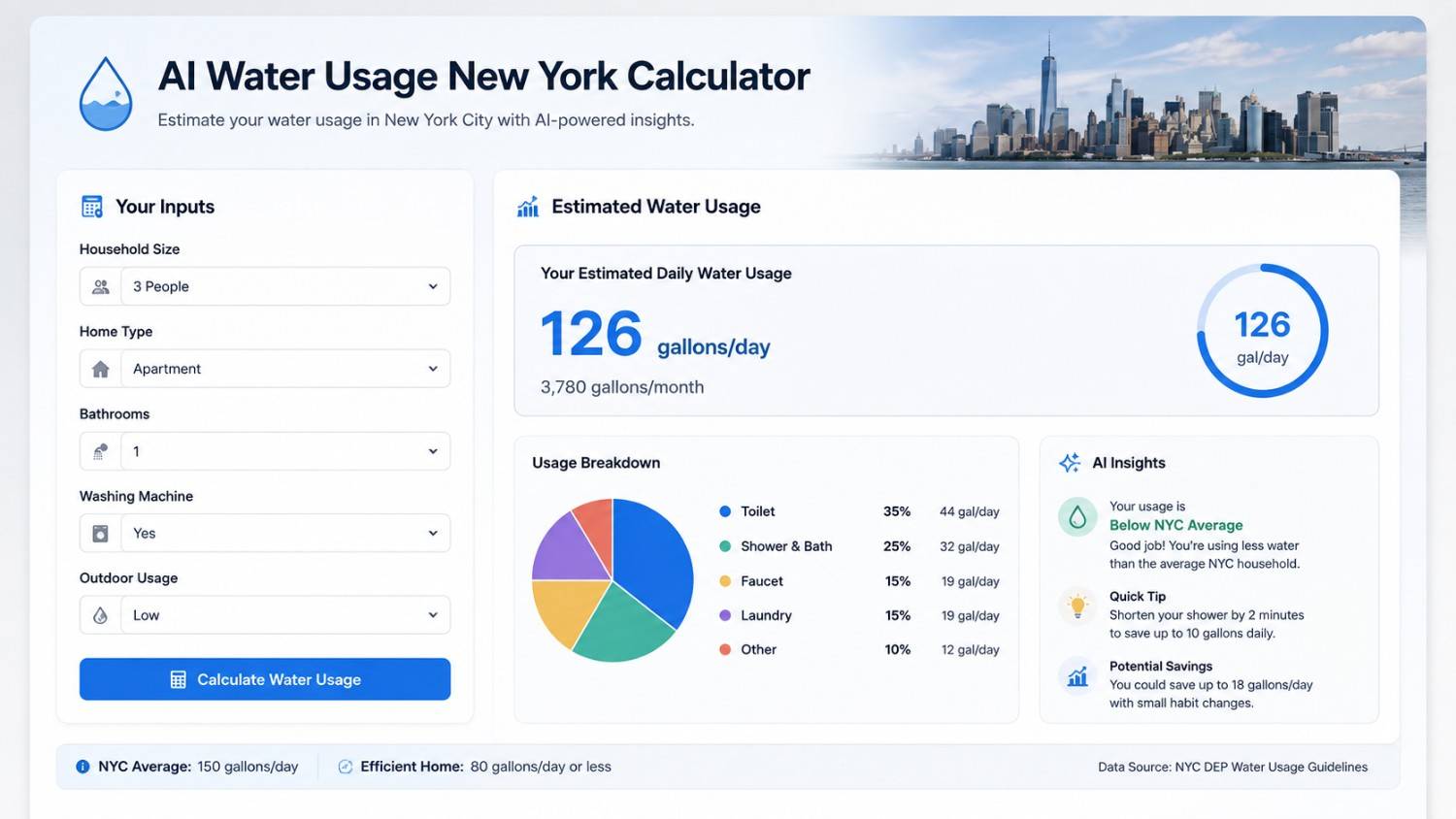
AI Water Usage New York Calculator
Estimate your household water consumption, compare it to New York averages, calculate your bill, and get AI-powered conservation insights.
AI Water Usage Analysis
–What This Means For You
–
What Exactly Is the AI Water Usage New York Calculator?
This calculator estimates your household’s total water consumption by analyzing six distinct usage categories — showers and baths, toilets and faucets, laundry, dishwasher and kitchen use, outdoor watering, and leak waste — then compares your estimated usage against verified averages for your specific location in New York. It goes beyond a simple per-person gallon estimate by modeling how your actual habits, appliances, housing type, and seasonal factors combine to produce your real-world water footprint. The “AI” component refers to the contextual analysis engine that examines your usage pattern across all categories simultaneously and generates specific, actionable conservation recommendations based on which categories are driving your highest consumption — rather than giving you the same generic “take shorter showers” advice that every water calculator provides.
New York’s water landscape is genuinely unusual compared to the rest of the country. New York City is one of only five major American cities that still operate unfiltered water supply systems, drawing over one billion gallons per day from the Catskill and Delaware watershed systems. The water is naturally filtered by the watershed’s forests and soils to a quality that meets or exceeds federal standards without chemical filtration. This means NYC tap water is not only safe but widely considered among the best-tasting municipal water in the nation — which makes the bottled water habit that many New Yorkers maintain particularly wasteful from both an environmental and financial perspective. Outside the city, water systems vary dramatically: Long Island relies entirely on groundwater aquifers that face contamination and saltwater intrusion concerns, upstate communities draw from a mix of surface water and groundwater with widely varying quality and treatment requirements, and the Hudson Valley has communities with aging infrastructure that loses 20-30% of treated water to pipe leaks before it ever reaches a customer’s tap.
The billing structures across New York are equally varied. NYC charges a combined water and sewer rate of approximately $4.34 per 100 gallons (as of the 2025 fiscal year rate schedule) — which sounds inexpensive per gallon but adds up quickly because the sewer charge is equal to the water charge, effectively doubling the per-gallon rate for water that goes down the drain. Nassau and Suffolk counties have their own district-level water authorities with rates that differ township by township. Upstate cities like Buffalo, Rochester, and Syracuse each have their own water departments with different rate structures, minimum charges, and tiered pricing. This calculator uses location-specific rate data to estimate your actual bill, not a generic state average.
Why Understanding Your Water Usage Matters in New York
Water costs in New York have been rising steadily for over a decade, and the rate of increase has accelerated in recent years as the city and state face enormous infrastructure investment needs. NYC’s water and sewer rates have increased by approximately 6-8% per year for the past several fiscal years — far outpacing inflation — driven by the need to fund the $2.3 billion Catskill/Delaware UV disinfection facility, the ongoing tunnel repair program, and deferred maintenance on a system that includes over 7,400 miles of water mains and 7,500 miles of sewer lines. For New York households, this means your water bill is one of the fastest-growing utility expenses you have.
Spot Hidden Waste
A running toilet can waste 200-300 gallons per day — over 6,000 gallons per month. That is roughly $130/month in NYC water and sewer charges for a single fixture you might not even notice is malfunctioning.
Compare Your Bill to Neighbors
NYC households of the same size in the same borough can have water bills that differ by 100% or more based on habits and fixtures. Knowing where you stand relative to the average tells you whether you have a problem.
Plan for Rate Increases
With NYC rates rising 6-8% annually, a $130/month bill today becomes $175-195/month in five years. Reducing your usage now creates a permanent buffer against future increases.
Outdoor Use Awareness
Suburban and upstate New York homeowners often discover that outdoor watering in summer doubles or triples their water bill compared to winter months. The calculator quantifies this seasonal spike.
There is also a broader environmental dimension that matters to many New Yorkers. The Catskill and Delaware watershed that supplies NYC’s water is one of the largest unfiltered water supply systems in the world, and its continued viability depends on maintaining the ecological health of the watershed. The city pays hundreds of millions of dollars to upstate communities for watershed protection programs. Every gallon wasted in the city still has to be pumped, treated, and delivered through an energy-intensive system. Using less water directly reduces this energy consumption and the associated carbon emissions.
How to Use This AI Water Usage Calculator (Takes 20 Seconds)
Set Household and Location
Enter your household size and exact New York location. Water rates vary significantly between NYC boroughs, Long Island towns, and upstate cities.
Describe Your Home and Habits
Select your housing type, season, and weekly appliance usage. Shower habits and dishwasher/laundry frequency are the largest indoor usage drivers.
Add Outdoor Use and Leaks
Outdoor watering can dwarf indoor use in summer months. Even a small leak can waste thousands of gallons — be honest about what you suspect.
Analyze and Act
Hit calculate to see your itemized usage, bill estimate, comparison to averages, and AI-generated conservation recommendations prioritized by impact.
Typical Water Usage by Category in New York Households
The table below shows average monthly water consumption by category for a household of four.
| Usage Category | NYC Apartment | NYC House | Long Island | Upstate |
|---|---|---|---|---|
| Showers & Baths | 2,400 gal | 2,600 gal | 2,800 gal | 2,500 gal |
| Toilets & Faucets | 1,800 gal | 2,000 gal | 2,200 gal | 2,000 gal |
| Laundry | 900 gal | 1,000 gal | 1,100 gal | 1,000 gal |
| Dishwasher & Kitchen | 600 gal | 700 gal | 800 gal | 700 gal |
| Outdoor (Summer) | 0 gal | 3,000 gal | 5,000 gal | 4,000 gal |
| Estimated Leak Waste | 200 gal | 500 gal | 700 gal | 600 gal |
| Total (Summer) | 5,900 gal | 9,800 gal | 12,600 gal | 10,800 gal |
How Water Systems and Rates Work Across New York
- NYC DEP water and sewer rates: The NYC Department of Environmental Protection charges a combined rate of approximately $4.34 per 100 gallons ($2.17 water + $2.17 sewer) with a minimum monthly charge of around $41.18 for a standard residential meter. Bills are mailed quarterly. NYC offers a sewer credit for properties with separate irrigation meters where water does not enter the sewer system.
- Long Island water districts: Over 60 separate water districts operate on Long Island with rates ranging from $2.50 to $12 per 1,000 gallons plus flat monthly service charges of $30-$80. The groundwater supply faces saltwater intrusion concerns from over-pumping.
- Upstate city systems: Buffalo, Rochester, Syracuse, and Albany each operate their own systems at generally lower rates ($2-$4 per 1,000 gallons for water) but with aging infrastructure and frequent water main breaks that add hidden costs to customer bills.
- NYC meter readings: Meters are read quarterly. If a meter cannot be read, DEP issues an estimated bill based on historical usage. Residents in buildings with submeters should verify accuracy — faulty submeters can over-report usage by 50-100%.
- Water quality: NYC’s unfiltered Catskill/Delaware water consistently ranks among the best municipal supplies nationally. However, buildings with lead service lines or pre-1987 plumbing may have elevated lead levels. NYC offers free lead testing kits by calling 311.
- Watershed protection: NYC spends over $200 million annually protecting the Catskill/Delaware watershed through land acquisition (180,000+ acres), septic upgrades, and agricultural programs — far cheaper than the estimated $8-10 billion cost of building a filtration plant.
Understanding the Trade-Offs in Water Conservation
- Low-flow showerheads — Pros: Reduce usage 25-50% for $15-$40 per unit, install in minutes. A family of four saves 5,000-10,000 gallons/year. Cons: Cheap models can have weak spray patterns. In buildings with already-low pressure, may make showers unsatisfying.
- High-efficiency toilets — Pros: Save 15,000-20,000 gallons/year. NYC offers free replacements for pre-1994 buildings. Cons: Require plumber ($150-$300). Some ultra-low-flow models need double-flushing. Co-op/condo board approval may be needed.
- HE laundry machines — Pros: Use 15-30 gallons/load vs. 40-60 for traditional machines, 40-60% water savings, extract more water reducing dryer time. Cons: Higher upfront cost ($700-$1,200), require HE detergent, not an option for apartment dwellers using building laundry rooms.
- Outdoor reduction — Pros: Native plants, drip irrigation, morning watering, and rain barrels can reduce outdoor use 50-80%. Cons: Landscaping changes are expensive. Some HOAs require maintained lawns. Rain barrels capture too little for lawn irrigation.
- Leak repair — Pros: Highest ROI — a running toilet costs $100-130/month in NYC. Most fixes cost $1-$15 and take minutes. Cons: Hidden leaks in walls or underground service lines require professional detection ($200-$500) and can cost $3,000-$15,000+ to repair.
What This Calculator Cannot Tell You
- Your actual meter reading is the only accurate number: This produces estimates based on statistical averages. For your real usage, read your meter at the same time daily for a week.
- Rate structures have complexity not fully modeled: NYC’s minimum charge, tiered pricing for large consumers, sewer credit for irrigation, and Long Island’s district-by-district variation are approximated.
- Building-level waste is not included: In NYC apartments, pipe leaks in walls and basement waste are charged to all residents through the master meter — only a building-wide audit can identify this.
- Seasonal variation is simplified: The seasonal multiplier is an average — your actual pattern may differ based on specific behaviors and weather conditions.
- Private well systems are not covered: If you are on a private well in rural upstate NY, your costs are different (electricity for pump, maintenance, well replacement) and this calculator does not model those.
What Happens With Your Information
Nothing — your household size, location, housing type, habits, outdoor use, and leak information are processed entirely in your browser. No data is sent to any server. No personal or household information is stored, logged, or transmitted. No cookies track your calculation. Close the tab and it is gone.
Frequently Asked Questions
The average NYC household pays approximately $100-$160 per month for water and sewer combined. A single person in a studio might pay $40-$60, while a family of five in a house with outdoor watering could pay $200-$350+ in summer. The FY2025 rate is approximately $4.34 per 100 gallons combined, with a minimum charge of around $41/month. Bills are mailed quarterly.
Yes. NYC tap water meets or exceeds all federal and state drinking water standards. The city performs over 600,000 tests per year. The water is naturally filtered by the Catskill/Delaware watershed and receives chlorine, fluoride, UV disinfection, and orthophosphate treatment. The main concern is lead from pre-1987 building plumbing — run water for 30-60 seconds if it has been sitting in pipes. Free lead test kits are available by calling 311.
Put a few drops of food coloring in the toilet tank and wait 15-30 minutes without flushing. If color appears in the bowl, you have a leak — almost always a worn $5-$15 flapper valve. Listen for hissing from the tank when the toilet has not been used recently. A running toilet wastes 360-720 gallons per day, costing $15-$31/month in NYC.
The most common causes: a running toilet (the number one cause), a leaky faucet or pipe, an underground service line leak, a malfunctioning submeter in a condo/co-op, or an estimated bill based on a previous higher-usage period. Check for toilet leaks first using the food coloring test, then call 311 to request a meter re-read or investigation.
Yes. Free high-efficiency toilet replacement for pre-1994 buildings, free showerhead kits, free water use audits for 5-50 unit buildings, and an AMR program for online daily usage tracking. The Water Efficiency and Rebate Program also provides financial incentives for commercial multi-family buildings. Over 1.8 million toilets have been replaced since 1994.
The average NYC resident uses approximately 55-75 gallons per day indoors — lower than the national 80-100 gallon average because apartment dwellers have no outdoor use. With outdoor use, suburban NY residents reach 90-150 gallons per day in summer. Nationally, the EPA estimates 300 gallons per day per household on average.
Yes, by installing a DEP-approved separate irrigation meter. The credit eliminates the $2.17/100-gallon sewer charge on metered outdoor water. Best for properties using 5,000+ gallons/month outdoors — could save $50-$100+/month in summer. Requires a licensed plumber and DEP application. Call 718-595-7000 for details.
Almost certainly. NYC tap water costs approximately $0.006/gallon. Bottled water costs $1.00-$3.00/gallon in single-serve bottles — 15-500x more expensive. One bottle per day at $1.50 = $550/year for water that costs less than $3 from the tap. A $20-$40 filter pitcher produces equivalent quality for pennies per gallon.
Your meter is typically in the basement (apartments) or a curb pit (houses). Read the number, subtract start from end reading, multiply by 7.48 (gallons per cubic foot). You can also track daily usage online through DEP’s My DEP Account portal if your building has an AMR system installed.
No. Your household size, location, housing type, usage habits, outdoor use, and leak information are processed in your browser and never leave your device. No server receives anything. No cookies are created. Close the tab and it is completely gone.