
Author: Junaidul Islam If you teach in New York City public schools, are preparing to join the NYC Department of Education (NYC DOE), or are comparing a teaching offer with your current job, the salary number you see online is only part of the picture. Your actual salary depends on your assigned salary step, education differential, eligible prior experience, and any applicable longevity increase.
The NYC DOE Teacher Salary Calculator below helps you estimate your annual gross salary and understand what that amount looks like monthly and per paycheck. It uses the 2026–27 teacher salary schedule effective September 14, 2026, and lets you compare the published salary amounts for different steps and education differentials.
Use it as a planning tool, then confirm your official salary placement with NYC Public Schools or the United Federation of Teachers (UFT).
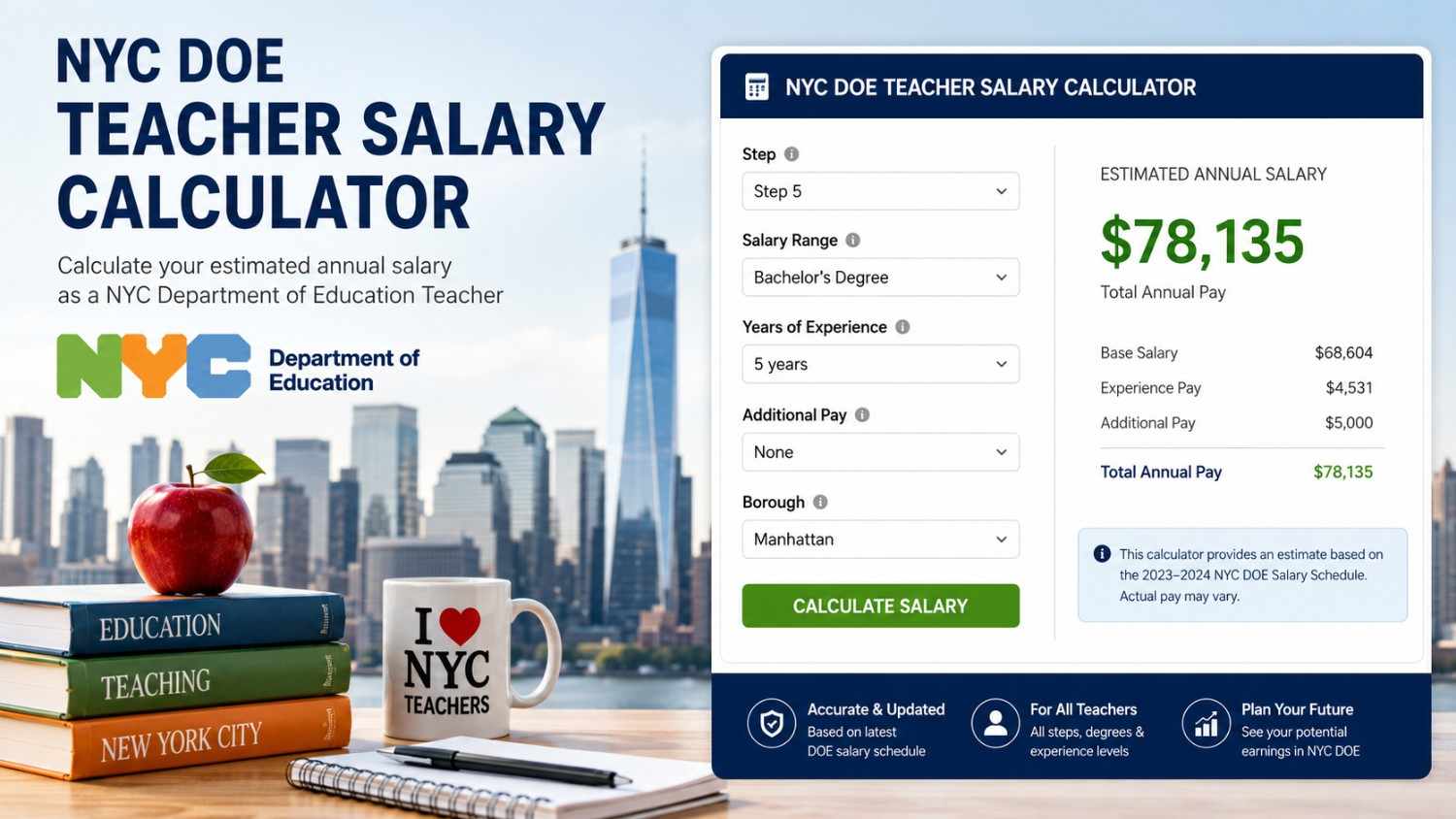
NYC DOE Teacher Salary Calculator
2026–2027 salary schedule · Effective September 14, 2026
Select a salary differential and step to estimate your annual gross salary, monthly equivalent, and paycheck amounts.
Choose your officially approved salary column.
Use your assigned step whenever possible.
Actual payroll arrangements depend on your title.
Optional planning assumption, not an official tax rate.
Salary breakdown
| Annual gross | $71,314 |
|---|---|
| Monthly gross (annual ÷ 12) | $5,942.83 |
| Selected paycheck equivalent | $2,971.42 |
| Illustrative annual deductions | $0 |
| Illustrative annual net | $71,314 |
Choose your salary differential and step to find the corresponding annual salary. The calculator also converts your annual amount into monthly and paycheck estimates. If you enter optional deductions, it will show an illustrative net-pay estimate rather than an official payroll result.
What Is the NYC DOE Teacher Salary Schedule for 2026–27?
NYC DOE teacher salaries are not determined by one flat starting rate. The salary schedule combines a teacher's approved salary step with an education differential. Longevity increments can also affect the salary of an eligible teacher who has served in the system for a qualifying period.
The salary schedule effective September 14, 2026 reflects a 3.5% increase under the 2023 DOE–UFT contract. The exact amount depends on the row and column that apply to the teacher.
For example, the 2026–27 schedule lists the following amounts:
| Salary schedule example | Annual gross salary |
|---|---|
| BAC1, Step 1A | $71,314 |
| BAC1, Step 8B | $94,612 |
| MA+30C6, Step 8B | $105,861 |
| MA+30C6+PD, Step 8B+L22 | $150,236 |
These are examples from specific cells of the schedule, not a promise that every newly hired teacher will receive the first amount or that every experienced teacher will qualify for the highest amount.
The published schedule is useful for planning, but your assigned salary status is what matters for payroll. Check the official NYC Public Schools Benefits and Pay page and the UFT salary resources before making a decision based on a particular figure.
How to Use This Teacher Salary Calculator
You do not need to work through the entire salary table manually. Follow these steps:
- Select your education differential. Choose the salary-schedule column that matches your approved differential.
- Select your salary step. Use your officially assigned step whenever possible. If you are applying for a job, choose a potential step only for planning.
- Review your annual salary. This is the published annual gross amount before deductions.
- Compare monthly and paycheck figures. The calculator divides the annual salary into common payment periods to help you plan your budget.
- Add optional deductions if you want a rough net estimate. Use figures that reflect your own circumstances rather than assuming everyone has the same tax rate.
- Confirm your placement. Check your salary notice, payroll information, or the relevant DOE and UFT resources.
If you are not sure which salary differential or step applies to you, do not select a higher column simply because you hold a particular degree. Your coursework, approved credits, applicable rules, and official salary status can affect your placement.
What Do Salary Steps Mean for NYC DOE Teachers?
A salary step generally reflects qualifying professional experience and service under the applicable salary rules. As teachers progress through the schedule, their base pay can increase.
For UFT-represented teachers, the usual progression during the early years of continuous service includes two step movements per year, subject to the applicable requirements. The schedule includes labels such as 1A, 1B, 2A, 2B and later steps.
The important point is that years of teaching experience and salary-step placement are related, but they are not automatically interchangeable. A teacher who has worked elsewhere should not assume that the same number of years will automatically translate into the same NYC DOE step.
New hires should review the salary-step placement process and ensure that relevant experience has been submitted for evaluation. The UFT explains salary steps, equated dates and prior experience in its salary steps and differentials guidance.
Can Previous Teaching Experience Increase Your Salary?
It may. Eligible prior teaching experience or certain other qualifying professional experience can affect salary placement, but the rules depend on the position, the type of work and the supporting documentation.
Before accepting an estimated salary, prepare details such as:
- The names of previous schools or employers.
- Employment dates and whether the work was full-time.
- Records verifying your teaching or other qualifying professional experience.
- Your current appointment and salary-placement information, if applicable.
For some license areas, NYC Public Schools also allows salary credit for certain related non-teaching experience when specific conditions are met. The DOE identifies requirements such as paid, full-time work, a qualifying period of experience and a reasonable relationship to the teacher's license area.
Related experience should be checked against the current rules rather than assumed to qualify. See the official DOE salary information and prior-experience guidance.
How Education Differentials Affect Teacher Salary
A teacher's education differential is a separate part of the salary calculation. The schedule has different columns for qualifying educational credentials and additional academic credits.
The 2026–27 teacher schedule includes these differential labels:
| Schedule label | What to check |
|---|---|
| BAC1 | The applicable bachelor's-level salary column |
| C1+PD | The published C1 column with promotional differential |
| BA+30C2 | The applicable additional-credit column |
| C2+ID | The applicable intermediate-differential column |
| MAC2+PD | The published master's-related column |
| C2+ID+PD | The column including the listed intermediate and promotional differentials |
| MA+30C6 | The higher education-differential column |
| MA+30C6+PD | The listed higher column with promotional differential |
These labels are salary-schedule codes, not a complete explanation of every eligibility requirement. The official salary schedule and applicable rules determine which column you can use.
Does a Master's Degree Automatically Guarantee a Higher Salary?
Not necessarily. A degree may be relevant to a higher differential, but you should verify the exact salary column for which you qualify. Additional credits, the nature of the coursework, applicable requirements and the status of your differential application can matter.
The UFT notes that differentials are not automatically awarded in the same way as routine step progression. Teachers need to apply for the applicable increase. Its published guidance advises applying within six months of completing coursework to help ensure the differential is effective from the relevant date.
If you recently completed a degree or additional coursework, confirm your eligibility and application status before including a higher differential in your budget.
What Is a Longevity Increase?
Longevity increases are additional salary increases linked to qualifying service in New York City public schools. The schedule includes longevity points associated with 5, 10, 13, 15, 18, 20 and 22 years of service.
In the 2026–27 table, these appear as entries such as L5, L10, L13, L15, L18, L20 and L22.
Longevity is not simply the same as total years spent teaching anywhere. The applicable NYC public-school service requirements and your salary status must be considered.
A teacher who has worked in another district for many years should therefore verify the assigned salary step and longevity eligibility rather than selecting a longevity row based only on total career length.
For more information, read the UFT's salary steps and differentials guidance.
Annual Salary vs. Monthly Salary vs. Paycheck
A salary schedule normally shows annual gross salary. That amount is not necessarily the amount deposited into your bank account.
For a simple comparison, suppose the published annual salary is $90,000.
| Pay calculation | Gross amount |
|---|---|
| Annual gross salary | $90,000 |
| Monthly equivalent (annual ÷ 12) | $7,500 |
| Semi-monthly equivalent (annual ÷ 24) | $3,750 |
| Biweekly equivalent (annual ÷ 26) | $3,461.54 |
These are mathematical equivalents, not a guarantee of the exact amount or timing of every payroll deposit.
UFT-represented teachers and other pedagogues in Q-bank titles are generally paid semi-monthly, with 24 paychecks annually. Some other employee groups use a biweekly schedule with 26 checks. Check the applicable payroll bank and calendar for your position.
The difference matters when comparing salaries. A monthly equivalent calculated by dividing by 12 is useful for household budgeting, but it does not mean that every teacher receives one monthly paycheck.
Gross Pay vs. Take-Home Pay
Your gross salary is the amount before payroll deductions. Take-home pay is what remains after applicable taxes and other deductions.
Your actual net pay may depend on factors including:
- Federal income tax withholding.
- New York State income tax withholding.
- New York City resident income tax, where applicable.
- Social Security and Medicare withholding, as applicable.
- Pension contributions and other payroll deductions.
- Health-benefit choices, union dues and voluntary deductions, where applicable.
- Your tax filing status and other individual circumstances.
The calculator's optional deduction fields are intended for personal planning. A percentage you enter is a hypothetical assumption, not an official tax calculation. The result should not be treated as a tax filing estimate or a payroll guarantee.
For a more reliable estimate, use your actual pay stub and consult current tax guidance or a qualified tax professional.
Can NYC DOE Teachers Earn More Than Their Base Salary?
Potentially. A teacher's total compensation may include eligible additional payments, stipends or paid extra work under the applicable rules. However, these amounts should not be confused with the base salary shown in the teacher salary schedule.
The UFT provides information about per-session work, salary schedules and other pay-related resources. If you are comparing two job opportunities, check whether any additional compensation is guaranteed, conditional or dependent on extra work.
Do not add a bonus or stipend to your salary estimate unless you have confirmed that it applies to your position and the relevant period.
How to Check Whether Your NYC DOE Salary Is Correct
If the calculator result differs from your actual pay, first compare the salary step and differential on your official salary information with the corresponding cell in the schedule.
Then check the following:
- Is the schedule effective for the relevant pay period?
- Is your salary step correct?
- Has qualifying prior experience been reviewed?
- Is your education differential approved and reflected in payroll?
- Are any longevity increases applicable?
- Are additional compensation and deductions being confused with base salary?
- Does the pay period or payroll bank explain the difference between the calculated equivalent and the deposited amount?
For unresolved questions, start with your payroll secretary or the appropriate DOE salary resource. UFT members can also consult the union's salary resources and Salary Checkup options.
The purpose of this calculator is to help you identify the right questions and make a useful estimate. It does not replace an official salary determination.
Frequently Asked Questions
What is the starting salary for an NYC DOE teacher in 2026–27?
The 2026–27 published schedule lists $71,314 for BAC1 at Step 1A. This is a specific salary-schedule entry, not a guarantee of the starting salary for every new teacher. Your approved differential and placement determine the applicable amount.
What is the highest salary on the 2026–27 NYC DOE teacher schedule?
The published table reaches $150,236 at MA+30C6+PD, Step 8B+L22. This is the highest cell in that schedule, not a salary that every experienced teacher will automatically receive.
How much does an NYC DOE teacher make per month?
Divide the applicable annual gross salary by 12 to calculate a monthly equivalent. For example, $90,000 annually equals $7,500 per month before deductions. Actual paycheck timing and amounts depend on the applicable payroll schedule.
Are NYC DOE teachers paid twice a month?
UFT-represented teachers and other pedagogues in Q-bank titles generally receive 24 paychecks per year, paid semi-monthly. Other employee groups may have different payroll arrangements. Check the payroll information for your particular position.
Can I include previous teaching experience in the calculator?
You can use an expected step for planning, but the calculator cannot approve your experience. Have the DOE evaluate your previous qualifying work and use the step officially assigned to you for a more accurate estimate.
Does the calculator show exact take-home pay?
No. It can display an illustrative estimate if you enter hypothetical deductions. Your actual net pay depends on tax withholding, pension and other deductions, benefits and individual circumstances.
Does a master's degree guarantee a higher salary?
No universal guarantee should be assumed. The applicable education differential depends on the salary rules, qualifying coursework and official approval. Check the relevant salary schedule and differential requirements.
Is this calculator for all NYC DOE employees?
No. It is designed for the teacher salary schedule described here. Paraprofessionals, school secretaries, counselors, school psychologists and other job titles may have separate schedules.
Where can I verify the official salary schedule?
Start with the NYC Public Schools Benefits and Pay page and the UFT salary resources. Check the schedule effective for your employment period and title.
Final Thoughts
Understanding an NYC DOE salary offer requires more than looking at one annual figure. Your assigned step, education differential, qualifying service and payroll arrangements all influence how that figure applies to you.
Use the NYC DOE Teacher Salary Calculator to compare the published schedule and estimate common pay periods. Before making a financial decision, verify your official placement and review the latest DOE and UFT information.
About the author: Junaidul Islam writes practical calculator guides intended to help readers understand salary figures, compare estimates and make better-informed decisions. This article is for informational purposes and is not an official NYC DOE salary determination, tax calculation or employment offer.