
Written by Junaidul Islam
Last reviewed: October 10, 2026
Planning for retirement can feel difficult when you do not know how much your investments might be worth in the future. You may be investing through a 401(k), contributing to a Roth IRA, or building a portfolio in a regular brokerage account. Whatever your starting point, understanding how time, contributions, investment returns, fees, and inflation interact can help you make more informed decisions.
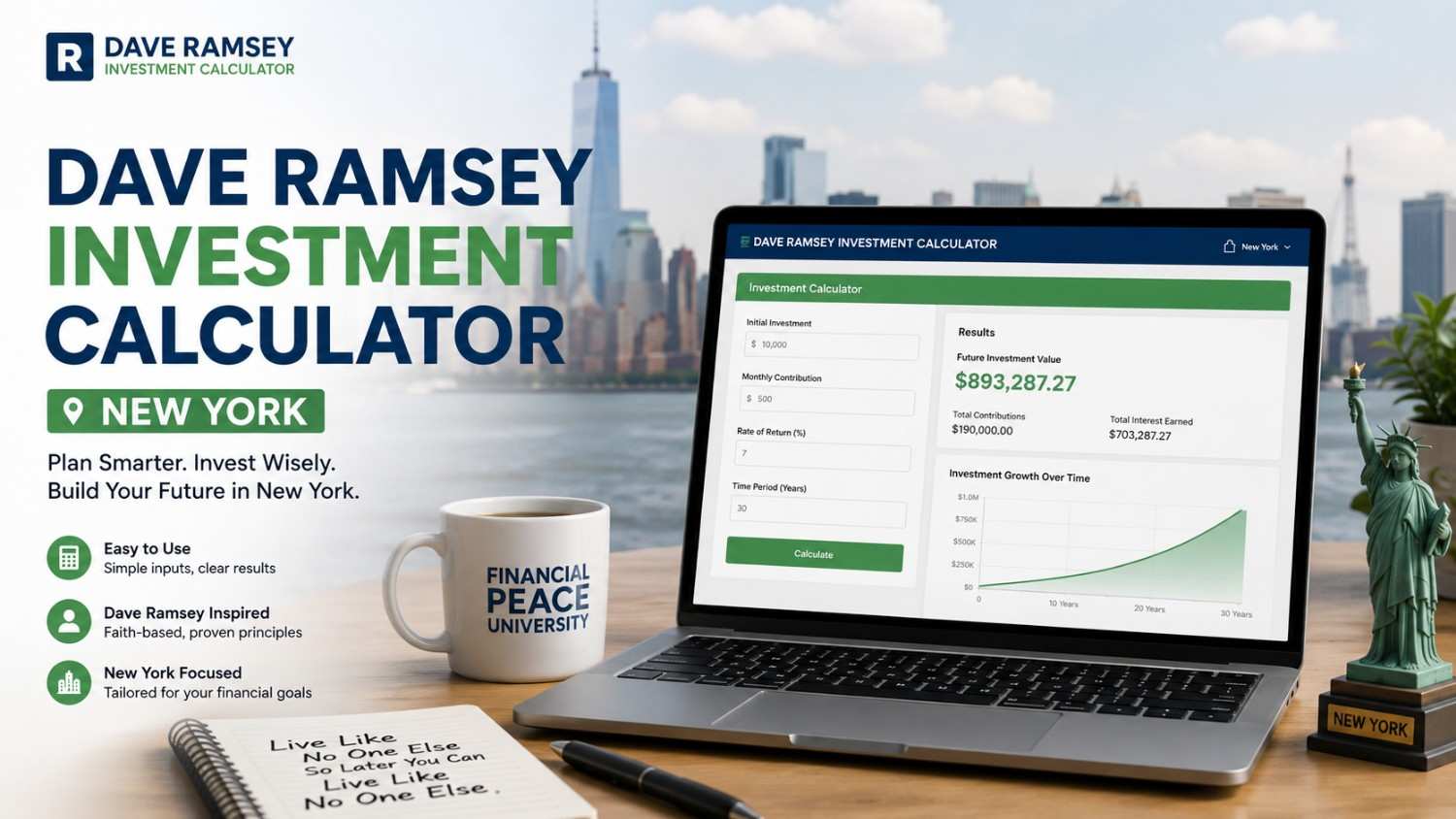
The Dave Ramsey Investment Calculator on NewYorkCalculator.com helps you estimate potential investment growth using your own financial assumptions. Enter your starting balance, monthly contribution, expected annual return, investment period, investment fees, and estimated inflation rate to explore different outcomes.
Unlike a projection that shows only one future balance, this calculator also helps you compare alternative return assumptions, estimate the effect of investment costs, and understand how inflation could affect your portfolio’s purchasing power.
Important: This is an independent educational calculator. It is not an official Dave Ramsey or Ramsey Solutions product, and its projections are estimates rather than promises of investment performance.
Dave Ramsey Investment Calculator
Estimate long-term investment growth, compare return scenarios, and explore the impact of fees and inflation.
Your Investment Projection
Compare Return Scenarios
The comparison changes the annual return by two percentage points above or below your selected rate. These scenarios are illustrations, not predictions.
Year-by-Year Investment Breakdown
Annual figures are rounded estimates. Fees are reflected in the net return used for the projection.
| Year | Contributions | Growth after fees | Ending balance |
|---|
What Is a Dave Ramsey Investment Calculator?
A Dave Ramsey Investment Calculator is a financial planning tool designed to estimate how an investment portfolio could grow over time. It uses inputs such as your existing investments, regular contributions, an assumed annual return, and the number of years you plan to invest.
The phrase is commonly associated with Dave Ramsey’s long-term approach to retirement saving and consistent investing. Ramsey Solutions offers its own investment and retirement calculators, but the calculator on this page is independently developed and uses its own calculation methodology.
The main purpose is simple: help you understand the possible long-term effect of your saving habits.
For example, investing $300 every month for 30 years produces a very different result from investing the same amount for just 10 years. The difference becomes even more significant when investment growth compounds over time.
However, no calculator can predict future market performance with certainty. Actual returns may be higher or lower than your assumptions, and investments can lose value.
How to Use the Investment Calculator
You can use the calculator above without opening a brokerage account or providing personal financial information.
Step 1: Enter Your Starting Investment
Enter the current amount you have invested. If you are starting from zero, enter $0.
For example, if your existing retirement and investment portfolio is worth $15,000, use that amount as your starting balance.
Step 2: Add Your Monthly Contribution
Enter the amount you expect to invest every month.
This could be $100, $250, $500, $1,000, or another amount that fits your budget. Use an amount you could realistically maintain rather than choosing a contribution simply to produce a larger projected balance.
Step 3: Choose an Annual Investment Return
Enter an estimated annual return percentage. You can change this number to see how different assumptions affect your results.
A 6% assumption, an 8% assumption, and a 10% assumption will produce different projections. These are illustrative scenarios, not forecasts or recommended returns.
Dave Ramsey-related calculators are sometimes associated with a 12% long-term return assumption. That figure should not be interpreted as a guaranteed return or as a reliable prediction of what your personal portfolio will earn.
Step 4: Select Your Investment Period
Choose how many years you plan to invest.
If you are 30 and expect to retire at 65, your initial investment period would be 35 years. If you are 45 and plan to retire at 65, it would be 20 years.
Your actual retirement date may change, so consider testing more than one time horizon.
Step 5: Include Investment Fees and Inflation
If your investments have annual fund or platform fees, include an estimate of those costs. Even relatively small fees can reduce the amount of money that remains invested and compounds over time.
Next, enter an assumed inflation rate. Inflation adjustment estimates what your future balance might be worth in today’s dollars. It does not predict the actual cost of living in your future retirement.
Step 6: Review Your Results
Review the projected ending balance, total contributions, estimated growth, estimated fee impact, and inflation-adjusted value.
Use the scenario comparison and yearly breakdown to understand how the results change when your assumptions change.
How Does Investment Growth Work?
Investment growth depends on three main factors: the amount you invest, how long your money remains invested, and the return your investments actually earn.
Your Contributions
Contributions are the amounts you add to your portfolio. If you invest $500 per month for 20 years, you will contribute $120,000, excluding any starting balance.
That amount represents money you put in yourself. It should not be confused with investment gains.
Compound Growth
Compounding occurs when investment earnings remain invested and potentially generate additional earnings.
Suppose an investment earns a positive return during one period. In a later period, the investment’s value may include both your original money and earlier gains. If the portfolio continues to earn positive returns, those gains can contribute to future growth.
Compounding works in both directions, however. Losses can reduce your balance, and future gains may not restore it immediately.
Why Time Matters
Starting earlier can give your contributions and potential earnings more time to compound. It may also allow you to reach a financial goal with smaller regular contributions than you would need if you started later.
This does not mean every investor should take the same level of risk. The appropriate investment strategy depends on your time horizon, ability to withstand losses, financial obligations, and personal circumstances.
How Much Could You Have If You Invest $500 a Month?
Consider a hypothetical investor who starts with $10,000 and contributes $500 at the end of each month for 30 years.
For illustration, assume a constant 7% annual return, monthly compounding, and no fees, taxes, or inflation adjustment.
Under these simplified assumptions, the portfolio could grow to approximately $682,000.
The investor would contribute $180,000 over 30 years, in addition to the initial $10,000. The remaining projected value would come from investment growth.
This is a mathematical illustration, not a forecast. Real investments do not normally earn the same return every month or every year. Market declines, changes in contributions, taxes, fees, and inflation can all change the outcome.
You can use the calculator to test other contribution amounts and return assumptions instead of relying on one example.
Understanding the 15% Retirement Investing Rule
Ramsey Solutions recommends investing 15% of gross household income toward retirement as part of its Baby Steps approach, after addressing certain financial priorities, including consumer debt and a fully funded emergency reserve.
This is a guideline associated with the Ramsey approach, not a universal rule that is appropriate for every household.
Your personal savings target may need to account for your current age, pension benefits, existing retirement savings, employer contributions, family expenses, expected retirement age, and other financial goals.
For example, someone who begins investing in their twenties may have several decades for contributions to compound. Someone who starts saving in their fifties may need a different plan, a higher savings rate, a later retirement date, or a combination of adjustments.
The most useful approach is to calculate what your own retirement goal requires and compare it with what you can reasonably contribute.
What Return Rate Should You Use?
There is no single return rate that applies to every investment portfolio.
Your potential return depends on the assets you own, their costs, market conditions, the timing of contributions and withdrawals, and the length of time you remain invested.
For planning purposes, you can test several assumptions:
- Lower-return scenario: Explore what happens if growth is weaker than you expect.
- Middle scenario: Use a separate assumption as a planning reference, not a promise.
- Higher-return scenario: Understand how stronger growth could affect the outcome without treating it as the expected result.
A stock-heavy portfolio may experience significant declines. Bonds, cash investments, and diversified portfolios have different risk and return characteristics. Past performance does not establish what future returns will be.
Do not choose an investment solely because a calculator produces an attractive balance at a high assumed return.
Why Inflation Matters for Your Retirement
A future balance does not tell you everything about your future financial security.
If the prices of housing, groceries, health care, transportation, and other necessities rise over time, the same dollar amount will buy less than it does today.
For example, with a hypothetical 3% annual inflation rate, prices would be roughly 2.43 times as high after 30 years if inflation remained constant throughout that period.
That is why this calculator includes an inflation-adjusted estimate. It divides the projected future balance by the cumulative inflation factor to express the result in approximate present-day dollars.
The calculation is a planning illustration. Actual inflation can fluctuate, and your personal expenses may rise faster or slower than the assumed rate.
For retirement planning, consider both the projected account balance and the amount you may need to cover future expenses.
How Investment Fees Affect Your Portfolio
Investment fees are easy to overlook because they may be presented as a small percentage of assets. However, fees can have a meaningful long-term effect.
Common costs include:
- Mutual fund and ETF expense ratios.
- Investment account or platform fees.
- Advisory fees.
- Transaction charges and other applicable expenses.
A fee reduces the portion of your portfolio that remains available to earn future returns. Over a long investment period, the effect can extend beyond the amount of fees paid because you also lose potential growth on the money used to pay them.
The calculator estimates the impact of the annual fee you enter. Actual charges vary by investment and provider, and some costs may not be captured by a simplified projection.
Review your fund documents and account statements to understand the expenses you actually pay.
Dave Ramsey’s Investment Approach: What Should You Know?
Dave Ramsey’s financial guidance emphasizes consistent retirement contributions, long-term investing, and a broader financial plan rather than frequent attempts to time the market.
His published approach commonly includes investing 15% of gross household income toward retirement after meeting specified financial priorities. Ramsey Solutions also discusses workplace retirement plans, Roth IRAs, diversification, and investing for the long term.
It is important to distinguish between that educational framework and the calculator’s mathematical assumptions.
The calculator does not verify that a particular portfolio follows Ramsey’s recommendations. It also does not determine whether a specific investment is suitable for you.
You should evaluate investments based on your goals, risk tolerance, diversification, costs, tax circumstances, and the possibility of losing money. Consider qualified, appropriately registered financial guidance if you need individualized advice.
Retirement Accounts to Understand in New York
People living in New York may use several types of accounts to save for retirement. The best choice depends on eligibility, income, workplace benefits, and tax circumstances.
401(k) Plans
A 401(k) is an employer-sponsored retirement plan. Contributions are commonly deducted from payroll, and the available investment choices depend on the plan.
A traditional 401(k) generally uses pre-tax employee contributions, while a Roth 401(k), when offered, uses after-tax employee contributions. Qualified withdrawals receive different tax treatment under the applicable rules.
If your employer offers matching contributions, understand the plan’s matching formula and vesting conditions. Employer matching can affect how quickly your retirement savings grow.
Traditional IRA
A Traditional IRA is an individual retirement account that may offer a tax deduction for eligible contributions. Deductibility and withdrawal taxation depend on the applicable rules and your circumstances.
Roth IRA
A Roth IRA uses after-tax contributions. Qualified distributions can be tax-free, subject to the applicable requirements.
Eligibility and contribution limits can depend on income, filing status, age, and other factors. Do not assume that everyone can contribute the maximum amount to a Roth IRA.
Regular Brokerage Accounts
A taxable brokerage account may provide additional flexibility when retirement-account limits or withdrawal rules do not match your needs.
However, dividends, interest, and realized capital gains may have tax consequences. The calculator’s projected balance does not automatically account for your individual tax liability.
New York Tax Considerations
New York residents should distinguish between federal tax rules, New York State tax rules, and any applicable local taxes. The treatment of retirement distributions can depend on the account type, the source of the distribution, your age, and other circumstances.
Consult current New York State tax guidance before making decisions based on an assumed tax benefit. This calculator does not provide an individualized New York tax calculation.
2026 Retirement Contribution Limits
For the 2026 tax year, the IRS announced the following important limits:
| Retirement account or contribution | 2026 limit |
|---|---|
| Employee 401(k) elective deferrals | $24,500 |
| IRA contributions | $7,500 |
| IRA catch-up contribution for eligible individuals age 50 or older | $1,100 |
| General 401(k) catch-up contribution for eligible individuals age 50 or older | $8,000 |
| Higher 401(k) catch-up limit for eligible individuals ages 60–63 | $11,250 |
These figures are subject to eligibility requirements and plan rules. Special provisions may apply, and the higher age-based 401(k) catch-up limit applies only to eligible participants in the specified age range.
The 401(k) figure is an employee elective-deferral limit, not a universal cap on all money that can enter every retirement plan. Employer contributions and overall plan limits are governed by separate rules.
The annual IRA limit applies across an individual’s Traditional and Roth IRA contributions combined; it is not a separate maximum for each account.
Before contributing, confirm the current rules directly with the IRS and your plan administrator.
How to Calculate the Monthly Investment You Need
If you have a specific retirement target, start with three questions:
- What portfolio balance do you want to reach?
- How many years do you have before you need the money?
- How much have you already invested?
Then consider your expected monthly contribution, fees, and inflation.
For a simple future-value calculation, the projected balance includes the growth of your starting investment plus the accumulated value of your regular contributions.
When the target is more important than the contribution you can currently afford, you can work backward from the goal. Test different monthly contributions and investment periods to find a combination that approaches your target under the assumptions you selected.
Remember that a mathematically achievable target is not necessarily a realistic investment outcome. You may need to revise your contribution, retirement date, spending expectations, or other financial plans.
Common Investment Calculator Mistakes to Avoid
Assuming Returns Are Guaranteed
An annual return field is an assumption, not a promise. A market portfolio can lose money even when the long-term projection appears positive.
Ignoring Fees
A projection that excludes investment expenses can overstate the amount you may eventually retain.
Forgetting Inflation
A large future balance may have considerably less purchasing power than the same number of dollars today.
Contributing More Than Your Budget Allows
A contribution plan should be sustainable. An overly ambitious target can force you to stop investing or withdraw money when unexpected expenses arise.
Ignoring Taxes and Withdrawal Rules
The same investment return can produce different after-tax outcomes depending on the account and your circumstances.
Treating a Projection as a Complete Retirement Plan
A calculator does not fully account for Social Security, health care expenses, pensions, changing household needs, market volatility, or the timing of withdrawals.
Use the results as a starting point for planning rather than a final financial decision.
Frequently Asked Questions
Is this the official Dave Ramsey Investment Calculator?
No. This is an independent educational tool published by NewYorkCalculator.com. It is not operated, sponsored, or endorsed by Dave Ramsey or Ramsey Solutions.
Does Dave Ramsey recommend a 12% investment return?
Dave Ramsey-related investment examples and calculators have used high long-term return assumptions. However, an assumed rate should not be treated as a guaranteed result or as a prediction for every portfolio. Always test different scenarios.
How much should I invest every month?
The amount depends on your income, current savings, retirement goal, age, time horizon, and other financial obligations. Use the calculator to explore contributions that fit your circumstances.
Can I become a millionaire by investing $500 per month?
It is mathematically possible under some combinations of starting balance, investment period, and return assumptions. It is not guaranteed. A longer period or higher assumed return may produce a larger projected balance, but actual results can be lower.
Does the calculator include inflation?
Yes. Enter an estimated annual inflation rate to see an approximate present-day value of your projected future portfolio. This is an estimate, not a forecast of actual future prices.
Does the calculator include investment fees?
Yes. You can enter an annual fee assumption to estimate how fees affect the projected balance. Actual expenses may differ, and not every possible charge is necessarily included.
Does the calculator calculate taxes in New York?
No. It does not calculate your federal, New York State, or local income taxes. Your tax treatment depends on your account type and personal circumstances.
Is investing 15% of income mandatory?
No. The 15% guideline is associated with Dave Ramsey’s financial approach. Your appropriate savings rate depends on your financial position, retirement goals, and other obligations.
Can my investment lose money?
Yes. Investments can lose value, and actual returns can be negative. The calculator shows mathematical projections based on the assumptions you enter; it cannot eliminate investment risk.
How accurate is the investment calculator?
The arithmetic follows the stated assumptions, but the assumptions themselves may not reflect future market performance. Actual balances can differ significantly because returns fluctuate and circumstances change.
Final Thoughts
Planning your financial future starts with understanding the relationship between contributions, time, investment returns, fees, and inflation. The Dave Ramsey Investment Calculator on NewYorkCalculator.com gives you a practical way to explore those relationships using your own numbers.
Start with a realistic monthly contribution, compare several return assumptions, and review the inflation-adjusted estimate before drawing conclusions. Revisit your plan when your income, expenses, or retirement goals change.
The most useful projection is not necessarily the one with the largest number. It is the one that helps you make informed decisions while recognizing uncertainty and keeping your long-term financial goals in view.
About the Author
Junaidul Islam writes practical calculator guides and educational resources for NewYorkCalculator.com. His work focuses on helping readers understand financial calculations, compare scenarios, and use online tools more confidently.
Disclaimer: This page is for educational and informational purposes only. It does not provide personalized financial, investment, legal, or tax advice. Investment returns are not guaranteed, and you may lose money. Consult qualified professionals when appropriate and verify current tax and contribution rules with official sources.
Sources and Further Reading
- Ramsey Solutions — Investment Calculator
- Ramsey Solutions — How Much Should You Invest for Retirement?
- U.S. Securities and Exchange Commission — Compound Interest Calculator
- U.S. Securities and Exchange Commission — How Fees and Expenses Affect Your Investment Portfolio
- Internal Revenue Service — 401(k) Contribution Limits
- Internal Revenue Service — 2026 Retirement Contribution Adjustments
- New York State Department of Taxation and Finance — Resident Income Tax Return Instructions
Contribution limits and tax guidance should be rechecked against the relevant official sources before publication and whenever this page is updated.