
By Junaidul Islam
Last reviewed: October 10, 2026
Understanding your paycheck in New York can be harder than it looks. Your gross earnings may seem straightforward, but federal income tax, New York State withholding, payroll taxes, insurance premiums, retirement contributions, and other deductions can make your final paycheck significantly different from your expected amount.
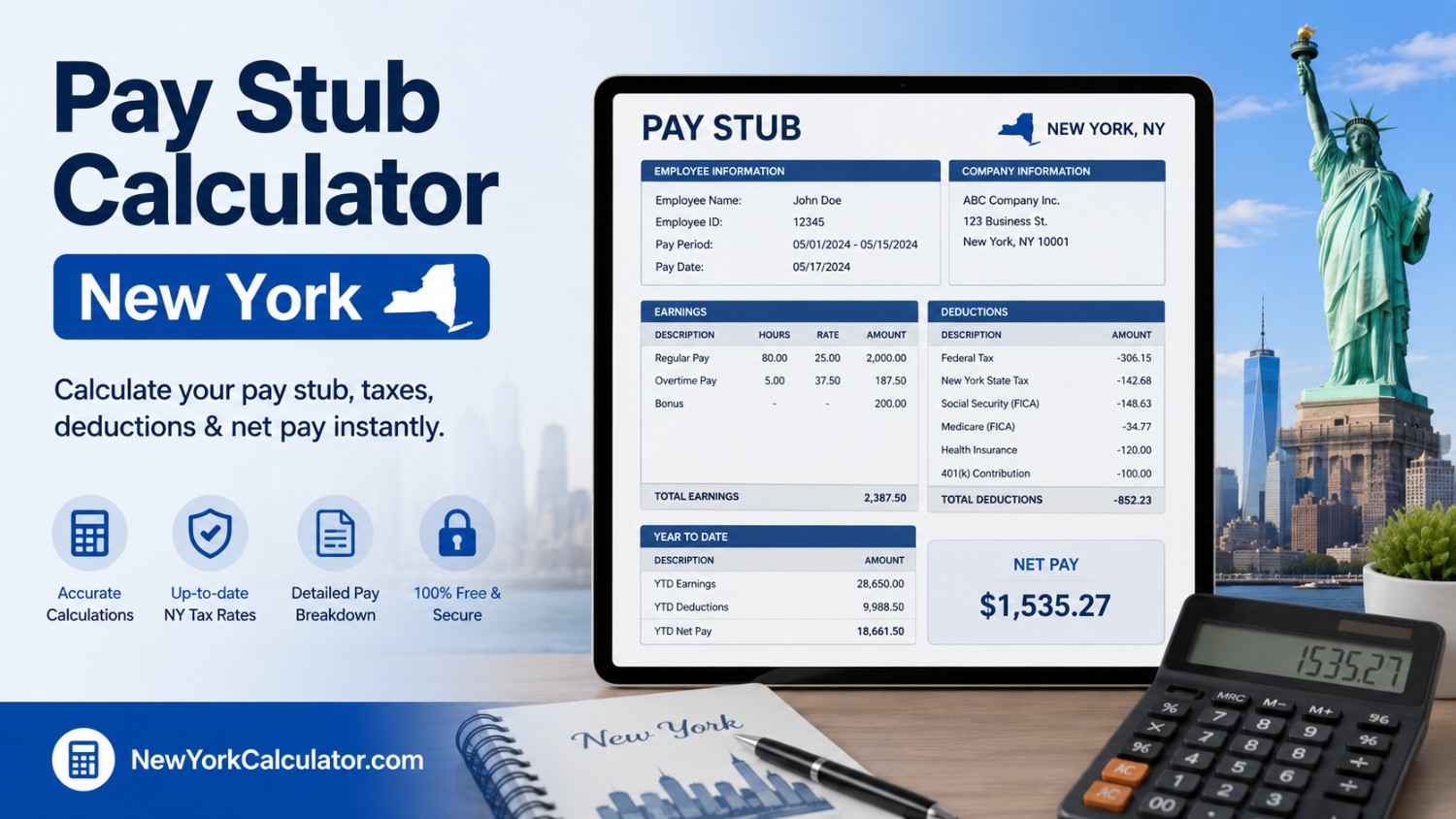
Our Pay Stub Calculator New York helps you organize your earnings and deductions to estimate your take-home pay. Whether you work in New York City, Buffalo, Albany, Rochester, Yonkers, or another part of the state, this guide explains what appears on a pay stub, which deductions to check, and why your actual deposit may differ from an estimate.
Use the calculator below to calculate gross pay, review common paycheck deductions, and see an estimated net amount based on the information you enter.
Important: This calculator provides an educational estimate, not an official payroll statement or a guarantee of your final tax liability. Actual withholding depends on your payroll records, tax forms, residency, applicable tax rules, and employer benefit arrangements.
Pay Stub Calculator New York
Estimate your paycheck, review common deductions, and compare your result with an actual pay stub.
Your Estimated Paycheck
| Pay stub item | Amount |
|---|
WordPress placement note: Insert the complete HTML calculator in this location, immediately after the introduction and before the detailed guide. The calculator should appear directly in the article flow.
What Is a Pay Stub Calculator?
A pay stub calculator helps you understand how earnings and deductions affect the amount you receive from your employer.
A pay stub, sometimes called a payslip or earnings statement, generally shows how much you earned during a pay period, the amounts withheld or deducted, and your resulting net pay. Depending on the employer and payroll system, it may also show year-to-date totals.
A paycheck calculator usually focuses on estimating take-home pay from wages and tax information. A pay stub calculator can be more useful when you also want to examine individual deduction amounts or compare an estimate with an existing earnings statement.
For example, if your gross biweekly pay is $2,500, the amount deposited into your bank account will generally be lower after applicable taxes and other deductions. Your actual result depends on your individual circumstances.
How to Use the New York Pay Stub Calculator
Follow these steps to get a useful estimate.
Step 1: Choose your pay type. Enter your annual salary or hourly wage. Hourly workers should also enter their regular hours and any overtime hours included in the paycheck.
Step 2: Select your pay frequency. Choose weekly, biweekly, semimonthly, or monthly, depending on your actual payroll schedule.
Step 3: Identify your tax location. Select the applicable location option. New York State income tax, New York City resident income tax, and Yonkers-related withholding are not interchangeable.
Step 4: Enter your deductions. Add known federal, state, and local withholding amounts when available. Include relevant benefit premiums, retirement contributions, and other payroll deductions.
Step 5: Calculate your estimate. Review gross pay, total deductions, and estimated net pay. Check the individual amounts rather than relying only on the final figure.
Step 6: Compare the result with your pay stub. If you already have an earnings statement, compare matching pay periods and investigate differences in hours, bonuses, withholding, or benefit deductions.
For the closest comparison, use the same pay period, wages, payroll frequency, and deduction information that appears on your actual statement.
How Is Take-Home Pay Calculated in New York?
The basic calculation is:
Net pay = Gross pay − Total applicable taxes and deductions
Gross pay is the amount earned before deductions. Net pay is the amount remaining after the deductions included in the calculation.
A typical employee paycheck may include several categories.
1. Federal income tax withholding
Federal income tax withholding depends on factors such as taxable wages, pay frequency, filing status, and information provided on Form W-4.
The IRS publishes federal withholding methods for payroll calculations. For 2026, Publication 15-T contains the applicable federal withholding tables and methods.
A simple flat percentage cannot reliably reproduce every employee’s federal withholding. If your employer’s actual withholding amount is available, entering that amount can make a manual comparison more useful.
2. New York State income tax
Employees subject to New York State income tax may see state income tax withholding on their pay statements.
New York’s withholding calculations depend on applicable rules, wages, payroll frequency, and withholding information. The state publishes specific tables and calculation methods rather than requiring every employee to use one universal percentage.
For payroll paid during 2026, consult the official New York State withholding tax tables and methods.
3. New York City income tax
New York City has a separate resident personal income tax. However, working in New York City does not automatically mean every employee owes NYC resident income tax.
Your residency and other applicable rules matter. Someone who works in the city but lives elsewhere should not automatically select the NYC resident option without checking the applicable requirements.
See the state’s official withholding publications for current calculation methods.
4. Yonkers withholding
Yonkers has separate rules for resident and nonresident withholding. Your circumstances determine whether a particular Yonkers-related tax or withholding method applies.
Do not assume that New York City and Yonkers use the same local tax calculation.
5. Social Security tax
For 2026, the employee Social Security tax rate is 6.2% on covered wages up to the annual taxable wage base of $184,500.
For an employee with $1,000 in covered wages below the applicable limit, the standard employee Social Security deduction would be $62.
The annual wage base matters when reviewing higher earners’ pay statements. Year-to-date covered wages and other employment circumstances may affect the amount withheld.
Official reference: Social Security Administration — Contribution and Benefit Base.
6. Medicare tax
The standard employee Medicare tax rate is 1.45% on covered wages, without the ordinary Social Security-style annual wage cap.
An additional Medicare withholding requirement may apply to certain higher-wage employees. Employers generally begin withholding the additional 0.9% Medicare tax after an employee’s wages from that employer exceed $200,000 during the calendar year.
This employer withholding threshold is not necessarily the same as the threshold used to determine an individual’s final Additional Medicare Tax liability.
7. Insurance, retirement, and other deductions
Your employer may deduct amounts for benefits or other authorized purposes, including:
- Medical, dental, and vision insurance
- Traditional 401(k) contributions or other retirement plans
- Health savings or flexible spending accounts, when applicable
- Union dues, where applicable
- Wage garnishments or court-ordered deductions
- Additional voluntary or post-tax deductions
Not all deductions receive the same tax treatment. For example, certain traditional retirement contributions can reduce wages used for some income-tax calculations while still being subject to Social Security and Medicare taxes.
Always use the actual payroll treatment of each deduction rather than assuming every benefit reduces every tax.
Example: Understanding a $2,500 Paycheck
Consider a hypothetical employee with $2,500 in gross pay for one pay period.
| Pay stub item | Illustrative amount |
|---|---|
| Gross pay | $2,500.00 |
| Federal withholding | $250.00 |
| New York State withholding | $110.00 |
| Social Security | $155.00 |
| Medicare | $36.25 |
| Insurance and retirement deductions | $150.00 |
| Illustrative net pay | $1,798.75 |
This is an arithmetic example, not a New York tax quote. The federal and state withholding amounts and benefit deductions are hypothetical. Actual withholding may be higher or lower, and applicable local taxes or other deductions may change the result.
The example demonstrates why two employees earning the same gross pay may receive different take-home amounts.
New York State vs. New York City vs. Yonkers
One of the most important details in a New York pay stub calculation is choosing the correct tax situation.
New York State: State income tax withholding may apply to employees subject to New York State income tax.
New York City: NYC resident income tax is a separate consideration. Residency matters; a workplace address alone does not establish NYC resident tax treatment.
Yonkers: Yonkers has distinct resident and nonresident withholding rules. The applicable method depends on the employee’s circumstances.
Living outside New York: Employees who live outside the state but work for a New York employer may face different state-tax questions. Residency, work location, reciprocal arrangements where relevant, and other applicable rules should be reviewed before assuming which withholding applies.
If your work and home locations differ, check the applicable official tax guidance or consult a qualified tax professional before treating a calculator result as definitive.
Why Is My Actual Paycheck Different From the Calculator?
It is common for an estimate and an actual paycheck to differ. The most frequent reasons include:
Different pay-period hours: A paycheck covering 75 hours will not match an estimate based on 80 hours.
Overtime or bonus payments: Extra earnings can affect gross wages and withholding. The payroll treatment may differ from a regular paycheck.
W-4 or New York withholding forms: Information on your federal Form W-4 and New York Form IT-2104 can affect withholding.
Pre-tax benefit deductions: Some benefits affect taxable wages differently depending on the deduction and tax involved.
Local tax treatment: Selecting the wrong residency or location option may produce an inaccurate estimate.
Year-to-date wage limits: Social Security withholding may change after covered wages reach the applicable annual limit.
Additional withholding: An employee may request additional tax withholding or have other payroll deductions that the calculator does not know about.
Payroll adjustments: Retroactive pay, corrections, reimbursements, unpaid leave, or benefit changes can affect the amount on a particular statement.
The best way to investigate a difference is to compare the same pay period and examine each line item separately.
How to Check Your Pay Stub for Errors
You do not need to understand every payroll formula to conduct a useful first review.
- Confirm the pay-period start and end dates.
- Check your regular hours, overtime hours, pay rate, and gross wages.
- Compare federal and state withholding with the amounts shown on your payroll records.
- Review insurance premiums, retirement contributions, and other deductions.
- Compare year-to-date totals with previous statements, allowing for corrections and adjustments.
- Verify that your net pay matches the amount paid, accounting for any separate reimbursements or adjustments.
If something looks wrong, ask your payroll or human resources department for an itemized explanation. Keep the relevant pay statements and records of hours worked.
For questions about New York wage payment requirements, consult the New York State Department of Labor. That agency provides information about required pay frequency and related labor standards.
How Often Are New York Employees Paid?
Pay frequency depends on the worker’s classification and applicable rules.
The New York State Department of Labor states that manual workers generally must be paid weekly, while clerical and other workers generally must be paid at least twice per month, subject to applicable exceptions and legal requirements.
Read the state’s Frequency of Pay guidance for details. Do not assume that every worker can be paid on the same schedule.
When using a calculator, select the frequency that matches the actual payroll period. Biweekly means every two weeks; semimonthly generally means twice per month. Those schedules are not identical.
What Is the Difference Between a Pay Stub and a W-2?
A pay stub reports earnings and deductions for a particular paycheck and may also show year-to-date totals.
A Form W-2 reports annual wage and tax information that an employer provides for tax filing purposes.
The figures may not match exactly when compared without context because certain benefits, tax treatments, adjustments, and reporting rules can affect the amounts. A pay stub is useful for reviewing an individual paycheck, while a W-2 is an important year-end tax document.
If you discover a discrepancy, compare the correct reporting categories and ask your employer for clarification.
What Makes a Pay Stub Calculator Accurate?
A useful calculator should do more than subtract a guessed tax percentage from gross pay.
It should account for the relevant tax year, pay frequency, taxable wages, withholding information, residency, and the treatment of each deduction. It should also explain when it cannot reproduce an employer’s exact payroll calculation.
For 2026, federal payroll withholding methods are published in IRS Publication 15-T. New York State publishes separate withholding methods for state, NYC resident, and Yonkers withholding.
These official publications should be used when developing a calculator that aims to provide more than a rough educational estimate.
The calculator on this page is intended to help users organize pay information and understand the effect of entered deductions. Unless it explicitly implements and validates the official tax tables and methods for a user’s circumstances, it should not be treated as an exact payroll engine.
Frequently Asked Questions
Is the New York Pay Stub Calculator free?
Yes. A free calculator can help you organize earnings, enter deduction amounts, and estimate take-home pay without purchasing payroll software.
Can I use this calculator for New York City?
Yes, for an educational estimate, provided you choose the appropriate location and enter the relevant withholding amounts. NYC resident tax treatment should not be assumed solely because your workplace is in the city.
Does this calculator calculate exact New York payroll taxes?
Not necessarily. Exact withholding depends on current tax methods, payroll records, filing information, and individual circumstances. Use the result as an estimate unless the calculator’s official calculation method covers your situation.
What is gross pay?
Gross pay is your earnings before payroll deductions. It can include regular wages, overtime, bonuses, commissions, or other compensation.
What is net pay?
Net pay is the amount remaining after the taxes and other deductions included in your payroll calculation.
Why is my paycheck smaller than my gross salary divided by 26?
Annual salary divided by 26 is a simple way to estimate a regular biweekly gross paycheck. It does not account for federal or state withholding, Social Security, Medicare, benefits, retirement contributions, or other deductions.
Does New York have a separate NYC income tax?
New York City has a separate resident personal income tax. Whether NYC resident tax treatment applies depends on the applicable rules and the employee’s circumstances.
What is the 2026 Social Security wage base?
The Social Security taxable wage base for 2026 is $184,500. Covered wages above that annual limit are generally not subject to the standard employee Social Security tax for that year.
Can overtime change my take-home pay?
Yes. Overtime increases gross wages and can affect tax withholding and other wage-based deductions. The amount depends on the hours, pay rate, applicable overtime rules, and payroll circumstances.
What should I do if my pay stub looks incorrect?
Compare hours, pay rates, gross wages, deductions, and net pay for the same pay period. Ask your employer’s payroll department for an explanation. If the issue concerns a possible wage-payment violation, consult the New York State Department of Labor.
Can I use a pay stub calculator instead of a tax professional?
You can use it for planning and basic payroll comparisons, but it is not a substitute for individualized tax advice, official payroll records, or a qualified professional when your circumstances are complex.
Official References for 2026
The following sources are useful for checking current rules and reviewing the methods behind paycheck calculations:
- IRS Publication 15-T — Federal Income Tax Withholding Methods for 2026
- New York State Withholding Tax Tables and Methods
- New York State Withholding Tax Resources
- Social Security Administration — Contribution and Benefit Base
- New York State Department of Labor — Frequency of Pay
Final Thoughts
Understanding a New York paycheck starts with knowing the difference between gross wages, tax withholding, other deductions, and net pay. A calculator can make those amounts easier to organize, but the result is only as reliable as its inputs and calculation method.
Use the Pay Stub Calculator New York to review your figures, compare the estimate with your actual earnings statement, and identify questions worth raising with your employer. For tax-specific questions, verify the applicable official guidance before making financial decisions.
About the Author: Junaidul Islam writes practical online calculator guides designed to help readers understand everyday financial calculations. This article is informational and should not be treated as individualized tax, legal, or payroll advice.
Spot on with this write-up, I honestly feel this amazing site
needs a great deal more attention. I’ll probably be back again to read more, thanks for the
advice!
Because the admin of this site is working, no question very rapidly
it will be renowned, due to its quality contents.
I’m impressed, I have to admit. Seldom do I come across a blog that’s both educative and interesting, and let me tell
you, you have hit the nail on the head. The problem is something which
not enough people are speaking intelligently about.
Now i’m very happy I stumbled across this during my search for something concerning
this.
I have read several excellent stuff here. Definitely worth bookmarking for revisiting.
I wonder how much attempt you place to make any such magnificent
informative web site.