
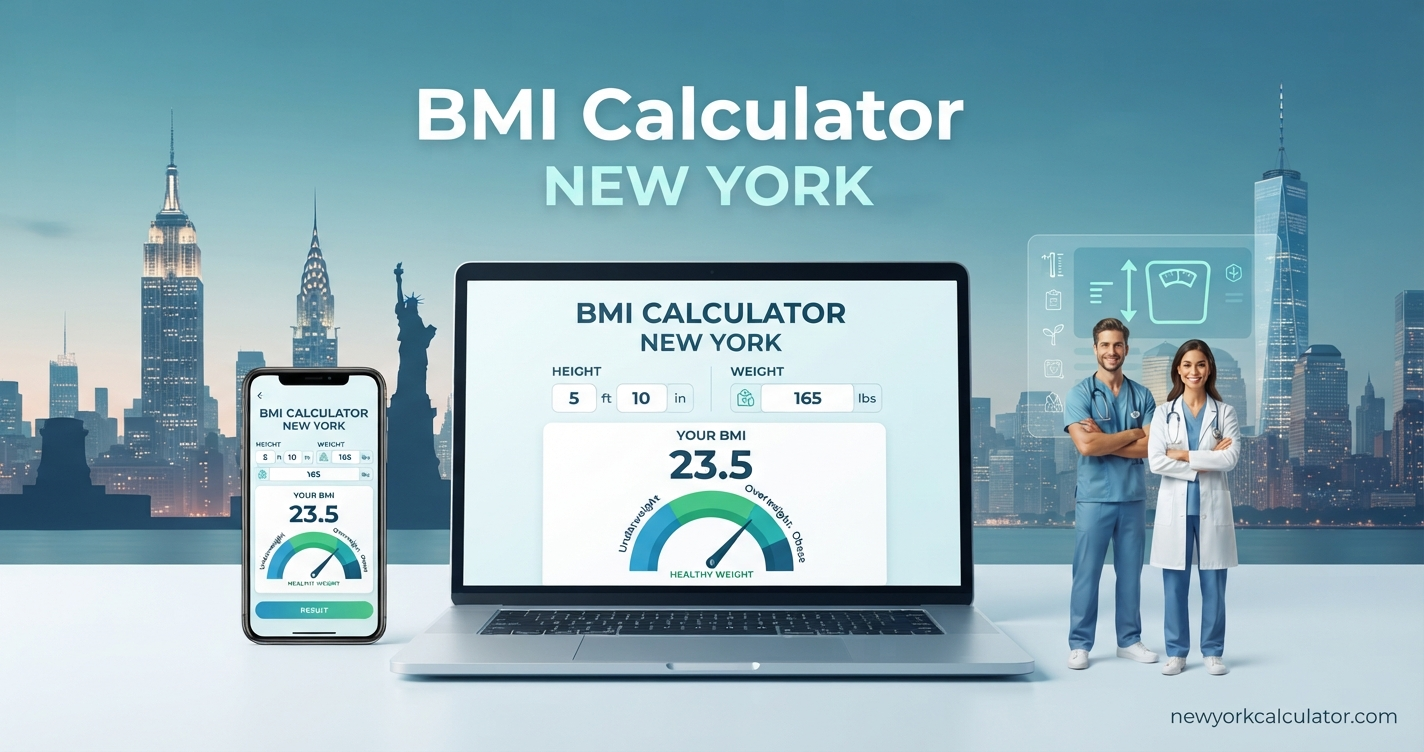
Enter your height and weight below to get your adult BMI, the CDC weight category it falls in, and the range of weights that corresponds to a healthy BMI at your height. You can use feet, inches and pounds, or centimeters and kilograms.
New York does not have its own BMI scale. Adults in New York City and New York State are classified with the same CDC categories used across the United States. What makes this page New York-specific is the local context further down: state health data, where to find care, and a note on why BMI can read differently for some New Yorkers.
BMI Calculator New York
Calculate your adult BMI using U.S. or metric measurements.
BMI is a screening measure, not a medical diagnosis. Results should be considered with other health information and do not replace professional medical advice. This calculator is for adults age 20 and older. It is not for use during pregnancy. Some health guidelines use lower BMI thresholds for adults of Asian descent, so ask your healthcare professional how to interpret your result.
How BMI Is Calculated
BMI stands for Body Mass Index. It compares your weight with your height.
- Metric: BMI = weight in kilograms ÷ (height in meters × height in meters)
- U.S. units: BMI = weight in pounds × 703 ÷ (height in inches × height in inches)
Here are three examples worked through by hand, so you can check the calculator yourself.
The calculator rounds your BMI to one decimal place and then picks the category, so the number you see always matches the category shown.
Adult BMI Categories
For adults age 20 and older, the CDC uses these categories. They are the same for men and women.
| BMI | Category |
|---|---|
| Below 18.5 | Underweight |
| 18.5 to 24.9 | Healthy weight |
| 25.0 to 29.9 | Overweight |
| 30.0 to 34.9 | Class 1 obesity |
| 35.0 to 39.9 | Class 2 obesity |
| 40.0 and above | Class 3 obesity |
Weight Range for a Healthy BMI at Your Height
A healthy BMI of 18.5 to 24.9 corresponds to a different weight at each height. This table shows the approximate range for several common heights. Your result in the calculator uses your exact height.
| Height | In centimeters | Weight range for BMI 18.5–24.9 |
|---|---|---|
| 4 ft 10 in | 147 cm | 89–119 lb |
| 5 ft 0 in | 152 cm | 95–127 lb |
| 5 ft 2 in | 157 cm | 101–136 lb |
| 5 ft 4 in | 163 cm | 108–145 lb |
| 5 ft 6 in | 168 cm | 115–154 lb |
| 5 ft 8 in | 173 cm | 122–163 lb |
| 5 ft 10 in | 178 cm | 129–173 lb |
| 6 ft 0 in | 183 cm | 136–183 lb |
| 6 ft 2 in | 188 cm | 144–193 lb |
| 6 ft 4 in | 193 cm | 152–204 lb |
These ranges are statistical, not personal targets. Many people are healthy outside them, and some people inside them have health problems. Use the range as context, not as a goal to chase.
What Your BMI Result Means
Below 18.5
This is the underweight category. It is not automatically a medical problem, because some people are naturally slim. If you have lost weight without trying, have trouble keeping weight on, or feel unwell, a healthcare professional can look for a cause.
18.5 to 24.9
This is the healthy weight range. It does not guarantee good health. Blood pressure, blood sugar, cholesterol, sleep, activity and family history all matter too.
25.0 to 29.9
This is the overweight category. A clinician looks at more than BMI at this level, such as waist size, blood pressure and blood tests.
30.0 and above
This is the obesity range, split into three classes. A higher class means a higher BMI, not a specific diagnosis or treatment. A healthcare professional can explain what it means for you and what, if anything, to do about it.
When BMI Can Be Misleading
- Muscle mass. BMI cannot tell muscle from fat. A muscular person can have a high BMI without a high amount of body fat.
- Where fat is stored. Fat around the waist is linked with higher health risk than fat elsewhere. Waist size is often used alongside BMI. Waist measurements above about 40 inches (102 cm) for men and 35 inches (88 cm) for women are commonly cited as a sign of higher risk, though a clinician should interpret them for you.
- Older adults. Muscle loss with age can hide changes in body composition, so weight and BMI can look steady while health is changing.
- Different body types. BMI is a simple average-based formula. It cannot account for bone structure, build or body composition.
BMI and Asian New Yorkers
New York is home to large Asian American communities, and this is a point many BMI pages skip. Research has found that some Asian populations can have a higher level of body fat and related health risk at a lower BMI than other groups. Because of this, some clinical guidelines use lower BMI cutoffs for certain screenings. For example, the American Diabetes Association recommends considering diabetes screening at a BMI of 23 or higher for Asian American adults, compared with 25 for the general adult population, when other risk factors are present.
The CDC categories in this calculator are the standard U.S. adult categories and do not change by ethnicity. If you are of Asian descent, ask your healthcare professional how your BMI and your other health measures fit together.
Who Should Not Use an Adult BMI Calculator
- Children and teens (ages 2 to 19). The CDC compares a young person's BMI with age- and sex-specific percentiles, such as the 5th, 85th and 95th percentiles, rather than using adult cutoffs. Use the CDC's BMI resources for children and teens or ask a pediatrician.
- People who are pregnant. Pregnancy weight guidance is based on your pre-pregnancy weight and stage of pregnancy. Ask your obstetric provider.
- People with, or at risk of, an eating disorder. A number and a weight range can be harmful here. If you are struggling with food or weight, please talk with a doctor or mental health professional rather than using a calculator.
New York Data on Weight and Obesity
The New York State Department of Health tracks adult weight through the Behavioral Risk Factor Surveillance System (BRFSS), a survey where adults report their own height and weight. In the department's 2023 report, about two out of three New York adults had overweight or obesity, and 28.0% of adults had obesity. Adults living in New York State outside New York City had a higher obesity rate, 30.8%, than the state as a whole.
Because the survey relies on self-reported height and weight, these figures are estimates. They describe groups of people and say nothing about your own result.
Finding Care in New York
If your result or your health history raises questions, a primary care provider is the best place to start. A few New York resources:
- NY State of Health: the state's official health plan marketplace, if you need coverage.
- NYC Health + Hospitals: the public health system with hospitals and clinics in the five boroughs. Ask about options if you are uninsured.
- NYC Department of Health and Mental Hygiene: public health information for New York City residents.
Common BMI Mistakes
- Mixing units. Entering pounds in the kilogram box gives a wildly wrong answer. Check the unit label.
- Entering inches above 11. Use feet and inches together, such as 5 ft and 10 in, not 5 ft and 70 in.
- Treating the number as a verdict. BMI is a starting point for a conversation, not a judgment of your health.
- Checking too often. Weight changes through the day. If you track it, use the same scale and conditions each time.
- Using it for a teenager. Adult categories do not apply under age 20.
Privacy
The calculator runs in your web browser. Your age, height and weight are used only to show the result on your screen, and the tool's code does not send them to our server. We do not ask for your name or any account details. See our Privacy Policy for how the site handles cookies and analytics.
Frequently Asked Questions
What is a good BMI in New York?
For adults age 20 and older, a BMI from 18.5 to 24.9 is the CDC's healthy weight range. New York uses the same range as the rest of the country.
Is BMI different in New York City?
No. There is no separate BMI formula or scale for New York City or New York State.
Is a BMI of 25 overweight?
Yes. A BMI from 25.0 to 29.9 is classified as overweight for adults.
Is a BMI of 30 considered obese?
Yes. A BMI of 30.0 or higher is in the obesity range. A BMI of 40 or higher is Class 3 obesity.
Do men and women use different BMI ranges?
No. The CDC adult categories use the same BMI cutoffs for everyone age 20 and older, which is why the calculator does not ask for sex.
Can I calculate BMI in pounds and inches?
Yes. Use the US Units tab for feet, inches and pounds, or the Metric tab for centimeters and kilograms.
Does BMI measure body fat?
No. BMI is calculated from height and weight only. It cannot tell muscle from fat or show where fat is stored.
Can an athlete have a high BMI and still be healthy?
Yes. People with a lot of muscle can have a high BMI without a high amount of body fat. A clinician can use other measurements to interpret this.
Can teenagers use this calculator?
No. Children and teens ages 2 to 19 are assessed with BMI-for-age percentiles, not adult categories.
Is the healthy weight range my goal weight?
No. It is the range of weights that gives a BMI of 18.5 to 24.9 at your height. It is a statistical range, not a personal target.
Is the result a medical diagnosis?
No. BMI is a screening measure. Only a healthcare professional can assess your health.
Important Health Disclaimer
This page and calculator are for general information only. BMI does not diagnose obesity, underweight, illness or overall health, and it does not replace an exam, medical history, lab tests or advice from a qualified healthcare professional. If you are pregnant, under 20, have or may have an eating disorder, have had unexplained weight changes, or have a condition that affects your weight, please speak with a healthcare professional instead of relying on this tool.
Sources and How We Review This Page
The BMI categories, formulas and age notes on this page follow published guidance from the CDC and the National Institutes of Health. New York figures come from the New York State Department of Health. Guidelines and data are updated over time, so check the original source for the latest numbers.
- Centers for Disease Control and Prevention (CDC): adult BMI categories, child and teen BMI-for-age
- National Heart, Lung, and Blood Institute (NIH): BMI, waist circumference and health risk
- New York State Department of Health: BRFSS “Overweight and Obesity, New York State Adults, 2023”
- American Diabetes Association: diabetes screening guidance, including BMI thresholds for Asian American adults
- NY State of Health, NYC Health + Hospitals: finding care
Read our Disclaimer and About Us pages for more on who we are and how our tools work.

Junaidul Islam
Founder & CEO, New York Calculator
Junaidul Islam founded New York Calculator to give New Yorkers free, easy-to-use calculators and plain-English guides. He is not a medical professional. He writes this page from published CDC, NIH and New York State Department of Health information, builds and tests the calculator, and checks the numbers against those sources before publishing.
Spotted a mistake? Contact us or read About Us.
© 2026 New York Calculator. The text, design and calculator code on this page are the property of New York Calculator. You may link to this page, but please do not copy or republish it without permission. New York Calculator is an independent website and is not affiliated with, endorsed by, or part of the State of New York, the City of New York or any government agency. See our DMCA Policy and Terms & Conditions.