
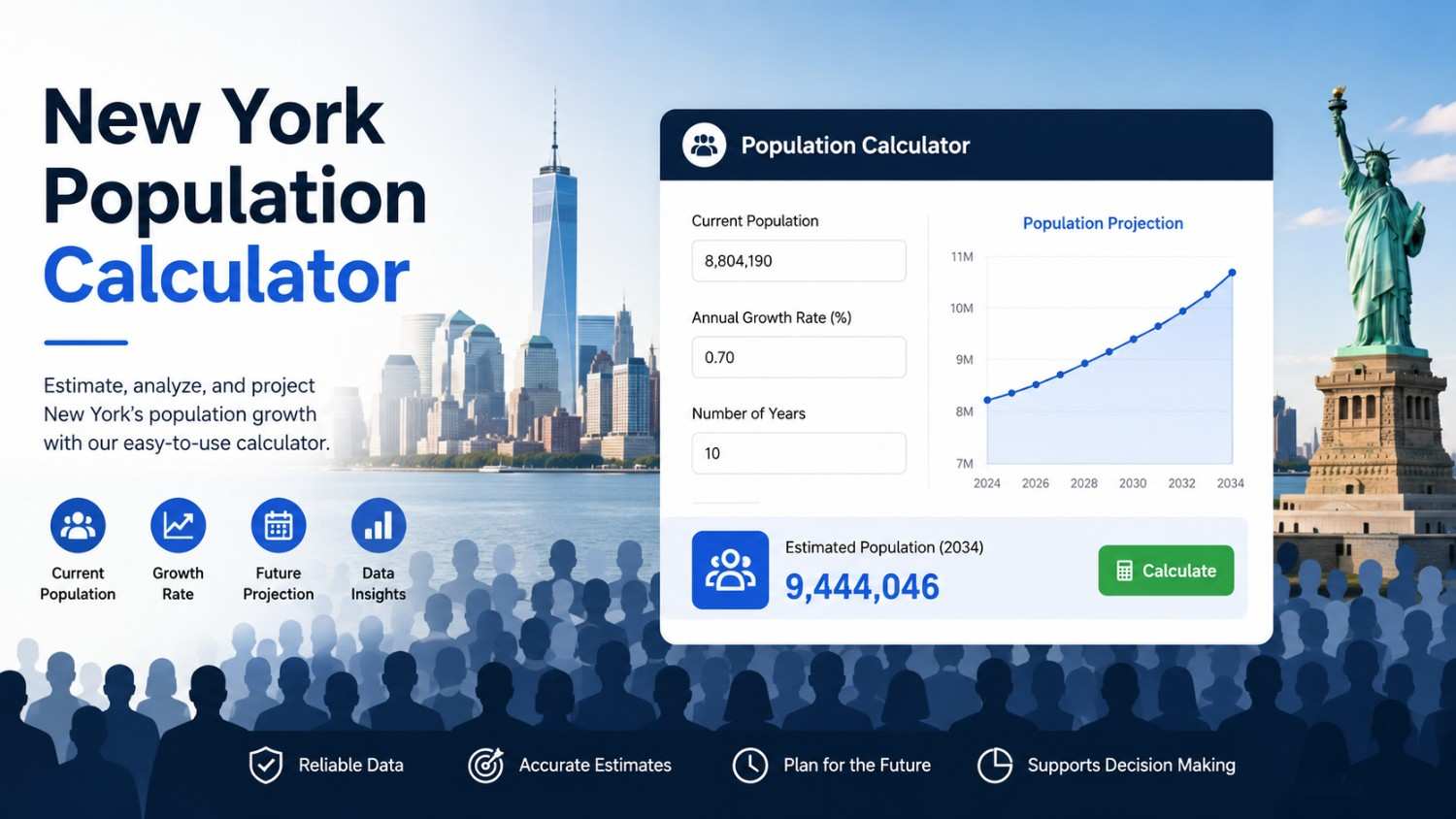
New York’s population is more than a number. It influences housing demand, public transportation, school planning, local services, business opportunities, and the everyday experience of living in one of the most diverse places in the United States.
Whether you live in Manhattan, Brooklyn, Queens, the Bronx, Staten Island, or another part of New York State, understanding population changes can help you make better decisions. However, finding accurate population figures is not always straightforward. New York City and New York State are two different geographic areas, and population estimates are not the same as an official decennial Census count.
The New York Population Calculator on NewYorkCalculator.com helps you explore population figures, compare geographic areas, calculate population growth, and understand population density using a straightforward interactive approach.
You can use this guide to understand how New York’s population is measured, explore the five NYC boroughs, compare historical figures, and perform your own population calculations.
What Is the Population of New York in 2026?
The latest completed U.S. Census Bureau annual estimate series available for this guide is Vintage 2025, with a reference date of July 1, 2025. These are the latest figures used here, not a claim that they represent an exact live population count on today’s date.
According to the Census Bureau’s July 1, 2025 estimates:
- New York State: 20,002,427 residents.
- New York City: 8,584,629 residents.
New York City accounts for a substantial share of the state’s population, but the two figures should never be used interchangeably.
The Census Bureau also reports a 2020 Census population of 20,201,249 for New York State and 8,804,190 for New York City. The 2025 estimates therefore indicate that both areas had lower estimated populations than their respective 2020 Census counts.
These comparisons use the Census Bureau’s revised 2025 estimate base where applicable. This distinction matters because population estimates can be revised as new administrative and demographic information becomes available.
Sources: U.S. Census Bureau QuickFacts and Vintage 2025 population estimates.
New York State vs. New York City Population
One of the most common mistakes in population research is treating New York State and New York City as the same location.
New York State covers a much larger area, including New York City, Long Island, the Hudson Valley, the Capital Region, Western New York, the North Country, and other communities.
New York City is a specific city within the state. It consists of five boroughs, each corresponding to a county.
| Geographic area | Population | Reference date |
|---|---|---|
| New York State | 20,002,427 | July 1, 2025 |
| New York City | 8,584,629 | July 1, 2025 |
The difference is approximately 11.42 million residents.
This distinction is important when researching housing markets, local business demand, public transportation, school enrollment, or demographic changes. A population statistic for New York City cannot automatically describe conditions throughout the entire state.
New York City Population by Borough
New York City is made up of five boroughs: Manhattan, Brooklyn, Queens, the Bronx, and Staten Island.
Each borough has a different population size, land area, residential pattern, and level of population density. Looking at the boroughs separately provides a more useful picture than relying on one citywide number.
The following table uses July 1, 2025 Census Bureau population estimates.
| NYC Borough | County | 2025 Population |
|---|---|---|
| Brooklyn | Kings County | 2,653,963 |
| Queens | Queens County | 2,358,182 |
| Manhattan | New York County | 1,664,862 |
| The Bronx | Bronx County | 1,406,332 |
| Staten Island | Richmond County | 501,290 |
Brooklyn: Brooklyn is the most populous borough. It is known for its residential neighborhoods, commercial districts, cultural communities, and connections to Manhattan.
Queens: Queens is the second-largest borough by population and covers a large land area. Its communities include a wide range of cultural and linguistic backgrounds.
Manhattan: Manhattan has a smaller land area than the other boroughs but a very high population density. It is an important center for business, tourism, education, and entertainment.
The Bronx: The Bronx is the northernmost borough of New York City. It has a substantial residential population and a distinctive history, cultural identity, and neighborhood structure.
Staten Island: Staten Island is the least populous of the five boroughs. Its residential development and lower population density make it different from the city’s other four boroughs.
Remember that borough population figures are estimates, not a count of every person physically present in the borough on a particular day.
How Many People Live in Each NYC Borough Per Square Mile?
Population density measures how many people live within a specific area of land. It is useful for understanding how concentrated a population is.
For example, Manhattan has fewer residents than Brooklyn, but its much smaller land area results in a significantly higher population density.
Using approximate land areas and July 2025 population estimates, the borough comparison is:
| Borough | Approx. land area | Estimated people per sq. mi. |
|---|---|---|
| Manhattan | 22.66 sq. mi. | 73,478 |
| Brooklyn | 69.38 sq. mi. | 38,255 |
| The Bronx | 42.17 sq. mi. | 33,349 |
| Queens | 108.72 sq. mi. | 21,690 |
| Staten Island | 57.52 sq. mi. | 8,715 |
These are approximate figures because the density calculation depends on the land-area definition and the population estimate used.
Water area should not be included in the land-area denominator when calculating population per square mile.
How to Calculate New York Population Growth
Population growth measures how much a population has increased or decreased between two reference dates.
You can calculate it for New York State, New York City, a borough, a county, or another geographic area, provided both population figures refer to the same geographic boundaries.
The formula is:
Population Growth (%) = [(New Population − Previous Population) ÷ Previous Population] × 100
For example, suppose a hypothetical New York community had 100,000 residents in an earlier year and 105,000 in a later year.
The calculation would be:
[(105,000 − 100,000) ÷ 100,000] × 100 = 5%
The community experienced a 5% population increase.
If the later population were 95,000 instead, the result would be −5%, indicating a population decline.
A negative result does not necessarily mean that an area is becoming economically weaker. Population change can be influenced by housing costs, employment, household size, births, deaths, domestic migration, and international migration.
How to Calculate Population Density in New York
Population density tells you how many residents live within one square mile or square kilometer.
The formula is simple:
Population Density = Total Population ÷ Land Area
For example, imagine an area with 250,000 residents and 50 square miles of land.
250,000 ÷ 50 = 5,000 people per square mile.
This means the area has an average density of 5,000 residents per square mile.
For metric calculations, use square kilometers instead of square miles.
One square mile equals approximately 2.58999 square kilometers.
To convert a density figure from people per square mile to people per square kilometer, multiply the square-mile figure by approximately 0.3861.
Population density is an average. It does not mean residents are distributed evenly throughout a neighborhood or county.
New York Population by County
New York State contains 62 counties, including the five counties that correspond to New York City’s boroughs.
Understanding county-level population is useful for people researching local markets, residential areas, regional services, and demographic differences.
The five NYC county equivalents are:
- Kings County — Brooklyn
- Queens County — Queens
- New York County — Manhattan
- Bronx County — The Bronx
- Richmond County — Staten Island
Outside New York City, important population centers include Nassau, Suffolk, Westchester, Erie, Monroe, Onondaga, and Albany counties.
County population estimates can change annually. For an accurate county comparison, use the same Census vintage for every county. Combining a 2020 Census count for one county with a 2025 estimate for another can produce misleading comparisons.
For additional county statistics, consult the Census Bureau’s population estimates and QuickFacts resources.
New York Population Growth: 2010, 2020 and 2025
Historical comparisons help explain how New York’s population has changed over time.
The following figures show the difference between decennial Census counts and the July 2025 estimates.
| Year | New York State | New York City |
|---|---|---|
| 2010 Census | 19,378,102 | 8,175,133 |
| 2020 Census | 20,201,249 | 8,804,190 |
| 2025 estimate | 20,002,427 | 8,584,629 |
Between the 2010 and 2020 Census counts, both New York State and New York City recorded population growth.
The later 2025 estimates show a different direction compared with the 2020 Census counts.
However, the 2025 Vintage estimates use an updated population-estimate base. For rigorous year-to-year analysis, the best practice is to compare figures within one consistent estimate series rather than mixing historical Census counts and revised annual estimates without explanation.
Population changes are influenced by several factors:
Domestic migration: Residents may move to another state for employment, housing affordability, family reasons, or lifestyle preferences.
International migration: International arrivals and departures can influence the population of both New York City and the wider state.
Births and deaths: Natural population change is the difference between births and deaths during a specified period.
Housing and affordability: Rent, home prices, available housing, and household expenses can influence where people choose to live.
Employment and education: Job opportunities, universities, and access to services can affect residential decisions.
New York Population Projection Calculator: How to Estimate Future Population
A population projection is an estimate of what a population might look like in the future under a set of assumptions.
It is not the same as an official government forecast.
One simple mathematical approach is compound growth:
Future Population = Current Population × (1 + Annual Growth Rate)^Number of Years
For example, suppose an area has 100,000 residents and you assume an annual growth rate of 1%.
After five years:
100,000 × (1.01)^5 = approximately 105,101.
This is an illustrative mathematical projection, not a prediction of the actual population of a New York borough or county.
Real population projections require more detailed assumptions, including age structure, fertility, mortality, migration, and the timing of demographic changes.
Use a single assumed annual rate only when you want a simplified scenario.
Census Population vs. Annual Population Estimates: What’s the Difference?
Understanding the difference between a Census count and an annual population estimate is essential when researching New York.
Decennial Census: The U.S. Census Bureau conducts a population count every ten years. The 2020 Census reference date was April 1, 2020.
Annual population estimates: These estimates provide population figures for years between decennial censuses. They use demographic information and administrative data to estimate population changes.
Estimate vintage: A Census estimate vintage is a consistent series of estimates produced using a particular release’s methodology and data. Later vintages may revise earlier estimates.
Population projection: A projection describes a possible future population under stated assumptions. It should not be presented as an official count.
For this guide, the July 1, 2025 Vintage 2025 estimate is used as the latest completed annual estimate series available in the cited Census sources.
Always check the reference date before comparing population statistics from different websites.
Why Does New York’s Population Change Every Year?
New York’s population is affected by a combination of economic, social, and demographic factors.
Housing affordability is one important consideration. Rent and home prices can influence whether residents remain in a neighborhood or move to another part of the state.
Employment opportunities also matter. New York City has major financial, professional, educational, cultural, and service industries, while other parts of the state have different economic strengths.
Migration patterns are another major factor. People move into and out of New York for work, family, education, retirement, and other reasons.
Births and deaths also contribute to annual changes. The overall population is the result of these factors working together, not one single cause.
It is therefore important to avoid explaining every population decline or increase using only one factor.
New York Population Calculator
Explore New York population estimates, compare NYC boroughs, calculate population growth and measure population density.
New York Population Overview
Population Growth Calculator
Population Density Calculator
Density is calculated using population divided by land area. Water area is excluded when land-area figures are used.
Future Population Projection
This is a simplified compound-growth scenario. It is not an official Census forecast.
Compare New York Populations
New York City Borough Population
| Borough | Population | Share of NYC |
|---|
Population data reference: July 1, 2025, Vintage 2025. Borough land areas are approximate. Calculated results are for general informational purposes.
How to Use the New York Population Calculator
NewYorkCalculator.com’s population calculator is designed to make population calculations easier without requiring spreadsheet software or complicated formulas.
You can use the calculator to:
- Select a geographic area or enter your own population figures.
- Choose the type of calculation you want to perform.
- Enter the previous and current population when calculating growth.
- Enter population and land area when calculating density.
- Compare population figures using consistent reference dates.
- Explore a future population scenario using an assumed annual growth rate.
- Review the calculated result and understand what it means.
The calculator is intended for general research, educational use, and basic demographic comparisons. Its mathematical results do not replace official Census statistics.
Frequently Asked Questions
1. What is the population of New York State in 2026?
The latest completed annual estimate series used in this guide reports 20,002,427 residents for New York State as of July 1, 2025. This should not be described as an exact 2026 population count. Check the U.S. Census Bureau for the newest release.
2. What is the population of New York City?
The U.S. Census Bureau’s July 1, 2025 estimate for New York City is 8,584,629 residents.
3. Which NYC borough has the largest population?
Brooklyn, also known as Kings County, has the largest population among the five boroughs in the July 2025 estimates, with 2,653,963 residents.
4. Which NYC borough has the smallest population?
Staten Island, corresponding to Richmond County, is the least populous borough, with an estimated 501,290 residents in July 2025.
5. Is New York City the same as New York State?
No. New York City is one city within New York State. The state includes many other cities, towns, villages, and counties.
6. How do I calculate population growth percentage?
Subtract the previous population from the new population, divide the result by the previous population, and multiply by 100.
7. How do I calculate population density?
Divide the total population by the land area. Use square miles for people per square mile or square kilometers for people per square kilometer.
8. Why can two websites show different New York population figures?
They may use different reference dates, estimate vintages, geographic boundaries, or data sources. One website may show a decennial Census count while another shows an annual estimate.
9. Are New York population estimates exact?
No. Annual population estimates are statistical estimates, not a physical count of every resident on the reference date. They may also be revised in later estimate vintages.
10. Can I calculate the future population of New York?
Yes. You can create a mathematical projection using a current population, an assumed annual growth rate, and a number of years. The result is a scenario, not an official forecast.
11. What is the difference between population and population density?
Population is the total number of residents in an area. Population density measures the average number of residents per unit of land area.
12. Where can I find official New York population data?
The U.S. Census Bureau’s QuickFacts, Population Estimates Program, and data.census.gov are useful starting points. NYC Department of City Planning also publishes local population information.
Data Sources and Methodology
The population figures in this article are based on official U.S. Census Bureau information, with July 1, 2025 used as the annual estimate reference date where indicated.
Primary references:
- U.S. Census Bureau QuickFacts: New York State and New York City.
- U.S. Census Bureau Vintage 2025 Population Estimates.
- U.S. Census Bureau Population Clock and population density tables.
- NYC Department of City Planning population research and estimates.
Borough density figures are approximate calculations based on the cited population estimates and approximate land areas. Different geographic definitions or revised source figures can produce slightly different results.
When comparing locations, use the same data vintage, reference date, and geographic definition wherever possible.
This guide is intended for informational and educational purposes. It is not an official government publication.
Article written by Junaidul Islam for NewYorkCalculator.com.