
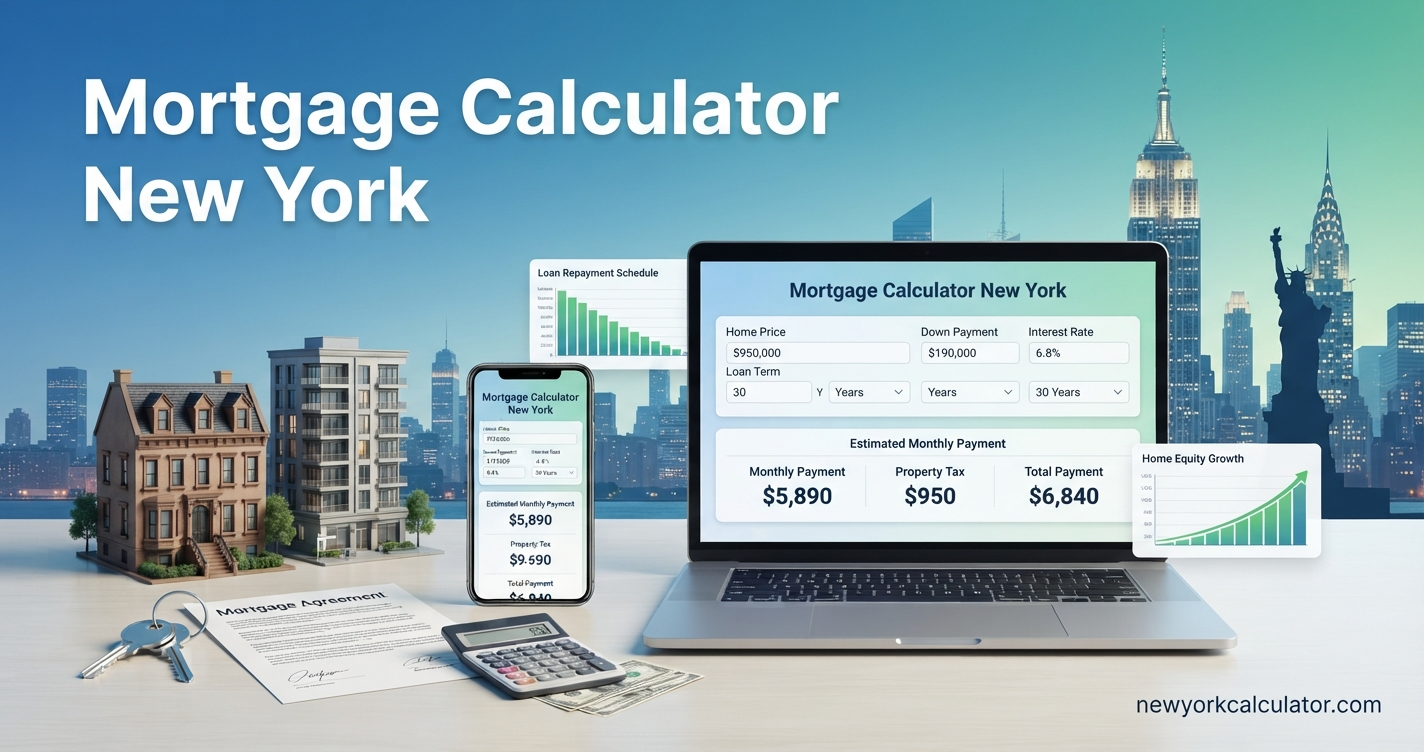
Buying a home in New York is not simply a matter of multiplying a mortgage amount by an interest rate. Your real monthly housing cost can also include property taxes, homeowners insurance, PMI, HOA or co-op maintenance, and other recurring expenses. The amount you need at closing can be different again because New York buyers may face mortgage recording taxes and, for qualifying high-value purchases, additional real estate taxes.
That is why a basic mortgage payment estimate can sometimes give a misleading picture of what a New York home will actually cost.
This New York Mortgage Calculator is designed to give you a more complete starting estimate.
It lets you estimate principal and interest, property taxes, homeowners insurance, PMI, HOA or maintenance costs, estimated closing costs, mortgage recording tax, and certain New York-specific purchase costs.
New York Mortgage Calculator
Estimate your monthly mortgage payment, property taxes, insurance, PMI, HOA or maintenance costs and selected New York purchase expenses.
1. Property & Loan Details
2. Monthly Housing Costs
Enter your lender’s PMI estimate if applicable.3. Affordability Information
Estimated Total Monthly Housing Cost $0Loan Amount $0Principal & Interest $0Property Tax / Month $0Insurance / Month $0PMI / Month $0HOA / Maintenance $0Total Interest $0Total Loan Payments $0Estimated Cash to Close $0New York Purchase Cost Estimate
Down Payment $0Estimated Closing Costs $0Estimated Mortgage Recording Tax $0Estimated Mansion Tax $0Estimated Total Upfront Cash $0Affordability Snapshot
Estimated Annual Housing Cost $0Housing Cost as % of Gross Income —Housing + Other Debt Ratio —
Year Principal Paid Interest Paid Remaining Balance Important: Mortgage recording tax, mansion tax, property taxes, STAR benefits, closing costs and other New York expenses can vary by location, transaction structure, property type and eligibility. These results are estimates for planning only and are not a mortgage offer, tax calculation, legal opinion or financial advice.This calculator uses the information entered by the user. For an actual purchase, confirm rates, taxes, insurance, closing costs and applicable New York taxes with your lender, attorney, title professional and the appropriate government authority.
Use the calculator above with your own home price, down payment, interest rate and estimated local costs. For a more realistic result, enter the actual property-tax amount and insurance quote when you have them.
What Does a New York Mortgage Calculator Calculate?
A mortgage calculator estimates the cost of borrowing money to purchase a home.
The basic mortgage payment consists of:
- Principal — the amount you borrowed
- Interest — the lender's charge for the loan
But homeowners often pay additional costs. Depending on the property and loan, your actual housing budget can also include:
- Property taxes
- Homeowners insurance
- Private mortgage insurance (PMI)
- HOA fees
- Condo common charges
- Co-op maintenance
- Mortgage-related closing costs
- Other recurring housing expenses
For a New York buyer, there is another important consideration: certain mortgage recording taxes apply when a mortgage is recorded against New York real property. New York State explains that the state imposes a tax on the privilege of recording a mortgage, with additional local taxes possible in New York City, Yonkers and certain counties.
That means the monthly mortgage payment is only one part of the financial picture.
How to Use This New York Mortgage Calculator
Start with five numbers:
- Home price
- Down payment
- Mortgage interest rate
- Loan term
- Estimated property taxes and other housing costs
For example, suppose you are considering a $600,000 home and plan to put 20% down.
Your estimated loan amount would be:
$600,000 − $120,000 = $480,000
The calculator then uses the loan amount, interest rate and repayment term to estimate principal and interest.
You can improve the estimate by entering your actual annual property tax, insurance premium and monthly HOA or maintenance cost.
The more accurate your inputs are, the more useful the result will be.
Why New York Mortgage Costs Can Be Different From Other States
New York has a wide range of housing markets.
Buying in Manhattan is very different from buying in Buffalo. A home in Westchester County can have a very different tax bill from a similarly priced property elsewhere in the state.
SmartAsset notes that New York property taxes vary substantially by county and that some New York areas have among the country's higher property-tax burdens.
That is why you should avoid relying on a single statewide tax percentage if you already know the property's actual tax bill.
For a purchase you are seriously considering, check the property's current tax information and ask the lender or real-estate professional which costs will be included in escrow.
Your Monthly New York Mortgage Payment Is More Than Principal and Interest
A useful way to think about your housing payment is:
Principal + Interest + Property Tax + Insurance + PMI + HOA/Maintenance = Estimated Monthly Housing Cost
Not every homeowner will have every expense.
For example:
- A buyer putting 20% down on a conventional loan may not have PMI.
- A condo owner may have common charges.
- A co-op buyer may have a substantial monthly maintenance bill.
- A homeowner may have property taxes and insurance collected through escrow.
- Some expenses may be paid directly rather than through the mortgage servicer.
The calculator therefore separates the major components rather than hiding everything inside one number.
Principal and Interest: The Core Mortgage Payment
The principal is the amount you borrow.
Interest is the cost charged by the lender for allowing you to use that money.
A typical fixed-rate mortgage payment is calculated using the loan amount, periodic interest rate and number of payments.
A lower interest rate generally reduces the monthly principal-and-interest payment and the total interest paid over the life of the loan.
However, the lowest advertised rate is not necessarily the rate you will receive. Your actual rate can depend on factors such as:
- Credit profile
- Loan type
- Down payment
- Property type
- Loan amount
- Occupancy
- Points
- Market conditions
Mortgage rates can also change quickly. For example, current published New York rate tables are updated regularly rather than remaining fixed for an entire year. NerdWallet's New York page currently publishes rate information with a specific October 2026 date, illustrating why users should check current quotes instead of treating an old rate as today's rate.
Down Payment: 5%, 10%, 20% or More?
Your down payment affects both your loan amount and the amount of cash you need before closing.
For a $600,000 property:
| Down Payment | Cash Down | Approx. Loan |
|---|---|---|
| 5% | $30,000 | $570,000 |
| 10% | $60,000 | $540,000 |
| 15% | $90,000 | $510,000 |
| 20% | $120,000 | $480,000 |
| 25% | $150,000 | $450,000 |
A larger down payment can reduce the loan balance and may reduce or eliminate PMI for certain conventional loans.
But there is a trade-off.
Putting every available dollar into the down payment can leave you with less money for:
- Closing costs
- Moving
- Repairs
- Furniture
- Emergency reserves
- Maintenance
- Unexpected ownership expenses
The best down payment is therefore not automatically the largest one you can afford.
New York Property Taxes Matter
Property taxes are one of the most important variables in your New York home-buying budget.
The tax bill is determined locally and can vary significantly between counties, municipalities and school districts.
Do not assume that two homes with identical purchase prices will have identical property taxes.
For a specific property, look for the actual current tax bill or official assessment information.
New York's Tax Department also recommends that new homeowners understand their assessment and check whether they may qualify for available property-tax exemptions.
A practical approach
If you know the annual property tax:
Annual property tax ÷ 12 = approximate monthly property-tax cost
For example:
$12,000 annual tax ÷ 12 = $1,000 per month
That $1,000 should be included in your housing budget even though it is not principal or interest.
What Is New York Mortgage Recording Tax?
This is one of the most important New York-specific costs that a generic mortgage calculator can miss.
New York State imposes a mortgage recording tax when a mortgage is recorded on real property in the state. The exact amount depends on the mortgage amount and the jurisdiction.
The New York State Department of Taxation and Finance currently lists a basic tax of 50 cents per $100 of mortgage debt, a special additional tax of 25 cents per $100, and an additional tax of 25 cents per $100—or 30 cents per $100 in Metropolitan Commuter Transportation District counties—with specific rules and deductions. Local mortgage taxes may also apply.
This is why a New York buyer should not simply copy a generic nationwide closing-cost percentage and assume the result is accurate.
Important: The calculator on this page provides an estimate. Your actual recording tax can depend on the property location, property type, mortgage structure and applicable local rules.
NYC Mortgage Recording Tax Deserves Extra Attention
If you are purchasing property in New York City, mortgage recording tax becomes especially important.
NYC is one of the jurisdictions where additional local mortgage taxes can apply. The exact amount should be confirmed using the current official rules and your closing statement.
For a serious purchase, your lender, attorney or title/closing professional should confirm the final amount before you close.
The calculator is intended to help you budget—not replace a closing disclosure or professional calculation.
What Is the New York Mansion Tax?
A common misconception is that “mansion tax” only applies to enormous luxury mansions.
That is not how the basic threshold works.
New York's mansion tax applies to qualifying residential real-estate transfers at $1 million or more, with a 1% tax at the basic threshold.
Higher-priced transactions can be subject to additional graduated rates.
For that reason, buyers looking at expensive New York City properties should consider the mansion tax before deciding how much cash they need to close.
It is also important to distinguish this from the mortgage recording tax.
Mortgage recording tax is connected to recording the mortgage.
Mansion tax is connected to the qualifying real-estate sale price.
They are different costs.
Co-op and Condo Buyers Need to Look Beyond the Mortgage
A New York mortgage calculator should not treat every property as a detached house.
New York City has a large co-op and condo market.
For a condo, you may have:
- Mortgage
- Property taxes
- Common charges
- Insurance
- Possibly other building-related costs
For a co-op, you may have:
- Mortgage
- Monthly maintenance
- Potentially other building charges
StreetEasy's NYC mortgage calculator specifically allows users to enter maintenance and property-tax costs, illustrating why these expenses matter when evaluating New York City housing.
A better question
Instead of asking:
“What is my mortgage payment?”
ask:
“What will this property cost me every month?”
That number is much more useful for comparing homes.
PMI: Why a Smaller Down Payment Can Increase Your Monthly Cost
Private mortgage insurance, or PMI, may apply to certain conventional mortgages when the down payment is below 20%.
PMI protects the lender rather than providing homeowners with additional property protection.
If your mortgage requires PMI, include the monthly premium in your housing budget.
The exact PMI cost depends on the loan and borrower.
Do not assume every borrower putting less than 20% down will receive the same PMI rate.
How Much Cash Do You Need to Buy a New York Home?
This is where many first-time buyers underestimate the total cost.
Your required cash can include:
Down payment
Closing costs
Mortgage-related taxes
Prepaid expenses
Other transaction costs
The result can be considerably higher than your down payment alone.
For a $600,000 home, a buyer with a $120,000 down payment does not necessarily need only $120,000 in available cash.
You should also budget for transaction costs and maintain a reasonable reserve after closing.
The calculator therefore shows estimated upfront costs separately from the recurring monthly payment.
New York Closing Costs Can Vary
There is no single closing-cost number that works for every New York home purchase.
Costs can vary based on:
- Purchase price
- Loan amount
- County
- Property type
- Mortgage type
- Attorney fees
- Title-related costs
- Lender fees
- Appraisal
- Inspection
- Prepaid taxes
- Insurance
- Escrow
- Mortgage recording tax
- Applicable transfer or purchase-related taxes
SmartAsset's New York analysis also treats closing costs as location-sensitive and includes mortgage taxes, transfer taxes and other fees in its broader analysis.
The calculator on this page uses an estimated closing-cost percentage as a budgeting tool. Replace the estimate with actual lender and attorney figures once available.
STAR Property Tax Benefits: An Important 2026 Update
New York's STAR program is another area where older articles can become misleading.
The state currently distinguishes between the STAR credit and STAR exemption.
For new homeowners and first-time STAR applicants, the STAR exemption program is closed to new applicants; eligible homeowners can instead register for the STAR credit.
For the 2026–2027 school year, New York lists a Basic STAR base amount of $30,000 and an Enhanced STAR base amount of $88,500 for the calculation process. Actual savings depend on local school-district and assessment information.
The current Basic STAR credit income limit is $500,000, while the Basic STAR exemption has a $250,000 income limit. Enhanced STAR has additional age and income requirements.
Another 2026 change is particularly important for seniors: eligible Enhanced STAR recipients can be automatically upgraded when they reach the required age, subject to the program's conditions.
One important warning
Do not subtract a guessed STAR amount from your property tax bill and assume that is your final tax obligation.
Actual STAR savings depend on local information, including school-district tax rates. New York says final STAR credit/savings figures cannot always be determined until the necessary local tax rates are available.
For that reason, the calculator should treat STAR as an estimate unless the user has verified the actual benefit.
Can First-Time Buyers Get Help in New York?
Potentially, yes.
New York State's Homes and Community Renewal operates SONYMA, the State of New York Mortgage Agency.
SONYMA programs can provide mortgage financing and assistance for qualifying buyers, with eligibility depending on the program, location, income, purchase price and other requirements.
In 2026, SONYMA introduced DPAL PLUS 2026, a limited enhanced down-payment assistance loan designed for eligible lower-income New Yorkers. The program can be used toward down payment, closing costs and certain mortgage-insurance costs, up to $30,000, subject to its requirements and available funding.
SONYMA's Achieving the Dream program also publishes county-specific income and purchase-price limits. The limits effective for reservations accepted from July 6, 2026 are published by SONYMA and vary by region, household size, target area and property type.
This is an important distinction:
A calculator can estimate affordability. It cannot determine whether you qualify for a SONYMA program.
Final eligibility must be determined under the applicable program rules and through the participating lender.
How Much Income Do You Need for a New York Mortgage?
The answer depends on more than your home price.
Lenders may consider:
- Gross income
- Monthly debt
- Credit history
- Down payment
- Loan type
- Interest rate
- Property taxes
- Insurance
- Other housing costs
A useful personal calculation is:
Monthly housing cost + other monthly debt = total monthly obligations
Then compare that amount with your gross monthly income.
SmartAsset, for example, uses a 36% guideline in its recommended-income calculation, although actual lender underwriting standards can differ.
Do not interpret any calculator's affordability result as a mortgage approval.
The lender makes the final underwriting decision.
New York Mortgage Calculator: 15-Year vs. 30-Year
A 30-year mortgage generally gives you a lower required monthly principal-and-interest payment.
A 15-year mortgage generally has a higher monthly payment but can reduce the amount of interest paid over the life of the loan.
For example, imagine two loans with the same starting balance and different terms.
30-Year Mortgage
Lower required payment
Longer repayment period
More total interest in many cases
15-Year Mortgage
Higher required payment
Shorter repayment period
Potentially much less total interest
The best option depends on your cash flow, goals, rate, reserves and overall financial situation.
A lower monthly payment is not automatically the cheaper loan.
What Happens If You Make Extra Mortgage Payments?
Extra principal payments can reduce the balance faster.
Suppose your required payment is $4,000 and you voluntarily pay an additional $300 toward principal each month.
That extra money can reduce the outstanding principal faster, which can reduce future interest and shorten the payoff period.
But check your mortgage documents and lender rules before making assumptions about prepayment.
You should also consider whether keeping the cash in an emergency fund or using it for another financial goal makes more sense for your situation.
New York Mortgage Affordability: A Better Way to Think About Price
Instead of starting with:
“How expensive a house can I qualify for?”
start with:
“What monthly housing cost can I comfortably maintain?”
That difference matters.
A lender may approve a mortgage that feels uncomfortable once you add:
- Property taxes
- Insurance
- Maintenance
- Utilities
- Repairs
- Transportation
- Childcare
- Student loans
- Credit-card payments
- Other household expenses
Your personal budget should therefore be more conservative than a simple maximum-loan calculation.
Example: Estimating a New York Home Purchase
Imagine a buyer is considering:
Home price: $600,000
Down payment: 20%
Mortgage: $480,000
Term: 30 years
Now add:
- Annual property taxes
- Homeowners insurance
- HOA or maintenance if applicable
- PMI if required
- Estimated closing costs
The resulting monthly housing cost can be substantially higher than the principal-and-interest figure alone.
That is exactly why this calculator separates the costs.
The goal is not to produce a magically precise number before you have a property, lender quote and tax information.
The goal is to produce a better planning estimate.
Why Your Actual Mortgage Payment May Be Different
No online calculator can perfectly predict your final mortgage payment before your loan closes.
Your final number can change because of:
- Final interest rate
- Loan type
- Credit profile
- Property taxes
- Insurance quote
- PMI pricing
- HOA or maintenance
- Closing costs
- Escrow requirements
- Points
- Property-specific factors
This calculator is therefore an educational planning tool.
For an actual transaction, rely on your lender's official disclosures and your closing professionals for final numbers.
Frequently Asked Questions
What is the average mortgage payment in New York?
There is no single useful average for the entire state because home prices, property taxes and other costs vary substantially by location. A mortgage payment in Manhattan can look very different from one in Buffalo or another upstate market.
Use the calculator with the actual purchase price and local tax information whenever possible.
How much should I put down on a New York home?
There is no universal answer. A larger down payment can reduce your loan balance and may reduce mortgage insurance, but using too much cash upfront can leave you without sufficient reserves.
Compare several scenarios before deciding.
Does New York charge mortgage recording tax?
Yes. New York State imposes a mortgage recording tax, and additional local taxes can apply depending on where the property is located.
Does NYC have a mortgage recording tax?
Yes. NYC is one of the New York jurisdictions where local mortgage recording taxes can apply. The exact amount depends on the applicable rules and mortgage/property details.
What is the New York mansion tax?
A mansion tax applies to qualifying residential real-estate transfers of $1 million or more, beginning with a 1% tax at that threshold. Higher-priced transactions can have additional graduated rates.
Does STAR reduce my mortgage payment?
No. STAR is a property-tax benefit. It can reduce eligible property-tax costs, but it does not reduce the principal or interest charged by your mortgage lender.
Can a new homeowner still get STAR?
New homeowners generally cannot newly enroll in the STAR exemption program. Eligible new homeowners can register for the STAR credit instead, subject to program requirements.
What is SONYMA?
SONYMA is the State of New York Mortgage Agency. It offers mortgage programs and assistance options for qualifying New York homebuyers. Program requirements vary.
Can SONYMA help with a down payment?
Some SONYMA programs provide down-payment assistance. For example, DPAL PLUS 2026 offers eligible borrowers up to $30,000 for qualifying uses, subject to program requirements and available funding.
Is this calculator an official mortgage quote?
No. It is an independent estimate intended for planning and educational purposes. Your lender's official disclosures and final closing documents control the actual transaction.
New York Mortgage Calculator Methodology
The mortgage portion of this calculator uses the standard fixed-rate mortgage payment formula:
M = P × [r(1+r)ⁿ] ÷ [(1+r)ⁿ − 1]
Where:
- M = monthly principal-and-interest payment
- P = loan principal
- r = monthly interest rate
- n = total number of monthly payments
Additional costs are then estimated separately.
Property tax is calculated from the annual tax amount divided by 12.
Homeowners insurance is calculated from the annual premium divided by 12.
HOA or maintenance is entered as a monthly amount.
PMI is treated as an estimated monthly cost when applicable.
New York-specific taxes are displayed separately because they are not part of the standard principal-and-interest mortgage formula.
Important Note About New York Taxes and Estimates
New York real-estate taxes are highly location dependent.
Mortgage recording tax rules can differ by jurisdiction, property type and mortgage structure. STAR savings depend on local school-tax information and eligibility. SONYMA programs have their own eligibility, income and purchase-price requirements.
For those reasons, the figures produced by this calculator should be treated as estimates, not legal, tax, lending or financial advice.
Before purchasing a property, verify important figures with the appropriate New York government agency, lender, attorney, title professional, insurance provider or tax professional.
Bottom Line
A good New York mortgage calculation should answer more than one question.
It should tell you:
How much will my mortgage payment be?
But it should also help you understand:
How much will taxes add?
What will insurance cost?
Will PMI apply?
What will my HOA or co-op maintenance cost?
How much cash might I need at closing?
Could mortgage recording tax apply?
Could mansion tax apply to the purchase?
Could STAR reduce eligible property-tax costs?
Could I qualify for a New York homebuyer assistance program?
And most importantly:
Can I comfortably afford the property—not merely qualify for the loan?
That is the reason we built this New York Mortgage Calculator as a broader home-buying planning tool rather than a simple principal-and-interest calculator.
Written by Junaidul Islam
NewYorkCalculator.com
Last reviewed: October 7, 2026
Sources and official references
For New York-specific information, verify current rules with the New York State Department of Taxation and Finance, New York State Homes and Community Renewal/SONYMA, and the applicable local government authority before making a purchase.