
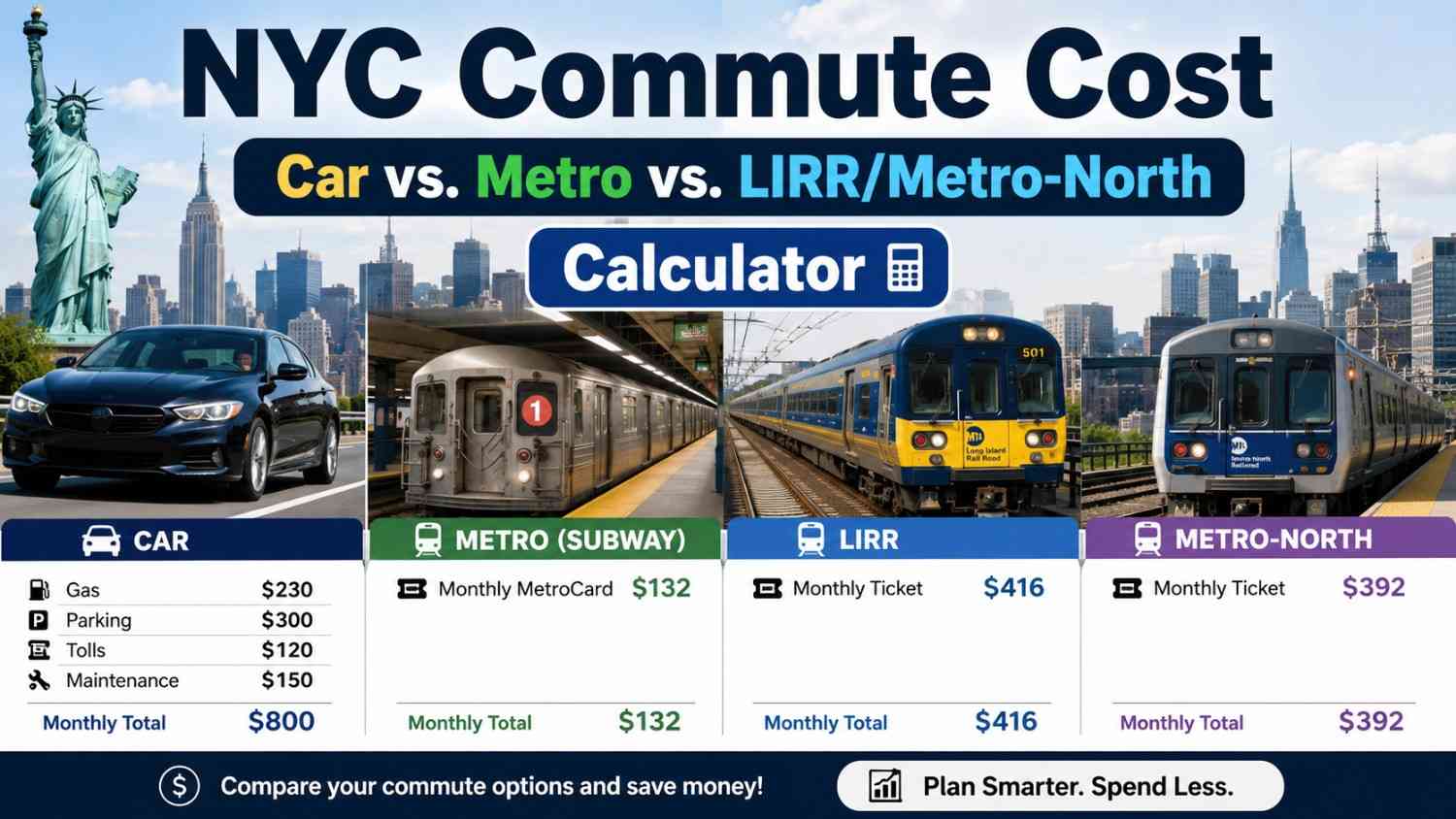
Choosing how to commute in New York City is not always as simple as comparing a train ticket with the price of gasoline. A car may seem convenient, but parking, insurance, maintenance, tolls, and vehicle depreciation can make driving considerably more expensive than expected. On the other hand, taking the subway or a commuter train is not automatically the cheapest option for every household or every route.
Your location, work schedule, destination, parking arrangements, and number of office days can change the financial picture significantly.
This NYC Commute Cost Calculator helps you compare four transportation options: driving your own car, using the NYC subway, taking the Long Island Rail Road (LIRR), and commuting with Metro-North Railroad. You can enter your own fares and expenses to estimate your daily, monthly, and annual transportation costs.
The goal is not simply to identify the cheapest ticket. It is to understand what your commute actually costs and which option makes the most financial sense for your situation.
NYC Commute Cost Calculator
Compare the real cost of driving, subway, LIRR and Metro-North. Calculate daily, monthly and yearly commuting expenses.
Your Work Schedule
Driving Cost
NYC Subway / Metro
LIRR Commuting
Metro-North Commuting
Your Commute Cost Results
Use the calculator to enter your commuting days, vehicle expenses, transit fares, parking costs, and other regular transportation expenses. For the most accurate comparison, use your actual ticket price and parking rate rather than relying on a general citywide estimate.
How Much Does It Cost to Commute in NYC in 2026?
New York’s transportation system includes several different pricing structures. A subway ride has a standard fare, while commuter rail prices depend on the stations and time of travel. Driving expenses depend on the vehicle, route, tolls, and parking arrangements.
Here is a quick overview of the main costs to consider.
| Transportation | Main expenses |
|---|---|
| Car | Gas, insurance, parking, tolls, repairs and depreciation |
| Subway | Individual fares and OMNY fare cap |
| LIRR | Origin-to-destination rail fare, parking and connections |
| Metro-North | Origin-to-destination rail fare, parking and connections |
NYC Subway Fare and OMNY Weekly Cap
As of October 2026, the regular fare for most NYC subway and local bus rides is $3 per trip. The OMNY seven-day fare cap is $35 for eligible subway and local bus travel.
This means eligible riders using the same OMNY card or contactless payment method can reach the $35 cap after 12 paid rides within a seven-day period. Eligible rides after reaching the cap are free for the remainder of that period.
For someone commuting five days a week with two paid rides per workday, the basic calculation is:
- 10 paid rides per week.
- 10 × $3 = $30.
- Estimated cost: $30 per week.
A commuter making six round-trip workdays in a seven-day period would otherwise spend $36, but the $35 cap can limit the eligible cost.
Remember that the cap is based on the same payment credential. Switching between a physical card, phone, and watch may split your fare-capping progress. Transfers also matter: an eligible free transfer should not be counted as another full paid trip.
Official fare information: MTA Fares and Tolls.
LIRR Commuting Costs
The Long Island Rail Road is a major commuting option for people traveling from Nassau County, Suffolk County, Queens, and other Long Island communities toward New York City.
However, there is no single LIRR fare that applies to every commuter. Your price depends on your origin station, destination station, ticket type, and travel period.
A person traveling from one Long Island station to Penn Station may pay a different fare from someone traveling from another station to Grand Central Madison.
Before estimating your monthly expense, check:
- Your exact departure station.
- Your destination station.
- Peak or off-peak travel eligibility.
- One-way or round-trip ticket prices.
- Weekly or monthly ticket options.
- Station parking or drop-off expenses.
- Additional subway or bus fares after arriving in the city.
Do not assume that a monthly ticket will always save money. If you work remotely several days a week, buying individual tickets or using another available ticket option may be more economical.
Use the official MTA LIRR fare information and the MTA TrainTime app to check current fares and schedules.
Metro-North Railroad Commuting Costs
Metro-North is especially useful for people traveling from Westchester County, the Hudson Valley, and parts of Connecticut to Manhattan.
Many commuters use stations such as White Plains, New Rochelle, Yonkers, Tarrytown, Stamford, and other stations across the network.
Metro-North fares also depend on the origin and destination stations and the applicable ticket rules. Peak and off-peak prices can differ.
For a realistic estimate, include the entire journey rather than only the train ticket. For example, someone driving from home to a Metro-North station may have to pay for station parking before boarding the train.
The full expense could include:
- Driving from home to the station.
- Daily or monthly station parking.
- Metro-North ticket.
- Subway or bus connection in Manhattan.
- Additional travel from the destination station to the workplace.
These expenses can make a substantial difference when comparing Metro-North with driving directly to work.
Official information: MTA Fares and Tolls.
The Real Cost of Driving a Car in New York City
Driving gives you flexibility, but the total cost of owning and using a vehicle is much greater than the amount you spend at a gas station.
A fair comparison should include both direct commuting expenses and the ownership costs associated with keeping a vehicle available for daily use.
1. Gasoline and Fuel Consumption
Fuel cost depends on three important factors:
- One-way commuting distance.
- Your vehicle’s miles per gallon (MPG).
- The current price of gasoline.
For example, suppose your one-way commute is 20 miles, your vehicle averages 25 MPG, and gasoline costs $3.50 per gallon.
Your estimated daily round-trip fuel consumption is:
40 miles ÷ 25 MPG = 1.6 gallons.
At $3.50 per gallon, the estimated daily fuel expense is $5.60.
This is only an example. Your own fuel price and actual fuel economy may be different.
2. Parking Expenses
Parking can be one of the largest expenses for NYC drivers.
Your workplace may offer free parking, a subsidized garage, or paid daily parking. If you park in a commercial garage, the monthly expense can be much higher than parking at a suburban workplace.
Consider these costs separately:
- Home parking.
- Workplace parking.
- Monthly garage subscription.
- Daily parking fees.
- Parking for park-and-ride arrangements.
Do not count home parking as a commuting expense unless you are intentionally calculating the full cost of keeping your car.
3. Car Insurance
New York car insurance prices vary based on your location, driving history, vehicle, coverage limits, and insurer.
If you already own a vehicle, insurance is still a recurring cost even on days when you work from home.
For a true cost-of-ownership comparison, include your monthly premium. For a narrower commute-only comparison, you can exclude insurance or include only the additional insurance expense caused by commuting.
This distinction is important because a vehicle’s entire insurance premium is not necessarily caused by commuting.
4. Vehicle Maintenance and Repairs
Regular driving increases vehicle wear.
Potential expenses include:
- Oil changes.
- Tire replacement.
- Brake service.
- Battery replacement.
- Scheduled maintenance.
- Unexpected repairs.
A mileage-based maintenance estimate can help you understand how additional commuting affects your annual vehicle budget.
5. Depreciation and Financing
Vehicle depreciation is the loss in market value as a car ages and accumulates mileage.
For someone who drives to work every weekday, the additional mileage can affect resale value.
If you are calculating the complete cost of owning a car, also consider the monthly loan payment or lease payment. However, do not add a loan payment and the full purchase price as separate costs. That would double-count part of the expense.
A more detailed ownership analysis may also distinguish between depreciation, financing interest, and principal repayment.
NYC Congestion Pricing: What Drivers Need to Know
Congestion pricing is an important part of the NYC commuting calculation.
The Congestion Relief Zone includes local streets and avenues in Manhattan at and below 60th Street. Passenger vehicles entering the zone are generally charged once per day.
As of the current published NYC311 schedule:
| Passenger vehicle toll | E-ZPass rate |
|---|---|
| Peak period | $9 |
| Overnight | $2.25 |
The peak period is generally 5 AM to 9 PM on weekdays and 9 AM to 9 PM on weekends. The overnight rate applies outside those periods.
Drivers without an eligible E-ZPass account can pay the higher Tolls by Mail rate.
Some river crossings qualify for a crossing credit toward the congestion toll when the applicable conditions are met. The credit can be up to $3 for passenger vehicles entering during the peak period through qualifying crossings.
This is particularly relevant to drivers using the Lincoln Tunnel, Holland Tunnel, Queens-Midtown Tunnel, or Hugh L. Carey Tunnel.
There are also exemptions and discount programs for certain qualifying drivers. Do not assume that every vehicle is charged the same amount.
Before driving into the zone, check the current official toll rules and route eligibility.
Official reference: NYC311 Congestion Pricing Program.
OMNY vs. Driving: Which Is Cheaper?
For many commuters who live and work near subway stations, public transportation can be less expensive than driving.
Consider a simplified five-day workweek:
| Expense | Subway example | Driving example |
|---|---|---|
| Weekly transportation | $30 | Depends on route |
| Parking | $0 | Depends on location |
| Fuel | $0 | Depends on vehicle |
| Insurance | $0 | May be substantial |
| Repairs and depreciation | $0 | Additional expenses |
| Tolls | $0 | Route-dependent |
The subway example assumes two $3 paid rides per workday and no additional paid travel.
Driving does not have a universal cost because a person with free parking and a short commute has a very different budget from someone paying for a Manhattan garage and entering the congestion zone.
The right comparison should use your actual expenses rather than a single average.
LIRR vs. Metro-North: Which Commuter Train Should You Choose?
These two railroads serve different geographic areas, so they are not interchangeable for most people.
The LIRR generally serves Long Island and connects riders with major New York City terminals. Metro-North serves communities north and east of Manhattan, including Westchester, the Hudson Valley, and Connecticut.
A useful comparison should consider more than the fare.
| Factor | LIRR | Metro-North |
|---|---|---|
| Main commuter region | Long Island | Westchester, Hudson Valley and Connecticut |
| Fare structure | Station-pair based | Station-pair based |
| Peak/off-peak | Ticket rules apply | Ticket rules apply |
| Station parking | Depends on location | Depends on location |
| Manhattan connections | Depends on terminal and destination | Depends on terminal and destination |
Your closest station is not always the best station financially. Sometimes a slightly longer drive to another station can produce a different overall journey cost, but you should compare parking, fuel, travel time, and train fares before making that decision.
Hybrid Work: How Working From Home Changes Your Commute Budget
The number of days you travel to work can change your transportation expenses significantly.
Someone commuting five days a week has a different cost profile from someone who visits the office twice or three times a week.
For example, suppose a commuter spends $15 per workday on transportation and works 20 days per month.
At five office days per week, the monthly commute expense is approximately $300.
If that person moves to three office days per week, the estimated monthly commuting expense becomes approximately $180, assuming the same daily cost and an unchanged four-week comparison period.
That is an estimated $120 monthly reduction.
However, fixed expenses such as car insurance, vehicle payments, and monthly parking may not decrease when you work remotely.
This is why a hybrid commuter should separate fixed monthly costs from expenses that occur only on office days.
The Hidden Cost of Driving to a Train Station
A common mistake in transportation comparisons is treating a train ticket as the entire cost of a rail commute.
Consider someone living in Long Island who drives to a station, parks the car, takes the LIRR, and then uses the subway to reach the workplace.
Their daily journey may involve:
- Fuel from home to the station.
- Vehicle maintenance from station access mileage.
- Station parking.
- LIRR fare.
- Subway fare.
- Time spent waiting and transferring.
The same issue applies to Metro-North commuters in Westchester and nearby communities.
A train commute may still be cheaper than driving directly into Manhattan, but the difference is only clear after accounting for the complete journey.
Pre-Tax Commuter Benefits: A Way to Reduce Your Costs
Eligible employees may be able to use employer-sponsored commuter benefit programs to pay for qualified transit and parking expenses with pre-tax income.
For 2026, the federal monthly exclusion limit is:
| Qualified benefit | Monthly limit |
|---|---|
| Transit | $340 |
| Qualified parking | $340 |
These are separate limits. They should not be combined into one $680 transit allowance.
The actual savings depend on your tax situation, employer plan, and eligible expenses.
For example, if an employee elects $200 per month in eligible pre-tax transit benefits and has an illustrative combined marginal tax impact of 25%, the estimated tax savings would be $50 per month.
That is an illustration, not a guaranteed refund or tax rate.
Not every commuting expense qualifies. Fuel, tolls, and ordinary personal vehicle operating expenses generally do not qualify as transit benefits under these rules.
NYC employees should also distinguish between the city’s own Commuter Benefits Program and the broader commuter benefits rules that apply to eligible employers.
Official resources:
How to Find Your Cheapest NYC Commuting Option
Before choosing a transportation method, follow these steps:
Step 1: Calculate your real commuting days.
Do not automatically assume you travel to work five days every week. Include remote days, holidays, vacation, and irregular office schedules.
Step 2: Calculate the entire driving expense.
Include fuel, tolls, parking, and maintenance. Add insurance, registration, and depreciation when comparing full vehicle ownership costs.
Step 3: Check your exact rail fare.
Use the origin and destination stations rather than a generic LIRR or Metro-North price.
Step 4: Include connections.
If you need a subway, bus, or another vehicle to complete your journey, include its cost.
Step 5: Check commuter benefits.
Ask your employer whether qualified transit or parking expenses can be paid using pre-tax deductions.
Step 6: Compare time as well as money.
A less expensive journey that takes significantly longer may not be the best option for everyone.
Step 7: Review the results annually.
Fares, tolls, fuel prices, parking rates, and work schedules can change. Recalculate when a major expense changes.
Is Driving Worth It in New York City?
Driving can make sense when your workplace is difficult to reach by public transportation, when you need a vehicle for family responsibilities, or when your commute involves multiple destinations.
It may also be practical for workers whose schedules do not match regular train or subway service.
However, someone traveling from a well-connected neighborhood to a Manhattan office may find that public transportation offers a better financial balance.
The answer depends on the individual journey. A household may even benefit from keeping one car for personal and weekend use while commuting to work by rail or subway.
That decision should be based on total annual expenses, not just the cost of one trip.
Frequently Asked Questions
1. How much does it cost to commute in NYC in 2026?
The cost depends on your travel method, distance, work schedule, and route. Most subway and local bus riders pay $3 per ride, with a $35 seven-day OMNY fare cap. Driving and commuter rail expenses vary by individual circumstances.
2. Is the NYC subway cheaper than driving?
For many commuters with convenient subway access, it is. Driving can involve fuel, parking, tolls, insurance, maintenance, and depreciation. Your own cost comparison will depend on these expenses.
3. What is the NYC subway fare in 2026?
The regular fare for most subway and local bus rides is $3 as of the January 4, 2026 fare change.
4. What is the OMNY weekly fare cap?
The standard seven-day fare cap for eligible subway and local bus travel is $35. Riders must use the same payment credential to accumulate qualifying rides.
5. Is LIRR more expensive than the subway?
It depends on the origin and destination stations. LIRR fares are route-based, while regular subway fares are generally flat. A commuter who also needs a subway connection should include that expense.
6. Is Metro-North cheaper than driving to Manhattan?
It can be, especially when Manhattan parking and congestion pricing make driving expensive. However, station parking, rail fares, and connecting transportation should all be included.
7. Does congestion pricing apply every time I enter Manhattan?
Passenger vehicles are generally charged once per day when entering the Congestion Relief Zone, subject to applicable exemptions, credits, and toll rules.
8. Can I use pre-tax commuter benefits for LIRR and Metro-North?
Qualified commuter benefit programs can cover eligible transit expenses, including commuter rail. The applicable employer plan and federal monthly limits determine how much can receive pre-tax treatment.
9. Is a monthly LIRR or Metro-North ticket worth buying?
It depends on how frequently you travel, your exact route, and the current ticket prices. Compare the cost of the available ticket options with the number of trips you actually expect to make.
10. How much can I save by working from home three days a week?
Your variable commute expenses may decrease significantly, but fixed costs such as car insurance, a vehicle payment, or monthly parking may remain unchanged. Calculate both types separately.
11. Should I drive to an LIRR or Metro-North station?
That can be a useful option if the station is accessible and parking is affordable. Include fuel, parking, train tickets, and any final subway or bus connection in your calculation.
12. What is the most accurate way to compare NYC commute costs?
Use your actual one-way distance, fuel economy, parking price, tolls, origin-to-destination train fare, subway trips, and office days. A calculator that separates fixed and variable expenses will give a more useful estimate.
Final Thoughts
There is no single transportation option that is cheapest for every New Yorker. Someone living in Queens and working in Manhattan may have a very different commute budget from someone traveling from Long Island or Westchester.
The important thing is to compare the entire journey rather than looking at one ticket price or one gasoline receipt.
Use the NYC Commute Cost Calculator above to estimate your driving, subway, LIRR, and Metro-North expenses. Update your inputs whenever your work schedule, fare, parking arrangement, or vehicle costs change.
A few minutes spent comparing your options can help you make a more informed commuting decision throughout the year.
About the Author
Junaidul Islam writes practical calculators and financial decision-making guides for NewYorkCalculator.com. His focus is on making everyday cost comparisons easier to understand through transparent calculations, useful explanations, and clearly identified assumptions.
Sources and Further Reading
- MTA — Fares and Tolls
- MTA — LIRR and Metro-North
- NYC311 — Congestion Pricing Program
- NYC Office of Payroll Administration — Commuter Benefits
- Internal Revenue Service — Publication 15-B (2026)
- NYC Department of Consumer and Worker Protection — Commuter Benefits Law
Editorial note: Transportation fares, tolls, and tax limits may change. The estimates produced by the calculator are planning estimates, not official quotes from transportation agencies or tax advice. Verify current prices with the relevant provider before purchasing tickets or making financial decisions.
By Junaidul Islam
Last Updated: October 11, 2026
Website: NewYorkCalculator.com