
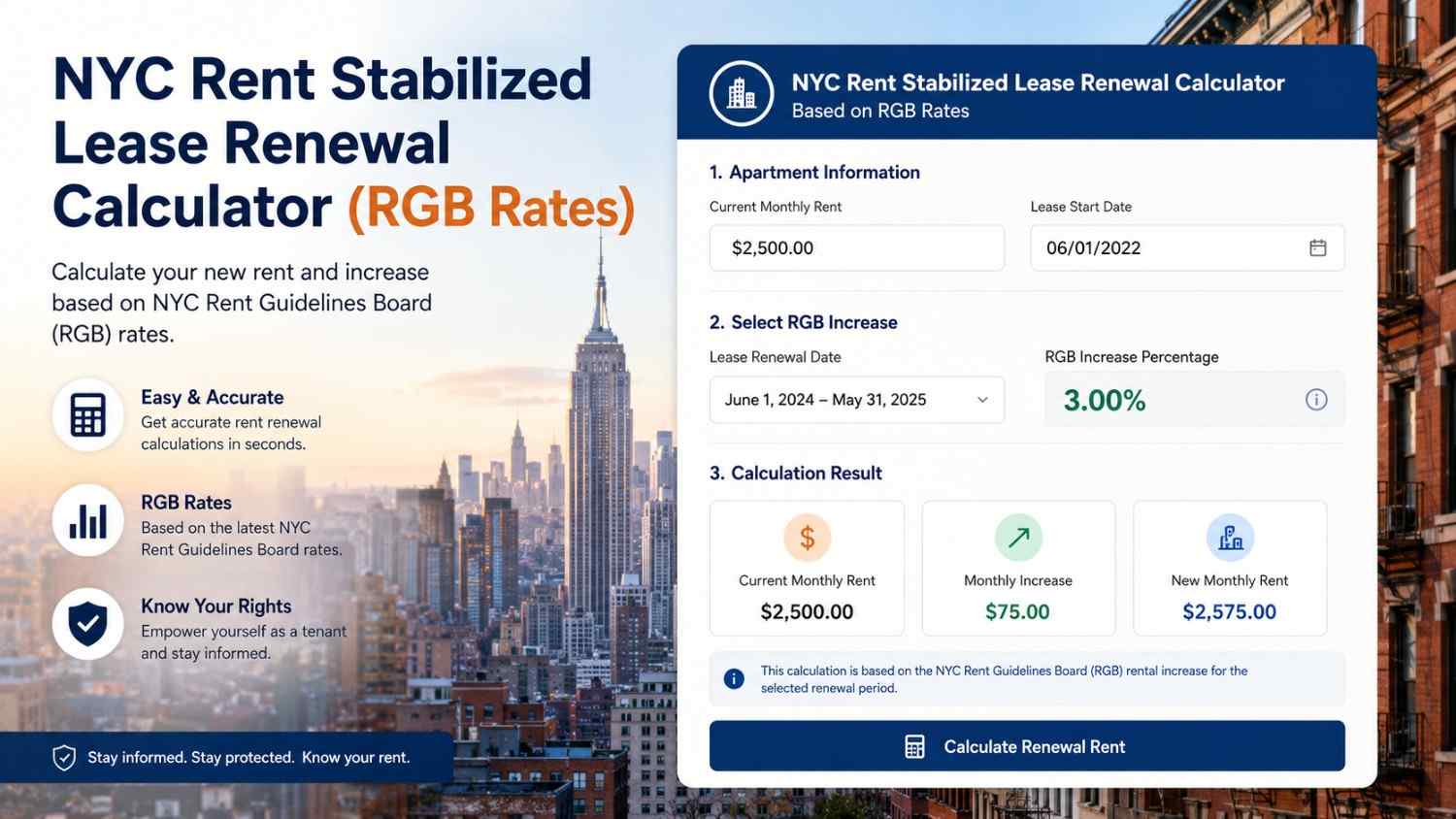
NYC Rent Stabilized Lease Renewal Calculator
Calculate exactly what your rent can legally increase to — based on current RGB rates, IAI improvements, MCI charges, and preferential rent rules under the 2019 Housing Stability Act.
Your Estimated Lease Renewal Rent
—What This Means For You
—
What Exactly Is the NYC Rent Stabilized Lease Renewal Calculator?
This calculator gives New York City rent-stabilized tenants a precise, line-by-line breakdown of what their rent can legally be increased to when their lease renews. It accounts for the three components that make up a rent-stabilized lease renewal increase: the annual RGB (Rent Guidelines Board) percentage increase, any IAI (Individual Apartment Improvement) rent surcharges that the landlord is legally permitted to add, and any MCI (Major Capital Improvement) charges that have been approved by the DHCR (Division of Housing and Community Renewal). It also handles the critical preferential rent calculation that was changed by the 2019 Housing Stability and Tenant Protection Act (HSTPA) — a change that confused tens of thousands of New York tenants and landlords alike.
The reason this calculator exists is that the math behind a rent-stabilized renewal is not straightforward addition. The RGB percentage is applied to one number (your preferential rent, if applicable, or your legal rent), the IAI is calculated as 1/40th of the total improvement cost and then checked against a per-room cap, and the MCI is a separate approved monthly charge that may or may not already be included in your current rent. These three components interact in specific ways, and getting any one of them wrong can mean overpaying by $50-$200 per month — or challenging an illegal increase that your landlord has no right to collect. In a city where the median rent-stabilized apartment costs approximately $2,800 per month, even small calculation errors add up to thousands of dollars over the life of a lease.
What makes this calculator specifically necessary for New York City is that rent stabilization is a uniquely New York institution. Approximately 1 million apartments in NYC — roughly 44% of all rental units — are rent-stabilized, and the rules governing their renewal are set annually by the nine-member Rent Guidelines Board, which issues new percentage increases every spring for the following October-through-September lease year. No other city in America has a system quite like this, and no other city has the layered complexity of RGB rates plus IAI caps plus MCI amortization plus preferential rent rules all interacting simultaneously. Generic rent calculators can’t handle any of this — they assume a simple percentage increase, which is almost never the full picture for a New York rent-stabilized tenant.
Why Getting Your Renewal Calculation Right Matters in NYC
Rent-stabilized tenants in New York City have specific legal protections that only work if you know what your rent should be. If your landlord overcharges you — even by a small amount each month — and you don’t catch it, you can file an overcharge complaint with the DHCR, but the process takes months or years, and there’s a four-year statute of limitations on rent overcharge claims (which was reduced from six years by the 2019 law). This means that if you don’t catch an overcharge within four years, the money is gone permanently. The calculator helps you catch errors before they become permanent financial losses.
Catch Illegal Overcharges
If your landlord’s renewal offer doesn’t match this calculator’s output, something may be wrong. Overcharges of $50-$200/month are common and add up to $2,400-$9,600 over a 4-year period.
1-Year vs. 2-Year Decision
The RGB sets different rates for 1-year and 2-year renewals. This calculator lets you see both options side by side so you can choose the one that saves you the most money.
Understand IAI Charges
Many tenants don’t realize that IAI increases are capped per room. If your landlord claims a $50,000 IAI on a 3-room apartment, the cap may limit the legal increase to far less than the full 1/40th amount.
Preferential Rent Protection
Since the 2019 law, your renewal is based on what you actually pay, not the higher legal rent. This calculator applies the correct base so you know exactly what you owe.
The preferential rent issue is particularly critical because it affects a very large number of tenants. During the early 2000s and 2010s, when NYC rents were rising rapidly but the legal registered rents on older rent-stabilized apartments were relatively low, many landlords offered “preferential rents” — charging less than the full legal registered rent — to attract and retain tenants in a competitive market. An estimated 30-40% of rent-stabilized tenants in NYC pay preferential rent. Before the 2019 Housing Stability Act, landlords could “reset” to the full legal rent upon lease renewal, which meant a tenant paying $2,500 on a $3,500 legal rent could suddenly face a renewal based on the $3,500 figure — a devastating jump. The 2019 law eliminated this practice, and this calculator correctly applies the preferential rent as the base for renewal calculations.
For tenants who are not in preferential rent situations, the calculation is simpler — the RGB percentage is applied directly to the legal registered rent. But even in these cases, IAI and MCI charges can create confusion. Many tenants don’t understand that IAI charges are permanent additions to the legal rent (they don’t go away when the improvement is paid off through the 1/40th amortization — the rent increase is permanent), while MCI charges are temporary (they come off the rent after the amortization period ends, typically 6-8 years). This distinction matters for long-term financial planning, and the calculator’s output helps you understand which parts of your rent increase are permanent and which are temporary.
How to Use This Calculator (Takes 30 Seconds)
Enter Your Current Rent
Put in what you actually pay monthly and the legal registered rent from your lease or a DHCR rent history. If they’re the same, enter the same number in both fields.
Set Lease Details
Select preferential rent status, renewal term (1 or 2 years), the correct RGB rate period, and your room count. The RGB period must match when your new lease starts.
Add IAI and MCI
Enter the total IAI improvement cost if your landlord did apartment work, and any approved MCI monthly charge. If MCI is already in your rent, mark that option.
Calculate and Compare
Hit calculate to see your legal renewal rent, line-by-line breakdown, warnings about IAI caps, and a comparison of 1-year vs. 2-year costs.
NYC Rent Guidelines Board Rates: Complete History (2015–2026)
The Rent Guidelines Board sets the allowable percentage increases for rent-stabilized lease renewals each year. These rates take effect on October 1st and apply to all lease renewals signed during the following 12-month period. The table below shows the complete recent history, which is essential for verifying past renewals or understanding trends.
| Lease Period | 1-Year Renewal | 2-Year Renewal | Context |
|---|---|---|---|
| Oct 2025 – Sep 2026 | 2.75% | 5.25% | Post-COVID stabilization, inflation moderating |
| Oct 2024 – Sep 2025 | 2.00% | 4.00% | Lower than expected; tenant advocacy impact |
| Oct 2023 – Sep 2024 | 3.00% | 6.00% | High inflation year; contested vote |
| Oct 2022 – Sep 2023 | 3.25% | 6.50% | Highest increase in years; inflation spike |
| Oct 2021 – Sep 2022 | 1.50% | 2.50% | Pandemic recovery, lower increases |
| Oct 2020 – Sep 2021 | 0% | 0% | COVID-19 emergency freeze |
| Oct 2019 – Sep 2020 | 1.50% | 2.50% | First year after HSTPA passed |
| Oct 2018 – Sep 2019 | 1.50% | 2.50% | Pre-HSTPA, preferential rent reset still allowed |
| Oct 2017 – Sep 2018 | 2.00% | 4.00% | Steady increase year |
| Oct 2016 – Sep 2017 | 1.00% | 2.00% | Lowest in decades at the time |
| Oct 2015 – Sep 2016 | 1.00% | 2.00% | Continued low-increase environment |
An important pattern to notice: the 2020-2021 COVID freeze at 0% means that tenants who renewed during that period got no increase at all — but their legal registered rent didn’t decrease, it just stayed the same. When the 2021-2022 increases returned (1.5% / 2.5%), they were applied on top of the frozen rent, not on some adjusted baseline. This created a two-year period where rent-stabilized tenants effectively fell behind market rents by a significant margin, which contributed to the aggressive increases in 2022-2024 as the RGB “caught up” to inflation that had accumulated during the freeze period.
Individual Apartment Improvements (IAI): How They Work and What’s Legal
IAI rent increases are the most frequently abused component of rent-stabilized renewals, and the area where tenants are most likely to be overcharged. Understanding the rules is essential for protecting yourself.
- What counts as an IAI: An Individual Apartment Improvement is a permanent physical improvement to your specific apartment that goes beyond ordinary maintenance and repair. Replacing a broken refrigerator with a similar refrigerator is maintenance — not an IAI. Upgrading from a standard refrigerator to a high-end model, or installing a dishwasher where there wasn’t one before, can qualify as an IAI. Other common IAIs include new kitchen cabinets, new countertops, bathroom renovations, new flooring, replacement windows, and new appliances that represent an upgrade. The key distinction is that maintenance keeps the apartment in the same condition, while an IAI improves it beyond its previous state.
- The 1/40th amortization rule: When a landlord performs an IAI, the rent increase is calculated as 1/40th of the total cost of the improvement. This means the landlord “recovers” the cost over 40 years through the rent increase. For a $12,000 kitchen renovation, the monthly rent increase would be $12,000 ÷ 40 = $300 per month. This $300 is permanent — it becomes part of your legal registered rent and never comes off, even after 40 years have passed. The 40-year amortization period is set by the RGB and applies to all IAIs regardless of the type of improvement.
- The per-room cap: The RGB sets an annual cap on the total IAI rent increase per room. For the Oct 2024 – Sep 2025 period, the cap is $16,657 per room. This means the TOTAL COST of all IAIs combined (not the monthly increase) cannot exceed $16,657 multiplied by the number of rooms in the apartment. For a 3-room apartment, the maximum total IAI cost is $49,971, which translates to a maximum monthly increase of $1,249.28 ($49,971 ÷ 40). If a landlord claims $60,000 in IAIs on a 3-room apartment, the legal increase is capped at the $49,971 figure — the extra $10,039 cannot be charged to the tenant.
- Prior approval requirements: For work performed in occupied apartments (which is the vast majority of IAI situations), the landlord must obtain prior approval from DHCR before adding the IAI rent increase to your rent. This means the landlord files an application (form RA-79) with DHCR documenting the improvement, the cost, and the proposed rent increase, and DHCR must approve it before the landlord can legally collect the increase. Many landlords skip this step or file retroactively — both of which may make the increase unenforceable. For work done in vacant apartments, prior approval is not required, but the landlord must still file documentation with DHCR after the fact.
- What’s NOT a valid IAI: Ordinary repairs and maintenance are not IAIs. This includes painting, plastering, fixing a leaky faucet, replacing a broken window with a similar window, fixing a malfunctioning appliance with a comparable replacement, and any work required to bring the apartment up to building code or housing maintenance code standards. If your landlord tries to add an IAI charge for work that was actually maintenance, you can challenge it through DHCR. Additionally, work that the landlord was legally required to do (such as correcting Housing Maintenance Code violations) cannot be used as the basis for an IAI increase.
- Landlord’s labor rate: If the landlord performs IAI work themselves (rather than hiring a contractor), they can only charge the hourly rate set by the RGB for their own labor. For the 2024-2025 period, this rate is approximately $36.35 per hour. They cannot charge a market-rate contractor price for their own time. Materials are charged at actual cost. If a landlord claims $200/hour for their own labor on an IAI project, the DHCR will reduce it to the RGB rate, which can significantly lower the total IAI cost and therefore the rent increase.
Preferential Rent After the 2019 Housing Stability Act
Preferential rent is one of the most important and misunderstood concepts in New York rent stabilization law. The 2019 Housing Stability and Tenant Protection Act (HSTPA) fundamentally changed how preferential rent works during lease renewals, and the change was retroactive — meaning it affected existing leases, not just new ones.
- What preferential rent is: Preferential rent exists when the legal registered rent on a rent-stabilized apartment is higher than what the tenant actually pays. For example, the legal rent might be $3,500, but the landlord agreed to charge $2,800 to attract a tenant. The $2,800 is the preferential rent. This situation arose frequently during periods when market rents were volatile — landlords would register a high legal rent to preserve future flexibility but offer a lower “preferential” amount to get the apartment rented.
- The old rule (before June 14, 2019): Under the old law, when a preferential rent lease came up for renewal, the landlord could “reset” the rent to the full legal registered rent and then apply the RGB percentage on top of that. In our example, if the legal rent was $3,500 and the tenant paid $2,800, the landlord could base the renewal on $3,500 + RGB% — a devastating jump that could add hundreds of dollars per month in one renewal cycle. This was known as the “preferential rent cliff,” and it was one of the most feared aspects of rent stabilization for tenants.
- The new rule (after June 14, 2019): The HSTPA eliminated the preferential rent cliff. Now, when a lease with preferential rent is renewed, the RGB percentage increase is calculated on the PREFERENTIAL rent — the amount the tenant actually pays — not the legal registered rent. In our example, the 2% increase would be calculated on $2,800 ($56), not on $3,500 ($70). The legal registered rent still exists and still gets updated (it increases by the RGB percentage applied to the legal rent plus any IAI and MCI charges), but the tenant’s rent is based on the preferential rent. This is a permanent protection — it applies to every renewal, not just the first one after the law changed.
- What happens when you move out: When a preferential rent tenant vacates the apartment, the landlord CAN charge the next tenant the full legal registered rent (which may have grown significantly through RGB increases, IAI additions, and MCI charges applied to the legal rent over the years). The preferential rent protection does not transfer to the next tenant. This is why landlords often prefer to have turnover in preferential rent apartments — it allows them to “reset” to the higher legal rent with a new tenant.
- How to verify your status: Check your lease for the term “preferential rent” or “legal rent.” Your lease should show both the legal registered rent and the preferential rent (the amount you actually pay). You can also request your apartment’s rent history from DHCR (form RR-2 or through the DHCR online portal), which will show the legal registered rent for every year and whether preferential rent was in effect. If the rent history shows a legal rent that’s higher than what you’ve been paying, you’re in a preferential rent situation and this calculator’s preferential rent mode applies to you.
- A subtle but important detail: The 2019 law’s preferential rent protection applies to lease renewals on or after June 14, 2019. If your lease renewal date fell before that date, even by a few days, the old rule may have applied to that specific renewal. However, all subsequent renewals are governed by the new rule. If you believe your landlord applied the old rule to a renewal after June 14, 2019, you may have an overcharge claim.
Major Capital Improvements (MCI): What Tenants Need to Know
MCI charges are rent increases for building-wide improvements — things like a new boiler, a new roof, elevator modernization, or rewiring the building’s electrical system. Unlike IAIs, which are apartment-specific, MCIs benefit the entire building and are spread across all rent-stabilized apartments.
- MCI approval process: The landlord must file an application with DHCR (form MCI-1) documenting the improvement, the total cost, the useful life of the improvement, and the proposed monthly rent increase for each apartment. DHCR reviews the application, may inspect the work, and issues an order either approving, modifying, or denying the MCI. The process typically takes 6-18 months. The landlord CANNOT add the MCI charge to your rent until DHCR issues an order approving it — if they do, it’s an overcharge.
- How the monthly charge is calculated: The MCI rent increase is calculated as 6% of the total cost of the improvement, divided by 12 months, divided by the total number of apartments in the building, multiplied by the ratio of your apartment’s rooms to the total rooms in the building. In practice, the DHCR order specifies the exact monthly amount for each apartment, so you don’t need to calculate it yourself — you just need to know the approved amount.
- MCI charges are temporary: Unlike IAI increases, which are permanent, MCI charges come off the rent after the amortization period ends. The amortization period is the “useful life” of the improvement as determined by DHCR — typically 6-8 years for most building systems. Once the period ends, the MCI charge must be removed from your rent. Many tenants don’t realize this and continue paying MCI charges that should have expired. Check your DHCR MCI order for the end date.
- Phase-in for large MCIs: For MCI orders issued after October 1, 2022, the MCI charge is phased in over multiple years rather than applied all at once. Typically, 1/6th of the monthly charge is added each year over a 6-year period. This was a change from the previous system where the full MCI charge was added immediately upon DHCR approval.
- Multiple MCIs stack: A building can have multiple approved MCI charges at the same time. If the building got a new boiler (MCI #1) and then a new roof (MCI #2), both monthly charges are added to your rent. This can result in a significant cumulative MCI burden — $50-$150/month is common in older buildings that have had several capital improvement projects.
What This Calculator Can’t Do — And How To Fill Those Gaps
- It doesn’t replace legal advice: This calculator provides estimates based on the publicly available RGB rates, IAI caps, and DHCR rules. It is not legal advice. If your landlord’s renewal offer differs significantly from this calculator’s output, or if there are unusual circumstances (succession rights, landlord-tenant litigation, building conversion issues), consult a tenant attorney or a housing counselor at organizations like the Housing Court Answers, Legal Aid Society, or NYC Housing Justice.
- It uses the IAI cap for the selected year: If your landlord performed IAI work in 2022 but is only now filing for the rent increase, the 2022 IAI cap applies, not the current year’s cap. The calculator uses the cap for the RGB period you select, which may not match the year the work was actually performed. Check the year the work was done and use the corresponding cap — the IAI cap history is provided in the article above.
- Succession and sublet situations aren’t handled: If you’re a successor tenant (you took over the lease after the previous tenant died or moved out and you were a qualifying family member), or if you’re subletting, the renewal calculation may have additional factors. Succession tenants have the same renewal rights as the original tenant, but the preferential rent situation may differ depending on when succession occurred.
- J-51 and other tax abatements aren’t calculated: Some rent-stabilized buildings are in the J-51 tax abatement program, which can affect the legal rent calculations in complex ways. If your building is J-51, the base legal rent may be different from what’s shown on the standard DHCR rent history. This is an advanced topic that requires professional analysis.
- Fuel surcharge adjustments aren’t included: In some years, the RGB authorized a fuel cost adjustment surcharge for buildings with fewer than 35 units where the landlord’s fuel costs exceeded a threshold. This has been largely phased out in recent years but could theoretically return. The calculator doesn’t model this.
- Rent registration errors aren’t detected: Many rent-stabilized apartments have errors in the DHCR rent registration — overcharges that accumulated over years, illegal rent increases that were never corrected, or simple clerical errors. This calculator assumes the legal registered rent you enter is correct. Always verify your legal rent by ordering a rent history from DHCR.
Your Rights as a Rent-Stabilized Tenant in NYC
Knowing your rights is just as important as knowing the math. Here are the key protections that every rent-stabilized tenant should understand in the context of lease renewals.
- The right to a renewal lease: Your landlord MUST offer you a renewal lease. They cannot refuse to renew, and they cannot offer a lease with terms that materially differ from the standard renewal lease form (DHCR form RTP-8). The renewal offer must be delivered to you between 90 and 150 days before your current lease expires. If the landlord fails to offer a renewal, you can file a complaint with DHCR, and your lease terms are extended on a month-to-month basis at the same rent until the issue is resolved.
- The right to choose 1-year or 2-year: You choose whether to renew for 1 year or 2 years — the landlord cannot force you to choose one or the other. The RGB sets separate rates for each term, and you pick whichever is more advantageous for your situation. In most years, the 2-year rate is slightly less than double the 1-year rate (meaning the 2-year lease is a slightly better deal per year), but this isn’t always the case — check both with this calculator.
- The right to challenge illegal increases: If the renewal rent is higher than what this calculator shows (and you’ve verified your inputs are correct), you can refuse to pay the illegal portion and file a rent overcharge complaint with DHCR (form RA-90). You must continue paying the legal portion of the rent while the complaint is pending. DHCR will investigate and issue an order. If the landlord overcharged you, they’ll be ordered to refund the overcharge with interest.
- The right to your rent history: You can request your apartment’s complete rent registration history from DHCR at any time. This shows the legal registered rent for every year, any IAI or MCI orders, and whether preferential rent was in effect. Request it through the DHCR online portal or by submitting form RR-2. This is free and is one of the most important tools for verifying that your rent has been calculated correctly over time.
- The right to be free of harassment: If your landlord is harassing you to get you to leave (so they can reset a preferential rent to the higher legal rent with a new tenant), that’s illegal. NY State law (since the 2019 HSTPA) makes tenant harassment a criminal offense. Document everything, file complaints with DHCR and HPD, and contact a tenant rights organization if this is happening to you.
What Happens With Your Rent Information
Nothing — your rent amount, legal rent, room count, improvement costs, and all other inputs are processed entirely in your browser. No data is sent to any server. No rent, lease, or housing information is stored, logged, or transmitted. No cookies, no tracking. Your rent is sensitive financial information, and a calculator has no business sending it anywhere. Close the tab and it’s completely gone.
Frequently Asked Questions
Yes, but only through approved IAI and MCI charges on top of the RGB percentage. The total increase is: RGB% + IAI monthly amount + MCI monthly amount. Your landlord cannot simply decide to raise your rent by more than the RGB percentage without an approved IAI or MCI. Any increase beyond these three components is illegal and can be challenged through a DHCR overcharge complaint. If you receive a renewal offer with an increase that doesn’t match this calculator’s output, ask your landlord for a written breakdown explaining each component of the increase. They are legally required to provide this.
If the work was done in your occupied apartment and the landlord did not obtain prior DHCR approval (form RA-79), the IAI rent increase is generally not enforceable. The landlord must file for DHCR approval before collecting the increase. If they’ve already added it to your rent without approval, you may be entitled to a refund of the IAI portion through a rent overcharge complaint. Don’t assume the landlord followed the rules — verify by checking whether there’s a DHCR order for the IAI. You can search for orders on the DHCR website or request your rent history. Many tenants have successfully challenged IAIs that were never properly filed.
It depends on the RGB rates and your situation. Compare both options using this calculator. In most years, the 2-year rate per year is slightly lower than the 1-year rate (for example, 4% over 2 years = 2%/year, vs. 2% for a 1-year lease). But the 2-year rate isn’t always exactly double the 1-year rate — in some years, the 2-year rate is proportionally higher, making the 1-year lease the better deal. Also consider your personal situation: if you might need to move within a year, a 2-year lease creates a subletting obligation. If you think RGB rates might increase next year, locking in a 2-year rate now could save you money. Use this calculator to run both scenarios and compare the total cost over 2 years.
It depends on when your renewal takes effect. If your lease renewal is on or after June 14, 2019, the preferential rent protection absolutely applies to you — there are no exceptions based on when the original preferential rent was established. The 2019 law is retroactive for all future renewals. Some landlords have tried to argue that pre-2019 preferential rent agreements are exempt, but DHCR and the courts have consistently ruled that the new law applies to all preferential rent renewals regardless of when the preferential rent was first set. If your landlord is making this claim, contact a tenant rights organization immediately — this is a common illegal practice.
There are three ways: (1) Check your current lease — it should state both the legal registered rent and the preferential rent (if applicable). (2) Request your apartment’s rent registration history from DHCR through their online portal or by submitting form RR-2. This is free and typically arrives within 2-4 weeks. It shows the legal registered rent for every year since the apartment was registered. (3) Check the “Rent Stabilized Building List” and registration database on the DHCR website, which shows the most recent registered rent for each apartment. Option 2 is the most comprehensive and reliable. If there are discrepancies between your lease and the DHCR rent history, the DHCR record generally controls, but complex situations may require legal guidance.
Technically yes, if they actually perform qualifying improvement work. But there are important limits. First, the per-room IAI cap limits the total rent increase from IAIs in any given year. Second, DHCR scrutinizes repeated IAI applications — if a landlord claims $15,000 in IAIs every single year, DHCR may question whether the work is genuinely new and qualifying or whether it’s a pattern of fabricating improvements to inflate rent. Third, the 1/40th amortization means each IAI permanently increases your legal rent by a fixed amount, so repeated IAIs compound over time. If your landlord is adding IAI charges every renewal, use this calculator to track the cumulative impact and verify that each one was properly approved by DHCR.
If you don’t respond to the renewal offer, your lease converts to a month-to-month tenancy at the same rent and terms as your expiring lease. The landlord can then file a “non-renewal” proceeding in housing court to evict you — but they must give you proper notice and follow the court process. You cannot be evicted without a court order. However, allowing your lease to go month-to-month is risky because you lose the security of a fixed-term lease, and the landlord could theoretically offer you a new lease at any time with different terms. The safest approach is to either sign the renewal or, if you believe the proposed rent is illegal, continue paying the legal portion of the rent and file a DHCR complaint to resolve the dispute.
No. The RGB rates, IAI caps, and MCI rules are the same for all five boroughs — Manhattan, Brooklyn, Queens, the Bronx, and Staten Island. There is no borough-specific variation in rent-stabilized renewal calculations. However, the prevalence of rent-stabilized apartments varies enormously by borough: approximately 66% of all rental units in the Bronx are rent-stabilized, compared to about 43% in Brooklyn, 36% in Manhattan, 28% in Queens, and only about 8% in Staten Island. The rates and rules are the same everywhere, but rent-stabilized tenants are concentrated in the Bronx, Brooklyn, and upper Manhattan.
Yes. The RGB sets the MAXIMUM allowable increase — landlords can offer a lower increase if they choose to. This is particularly common in buildings where the landlord wants to retain a reliable, long-term tenant rather than risk vacancy (especially in a soft rental market). There’s no harm in politely asking your landlord if they’d consider a lower increase, particularly if you’ve been a good tenant, pay on time, and maintain the apartment well. The worst they can say is no. If you’re in a preferential rent situation and the landlord wants to keep you (to avoid the risk of vacancy and having to find a new tenant at the legal rent), you may have more leverage than you think.