
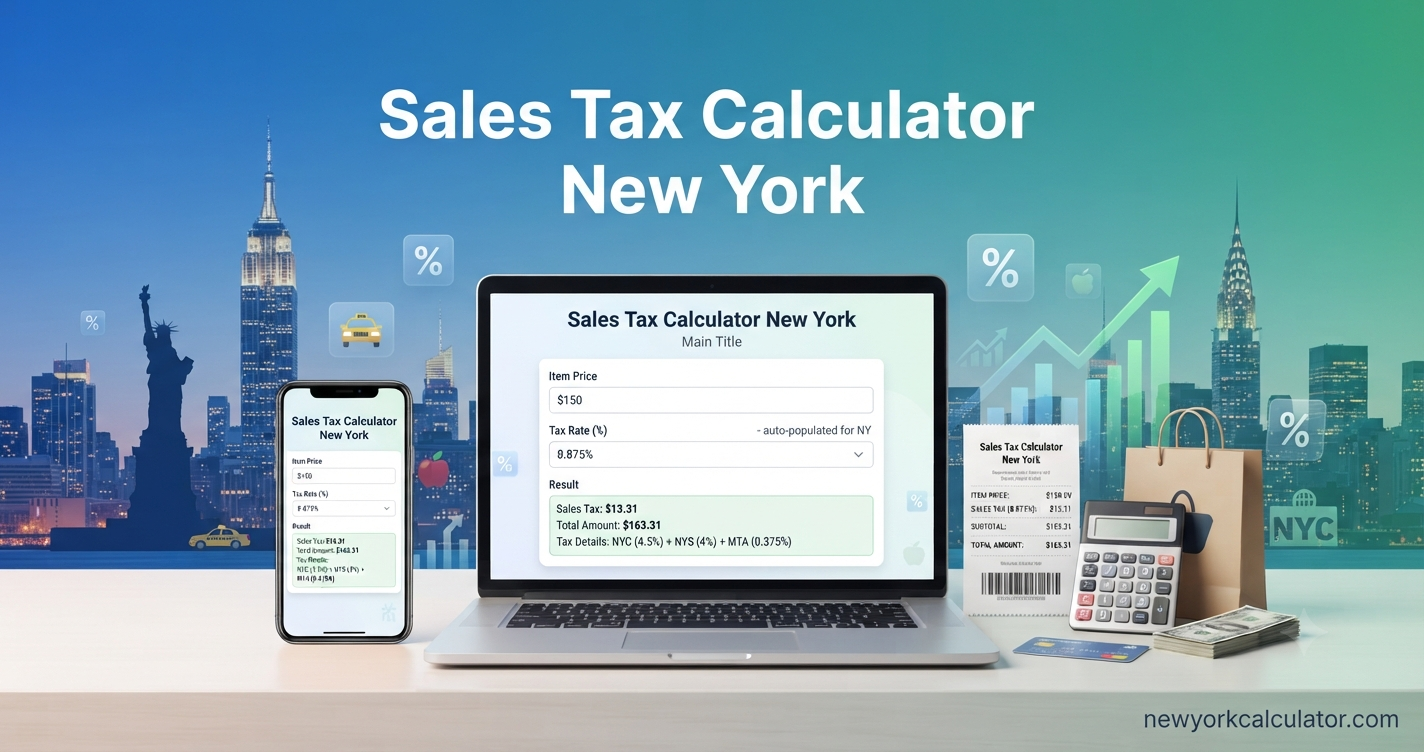
If you are buying something in New York and want to know exactly how much sales tax you may pay, the answer is not always as simple as adding 4% to the purchase price.
New York has a 4% statewide sales tax, but counties, cities and other local jurisdictions can add their own taxes. In certain areas, the Metropolitan Commuter Transportation District (MCTD) adds another 0.375% to taxable sales. That is why the final combined rate depends on where the transaction takes place.
New York Sales Tax Calculator
Calculate estimated New York sales tax, tax amount, and final purchase price.
Use the New York Sales Tax Calculator below to estimate the tax on a purchase, see the total amount after tax, and understand how the calculation works.
Important: A sales tax calculator is an estimate unless the correct current rate and taxability of the specific transaction are known. For an exact jurisdiction rate, New York State provides an official address-based lookup service.
New York Sales Tax Calculator
Enter your purchase amount, choose a New York location or enter the applicable tax rate, and the calculator will estimate your sales tax and final price.
[CALCULATOR TOOL GOES HERE]
How the calculator works
The basic calculation is:
Sales Tax = Taxable Amount × Sales Tax Rate
For example, if a taxable purchase is $500 and the applicable combined sales tax rate is 8.875%:
$500 × 8.875% = $44.38 sales tax
The estimated final price would therefore be:
$500 + $44.38 = $544.38
New York’s tax guidance says sales tax is calculated by applying the combined state and local rate to the taxable sale and rounding the tax due to the nearest cent.
What Is the New York Sales Tax Rate in 2026?
New York’s statewide sales tax rate is 4%.
However, 4% is not necessarily the rate you see on a retail receipt.
Local governments can impose additional sales taxes, so the combined rate differs by jurisdiction. The New York State Department of Taxation and Finance explains that the combined rate consists of the 4% state rate plus applicable local taxes, with an additional 0.375% MCTD rate in qualifying areas.
For 2026, commonly referenced combined rates include:
| Location | Combined Sales Tax |
|---|---|
| New York City | 8.875% |
| Albany | 8.00% |
| Buffalo | 8.75% |
| Rochester | 8.00% |
| Syracuse | 8.00% |
| Schenectady | 8.00% |
| White Plains | 8.375% |
| New Rochelle | 8.375% |
| Mount Vernon | 8.375% |
| Yonkers | 8.875% |
| Saratoga Springs | 7.00% |
| Utica | 8.75% |
Rates can differ by jurisdiction and special rules can apply to particular products or services. New York State’s Publication 718 is one of the official resources used to identify rates by jurisdiction.
Do not assume that every ZIP code, city or county has one universal rate. New York itself warns that ZIP codes do not necessarily correspond to political tax boundaries.
Why Is New York Sales Tax Different From One Place to Another?
New York is not simply a “4% sales tax state” from a customer’s point of view.
Think of your sales tax as several possible components:
New York State tax + local tax + applicable special tax
The local portion can depend on the jurisdiction where the taxable sale occurs.
For example, a $1,000 taxable purchase at 8.875% would generate:
- Purchase price: $1,000
- Sales tax: $88.75
- Total: $1,088.75
But the same $1,000 taxable purchase in a jurisdiction with a 7% combined rate would produce:
- Purchase price: $1,000
- Sales tax: $70
- Total: $1,070
That difference is why using the correct location matters.
New York Uses a Destination-Based Sales Tax System
One of the most useful details for online shoppers and businesses is that New York generally uses a destination-based approach.
In simple terms, the location where the customer receives the taxable item can determine the applicable local rate.
For an online order, this means the tax is not necessarily based on the seller’s physical store.
For example, if an online retailer ships a taxable item to a customer’s home in Erie County, the applicable combined rate is generally determined by the delivery jurisdiction. New York’s own guidance gives a similar online-purchase example.
This is particularly important for:
- Amazon purchases
- Online stores
- Mail-order purchases
- E-commerce businesses
- Businesses shipping products to customers
- Out-of-state sellers
Is New York Sales Tax Based on ZIP Code?
Not always.
A ZIP code can help identify a general area, but it should not automatically be treated as the exact taxing jurisdiction.
New York State specifically says reporting codes rather than ZIP codes should be used for identifying customer location for tax reporting because postal boundaries do not always match political boundaries.
The New York State Department of Taxation and Finance provides an address-based jurisdiction/rate lookup for finding the applicable combined rate.
That is also why our calculator lets you enter a known tax rate instead of pretending that every ZIP code has one universal rate.
What Is the MCTD Sales Tax?
MCTD stands for Metropolitan Commuter Transportation District.
A 0.375% additional sales tax applies to taxable sales within the MCTD.
The district includes:
- New York City
- Dutchess County
- Nassau County
- Orange County
- Putnam County
- Rockland County
- Suffolk County
- Westchester County
New York State’s guidance confirms the additional 0.375% rate and identifies these jurisdictions.
For New York City, the commonly quoted 8.875% combined rate consists of:
- 4% New York State
- 4.5% New York City
- 0.375% MCTD
NYC’s official information confirms the 8.875% combined rate.
New York City Sales Tax Rate
For many ordinary taxable purchases in New York City, the combined sales and use tax rate is 8.875%.
That includes:
4% state + 4.5% NYC + 0.375% MCTD
So, for a $100 taxable purchase:
$100 × 8.875% = $8.88 tax
Estimated total:
$108.88
For a $500 taxable purchase:
$500 × 8.875% = $44.38
Estimated total:
$544.38
NYC also has special rules for particular services and transactions, so the 8.875% rate should not automatically be applied to every possible transaction.
Is Everything Taxable in New York?
No.
This is one of the biggest reasons a simple percentage calculator cannot answer every New York sales-tax question.
New York taxes many forms of tangible personal property and certain services, but numerous exemptions exist.
The state lists taxable categories including:
- Tangible personal property unless specifically exempt
- Certain utilities
- Certain services
- Restaurant, tavern and caterer food and beverages
- Hotel and short-term rental occupancy
- Certain admission charges and dues
At the same time, New York exempts many transactions, including most food for home consumption and prescription and nonprescription medicines.
Are Groceries Taxed in New York?
Most food purchased for home consumption is exempt from New York sales tax.
That does not mean every food-related purchase is automatically tax-free.
Prepared food and beverages sold by restaurants, taverns and caterers are generally treated differently and can be taxable.
So there is an important difference between:
Buying groceries to prepare at home
and
Buying a prepared meal from a restaurant.
If you are unsure whether a particular food item is taxable, check the New York State taxability guidance rather than relying only on a calculator.
Are Clothing and Shoes Taxable in New York?
New York has special rules for clothing and footwear.
Eligible clothing and footwear costing less than $110 per item or pair can qualify for an exemption from New York State sales tax, but local treatment can vary by jurisdiction.
New York maintains a dedicated Publication 718-C covering clothing and footwear rates and exemptions by jurisdiction.
New York City has a particularly straightforward rule for eligible clothing and footwear under $110: those purchases are exempt from NYC and New York State sales tax. Items costing $110 or more are generally subject to the full combined rate in NYC.
Because local rules matter, do not assume that the clothing rule is identical everywhere in New York State.
Are Medicines Taxable in New York?
New York exempts prescription and nonprescription medicines from sales tax under its general sales-tax guidance.
However, the exact tax treatment of a particular medical product can depend on what the product is and how it is classified.
For unusual or high-value purchases, check the official New York tax guidance.
Are Restaurant Meals Taxable?
Generally, yes.
New York specifically identifies food and beverages sold by restaurants, taverns and caterers as taxable transactions.
This is why you should not use the grocery-food exemption to assume that a restaurant meal is tax-free.
For example, if a taxable restaurant bill is $100 and the applicable rate is 8.875%, the sales tax portion would be approximately $8.88 before considering any separate tip.
Sales tax and tip are different charges.
Is Online Shopping Taxable in New York?
An online purchase can be subject to New York sales or use tax.
The important question is not simply whether the seller has a New York storefront.
For taxable products shipped to New York, the delivery destination can determine the applicable local rate.
This is why an online checkout may show a different tax amount depending on the shipping address.
If a taxable purchase is made from outside New York and the required sales tax was not collected, New York’s use tax rules may apply to property used in the state.
What Is New York Use Tax?
Use tax is designed to cover taxable purchases on which New York sales tax was not properly collected.
A common example is buying a taxable item outside New York or from an online seller and bringing or shipping that item into New York for use.
The tax system is intended to prevent the result where the same taxable item becomes tax-free simply because it was purchased from an out-of-state seller.
Businesses and consumers should review the official New York use-tax guidance for their particular situation.
Is Shipping Taxable in New York?
Shipping and delivery charges can affect the taxable amount of a transaction.
The treatment depends on the underlying sale and applicable New York sales-tax rules.
This is an area where a basic calculator should not simply assume that every shipping charge is either always taxable or always exempt.
For business transactions, use the New York Department of Taxation and Finance guidance applicable to the type of sale.
New York Car Sales Tax Is Different
Vehicle purchases deserve special attention.
New York’s sales-tax guidance states that sales tax on motor vehicles, including cars, trucks, certain boats, boat trailers, RVs and motorcycles, is calculated using the rate applicable to the jurisdiction where the vehicle owner is a resident, normally the address where the vehicle will be registered.
That means you should not automatically use the seller’s location when estimating vehicle sales tax.
This is one reason a general New York sales-tax calculator should be treated as an estimate for vehicle transactions unless the specific vehicle-tax rules are applied.
Passenger Car Rental Tax
Passenger car rentals have their own additional tax rules.
New York’s current taxability guidance lists an additional 12% tax on passenger car rentals inside and outside the MCTD.
This is another example of why the standard retail sales-tax percentage should not be applied blindly to every transaction.
Other Special New York Taxes and Fees
Some purchases can involve taxes or fees beyond the ordinary combined sales-tax rate.
New York’s current guidance lists examples including:
- Paper carryout bag reduction fees in participating localities
- Passenger car rental taxes
- Peer-to-peer car-sharing taxes
- Vapor-product supplemental sales tax
- Waste tire management and recycling fees
- Certain utility-related local taxes
These are transaction-specific and should not simply be added to every sales-tax calculation.
New York Sales Tax for Online Businesses
If you operate an online store and sell to New York customers, the rules become more important.
A business with no physical presence in New York can still have a New York sales-tax registration obligation.
New York’s current guidance says that, for the applicable remote-seller test, a business can be required to register when, during the immediately preceding four sales-tax quarters, it has:
- More than $500,000 in gross receipts from sales of tangible personal property delivered into New York, and
- More than 100 sales of tangible personal property delivered into New York.
Both conditions are part of the stated threshold test.
This can apply to online sellers, mail-order businesses and other businesses making taxable sales delivered into New York.
Marketplace sales can also be relevant to the threshold analysis under New York’s rules.
If you operate a business, do not rely solely on a public calculator to determine your registration or filing obligations.
What Records Should a New York Sales-Tax Business Keep?
Businesses collecting sales tax have recordkeeping responsibilities.
New York says sales-tax vendors should maintain records such as:
- Sales-tax collected
- Sales amounts
- Receipts or invoices
- Returns and credits
- Jurisdiction where sales or deliveries occurred
- Exemption certificates
- Daily records of cash, debit and credit sales
The state’s business guidance explains these requirements in more detail.
For a business, the rate is only one part of sales-tax compliance.
How to Calculate New York Sales Tax Manually
Suppose your taxable purchase is:
$750
And the applicable combined rate is:
8.875%
Calculation:
$750 × 0.08875 = $66.56
So:
Sales tax = $66.56
Total = $816.56
The exact amount is rounded to the nearest cent.
For another example, suppose you buy a taxable $2,000 item at 8%:
$2,000 × 0.08 = $160
Final amount:
$2,160
The key is using the correct taxable amount and correct jurisdiction rate.
What If I Know the Tax Rate but Not My ZIP Code?
That is perfectly fine for an estimate.
For example, if your known applicable rate is 8.25%, enter:
Purchase price: $1,000
Tax rate: 8.25%
The calculation is:
$1,000 × 8.25% = $82.50
Total = $1,082.50
Our calculator therefore allows you to enter a tax rate manually.
For tax compliance or an exact jurisdiction determination, use New York State’s official address-based lookup.
Why You Should Not Assume the Same Rate Across New York
New York has many local taxing jurisdictions.
A rate that is correct in New York City may be wrong in Albany.
A rate that works in Buffalo may be wrong in Rochester.
Even nearby communities can have different combined rates.
For example, current 2026 published information shows:
- New York City: 8.875%
- Albany: 8%
- Rochester: 8%
- Buffalo: 8.75%
- Yonkers: 8.875%
- White Plains: 8.375%
- Saratoga Springs: 7%
The official New York rate publications should be treated as the authoritative reference when the exact rate matters.
Frequently Asked Questions
What is the New York sales tax rate in 2026?
The New York State base sales tax rate is 4%. Local taxes can increase the combined rate, and the maximum commonly published general combined rate is 8.875%.
What is NYC sales tax in 2026?
For ordinary taxable transactions subject to the standard NYC combined rate, the rate is 8.875%.
How much is sales tax on $100 in New York?
It depends on the applicable combined rate. At 8.875%, $100 produces $8.88 in sales tax, for an estimated total of $108.88.
How much is sales tax on $500 in NYC?
At 8.875%, $500 produces $44.38 in sales tax, making the estimated total $544.38.
Is New York sales tax based on ZIP code?
A ZIP code can help with locating a general area, but it should not automatically be treated as the exact taxing jurisdiction. New York recommends using its jurisdiction/rate lookup and reporting codes for accurate tax determination.
Is food taxable in New York?
Most food for home consumption is exempt, but prepared food and beverages sold by restaurants, taverns and caterers are generally taxable.
Are clothes tax-free in New York?
Eligible clothing and footwear under $110 can qualify for an exemption from the New York State tax, but local rules can differ. NYC has its own clearly stated exemption for eligible clothing and footwear under $110.
Is online shopping subject to New York sales tax?
Taxable online purchases delivered into New York can be subject to sales or use tax. The delivery destination can determine the applicable local rate.
What is the New York use tax?
Use tax generally applies when taxable property or services are purchased without the required New York sales tax being collected and are then used in New York.
What is the New York sales-tax nexus threshold for remote sellers?
For the applicable no-physical-presence registration test, New York currently states a threshold of more than $500,000 in gross receipts from tangible personal property delivered into New York and more than 100 such sales during the immediately preceding four sales-tax quarters. Both conditions must be met under that test.
Is car sales tax calculated the same way as normal retail sales?
Not necessarily. New York has special motor-vehicle rules, including determining the rate based on the vehicle owner’s residency jurisdiction.
Final Takeaway
The easiest mistake to make with New York sales tax is assuming that 4% is the amount every shopper pays.
The 4% figure is the statewide base rate. The actual amount can be higher because local taxes and, in certain areas, the MCTD component are added.
The second major mistake is assuming that the seller’s location or ZIP code always determines the tax. New York generally uses a destination-based approach, so the delivery or possession location can be critical.
For a quick estimate, use the New York Sales Tax Calculator on this page.
For business compliance, vehicle transactions, unusual services, exemptions or an exact jurisdiction determination, verify the transaction against the latest New York State Department of Taxation and Finance guidance.
Information reviewed for October 2026. Tax rules can change, so official New York State guidance should be checked before making tax-compliance decisions.
Sources: New York State Department of Taxation and Finance, NYC Department of Finance, and current 2026 rate references.
Article Writer: Junaidul Islam
Last reviewed: October 2026