
Updated October 8, 2026 | Written by Junaidul Islam
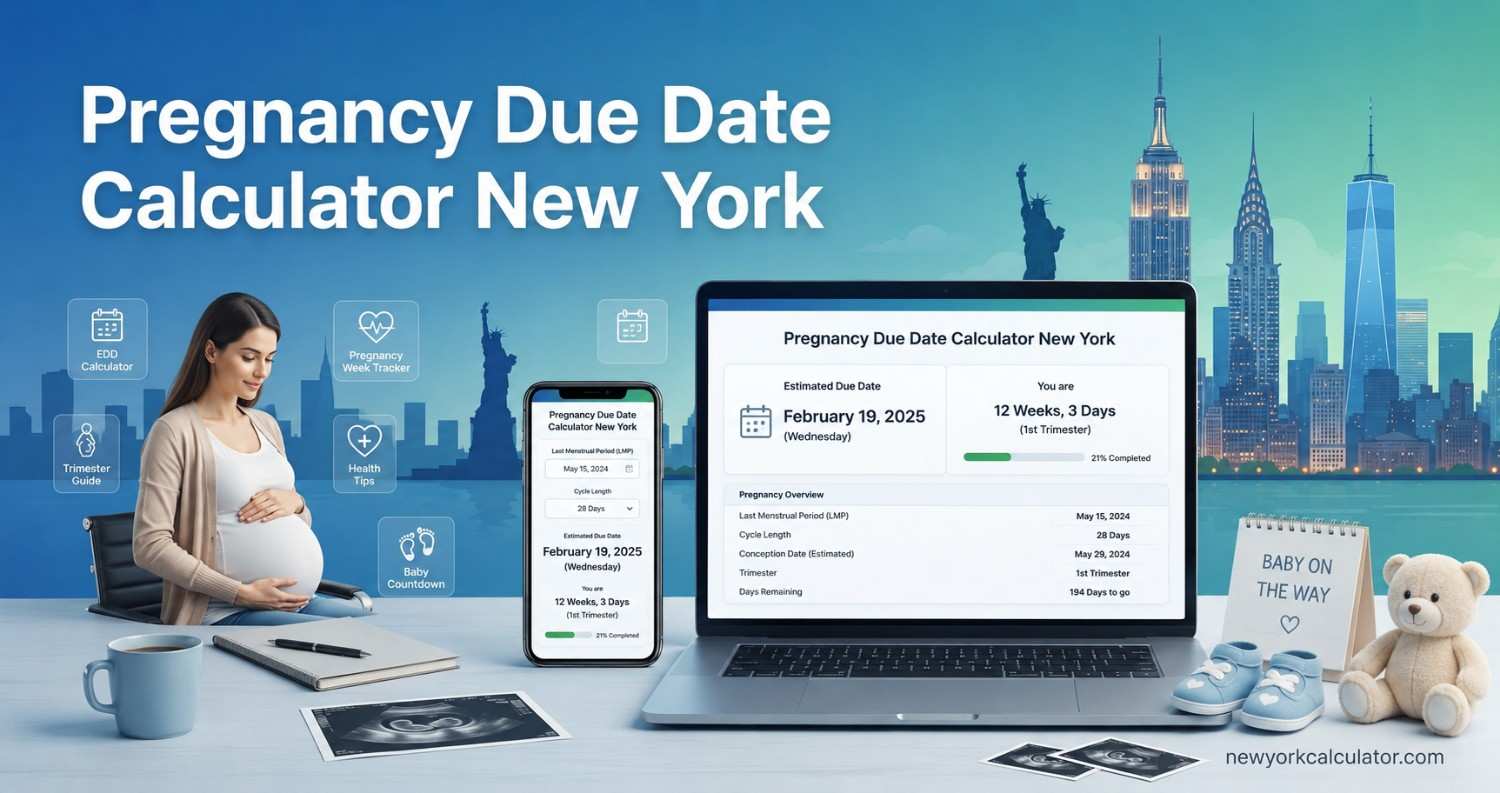
If you are pregnant in New York and want to know when your baby may be due, the New York Pregnancy Due Date Calculator can give you a quick estimated date based on your last menstrual period, cycle length, conception date, IVF embryo transfer, or ultrasound information.
Your estimated due date can also help you think ahead about prenatal care, health insurance, maternity planning, work, transportation, and other preparations.
However, a due date is an estimate, not a guaranteed delivery date. Your healthcare provider may establish or change your official due date after considering your menstrual history, ultrasound findings, fertility treatment information, and other clinical factors.
New York Pregnancy Due Date Calculator
Estimate your due date, pregnancy week, trimester and key dates.
Pregnancy Milestones
The calculator is for informational and planning purposes. It does not replace prenatal care or medical advice.
What Is a Pregnancy Due Date?
A pregnancy due date, commonly called an estimated due date (EDD), is the approximate date when a baby is expected to be born.
A traditional pregnancy calculation uses 40 weeks, or approximately 280 days, from the first day of the last menstrual period (LMP). This calculation assumes a typical 28-day menstrual cycle, which is why the average cycle length can affect the estimate. The NHS also provides cycle-length adjustment in its pregnancy due-date calculator.
Your actual delivery date can be different from the calculated date. A due date should therefore be used as a planning reference rather than a fixed appointment.
How Does the New York Pregnancy Due Date Calculator Work?
The calculator on this page provides several ways to estimate a due date.
You can calculate from:
- Last menstrual period
- Average menstrual cycle length
- Estimated conception date
- IVF embryo transfer
- Ultrasound gestational age
It also estimates your current pregnancy week, trimester, approximate conception date, days remaining and pregnancy progress.
This makes the calculator useful for people who want more than just a single calendar date.
Calculate Your Due Date From Your Last Period
For many pregnancies, the simplest starting point is the first day of the last menstrual period.
The traditional calculation is:
First day of LMP + approximately 280 days = estimated due date
If your average cycle is longer or shorter than 28 days, the estimate can be adjusted.
For example, someone with an average 32-day cycle may have a different estimated due date from someone with a 28-day cycle even when their LMP date is the same.
The important thing to remember is that an LMP-based calculation assumes that the date you entered is correct and that your cycle information provides a reasonable estimate of ovulation.
What If My Menstrual Cycle Is Not 28 Days?
Not everyone has a 28-day menstrual cycle.
If your cycle is normally:
- 24 days
- 26 days
- 30 days
- 32 days
- 35 days
you can enter your average cycle length into the calculator.
This can make an LMP-based estimate more personalized.
However, cycle adjustment cannot determine the exact day you ovulated. If your periods are very irregular or you do not know your usual cycle length, your healthcare provider may be able to provide more reliable pregnancy dating.
Calculate a Due Date From Conception
If you know an approximate conception date, you can use the conception option in the calculator.
A commonly used estimate is:
Conception date + approximately 266 days = estimated due date
There is an important limitation.
The date of intercourse is not necessarily the exact date conception occurred. Sperm can survive for several days, and ovulation does not always happen on the same day of every cycle.
Therefore, a conception-based result should also be considered an estimate.
IVF Pregnancy Due Date Calculator
Pregnancy dating can be different when pregnancy occurs through IVF or another assisted reproductive technology.
The calculator includes options for embryo transfers such as:
- Day 3 embryo transfer
- Day 5 embryo transfer
- Day 6 embryo transfer
For example, a Day 5 embryo transfer is commonly used with an estimated due-date calculation based on the embryo’s known developmental age.
ACOG’s pregnancy dating guidance includes assisted reproductive technology and embryo-transfer information when establishing an estimated due date.
If your fertility clinic has already provided an official estimated due date, use the date provided by your medical team for your pregnancy care.
Can an Ultrasound Change My Due Date?
Yes.
An ultrasound can provide important information about pregnancy dating, particularly when the LMP is unknown, uncertain or does not appear to match the pregnancy’s development.
The calculator includes an ultrasound option where you can enter the ultrasound date and the gestational age recorded at the time of the scan.
However, an online calculator cannot interpret an ultrasound image.
Your healthcare professional is responsible for interpreting the ultrasound and determining whether pregnancy dating should be changed.
The NHS notes that pregnancy scans can help establish gestational age, while clinical guidance from ACOG addresses how LMP and ultrasound dating are considered together.
Why Is My Doctor’s Due Date Different From the Calculator?
It is possible for your online calculator result and your healthcare provider’s estimated due date to be different.
Possible reasons include:
- You entered an incorrect LMP date.
- Your menstrual cycle is longer or shorter than average.
- Your periods are irregular.
- You ovulated earlier or later than expected.
- Your conception date was uncertain.
- Your pregnancy resulted from IVF.
- Your ultrasound provides different dating information.
Cleveland Clinic explains that healthcare providers may use ultrasound and other clinical information when establishing or revising a due date.
If your healthcare provider gives you an official estimated due date, that date should be used for your medical care.
How Far Along Am I?
One of the most common questions after calculating a due date is:
“How many weeks pregnant am I?”
The calculator estimates your pregnancy age in:
Weeks + days
For example:
12 weeks 4 days
It also shows the approximate trimester and the estimated number of days remaining until the calculated due date.
Pregnancy dating is conventionally counted from the first day of the last menstrual period rather than from the actual day of conception. This is why pregnancy age can appear to be about two weeks ahead of the time since conception.
Pregnancy Trimesters
For general informational purposes, pregnancy is divided into three trimesters.
First Trimester
Approximately weeks 1–13.
This is the early stage of pregnancy when prenatal care becomes particularly important.
Second Trimester
Approximately weeks 14–27.
Pregnancy continues to progress through important developmental and prenatal-care stages.
Third Trimester
Approximately week 28 until delivery.
During this stage, preparation for birth and continued prenatal monitoring become increasingly important.
Your healthcare provider may use slightly different clinical terminology depending on your individual circumstances.
Pregnancy Milestone Calendar
Knowing the estimated due date can help you understand your pregnancy timeline.
The calculator can provide approximate dates for milestones such as:
- 8 weeks
- 12 weeks
- 16 weeks
- 20 weeks
- 24 weeks
- 28 weeks
- 32 weeks
- 36 weeks
- 37 weeks
- 38 weeks
- 39 weeks
- 40 weeks
These dates are useful for general planning.
They should not be treated as personal medical appointment instructions because the timing of tests, scans and other care depends on the individual pregnancy.
What If I Don’t Know My Last Period?
If you do not remember the first day of your last menstrual period, do not simply choose a random date to make the calculator work.
Your healthcare provider can use other information to help establish pregnancy dating.
Depending on your circumstances, this may include ultrasound findings, pregnancy history and other clinical information.
Cleveland Clinic also recommends discussing uncertain or unknown LMP information with a healthcare professional.
What If I Have Irregular Periods?
An irregular menstrual cycle can make a simple LMP calculation less reliable.
The calculator allows you to enter your average cycle length, but this is still only an estimate.
If your periods are highly irregular, you do not know when you ovulated, or your calculated date differs substantially from your healthcare provider’s date, discuss pregnancy dating with your medical team.
Reverse Due Date Calculation: When Did I Conceive?
If you already know your estimated due date, you may want to estimate when conception occurred.
A simple reverse estimate is:
Estimated due date − approximately 266 days = estimated conception date
This can provide a useful approximation, but it cannot prove the exact day conception occurred.
An estimated conception date should not be used to make medical, legal or paternity conclusions.
How Accurate Is a Pregnancy Due Date Calculator?
A pregnancy calculator can provide a useful estimate, but it cannot predict the exact day your baby will be born.
Accuracy depends on the information used.
The estimate may be more straightforward when:
- You know the first day of your last period.
- Your cycles are relatively regular.
- Your average cycle length is known.
Dating may be more complicated when:
- You do not know your LMP.
- Your cycles are irregular.
- Ovulation timing is uncertain.
- Conception timing is uncertain.
- You used fertility treatment.
- Ultrasound dating differs from the LMP calculation.
Cleveland Clinic emphasizes that an estimated due date is not a guaranteed delivery date.
Your Due Date Is Not a Deadline
It is easy to think of an estimated due date as the exact day your baby should arrive.
It is better to think of it as an important reference point in your pregnancy timeline.
Your healthcare provider will monitor your pregnancy and advise you about your individual situation.
If the estimated date passes, that does not automatically mean there is a problem. Decisions about additional monitoring or delivery should be made with your healthcare provider.
Pregnancy Resources for People in New York
The biggest difference between a generic pregnancy calculator and a New York Pregnancy Due Date Calculator should not be the mathematical formula.
The calculation itself does not change simply because you live in New York.
The benefit of a New York-focused page is that it can also help you find relevant local healthcare and support information.
New York Prenatal Care
New York State provides information about prenatal healthcare and pregnancy-related Medicaid coverage.
The state’s 2026 Medicaid Perinatal Care Standards include requirements related to prenatal, delivery and postpartum care.
If you are pregnant and have questions about obtaining prenatal care, insurance or Medicaid coverage, check current information directly from New York State rather than relying on an old article.
New York Medicaid and Pregnancy
New York Medicaid provides pregnancy-related healthcare coverage for eligible individuals.
The state has specific rules for pregnancy-related Medicaid and prenatal care, including information about eligibility and coverage.
New York’s 2026 perinatal-care standards also contain current pregnancy-related Medicaid provisions.
Because eligibility and program rules can change, always verify your current situation through official New York State resources.
New York WIC
WIC stands for Women, Infants, and Children.
New York’s WIC program provides eligible participants with services that can include nutritious foods, nutrition education and breastfeeding support.
New York has published 2026–2027 WIC income eligibility information, so people checking eligibility should use the current state information rather than older articles or social-media posts.
Pregnancy Planning in New York
Once you know your estimated due date, you can begin thinking about practical issues such as:
- Choosing or confirming prenatal care
- Understanding your health insurance
- Checking Medicaid eligibility if applicable
- Planning transportation
- Discussing maternity leave with your employer
- Preparing your home
- Planning childcare
- Keeping your pregnancy records organized
Your estimated due date can be useful for planning, but your healthcare provider’s medical guidance should take priority.
What Should I Do After Using the Calculator?
After getting an estimated date, consider these practical steps.
1. Confirm your pregnancy care
If you have not already done so, arrange appropriate prenatal care.
2. Tell your provider your LMP
If you know your last menstrual period, keep the date available for your appointment.
3. Ask about your official due date
Your provider may use a different dating method and establish another estimated date.
4. Check health coverage
If you are concerned about healthcare costs, investigate your current insurance and New York pregnancy-related coverage options.
5. Keep your records
Save your important pregnancy information and dates so that you can refer to them during appointments.
Frequently Asked Questions
Is the New York Pregnancy Due Date Calculator free?
Yes. The calculator is designed as a free online tool and does not require an account to perform a calculation.
Does living in New York change my due date?
No. New York does not use a different biological pregnancy formula. The New York focus provides local pregnancy information and resources in addition to the calculation.
How many weeks pregnant am I?
The calculator estimates your pregnancy age in weeks and days using the information you provide.
Can I calculate my due date from my last period?
Yes. Enter the first day of your last menstrual period and your average cycle length.
Can I calculate my due date from conception?
Yes. If you have a reasonably reliable estimated conception date, you can use the conception option.
Can IVF patients use this calculator?
Yes. The calculator includes embryo-transfer options for IVF pregnancies.
Can an ultrasound change my due date?
It can. Your healthcare provider may establish or revise pregnancy dating based on ultrasound findings and other clinical information.
What if I have irregular periods?
The calculator allows cycle-length adjustment, but irregular cycles can make LMP-based estimates less reliable. Discuss uncertain dating with your healthcare provider.
What if I don’t know my last period?
Do not guess if you need accurate medical dating. A healthcare provider can help determine the appropriate pregnancy dating method.
Is my calculator result my official medical due date?
No. It is an estimate. Use the estimated due date established by your healthcare provider for medical care.
Does the calculator diagnose pregnancy?
No. It only estimates pregnancy dates after pregnancy has been established.
Can the calculator tell me exactly when I conceived?
No. It can estimate a conception date, but it cannot determine the exact day conception occurred.
Can I use the calculator for twins or multiples?
You can use the calculator to obtain a general pregnancy-date estimate, but pregnancies involving multiples require individualized medical care. Your healthcare provider should determine appropriate dating and monitoring.
Medical Disclaimer
The New York Pregnancy Due Date Calculator is provided for general informational and planning purposes only.
It is not a medical diagnostic tool and does not replace prenatal care, medical examination, ultrasound, laboratory testing or advice from a qualified healthcare professional.
Pregnancy dating can be affected by menstrual-cycle length, uncertainty about the last menstrual period, ovulation timing, conception timing, IVF treatment and ultrasound findings.
If your healthcare provider gives you a due date that differs from this calculator, follow the date and guidance provided by your healthcare team.
If you have urgent concerns about your pregnancy, contact your healthcare provider or seek appropriate medical care rather than relying on an online calculator.
About the Author
Junaidul Islam writes practical calculator and cost-of-living resources for NewYorkCalculator.com, with a focus on making complex information easier to understand and use.
This article is intended to provide an original, practical explanation of pregnancy due-date calculations while directing readers to authoritative medical and New York State resources for information that can change over time.
Sources
- American College of Obstetricians and Gynecologists (ACOG) — pregnancy dating and estimated due-date guidance.
- Cleveland Clinic — pregnancy due-date calculation, ultrasound, IVF and dating information.
- NHS — pregnancy due-date calculation and cycle-length information.
- New York State Department of Health — Medicaid Perinatal Care Standards.
- New York State Department of Health — WIC program.
- New York State Department of Health — 2026–2027 WIC eligibility information.