
By Junaidul Islam Paying for college in New York can involve much more than tuition. Depending on where you study, your total cost may include housing, meals, books, transportation, technology, fees and other education-related expenses. Scholarships, grants, family savings and a 529 account can reduce the amount you need to borrow—but if there is still a funding gap, an education loan may become part of the plan.
That is why a simple monthly-payment calculator is not always enough.
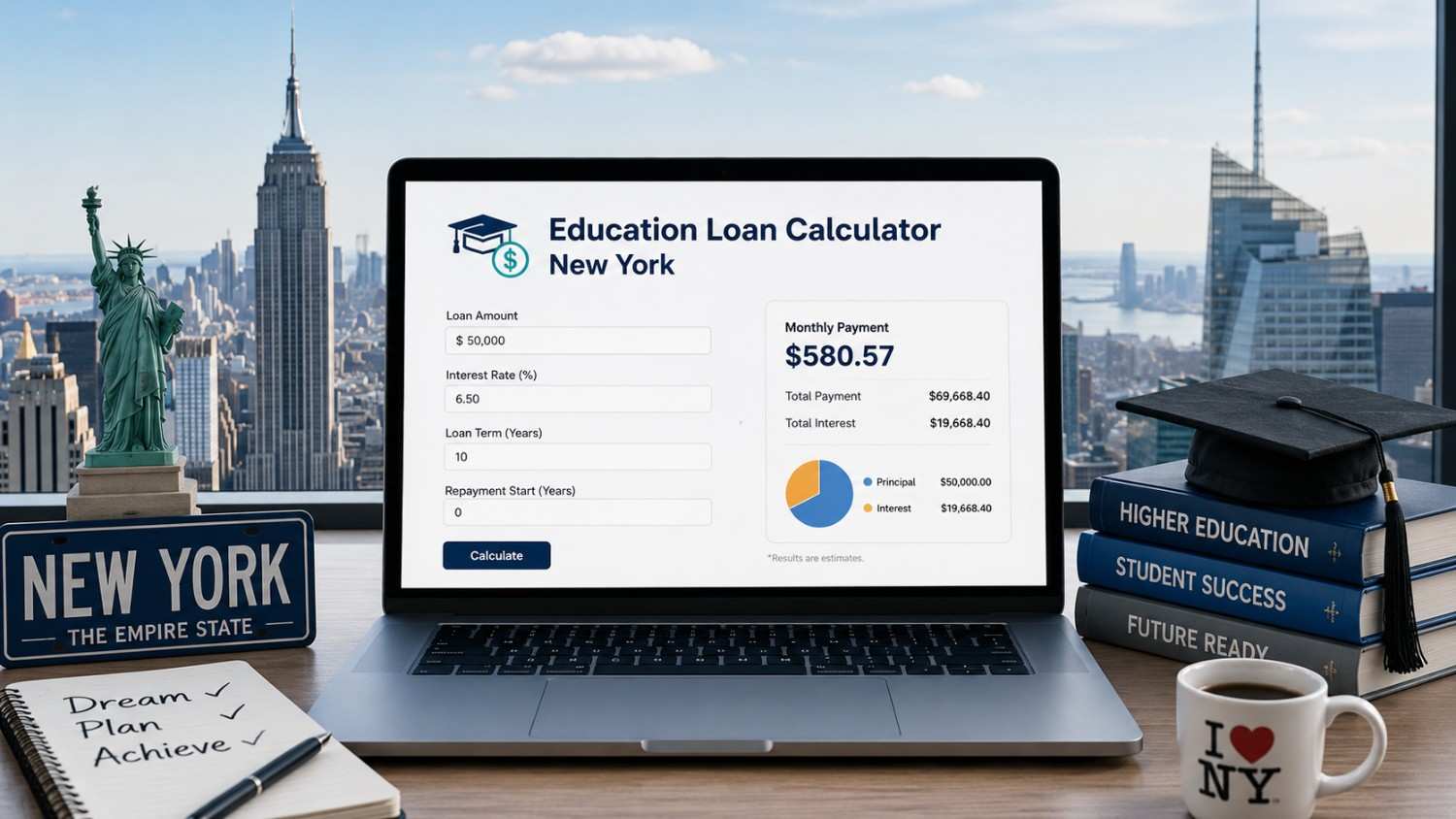
Our New York Education Loan Calculator is designed to help students, parents and borrowers estimate the amount they may need to finance, the expected monthly payment, total interest, total repayment and the potential effect of making extra payments.
Important: Calculator results are estimates for educational and planning purposes. Your actual student-loan payment, eligibility, interest rate, fees, repayment plan and forgiveness options depend on your specific loan, lender and federal or state rules.
New York Education Loan Calculator
Before borrowing, it helps to answer three questions:
- How much will my education actually cost?
- How much of that cost can I cover without borrowing?
- If I borrow the remaining amount, what could repayment look like?
Our calculator brings those questions together instead of showing only one monthly-payment number.
What the calculator can help you estimate
Depending on the information you enter, you can estimate:
- Education funding gap
- Estimated loan amount
- Monthly principal-and-interest payment
- Total interest
- Total repayment
- Interest accumulated during school
- Estimated balance when repayment begins
- Effect of a grace period
- Effect of additional monthly payments
- Estimated payoff time
- Multiple-loan totals
- Approximate payment-to-income ratio
New York Education Loan Calculator
Estimate your education funding gap, monthly student loan payment, total interest, total repayment and potential savings from extra payments.
1. Education Funding
2. Loan Details
Estimated Results
Estimated Funding Gap $0Repayment Starting Balance $0Estimated Monthly Payment $0Total Interest $0Total Repayment $0Estimated Payoff 0 monthsInterest With Extra Payment $0Potential Interest Savings $0Repayment Schedule Preview
Month Payment Principal Interest Remaining Balance This calculator provides estimates for educational and planning purposes only. Actual payments can differ because of loan type, lender rules, repayment plan, fees, interest capitalization, eligibility and other factors. Income-driven federal repayment plans should be checked separately through official federal resources or your loan servicer.
What Is an Education Loan Calculator?
An education loan calculator is a financial planning tool that estimates how borrowing for college or another qualifying education program could affect your future budget.
The basic calculation uses the loan amount, interest rate and repayment term. A standard fixed-rate installment calculation generally determines how much of each payment goes toward interest and how much reduces principal.
But real student-loan decisions can be more complicated.
For example, two students could each borrow $40,000 but have very different outcomes if one has a 5% fixed rate and the other has a 7% rate. The repayment term can also change the result. A longer term may reduce the required monthly payment while increasing the total interest paid over the life of the loan.
That is why it is useful to look at monthly payment and lifetime cost together.
Why a New York-Specific Student Loan Calculator Matters
A generic student loan calculator can tell you what happens after you enter a loan balance, interest rate and repayment term.
A New York student may need to consider much more.
For example, a student attending a public college in New York may have a different cost structure from a student attending a private university in New York City. A student living at home may also need significantly less borrowing than a student paying for housing and food.
The starting point should therefore be the education funding gap, not simply the amount a lender is willing to provide.
A useful planning formula is:
Total education cost − grants − scholarships − savings − other available funds = estimated amount that may need financing
This is only a planning calculation. Your school’s official cost of attendance and financial-aid award should be used when determining your actual financing need.
What Should Be Included in New York College Costs?
When estimating how much you may need to borrow, consider more than tuition.
Potential education expenses can include:
Tuition and mandatory fees
Tuition is usually the largest expense, but mandatory institutional fees can also affect the total.
Housing
If you live on campus or rent away from home, housing can significantly increase the amount you need to finance.
Food
Meal plans and other food costs should be considered when building a realistic college budget.
Books and supplies
Textbooks, course materials, equipment and supplies can add to the annual cost.
Computer and technology expenses
Some programs may require a computer or specialized equipment.
Transportation
Transportation can be particularly important if you attend college away from home.
Other education-related expenses
Depending on the program, you may have additional academic or personal expenses.
New York law defines higher-education expenses for certain education-loan purposes to include tuition and fees, books, room and board and other education-related expenses.
SUNY, CUNY or Private College: Why Your Loan Need Can Differ
New York has a wide range of higher-education options.
A student attending a public institution may have a different tuition and living-cost profile from someone attending a private college. Within New York City, a commuter attending a CUNY school may have a very different financing requirement from a student paying for campus housing elsewhere.
The important point is not to assume that one average number represents every New York student.
Instead, build your estimate around your own:
- School
- Program
- Enrollment period
- Housing situation
- Financial aid
- Savings
- Family contribution
- Other education expenses
The calculator is most useful when you enter realistic numbers rather than borrowing an amount simply because it is available.
How Much Student Loan Do You Actually Need?
This is one of the most important questions to answer before taking out an education loan.
Suppose your estimated annual education cost is:
$35,000
And you expect:
- $8,000 in grants and scholarships
- $5,000 from savings
- $4,000 family contribution
Your estimated remaining funding gap would be:
$35,000 − $8,000 − $5,000 − $4,000 = $18,000
That does not automatically mean you should borrow $18,000. You should first review your school’s financial-aid package, federal loan eligibility, work-study opportunities and other available resources.
The calculator is intended to make that gap easier to see.
Federal Student Loans vs. Private Student Loans
One of the biggest decisions is whether your education financing comes from a federal program or a private lender.
Federal student loans generally come with protections and repayment options that private loans do not necessarily provide.
Private student loans are offered by banks, credit unions and other private lenders. Approval, interest rates and terms can depend on factors such as credit history, income and whether a qualified cosigner is used.
SoFi, for example, explains that private student-loan rates may be based on borrower information such as credit history and income, while federal loans have different rules and protections.
Before considering private borrowing, students should understand what federal aid they qualify for.
Fixed vs. Variable Student Loan Interest Rates
Interest rate type can materially affect your long-term borrowing cost.
A fixed rate stays the same under the loan’s applicable terms.
A variable rate can change over time according to the terms of the loan and the relevant benchmark.
For a long repayment period, a changing rate can make future costs less predictable.
Federal student loans generally use fixed rates established under federal rules, while private student loans may offer fixed or variable-rate options.
If you are comparing loans, do not look only at the starting monthly payment. Compare the rate, repayment period, fees, protections and total expected cost.
Why the Loan Term Matters
Consider two otherwise identical loans.
A shorter repayment period generally means:
- Higher monthly payment
- Less time paying interest
- Lower total interest
A longer repayment period generally means:
- Lower monthly payment
- More months of repayment
- Potentially higher total interest
For someone with a tight starting salary, the lower payment may appear attractive. But a longer term can increase the lifetime cost.
This is why the New York Education Loan Calculator displays both monthly payment and total repayment.
Interest During College Can Change Your Starting Balance
Many borrowers focus only on the amount originally borrowed.
That can be misleading.
Depending on the loan type and terms, interest may accrue while you are in school or during a period when payments are deferred.
For example, if $30,000 is borrowed and interest accumulates before regular repayment begins, the balance used for repayment may be different from the original amount.
Some private lenders also offer different in-school repayment options. College Ave, for example, describes deferred, interest-only, flat-payment and full principal-and-interest approaches for certain loans.
That is why our calculator includes an optional school-period interest estimate.
What Is Capitalized Interest?
Capitalized interest is interest that is added to the principal balance under applicable loan rules.
Once interest becomes part of the principal, future interest can be calculated on the larger balance.
This can increase the eventual cost of borrowing.
For that reason, borrowers should not look only at:
Original loan amount
They should also consider:
Balance when repayment begins
and
Total interest over the repayment period.
Grace Period and Student Loan Repayment
Some student loans provide a period after leaving school before regular payments are required.
The exact rules depend on the loan type.
A grace period can be useful for transitioning from school into employment, but it does not necessarily mean that interest stops accumulating.
When planning your finances, check the actual terms of your loan rather than assuming that a grace period is interest-free.
Our calculator allows users to model a school period and an additional grace period so they can see how those assumptions can affect the repayment starting balance.
New York Student Loan Rules Are Changing in 2026
This is one of the most important reasons to update an old student-loan article.
Federal student-loan repayment rules changed significantly in 2026.
New York’s Attorney General explains that borrowers’ repayment options can depend on when their most recent federal loan was disbursed or consolidated.
New York City consumer guidance also explains that the SAVE Plan is ending and that borrowers need to transition to other repayment options.
Therefore, an article written several years ago may no longer accurately describe the repayment options available to a borrower in New York.
What Is the Repayment Assistance Plan (RAP)?
The Repayment Assistance Plan (RAP) is a new federal income-driven repayment option introduced in 2026.
New York’s Department of Financial Services states that RAP is the income-driven repayment plan available for federal student-loan borrowers taking out one or more loans after July 1, 2026, subject to the applicable eligibility rules.
Under RAP, the payment calculation is based on adjusted gross income and family size. The New York Department of Financial Services currently describes a percentage-based calculation ranging from 1% to 10% of income, with a dependent adjustment and a $10 minimum monthly payment.
RAP also has a long-term forgiveness provision after qualifying payments, subject to the applicable federal rules.
Because RAP is an official federal repayment program, borrowers should confirm their individual eligibility and actual payment through Federal Student Aid or their loan servicer.
Our standard loan calculator should not be treated as an official RAP eligibility or payment calculator.
What Happened to the SAVE Plan?
The SAVE Plan has been a major part of recent student-loan discussions, but borrowers should not assume that old SAVE information remains current.
The New York Attorney General’s 2026 student-lending guidance says the SAVE Plan is becoming unavailable and that borrowers enrolled in SAVE need to select another repayment option under the applicable transition rules.
New York City consumer guidance similarly advises SAVE borrowers to review their options and transition to another plan.
This is a good example of why student-loan information should always be checked against current official sources before making a financial decision.
Borrowers Who Took Out Loans Before July 1, 2026 May Have Different Options
Loan timing matters.
According to the New York Attorney General’s current guidance, borrowers whose most recent loan was disbursed or consolidated before July 1, 2026 may have access to options such as IBR and traditional repayment plans, depending on their circumstances. Borrowers with loans disbursed or consolidated on or after July 1, 2026 face a different repayment-plan framework.
That means two New Yorkers with similar balances can potentially have different repayment choices because their loan histories are different.
This is another reason a generic “monthly payment = X” answer is not enough.
Parent PLUS Loans Have Different Rules
Parents borrowing for a student’s education should pay particular attention to the type of loan.
The New York Attorney General explains that Parent PLUS borrowers are subject to different repayment rules and are not eligible for RAP. The applicable options also depend on when the loan was disbursed or consolidated.
If you are a parent, do not assume that a calculator designed around a student’s Direct Loan automatically represents your Parent PLUS situation.
New York 529 College Savings Can Reduce Borrowing
A 529 plan can be an important part of a college funding strategy.
New York’s Higher Education Services Corporation explains that the NY 529 College Savings Program can be used for qualified higher-education expenses and provides tax advantages under applicable rules.
Qualified uses can include tuition, fees, books, supplies, certain room-and-board expenses and other eligible education costs.
New York taxpayers may also receive state tax benefits subject to applicable rules.
The practical lesson is simple:
Money available from savings can reduce the amount that needs to be borrowed.
That can also reduce future interest.
Can a 529 Account Be Used to Repay Student Loans?
Under applicable federal rules, 529 funds can be used for certain qualified student-loan repayment expenses.
New York’s own statutory framework also addresses qualified education-loan payments within the state’s college savings program.
However, federal and New York tax treatment can differ for some distributions, so account owners should check current rules before making a withdrawal.
The NY 529 program itself advises account owners to consider the applicable rules and seek qualified tax advice when necessary.
New York College Tuition Tax Benefit
Another area that is easy to overlook is the New York State college tuition credit or itemized deduction.
The New York State Department of Taxation and Finance explains that eligible full-year New York residents may qualify when they, their spouse or an eligible dependent paid qualified undergraduate tuition expenses, subject to the program’s requirements.
The tax rules are specific, and not every college expense qualifies.
This should therefore be treated as a separate tax-planning consideration rather than simply subtracting a tax benefit from your student-loan balance.
Multiple Student Loans: Why One Number May Not Be Enough
Many borrowers have more than one education loan.
For example:
- Loan 1: $10,000 at 5.5%
- Loan 2: $15,000 at 6.2%
- Loan 3: $8,000 at 7.0%
A calculator that treats everything as one balance can hide differences between the loans.
SmartAsset’s student-loan calculator, for example, allows users to add multiple loans and calculates the combined payment and amortization.
For that reason, our calculator is designed to let you compare multiple loan scenarios rather than forcing every borrower into a single-loan example.
How Extra Payments Can Save Interest
An additional payment can potentially reduce the time you remain in debt.
Suppose your required payment is:
$500 per month
and you voluntarily pay:
$100 extra per month
Your total payment becomes:
$600 per month
If the additional payment is applied according to the loan’s terms, the balance can fall faster and less interest may accrue over time.
The actual savings depend on the loan balance, rate, payment structure and how your servicer applies extra payments.
That is why the calculator includes an extra monthly payment field.
Monthly Payment Is Not the Same as Total Cost
This is perhaps the most important lesson when using a student-loan calculator.
Imagine:
Option A
$550 monthly payment
10-year term
Option B
$400 monthly payment
15-year term
Option B may look better because the monthly bill is lower.
But you need to ask:
How much will I pay in total?
A lower monthly payment can sometimes mean a longer repayment period and more interest.
Always compare:
- Monthly payment
- Total interest
- Total repayment
- Repayment period
together.
How to Use the New York Education Loan Calculator
Step 1: Estimate your education cost
Enter your expected tuition and other education expenses.
Step 2: Enter grants and scholarships
Subtract financial aid that does not need to be repaid.
Step 3: Add savings or 529 funds
Include the amount you realistically plan to use.
Step 4: Estimate the remaining funding gap
This is the amount that may need financing.
Step 5: Enter the expected interest rate
Use the rate shown in your actual loan offer when available.
Step 6: Select the repayment term
Try several terms rather than checking only one.
Step 7: Review the results
Look at:
- Estimated monthly payment
- Total interest
- Total repayment
- Starting repayment balance
- Potential interest savings from extra payments
Step 8: Compare scenarios
Try changing the loan amount, interest rate, term or extra payment.
The goal is not to find a number that looks comfortable today. The goal is to understand the long-term cost before you borrow.
Example: How a New York Student Could Use the Calculator
Imagine a student estimates:
Education cost: $40,000
Available resources:
Scholarships: $8,000
Savings: $5,000
Family contribution: $3,000
Estimated funding gap:
$40,000 − $8,000 − $5,000 − $3,000 = $24,000
The student can then test a $24,000 loan under several interest-rate and repayment-term scenarios.
For example, they might compare:
- 5-year repayment
- 10-year repayment
- 15-year repayment
They can then compare monthly payment against total interest.
The actual loan terms will determine the real payment. The example is only for demonstrating how the calculator can be used.
Should You Borrow the Maximum Amount Offered?
Not necessarily.
A lender or financial-aid package showing that you can borrow a certain amount does not mean borrowing the maximum is financially ideal.
Before borrowing, consider:
- Expected starting salary
- Housing costs after graduation
- Transportation
- Taxes
- Insurance
- Other debt
- Emergency savings
- Family responsibilities
- Whether your income could vary
A student who borrows less today may have more financial flexibility after graduation.
What If You Cannot Afford Your Student Loan Payment?
Do not simply stop paying without understanding the consequences.
For federal loans, borrowers may have repayment-plan, deferment, forbearance, consolidation or other options depending on their circumstances.
New York also provides consumer resources for student-loan borrowers.
The New York Department of Financial Services advises borrowers to review their loans and available repayment options, while the New York Attorney General provides student-lending guidance for New Yorkers.
If you are struggling, contact your loan servicer and review your official federal student-loan account before making a decision.
Be particularly careful with companies that demand upfront fees for federal student-loan assistance. New York City consumer guidance warns borrowers about student-loan scams and notes that legitimate federal and state programs do not require borrowers to pay for access to those free programs.
Student Loan Forgiveness: Do Not Assume You Qualify
“Student loan forgiveness” is not one single program.
Eligibility can depend on:
- Loan type
- Employer
- Repayment plan
- Qualifying payments
- Employment history
- Date of borrowing
- Program rules
Public Service Loan Forgiveness is one example where qualifying employment and payments matter.
Because federal student-loan policies can change, borrowers should verify current requirements directly with Federal Student Aid or another authoritative government resource.
Do not rely on a social-media post or a company promising guaranteed forgiveness.
Student Loan Consolidation vs. Refinancing
These terms are often confused.
Federal consolidation
Federal consolidation combines eligible federal loans into a new federal loan under applicable rules.
It can change the structure of repayment, but it is not automatically a way to lower your interest rate.
Private refinancing
Private refinancing involves replacing existing loans with a new private loan.
A lower interest rate can potentially reduce interest costs, but refinancing federal loans into a private loan can also mean losing federal protections and repayment options.
So refinancing should not be evaluated only by looking at the new monthly payment.
Compare the complete package.
What Information Should You Have Before Using a Student Loan Calculator?
For a more useful estimate, have these numbers available:
- Current or expected loan balance
- Interest rate
- Repayment term
- Number of months in school
- Expected grace period
- Scholarships
- Grants
- Savings
- 529 funds
- Other financial aid
- Expected extra monthly payment
If you already have multiple loans, gather the balance and interest rate for each one.
The more accurate your inputs, the more useful the estimate will be.
Why Calculator Results Are Only Estimates
A calculator cannot know every detail of your actual loan agreement.
Your real payment may depend on:
- Loan type
- Disbursement date
- Interest rate
- Fees
- Servicer calculation
- Repayment plan
- Eligibility rules
- Income
- Family size
- Loan status
- Federal policy
- State rules
For income-driven repayment plans, the standard amortization formula used by a basic calculator may not represent the actual payment.
Therefore, use this calculator for planning and comparison, not as an official determination of eligibility or payment.
A Better Way to Plan Your Education Loan
The best approach is to work backward from your actual education cost.
Start with:
What will school cost me?
Then ask:
What financial aid do I have?
Then:
How much can I pay without borrowing?
Then:
How much would I need to finance?
Finally:
What will that borrowing cost me after graduation?
That last question is where the New York Education Loan Calculator becomes especially useful.
Instead of focusing only on today’s loan amount, you can see the potential long-term effect of interest, repayment term and additional payments.
Frequently Asked Questions
What is an Education Loan Calculator New York?
It is a calculator designed to help New York students, parents and borrowers estimate education-loan costs, monthly payments, total interest and repayment scenarios.
Does the calculator tell me how much I can borrow?
No. It estimates borrowing needs based on the information you enter. Your actual loan eligibility and borrowing limits depend on your school, loan program, lender and applicable rules.
Can I use it for federal student loans?
Yes, you can use the standard loan calculation for planning. However, income-driven federal repayment plans such as RAP use separate eligibility and payment rules, so the calculator should not be treated as an official federal repayment-plan calculator.
Can I use it for private student loans?
Yes. Enter the actual loan amount, interest rate and repayment term from the private lender’s offer when available.
Does it calculate total interest?
Yes. The standard repayment calculation estimates total interest over the repayment period.
Can I calculate multiple loans?
Yes, the tool can be used to compare multiple loan balances and rates.
Does a longer repayment term reduce my monthly payment?
Usually, a longer term reduces the required monthly payment, but it can increase the total interest paid.
Can extra payments save interest?
They can, depending on the loan’s terms and how the additional payment is applied. Paying principal down faster generally reduces the amount of time interest can accrue.
Does NY 529 reduce student-loan borrowing?
Potentially. Money used from eligible 529 savings for qualified education expenses can reduce the amount that otherwise needs to be financed.
Is RAP available to every student-loan borrower?
No. Eligibility depends on the applicable federal rules and loan circumstances. New York’s Department of Financial Services and Attorney General provide current guidance, but borrowers should confirm their own status through Federal Student Aid or their loan servicer.
Is the SAVE Plan still available?
Current New York guidance says the SAVE Plan is ending and borrowers must transition under the applicable 2026 rules.
Is this calculator financial advice?
No. It is an educational planning tool. It does not provide personalized financial, legal or tax advice.
Final Thoughts
An education loan should be viewed as a long-term financial commitment, not simply as money available to pay today’s tuition bill.
For a New York student or parent, the better question is not:
“How much can I borrow?”
It is:
“How much do I actually need, and what could that borrowing cost me over time?”
Start with the full education budget. Subtract scholarships, grants, savings and other available resources. Then estimate the remaining financing need and compare different interest rates and repayment terms.
The 2026 federal student-loan changes make this even more important. Borrowers should pay attention to the date their loans were disbursed or consolidated, because repayment options can differ depending on that timing.
Use the calculator to compare scenarios, but verify your actual loan terms and repayment eligibility with your school, lender, loan servicer or official government resources before making a borrowing decision.
Last reviewed: October 2026
Author: Junaidul Islam
Disclaimer: This article is provided for general educational and informational purposes. It is not financial, legal or tax advice and does not guarantee loan eligibility, approval, repayment-plan eligibility, forgiveness or any specific payment amount. Federal and New York education-loan rules can change. Always verify current requirements and your individual loan information with the appropriate official source or loan servicer.