
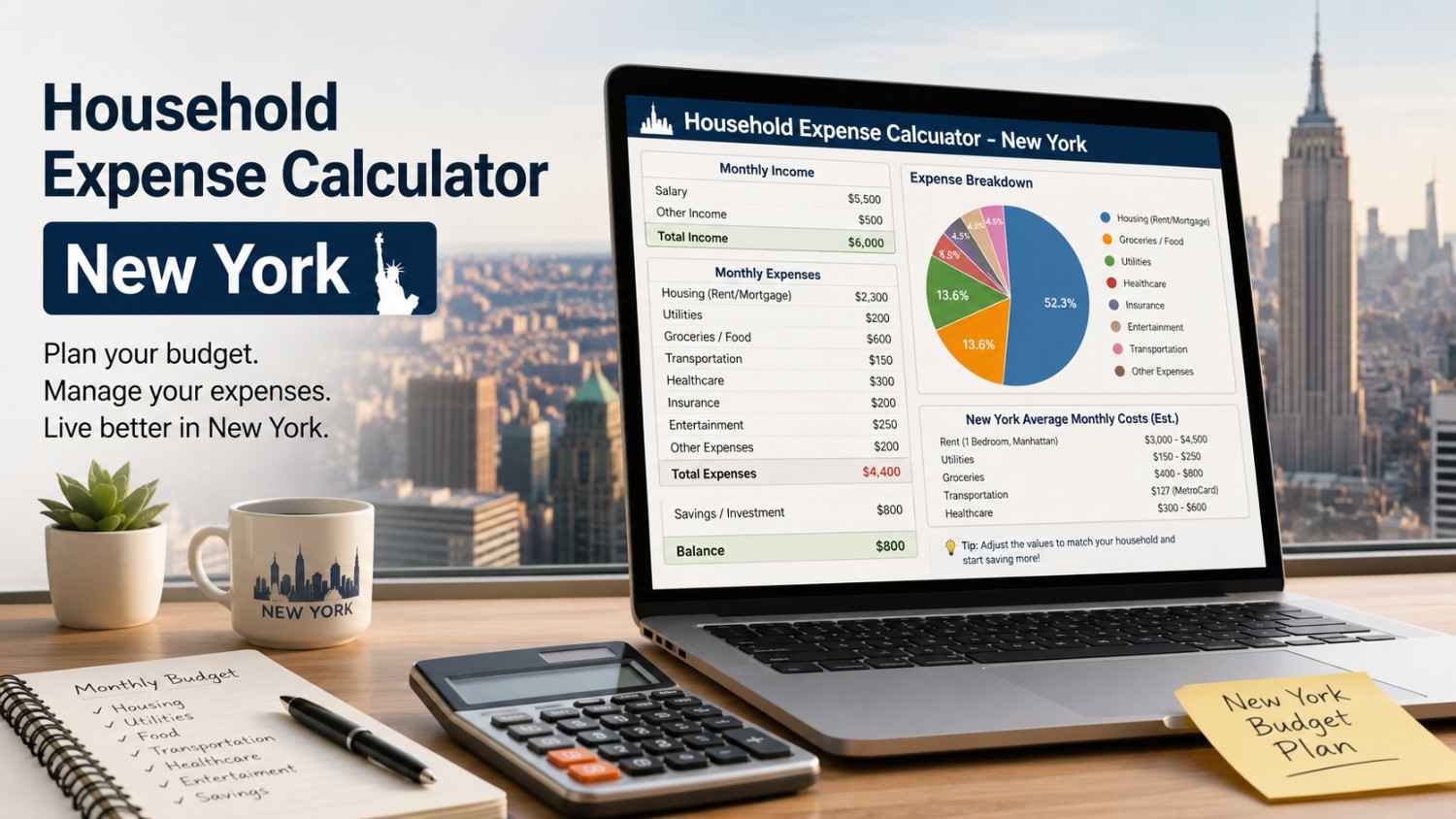
Managing a household in New York requires more than knowing how much you earn. Rent, mortgage payments, groceries, electricity, transportation, healthcare, insurance, childcare, taxes, and everyday purchases all compete for the same paycheck. Even households with a relatively comfortable income can find it difficult to understand where their money actually goes.
That is why having a clear household budget matters.
The Household Expense Calculator New York helps you estimate your family’s monthly, weekly, and annual living expenses using your own numbers. Instead of relying on a generic national budget, you can enter your actual housing costs, transportation expenses, food spending, family commitments, and other recurring payments.
Whether you live in Manhattan, Brooklyn, Queens, Buffalo, Albany, Rochester, Syracuse, Long Island, or another part of New York State, this calculator can help you organize your household finances and understand how much money remains after paying your regular expenses.
Use the calculator below to create a household budget based on your personal financial situation.
Household Expense Calculator New York
A household expense calculator is a budgeting tool that combines your regular living costs into one financial overview. It helps you see your total spending, compare expenses with household income, and estimate how much money you may have left each month.
The calculator on this page allows you to enter expenses across multiple categories, including:
- Housing and mortgage payments
- Electricity, gas, water, and internet
- Groceries and household supplies
- Transportation and vehicle costs
- Healthcare and insurance
- Childcare and education
- Credit card and loan payments
- Entertainment and personal spending
- Savings and emergency funds
- Other recurring household costs
You can use your own expense figures rather than accepting a preset cost estimate as if it represented every New York household.
Household Expense Calculator New York
Calculate your family’s monthly, weekly and annual expenses. Understand your household budget, compare spending with income, and plan your finances with confidence.
1. Location Information
Location is for organizing your budget. The calculator does not automatically apply local market prices.
2. Household Information
Enter combined after-tax household income, including any additional income you want to count.
3. Monthly Household Expenses
Enter your average monthly spending in each category. Leave categories at $0 if they do not apply.
Avoid double counting. For example, do not enter property taxes separately if they are already included in your mortgage figure. Do not count credit card purchases again if they are already listed in another expense category.
Your New York Household Budget Report
Your personalized expense summary
Monthly Expense Breakdown
Detailed Annual Budget
| Expense Category | Monthly | Annual |
|---|---|---|
| Total | $0 | $0 |
Budget Insights
Household Expense Calculator for New York residents. Your entered figures are processed in your browser by this calculator. No external API is required.
After entering your information, review your monthly total, annual spending, weekly equivalent, remaining income, and category-by-category expense breakdown.
How Much Does the Average Household Spend in New York?
New York is not one uniform housing or consumer market. A household renting an apartment in Manhattan may face a very different budget from a family owning a home in a smaller Upstate community.
One useful benchmark comes from the U.S. Bureau of Labor Statistics (BLS).
According to its January 6, 2026 release covering the 2023–24 Consumer Expenditure Survey, households in the New York–Newark–Jersey City metropolitan area spent an average of $91,520 per year. Housing, food, and transportation together represented 64.6% of that spending.
That figure is useful for understanding the scale of household spending in the metropolitan area, but it should not be treated as a statewide average or as the amount every family needs.
A household’s actual costs depend on its location, family size, housing arrangement, commuting habits, insurance coverage, and personal choices.
For a more realistic estimate, enter your own expenses in the calculator instead of simply multiplying a published average.
New York City vs. Upstate New York: Why Location Matters
One of the biggest mistakes people make when estimating New York living costs is assuming that expenses are similar throughout the state.
They are not.
New York City
New York City households may face several location-specific costs:
- Higher rent in many neighborhoods
- Parking and vehicle ownership expenses
- Public transportation and commuting costs
- Higher prices for certain services
- Childcare and after-school care expenses
- Additional costs associated with smaller living spaces
However, a household without a car may avoid expenses such as auto insurance, fuel, vehicle financing, parking, and maintenance.
Long Island and the Hudson Valley
Households in Nassau, Suffolk, Westchester, and surrounding communities may need to consider a combination of housing costs and commuting expenses.
Owning a vehicle can become more important depending on the neighborhood, workplace, and access to public transportation.
Property taxes, homeowners insurance, heating, and home maintenance may also make a significant difference for homeowners.
Upstate New York
Cities and communities such as Buffalo, Rochester, Syracuse, Albany, and smaller surrounding towns have different housing markets and transportation patterns.
Some households may spend less on housing than comparable households in New York City, but that does not automatically mean their total cost of living will be low.
Heating during winter, vehicle ownership, property maintenance, and longer commuting distances can influence the annual budget.
The best approach is to calculate expenses using the actual costs of your household and location.
Understanding the Main Categories of Household Expenses
A useful household budget should include more than rent and groceries. Some expenses are easy to remember because they arrive every month, while others occur occasionally and can create financial pressure when they are overlooked.
1. Housing Expenses
Housing is often one of the largest parts of a household budget.
Renters should include:
- Monthly rent
- Renter’s insurance
- Parking fees
- Storage costs
- Additional building charges
- Regular maintenance or service expenses paid by the tenant
Homeowners should consider:
- Mortgage principal and interest
- Property taxes
- Homeowners insurance
- HOA or condominium fees
- Repairs and maintenance
- Heating and other property-related expenses
Do not count an expense twice. For example, if your mortgage payment already includes an escrow amount for property taxes and insurance, avoid entering those same amounts again.
2. Electricity, Gas, Water, and Internet
Utility costs can change throughout the year.
In colder parts of New York, winter heating may increase household spending. Electricity use can also rise during periods of heavy heating or air-conditioning use.
Your utility budget may include:
- Electricity
- Natural gas
- Heating oil
- Water and sewer
- Trash collection
- Internet
- Mobile phone services
- Cable or streaming services
For a better annual estimate, consider reviewing your previous 12 months of bills rather than relying on only one month’s payment.
3. Groceries and Household Supplies
Food spending depends on household size, shopping habits, dietary preferences, and how often family members eat outside the home.
Separate grocery spending from restaurant spending whenever possible.
Include:
- Supermarket purchases
- Meat, fish, fruits, and vegetables
- Dairy and bakery products
- Cleaning supplies
- Laundry products
- Paper products
- Toiletries
- Other household essentials
A family that cooks at home regularly may have a very different spending pattern from a household that frequently purchases prepared meals.
4. Transportation Expenses
Transportation is particularly important when comparing New York City with other parts of the state.
A household that relies on the subway and buses may have a different transportation budget from a family that owns two vehicles.
Consider including:
- Subway and bus fares
- Commuter rail
- Vehicle loan or lease payments
- Gasoline
- Auto insurance
- Vehicle registration
- Parking
- Tolls
- Repairs and maintenance
- Rideshare services
If you own a car, do not forget less frequent expenses such as tires, inspections, registration renewals, and unexpected repairs.
5. Healthcare and Insurance
Healthcare costs can vary considerably depending on employment benefits, insurance plans, family size, and individual medical needs.
Your budget may include:
- Health insurance premiums paid directly by your household
- Dental insurance
- Vision insurance
- Prescription medications
- Doctor visits
- Copayments
- Deductibles
- Dental appointments
- Other out-of-pocket healthcare expenses
If health insurance is deducted from your paycheck, make sure you understand whether your income figure is before or after that deduction. Avoid counting the same premium twice.
6. Childcare and Education
Families with children often need a separate childcare and education budget.
Possible expenses include:
- Daycare
- Preschool
- Babysitting
- After-school programs
- School supplies
- Tuition
- Tutoring
- Children’s activities
- School transportation
The age of a child and the number of children requiring care can significantly change a family’s monthly expenses.
New York State’s childcare and family support programs may also affect eligible households. However, eligibility and actual costs should be checked using current official program information rather than assumed in a household calculator.
7. Credit Cards, Loans, and Debt Payments
Debt payments should be included because they reduce the money available for everyday household needs.
Examples include:
- Credit card minimum payments
- Personal loans
- Auto loans
- Student loans
- Other installment payments
For better financial planning, distinguish between your required monthly payments and additional payments you voluntarily make toward reducing debt.
Remember that credit card purchases should not be counted twice. If you already included groceries and other purchases in their relevant categories, do not add the full credit card statement again as another household expense.
8. Entertainment and Personal Spending
A realistic budget should include reasonable personal spending rather than assuming that every dollar goes toward basic necessities.
Examples include:
- Restaurants
- Movies and entertainment
- Gym memberships
- Clothing
- Personal care
- Hobbies
- Travel savings
- Subscriptions
These expenses may be adjustable when you need to reduce your monthly spending.
9. Savings and Emergency Funds
Savings deserve a separate place in your financial plan.
Consider setting aside money for:
- Emergency savings
- Retirement contributions
- Future home repairs
- Medical emergencies
- Vehicle replacement
- Education
- Planned travel
- Other financial goals
An emergency fund can help protect a household from unexpected expenses without immediately relying on credit cards or personal loans.
There is no single savings target that works for everyone. Start with an amount that fits your income, necessary expenses, debt obligations, and financial responsibilities.
What Does the 2026 ALICE Report Tell New York Households?
The United For ALICE 2026 New York report provides another important perspective on household affordability.
According to the report, New York had 7,809,082 households. Of these, 14% were below the Federal Poverty Level, while another 34% were classified as ALICE households.
ALICE stands for Asset Limited, Income Constrained, Employed. These households earn above the Federal Poverty Level but may still struggle to afford basic living costs.
The report estimates the Household Survival Budget at:
- $37,956 annually for one adult
- $102,540 annually for a family of four consisting of two adults, an infant, and a preschooler
These are survival-budget estimates based on specific household compositions and locations, not universal spending averages or recommended salaries.
The important lesson is that an income above the official poverty threshold does not necessarily mean a household can comfortably afford housing, food, transportation, healthcare, and childcare.
This is why a personalized household expense calculator can be more useful than a single statewide average.
How to Calculate Your Monthly Household Expenses
The calculation is straightforward once you have listed your regular costs.
Monthly Household Expenses = Sum of All Monthly Expense Categories
For example, imagine a household enters the following illustrative expenses:
| Expense Category | Monthly Amount |
|---|---|
| Rent | $2,200 |
| Utilities | $250 |
| Groceries | $700 |
| Transportation | $450 |
| Healthcare | $300 |
| Childcare | $500 |
| Insurance | $150 |
| Debt Payments | $250 |
| Personal and Entertainment | $200 |
| Other Expenses | $150 |
| Total | $5,150 |
In this example, the household spends $5,150 per month.
The annual equivalent is:
$5,150 × 12 = $61,800
The weekly equivalent is:
$61,800 ÷ 52 = $1,188.46
These figures are illustrative, not New York market averages.
Your own result will depend on the numbers you enter.
How to Understand Your Household Budget Results
After calculating your expenses, look beyond the total amount.
Monthly Remaining Income
Subtract your monthly household expenses from your monthly take-home income.
Remaining Income = Monthly Take-Home Income − Monthly Expenses
If the result is positive, your household has money remaining after the expenses entered.
If the result is negative, your current spending exceeds your stated take-home income.
This does not automatically mean your household is financially unhealthy. It means you should review the numbers, check for missing income, and identify which expenses may need attention.
Expense-to-Income Ratio
Your expense-to-income ratio shows how much of your take-home income is being used for the expenses included in your budget.
For example, if your monthly take-home income is $7,000 and your monthly expenses are $5,600:
$5,600 ÷ $7,000 × 100 = 80%
This means 80% of your take-home income is being used for the expenses entered.
A lower ratio generally leaves more room for savings and unexpected costs, although household circumstances vary.
Category Spending Percentage
You should also understand which categories consume the largest portion of your budget.
For example, housing may represent a much larger share of spending for one family, while childcare or transportation may be the largest category for another.
Identifying these categories helps you decide where a realistic adjustment could make the greatest difference.
Hidden Household Expenses New Yorkers Should Not Forget
Many household budgets look manageable until irregular expenses arrive.
These costs are often overlooked because they do not appear every month.
Seasonal Heating and Cooling
Heating bills can rise during colder months. Air-conditioning can increase electricity costs during summer.
Rather than planning around your lowest utility bill, consider your annual utility spending and divide it by 12.
Home and Vehicle Repairs
A household may need to replace an appliance, repair a roof, fix plumbing, replace vehicle tires, or pay for an unexpected mechanical problem.
These expenses should be considered separately from ordinary monthly maintenance.
Annual and Semiannual Payments
Some insurance premiums, memberships, registration fees, and service contracts are paid annually or twice a year.
Convert them into monthly equivalents when preparing your budget.
For example, a $600 annual expense is equivalent to $50 per month.
School and Holiday Spending
School supplies, seasonal clothing, holiday travel, gifts, and family events can increase spending during certain months.
A planned monthly allowance can make these costs easier to manage.
How to Build a More Realistic New York Household Budget
A useful household budget should reflect your actual lifestyle rather than an idealized spending plan.
Here are several practical steps.
1. Start with take-home income.
Use the amount that reaches your household after payroll deductions. If you enter gross income instead, make sure you do not compare it directly with expenses that must be paid from after-tax money.
2. Review your previous three to twelve months of spending.
Bank statements, credit card statements, utility bills, insurance invoices, and receipts can help you identify expenses that are easy to forget.
3. Separate essential and adjustable expenses.
Rent, utilities, groceries, and necessary transportation are different from optional entertainment and subscriptions.
4. Account for irregular costs.
Divide predictable annual expenses by 12 and include an appropriate monthly amount in your budget.
5. Compare your budget with your income.
Look at the remaining balance and identify categories that may need adjustment.
6. Revisit your numbers regularly.
Rent renewals, insurance changes, utility bills, childcare arrangements, and changes in household income can all affect your financial situation.
How Much Should You Spend on Housing in New York?
There is no single housing percentage that guarantees a comfortable budget.
A commonly discussed guideline is the 30% housing-cost benchmark. It is often used in discussions of housing affordability, but it should not be treated as a complete financial rule.
For example, two households with the same income may have very different financial situations because one has student loans, childcare, or high transportation expenses while the other does not.
A better approach is to calculate your actual housing costs alongside all other household expenses.
For homeowners, remember to include property taxes, insurance, repairs, and applicable association fees. For renters, consider rent increases, parking, renter’s insurance, and additional housing charges.
How to Reduce Household Expenses Without Sacrificing Essential Needs
Reducing expenses does not necessarily mean eliminating everything enjoyable.
Start by reviewing costs that can be adjusted without creating unnecessary financial stress.
- Compare internet and mobile plans.
- Review unused streaming and subscription services.
- Plan grocery purchases before shopping.
- Reduce avoidable food waste.
- Compare insurance coverage and renewal prices.
- Review transportation choices and commuting costs.
- Check whether eligible public benefits or assistance programs can reduce household expenses.
- Plan ahead for seasonal utility costs.
- Avoid paying unnecessary interest and fees.
- Build an emergency fund gradually.
When comparing services or insurance, look at the coverage and terms rather than choosing solely on the lowest advertised price.
What Official Data Can and Cannot Tell You
Published household expense data can provide useful context, but every source measures something different.
The BLS Consumer Expenditure Survey reports average spending across a defined population and geographic area. It is useful for understanding spending patterns but does not describe every household in New York State.
The United For ALICE Household Survival Budget estimates the cost of basic needs for specific household types and locations. It is designed to measure financial hardship, not to represent a comfortable lifestyle.
The IRS Local Standards for Housing and Utilities provide county-level allowances for federal tax administration. They should not be interpreted as recommended rental prices or ordinary household spending averages.
The New York State Department of Labor’s Self-Sufficiency Earnings Estimator is another useful resource because it allows users to explore how family composition and county location influence the income needed to meet basic expenses.
Use these sources as reference points, not substitutes for your actual bills.
Frequently Asked Questions
1. What is a Household Expense Calculator?
A household expense calculator is a budgeting tool that adds your regular household costs, including housing, groceries, utilities, transportation, healthcare, childcare, debt, and personal expenses. It can help you understand your monthly and annual spending.
2. How much does an average household spend in New York?
Spending varies significantly by location, household size, and lifestyle. The BLS reported average annual expenditures of $91,520 for the New York–Newark–Jersey City metropolitan area in 2023–24. This is a metropolitan-area figure, not a statewide average.
3. Does this calculator work for all New York counties?
Yes. You can use it for households throughout New York State by entering your actual expenses. The selected location helps organize your budget, but it does not automatically determine your rent, utilities, or other costs.
4. Can I calculate expenses for a family of four?
Yes. Enter the combined monthly expenses of the household. Include the costs of both adults and all children, such as groceries, childcare, healthcare, transportation, and housing.
5. Should I use gross income or take-home income?
For comparing your income with monthly household bills, take-home income is generally more useful because it represents the money available after payroll deductions. Be consistent and avoid counting deductions twice.
6. Are mortgage payments and property taxes separate expenses?
They can be entered separately if you pay them separately. If your mortgage payment already includes property taxes and insurance through escrow, avoid entering those amounts again.
7. Should I include credit card payments?
Include required credit card payments as debt obligations. However, do not count purchases twice. If grocery and utility spending is already included in their categories, do not add the full credit card statement as another expense.
8. How do I calculate annual household expenses?
Multiply your monthly expenses by 12 if your spending is relatively consistent. For a more accurate annual estimate, include seasonal bills, annual insurance payments, maintenance, and other irregular costs.
9. Why are household expenses different in NYC and Upstate New York?
Housing markets, transportation options, commuting distances, property taxes, utilities, childcare availability, and local service prices vary. As a result, households with similar incomes may have very different budgets.
10. What if my household expenses are higher than my income?
First, review your entries for duplicate expenses or missing income. Then identify which costs are essential and which may be adjustable. If the shortfall continues, consider speaking with a qualified nonprofit financial counselor.
11. Does the calculator use live New York market prices?
No. The calculator is designed to calculate the figures you enter. It does not claim to provide live rent quotes, utility prices, grocery prices, or personalized tax calculations.
12. Can I use this calculator for a retirement budget?
Yes. Retirees can enter pension income, Social Security income, housing, healthcare, insurance, transportation, food, and other recurring costs to prepare a household budget.
13. How often should I update my household budget?
Review it monthly and whenever a major expense changes. At minimum, reassess your budget after rent renewals, insurance changes, income changes, and major household purchases.
14. Is the Household Expense Calculator free?
Yes. You can use the calculator on this page to enter your household income and expenses and view your estimated monthly, weekly, and annual budget.
Final Thoughts
A realistic household budget is not simply a list of bills. It is a way to understand how your income supports your housing, family, transportation, health, and financial goals.
New York households face different financial pressures depending on where they live and how their families are structured. A useful budget should reflect those differences instead of relying on one number for the entire state.
Use the Household Expense Calculator above with your actual figures, review the categories carefully, and update your information whenever your financial situation changes.
The goal is not to achieve a perfect budget. It is to make better financial decisions with a clearer understanding of where your money goes.
Article written by Junaidul Islam for NewYorkCalculator.com.
Financial information on this page is for general educational and budgeting purposes. Calculator results are estimates based on user-entered information and should not be considered financial, legal, tax, or investment advice.
Sources and Further Reading
- U.S. Bureau of Labor Statistics – Consumer Expenditures in the New York Metropolitan Area, 2023–24
- United For ALICE – The State of ALICE in New York, 2026 Report
- New York State Department of Labor – Self-Sufficiency Earnings Estimator
- Internal Revenue Service – New York Local Standards: Housing and Utilities
- Federal Reserve Bank of New York – Survey of Consumer Expectations: Household Spending
- NYC Government – True Cost of Living Report