
Raising a family in New York can be expensive. From childcare and groceries to housing, healthcare, and school expenses, parents face significant financial responsibilities. Fortunately, eligible families may qualify for valuable tax credits that can reduce their federal and New York State tax bills or increase their tax refunds.
The New York Child Tax Credit system includes two separate benefits: the federal Child Tax Credit (CTC) and the New York Empire State Child Credit (ESCC). Although both programs support families with qualifying children, their eligibility rules, income limits, identification requirements, and credit amounts are different.
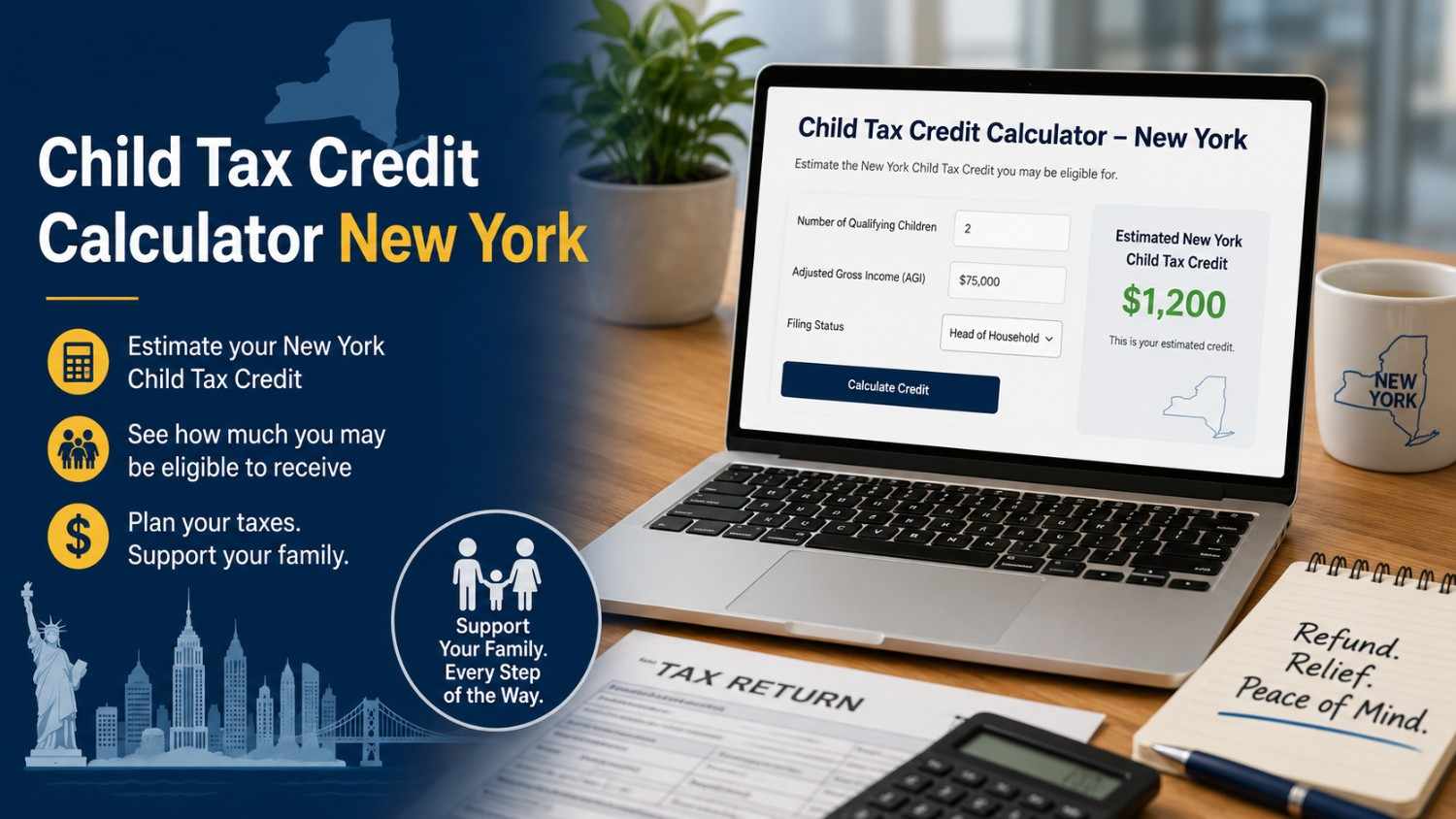
Our Child Tax Credit Calculator New York helps you estimate these benefits using your tax year, filing status, household income, and the number and ages of your qualifying children. Instead of guessing how much you might receive, you can review a breakdown of potential federal and state credits in one place.
Whether you live in New York City, Buffalo, Albany, Rochester, Syracuse, or another part of New York State, this guide explains the important rules you should understand before filing your tax return.
Important: This calculator provides an educational estimate, not an official tax determination. Your final credit depends on your complete federal and New York tax returns.
Use the calculator below to estimate your potential Federal Child Tax Credit and New York Empire State Child Credit.
New York Child Tax Credit Calculator
Estimate your 2025 or 2026 Federal Child Tax Credit and New York Empire State Child Credit.
1. Tax Information
2. Children Information
3. Eligibility Confirmation
Your Estimated Tax Credit Results
Calculation Breakdown
The calculator separates federal and state benefits because the two programs do not use identical eligibility requirements. Make sure you select the correct tax year before entering your information.
What Is the Child Tax Credit in New York?
New York families may qualify for two different child-related tax credits.
1. Federal Child Tax Credit
The Federal Child Tax Credit is administered by the Internal Revenue Service (IRS). It helps eligible taxpayers who have qualifying children under age 17 at the end of the tax year.
For tax years 2025 and 2026, the maximum federal credit is $2,200 per qualifying child. The refundable portion, known as the Additional Child Tax Credit (ACTC), can be as much as $1,700 per qualifying child.
The federal credit is subject to income limits and other eligibility conditions. A taxpayer’s income, filing status, earned income, tax liability, and the child’s identification information can all affect the amount available.
2. New York Empire State Child Credit
The Empire State Child Credit is a separate refundable New York State tax credit. It is administered by the New York State Department of Taxation and Finance.
The credit was significantly expanded beginning with the 2025 tax year. Unlike the federal credit, the New York program has different payment amounts for younger and older children.
For tax year 2026, eligible families may receive:
- $1,000 for each qualifying child younger than age four.
- $500 for each qualifying child aged four through 16.
The credit is refundable. This means an eligible taxpayer may receive the benefit even when the credit exceeds their New York State income tax liability.
The two programs should not be confused. Qualifying for the New York credit does not automatically mean you qualify for the federal credit, and the reverse is also true.
Federal Child Tax Credit Amount for 2025 and 2026
The federal Child Tax Credit provides up to $2,200 for each qualifying child for both the 2025 and 2026 tax years.
| Federal CTC detail | 2025 | 2026 |
|---|---|---|
| Maximum credit per qualifying child | $2,200 | $2,200 |
| Maximum refundable ACTC per child | $1,700 | $1,700 |
| Child age requirement | Under 17 | Under 17 |
| Single and most other filing statuses phaseout begins | $200,000 | $200,000 |
| Married Filing Jointly phaseout begins | $400,000 | $400,000 |
| Earned income threshold for ACTC formula | $2,500 | $2,500 |
These amounts are based on IRS tax-year guidance. The 2026 instructions and applicable inflation adjustments should be checked again when preparing the actual return.
How Federal Income Limits Affect Your Credit
The federal CTC begins to phase out when modified adjusted gross income (MAGI) exceeds:
- $200,000 for Single, Head of Household, and most other filing statuses.
- $400,000 for Married Filing Jointly.
The credit is generally reduced by $50 for each $1,000, or part of $1,000, that MAGI exceeds the applicable threshold.
For example, a single taxpayer with MAGI of $205,000 is $5,000 above the $200,000 threshold. The phaseout reduction would generally be $250.
The actual available credit also depends on the number of qualifying children and other federal tax rules.
New York Empire State Child Credit Amounts
The Empire State Child Credit changed substantially for tax year 2025.
The following comparison shows why choosing the correct tax year is essential.
| Child’s age | Tax year 2025 | Tax year 2026 |
|---|---|---|
| Under age 4 | $1,000 | $1,000 |
| Age 4–16 | $330 | $500 |
| Age 17 or older | Not eligible | Not eligible |
For example, a qualifying New York family with two children aged two and seven could have the following maximum state credit:
Tax Year 2025
- Child aged two: $1,000
- Child aged seven: $330
- Potential total: $1,330 before any income-based reduction.
Tax Year 2026
- Child aged two: $1,000
- Child aged seven: $500
- Potential total: $1,500 before any income-based reduction.
These examples assume that both children meet the applicable eligibility requirements and that the household qualifies for the full state credit.
New York Child Tax Credit Income Limits
The Empire State Child Credit uses different income thresholds depending on filing status.
| New York filing status | Income threshold |
|---|---|
| Married Filing Jointly | $110,000 |
| Single | $75,000 |
| Head of Household | $75,000 |
| Qualifying Surviving Spouse | $75,000 |
| Married Filing Separately | $55,000 |
When federal adjusted gross income (AGI) exceeds the applicable threshold, the New York credit is reduced.
The reduction is $16.50 for every $1,000 of income above the threshold. For the official calculation, the excess AGI is rounded down to the nearest $1,000.
Example of New York Income Phaseout
Imagine a Single taxpayer has federal AGI of $80,000.
The applicable threshold is $75,000.
Excess income:
$80,000 − $75,000 = $5,000
Reduction:
5 × $16.50 = $82.50
If the taxpayer has one qualifying child aged eight in tax year 2026, the initial credit is $500.
After the income reduction:
$500 − $82.50 = $417.50
The estimated state credit is therefore $417.50.
This is a simplified example. The official tax form and instructions determine the final amount.
Who Qualifies for the Federal Child Tax Credit?
Not every child living in a household automatically qualifies.
The IRS applies qualifying-child rules to determine whether a taxpayer can claim the federal credit.
Generally, a qualifying child must meet the following conditions:
Age Requirement
The child must be younger than 17 at the end of the tax year. A child who turns 17 during the year generally does not qualify for the federal CTC for that year.
Relationship Requirement
The child must be the taxpayer’s qualifying son, daughter, stepchild, eligible foster child, sibling, stepsibling, half-sibling, or a descendant of one of these relatives, such as a grandchild, niece, or nephew.
Residency Requirement
The child generally must have lived with the taxpayer for more than half of the tax year, subject to specific IRS exceptions.
Support Requirement
The child must not have provided more than half of their own support during the tax year.
Dependent Requirement
The child must generally be claimed as a dependent on the taxpayer’s federal income tax return.
Citizenship and Residency Status
The child must generally be a U.S. citizen, U.S. national, or U.S. resident alien.
Social Security Number Requirement
For the federal CTC, the qualifying child must have a valid Social Security number (SSN) issued by the return’s due date, including extensions, and valid for employment in the United States.
Beginning with tax year 2025, the taxpayer or at least one spouse on a joint return must also meet the applicable SSN requirement. For a joint return, the other spouse may generally use an SSN or an eligible ITIN issued by the return’s due date.
These identification requirements are important. An ITIN for a child does not satisfy the federal qualifying-child SSN requirement for the CTC.
Who Qualifies for the New York Empire State Child Credit?
New York State has its own eligibility rules.
Generally, you must:
- Be a full-year New York State resident.
- Have at least one qualifying child younger than 17 on December 31 of the tax year.
- Meet the applicable relationship and residency requirements for the child.
- Provide a valid SSN or ITIN for yourself and each child listed on Form IT-213.
- File a New York State income tax return and claim the credit using the applicable form.
A qualifying child generally must have lived with you for more than half of the year, must not have provided more than half of their own support, and must meet the relationship requirements.
One important difference is that New York’s Empire State Child Credit accepts qualifying SSNs or ITINs for the taxpayer and children. This is different from the federal CTC’s qualifying-child SSN rule.
What About Part-Year New York Residents?
The Empire State Child Credit is generally available to full-year New York State residents.
If you moved into or out of New York during the tax year, do not assume that you automatically qualify for the full credit. Review the New York State residency rules and the relevant tax-year instructions.
A New York City address and New York State residency are also not interchangeable concepts. NYC is within New York State, but local tax obligations can be different.
Refundable vs. Nonrefundable Child Tax Credits
Understanding the difference between refundable and nonrefundable credits can help you interpret your calculator results.
What Is a Nonrefundable Credit?
A nonrefundable tax credit can reduce your tax liability, but generally cannot reduce that particular tax below zero.
For example, if your eligible nonrefundable credit is $2,000 but your applicable tax liability is only $1,200, you may use only $1,200 of that nonrefundable credit.
The unused amount does not automatically become a cash refund.
What Is a Refundable Credit?
A refundable credit can provide a payment even when the amount of the credit exceeds your tax liability.
The New York Empire State Child Credit is refundable.
The federal refundable portion of the CTC is called the Additional Child Tax Credit.
Additional Child Tax Credit (ACTC)
For tax years 2025 and 2026, the ACTC can be worth up to $1,700 per qualifying child.
The general earned-income calculation allows 15% of earned income above $2,500, subject to the applicable per-child maximum and other limitations.
For example:
- Earned income: $20,000
- Amount above $2,500: $17,500
- 15% of $17,500: $2,625
With one qualifying child, the general ACTC maximum would limit the amount to $1,700.
This does not mean every taxpayer automatically receives $1,700. The unused CTC, earned-income calculation, qualifying-child rules, and other Schedule 8812 limitations determine the actual refundable amount.
How Much Child Tax Credit Can a New York Family Receive?
The combined value of the federal and state credits can be significant.
Consider a hypothetical New York family with:
- Two qualifying children.
- One child aged two.
- One child aged eight.
- Married Filing Jointly.
- Federal AGI of $90,000.
- Full-year New York State residency.
- All applicable eligibility requirements satisfied.
Federal Credit
Two children × $2,200 = $4,400 potential federal CTC.
New York State Credit for 2026
Child aged two = $1,000.
Child aged eight = $500.
Initial state credit = $1,500.
The family’s AGI is below the $110,000 joint-filing threshold, so the illustrated state credit is not reduced by the income phaseout.
Combined Potential Credit
Federal CTC: $4,400
New York Empire State Child Credit: $1,500
Potential combined credit: $5,900.
This is an illustration of potential credit amounts, not a guaranteed tax refund. The actual federal refundable and nonrefundable portions depend on the family’s federal tax return.
Can Low-Income Families Receive the New York Child Tax Credit?
Yes. The expanded Empire State Child Credit removed the former minimum-income phase-in restriction for the enhanced credit.
This is particularly important for lower-income families.
Under the current state rules, eligible full-year residents may qualify for the full age-based credit even when their income is low, subject to the other eligibility requirements.
The federal credit works differently. The refundable ACTC has an earned-income formula, so a household’s earned income can affect how much of the federal credit is refundable.
Families with low or no earnings should also review other available programs, including:
- Federal Earned Income Tax Credit (EITC).
- New York State Earned Income Credit.
- New York City Earned Income Credit, if eligible.
- Child and Dependent Care Credit.
- Other applicable family tax benefits.
These programs have separate eligibility requirements. Qualifying for one does not automatically qualify you for another.
Child Tax Credit for Divorced or Separated Parents
Divorced and separated parents should pay particular attention to the dependent and custody rules.
Generally, only one parent can claim a child for the federal CTC for a particular tax year.
The custodial parent is usually the parent with whom the child lived for the greater number of nights during the year.
There are special rules that may allow a noncustodial parent to claim certain dependency-related benefits when the custodial parent releases the claim using the appropriate documentation, generally Form 8332.
However, a divorce decree or private agreement alone does not automatically override federal tax requirements.
Parents should also consider New York’s separate eligibility requirements when claiming the Empire State Child Credit.
If both parents attempt to claim the same child, the IRS may reject or review the returns. Keep custody records, residency information, and required documentation.
Does New York City Have a Separate Child Tax Credit?
The Federal Child Tax Credit and Empire State Child Credit are available to eligible families throughout New York State, including New York City.
However, NYC residents may also qualify for certain city-specific tax benefits, such as the NYC Earned Income Credit, depending on their income, filing status, and other circumstances.
Do not confuse the NYC Earned Income Credit with the Empire State Child Credit.
The NYC EITC is a separate benefit with different eligibility and calculation rules.
For this reason, a calculator that estimates only federal CTC and state ESCC should not advertise its result as the family’s complete New York tax refund.
How to Claim the Child Tax Credit in New York
You generally need to file both the appropriate federal and New York State income tax returns to claim the respective credits.
Step 1: Prepare Your Federal Tax Return
Use Form 1040 and the applicable instructions.
The federal Child Tax Credit and Additional Child Tax Credit are generally calculated using Schedule 8812.
Step 2: Prepare Your New York State Return
New York residents generally use Form IT-201 for their resident income tax return.
Step 3: Complete Form IT-213
Eligible taxpayers use Form IT-213, Claim for Empire State Child Credit, to calculate and claim the New York State credit.
Always use the form and instructions for the correct tax year.
Step 4: Review Child Information
Check each child’s:
- Full legal name.
- Date of birth.
- SSN or applicable identification number.
- Relationship to the taxpayer.
- Residency information.
- Dependent status, where applicable.
Step 5: Submit Your Returns
Submit your federal and state returns using an eligible filing method.
Keep copies of your returns and supporting records.
Important Tax Forms for New York Parents
| Form | Purpose |
|---|---|
| Federal Form 1040 | Individual federal income tax return |
| Schedule 8812 | Federal CTC and ACTC calculation |
| Form IT-201 | New York resident income tax return |
| Form IT-213 | Empire State Child Credit |
| Form 8332 | Release or revocation of a custodial parent’s claim to a child, when applicable |
Forms can change between tax years. Always download the current version from the official government website.
When Will You Receive Your Child Tax Credit Refund?
The timing depends on how and when you file your returns, whether the returns require additional review, and whether you claim refundable credits.
The IRS generally cannot issue refunds before mid-February for returns claiming the ACTC. This restriction applies to the entire refund, not just the ACTC portion.
For New York State refunds, processing times can vary.
You can use the official refund-tracking services:
- IRS Where’s My Refund: https://www.irs.gov/wheres-my-refund
- New York State Check Your Refund Status: https://www.tax.ny.gov/pit/file/refund.htm
A calculator cannot determine your refund date or guarantee that a refund has been approved.
Common Child Tax Credit Mistakes New York Families Should Avoid
1. Selecting the Wrong Tax Year
The 2025 and 2026 New York Empire State Child Credit amounts are different for children aged four through 16.
2. Assuming Every Dependent Qualifies
A child must meet specific qualifying-child requirements. Simply listing someone as a household member is not enough.
3. Confusing AGI With Take-Home Pay
The New York state phaseout uses federal adjusted gross income, not monthly take-home pay or gross salary alone.
4. Assuming the Full Federal Credit Is Refundable
The maximum federal CTC and the maximum ACTC are not the same amount.
5. Using an ITIN for a Child to Claim Federal CTC
A child’s ITIN does not replace the federal qualifying-child SSN requirement.
6. Forgetting Form IT-213
Eligible New York taxpayers need to follow the applicable state filing instructions to claim the Empire State Child Credit.
7. Allowing Two Parents to Claim the Same Child
Custody and dependent rules determine which parent can claim the child.
Federal Child Tax Credit vs. New York Empire State Child Credit
| Feature | Federal CTC | Empire State Child Credit |
|---|---|---|
| Administered by | IRS | NY Tax Department |
| Tax year 2026 maximum | $2,200 per child | $1,000 or $500 |
| Child age | Under 17 | Under 17 |
| Income phaseout | $200,000 / $400,000 | $55,000 / $75,000 / $110,000 |
| Refundable portion | ACTC, up to $1,700 | Refundable state credit |
| Child identification | Qualifying SSN | SSN or ITIN |
| Main federal/state form | Schedule 8812 | Form IT-213 |
Frequently Asked Questions
1. How much is the Child Tax Credit in New York in 2026?
Eligible families may receive up to $2,200 per qualifying child through the federal CTC. The New York Empire State Child Credit provides $1,000 for each qualifying child under age four and $500 for each qualifying child aged four through 16.
2. Is the New York Child Tax Credit refundable?
Yes. The Empire State Child Credit is refundable. Eligible taxpayers may receive the credit even when it exceeds their New York State income tax liability.
3. What is the income limit for the New York Empire State Child Credit?
The income thresholds are $110,000 for Married Filing Jointly, $75,000 for Single and Head of Household, and $55,000 for Married Filing Separately.
4. Can I claim the federal CTC with an ITIN?
A qualifying child needs a valid employment-eligible SSN for the federal CTC. A taxpayer filing jointly may generally have one spouse with an SSN and the other with an SSN or eligible ITIN. Special identification rules apply.
5. Can I get the New York Child Credit if I have a low income?
Yes. The enhanced Empire State Child Credit no longer has the former minimum-income phase-in requirement. You must still meet the residency, qualifying-child, and other applicable requirements.
6. Can I claim both the federal CTC and New York Child Credit?
Yes. Eligible taxpayers may claim both because they are separate tax programs. Each has its own eligibility and calculation rules.
7. What happens if my child turns 17 during 2026?
A child who is 17 on December 31, 2026, generally does not qualify for either the federal CTC or the New York Empire State Child Credit for tax year 2026.
8. Can both parents claim the same child?
Generally, no. Federal tax rules usually allow only one taxpayer to claim the child for the same tax year. Special custodial-parent release rules may apply.
9. Which New York form is used to claim the Empire State Child Credit?
Eligible taxpayers generally use Form IT-213 with their New York State income tax return.
10. Does New York City have a separate Child Tax Credit?
The Empire State Child Credit is available across New York State. NYC residents may also qualify for other city tax benefits, including the NYC Earned Income Credit, subject to separate requirements.
11. Is the calculator an official IRS or New York State tool?
No. It is an independent educational calculator. It provides estimates based on the information entered and does not replace official tax forms or professional tax advice.
12. Can I use the calculator for 2025 and 2026?
Yes. Select the applicable tax year before entering your details. The state credit for children aged four through 16 differs between the two years.
Official Sources and Tax References
For accurate tax information, use official government resources rather than relying only on third-party calculators.
- IRS Child Tax Credit: https://www.irs.gov/credits-deductions/individuals/child-tax-credit
- IRS Schedule 8812 Instructions: https://www.irs.gov/instructions/i1040s8
- IRS 2026 Schedule 8812 Draft: https://www.irs.gov/pub/irs-dft/i1040s8–dft.pdf
- New York Empire State Child Credit: https://www.tax.ny.gov/pit/credits/empire_state_child_credit.htm
- New York Form IT-213 Instructions: https://www.tax.ny.gov/forms/current-forms/it/it213i.htm
- New York Tax Law Section 606: https://www.nysenate.gov/legislation/laws/TAX/606
- IRS Refund Tracking: https://www.irs.gov/wheres-my-refund
- New York Refund Tracking: https://www.tax.ny.gov/pit/file/refund.htm
Disclaimer
This article and calculator are provided for general educational and informational purposes. They do not constitute legal, financial, or tax advice. Tax laws, eligibility conditions, and filing requirements can change. The estimated results are not a guarantee of a tax credit or refund. Always verify your eligibility using the latest IRS and New York State tax instructions or consult a qualified tax professional before filing.
Article written by Junaidul Islam for NewYorkCalculator.com. Last Updated: October 12, 2026