
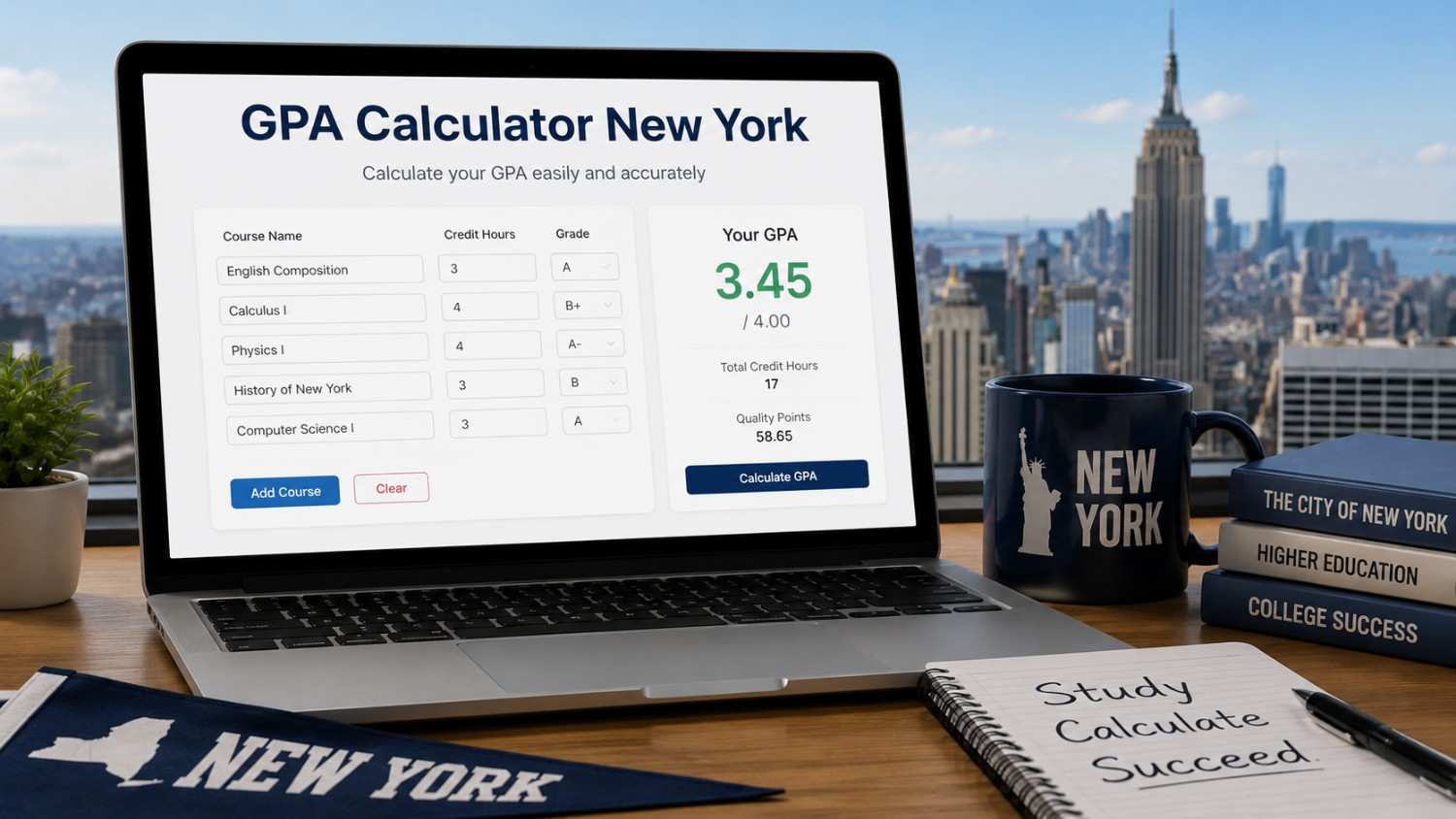
By Junaidul Islam If you are a high school or college student in New York and want to know your GPA, you do not always need to calculate every course by hand.
This New York GPA Calculator lets you enter your courses, credits, and grades to estimate your GPA quickly. You can also use the calculator to understand your cumulative GPA and see what average you may need in future courses to reach a target GPA.
Important: New York does not have one statewide GPA calculation rule for every high school. The New York State Education Department says grading policies are determined locally by individual schools or districts. College and university grading policies can also differ. Therefore, this calculator should be treated as an educational estimate, while your official transcript and institution’s published grading policy remain the final authority.
New York GPA Calculator
Calculate an estimated GPA using course credits and letter grades.
Already have a cumulative GPA? Enter your current GPA, completed GPA credits, target GPA and future credits to estimate the average GPA needed in your future coursework.
How to use the calculator
- Enter the name of each course.
- Enter the number of credits for the course.
- Select the final letter grade.
- Add additional courses if necessary.
- Click Calculate GPA.
- Review your total credits, quality points and estimated GPA.
For a simple 4.0-style calculation, the basic formula is:
GPA = Total Quality Points ÷ Total GPA Credits
For example, if a course is worth 3 credits and the grade has a value of 3.0, that course contributes:
3 × 3.0 = 9.0 quality points
The quality points from all GPA-counted courses are then added together and divided by the credits included in the GPA calculation.
CUNY schools publish this same basic quality-point method in their grading information, although individual institutional policies determine exactly which grades and credits are included.
What Is a GPA?
GPA stands for Grade Point Average. It summarizes your academic performance using numerical grade points.
Instead of looking at every individual letter grade separately, GPA gives you one number that represents the average performance of the courses included in the calculation.
A common 4.0-style scale looks approximately like this:
| Letter Grade | Typical Grade Point |
|---|---|
| A / A+ | 4.00 |
| A- | 3.70 |
| B+ | 3.30 |
| B | 3.00 |
| B- | 2.70 |
| C+ | 2.30 |
| C | 2.00 |
| C- | 1.70 |
| D+ | 1.30 |
| D | 1.00 |
| F | 0.00 |
However, students should not assume that this table applies identically to every New York school.
For example, CUNY institutions use a common quality-point framework, while individual schools may publish their own grade ranges and additional grading symbols. Queensborough Community College lists A = 4.00, A- = 3.70, B+ = 3.30 and so on, while its published grade ranges are institution-specific.
Is There One GPA Scale for Every New York School?
No.
This is one of the most important things New York students should understand.
The New York State Education Department specifically states that grading policies are locally determined by each New York State school or district. The state also says that the format and content of high-school transcripts are generally locally determined, apart from specified state requirements.
That means two New York high schools may use different grading practices.
One school might calculate or report GPA differently from another. Some schools may use weighted systems for advanced courses, while another school may report an unweighted GPA or use a different transcript convention.
Therefore, a calculator can provide an estimate, but your official school transcript is more authoritative than a generic online GPA calculator.
How to Calculate GPA in New York
The easiest way to understand GPA calculation is to look at credits and grade points together.
Suppose a student has these courses:
| Course | Credits | Grade | Grade Points | Quality Points |
|---|---|---|---|---|
| English | 3 | A | 4.00 | 12.00 |
| Mathematics | 4 | B+ | 3.30 | 13.20 |
| Biology | 3 | A- | 3.70 | 11.10 |
| History | 3 | B | 3.00 | 9.00 |
Total credits:
3 + 4 + 3 + 3 = 13
Total quality points:
12 + 13.20 + 11.10 + 9 = 45.30
Estimated GPA:
45.30 ÷ 13 = 3.48
So the estimated GPA is:
3.48
The important point is that GPA is normally credit-weighted. A four-credit class has more influence on the calculation than a one-credit class.
Official CUNY grading guidance describes the same basic process: multiply the grade’s numerical value by course credits, total the quality points, and divide by the credits used in the GPA calculation.
Why Course Credits Matter
Students sometimes make the mistake of simply averaging their letter-grade numbers.
That can produce the wrong result when courses have different credit values.
For example:
- Course A = 1 credit
- Course B = 4 credits
If both courses receive the same grade, they do not contribute the same number of quality points.
The 4-credit course has four times the credit weight of the 1-credit course.
This is why entering the correct number of credits is one of the most important steps when using a GPA calculator.
Semester GPA vs. Cumulative GPA
These two terms are related, but they are not the same.
Semester GPA
Semester GPA measures your performance during one semester or academic term.
For example:
Fall semester GPA = 3.42
Cumulative GPA
Cumulative GPA represents the GPA across the courses included in your academic record according to your institution’s rules.
For example:
- Previous GPA credits: 45
- Previous GPA: 3.10
- New semester credits: 15
- New semester GPA: 3.60
Your cumulative result will not simply be:
(3.10 + 3.60) ÷ 2
Instead, cumulative GPA needs to account for the number of GPA credits behind each result.
That is why students should use total credits and quality points rather than simply averaging semester GPAs.
How to Calculate Your Cumulative GPA
If you already know your current GPA and GPA credits, you can estimate your new cumulative GPA.
Use:
New Cumulative GPA = Total Quality Points ÷ Total GPA Credits
For example, suppose:
- Current GPA = 3.00
- Current GPA credits = 40
Your existing quality points are:
3.00 × 40 = 120
Now suppose you complete another 15 credits with a 3.60 GPA.
New quality points:
3.60 × 15 = 54
Total quality points:
120 + 54 = 174
Total credits:
40 + 15 = 55
New cumulative GPA:
174 ÷ 55 = 3.16
Your GPA therefore increases from approximately 3.00 to 3.16.
How Many A’s Do I Need to Raise My GPA?
This is a much more useful question than simply asking what your current GPA is.
Suppose your current GPA is:
2.80
and you want to reach:
3.20
The answer depends on:
- your current GPA credits,
- how many future credits you will complete,
- and the grades you earn in those future courses.
A student with 15 completed credits may be able to change their GPA much faster than someone with 100 completed credits.
That is because the larger your existing GPA-credit history becomes, the more new credits you generally need to move the cumulative average significantly.
Our calculator can help you estimate your current GPA, while a future-grade planning calculation can be used to understand what average you may need next.
What GPA Do I Need to Reach a Target GPA?
You can use a target-GPA calculation to answer questions such as:
“My GPA is 2.9. What average do I need in my remaining courses to reach 3.2?”
The basic calculation is:
Required Future GPA = (Target Quality Points − Current Quality Points) ÷ Future Credits
For example:
Current GPA: 2.90
Current GPA credits: 60
Target GPA: 3.20
Future credits: 30
Current quality points:
2.90 × 60 = 174
Target total quality points:
3.20 × 90 = 288
Additional quality points required:
288 − 174 = 114
Required future GPA:
114 ÷ 30 = 3.80
So the student would need an average of approximately 3.80 over the remaining 30 credits to finish at a 3.20 cumulative GPA, assuming all those credits count under the same calculation.
This is an estimate, not an institutional academic-advising decision.
Weighted vs. Unweighted GPA in New York
You may have heard students talk about weighted GPA and unweighted GPA.
Unweighted GPA
An unweighted GPA generally evaluates courses using a standard grade-point scale without adding additional course-level weighting.
Weighted GPA
A weighted GPA may give additional value to certain advanced courses, such as:
- Honors
- AP
- IB
- Other advanced coursework
But there is an important New York-specific issue here.
There is no single statewide high-school weighted-GPA formula that every New York school must use.
The New York State Education Department says grading policies are locally determined by schools or districts.
Therefore, you should not assume that an AP or Honors class automatically receives the same GPA bonus at every New York high school.
For an official application, scholarship, transcript or admission requirement, use the GPA reported by your school and follow the institution’s instructions.
Do Regents Exam Scores Automatically Change Your GPA?
Not necessarily.
This is another area where online explanations can be misleading.
The New York State Education Department says it does not require or recommend that Regents Examination scores be included in final course-grade calculations. Local school or district grading policies determine how those scores are treated.
So if you are a New York high-school student, do not assume that a Regents score should simply be entered into a generic GPA calculator as if it were another course grade.
Your school’s grading policy is the better source.
New York High School GPA: Why Your School’s Transcript Matters
For high-school students, the most important number may be the GPA shown on the official transcript.
A generic calculator cannot know every school’s:
- weighting policy,
- course classification,
- transcript rules,
- grade replacement policy,
- treatment of repeated courses,
- treatment of special grades,
- calculation period,
- or internal ranking methodology.
NYSED explains that school and district grading policies are locally determined and that transcript format/content is generally locally determined.
Therefore:
Use an online calculator for planning and estimation. Use your official transcript for official applications.
College GPA Calculator for New York Students
College students generally have a more clearly defined institutional grading policy.
For example, CUNY schools publish quality-point systems in their academic policies.
Queens College lists:
- A+ = 4.0
- A = 4.0
- A- = 3.7
- B+ = 3.3
- B = 3.0
- B- = 2.7
- C+ = 2.3
- C = 2.0
- C- = 1.7
- D+ = 1.3
- D = 1.0
- F = 0.0
It also identifies several non-standard transcript grades that do not affect GPA in the same way as regular letter grades.
Another CUNY institution, Queensborough Community College, publishes a similar quality-point structure and explains the credit-weighted GPA calculation.
This illustrates why students should check the grading policy of their own college rather than assuming every institution calculates GPA identically.
CUNY GPA Calculator
If you attend a CUNY college, your institution’s grading policy is especially important.
CUNY maintains university-wide academic policies and a uniform grade glossary, while individual colleges publish their own academic and grading information.
CUNY grading information commonly uses quality points such as:
A = 4.00
A- = 3.70
B+ = 3.30
B = 3.00
B- = 2.70
C+ = 2.30
C = 2.00
C- = 1.70
D+ = 1.30
D = 1.00
F = 0.00
But CUNY students should still check the exact policy of their college because special grades, repeats, withdrawals, pass/fail courses and other situations may affect the official calculation differently.
CUNY’s official materials show that some grades do not carry numerical quality points and therefore are not included in the GPA in the same way as regular letter grades.
SUNY GPA Calculator
SUNY includes many colleges and universities, and students should check the grading policy of their specific institution.
For example, Empire State University provides a GPA calculator for estimating term and cumulative GPA and specifically notes that the calculation should use credits included in that institution’s GPA calculation.
Its 2026–2027 academic catalog also publishes detailed grading and evaluation policies.
The lesson is simple:
Do not assume every SUNY campus uses exactly the same institutional GPA rules for every situation.
Use your college’s official catalog or registrar information when your GPA is being used for an official academic decision.
Does a 3.0 GPA Mean the Same Thing Everywhere in New York?
Not necessarily.
A 3.0 on a common 4.0 scale is generally interpreted as an average around the B level, but the meaning of a GPA depends on:
- the grading system,
- the school,
- the course difficulty,
- the academic program,
- the institution’s policies,
- and the purpose for which the GPA is being used.
A GPA should therefore be interpreted in context rather than treated as a universal ranking of every student.
Is a 3.5 GPA Good?
A 3.5 GPA is generally a strong academic average on a conventional 4.0 scale.
However, whether it is sufficient for a particular college, major, scholarship or program depends on that institution’s requirements.
Do not use a generic “3.5 guarantees admission” claim. Admission decisions can involve multiple academic and non-academic factors.
Is a 4.0 GPA Good?
A 4.0 is generally the maximum on a standard unweighted 4.0 scale.
But students should be careful when comparing a 4.0 from different schools because high-school weighting systems and transcript practices can differ.
For college students, the official institutional grading policy should be used when determining what a 4.0 represents.
GPA and College Admissions in New York
GPA can be an important part of an admissions profile, but there is no single GPA number that guarantees admission to every New York college.
For example, CUNY publishes admission-review information and statistics for its colleges, demonstrating that admissions can vary considerably among institutions.
If you are applying to college, consider your:
- GPA
- completed courses
- course rigor
- grades in relevant subjects
- test scores where applicable
- activities
- essays
- program requirements
- and the specific college’s current admission criteria.
Always check the current official admission requirements before making an application decision.
Does a Low GPA Mean You Cannot Improve?
No.
A cumulative GPA changes gradually because it contains your previous academic history.
If you have completed only a small number of credits, new grades can have a relatively large effect.
If you have completed many credits, the same number of new A grades may produce a smaller change.
This is why students should focus not only on the GPA number but also on:
Current GPA + completed credits + future credits + expected grades.
That combination gives you a much clearer picture of your academic trajectory.
A Better Way to Think About GPA
Instead of asking only:
“What is my GPA?”
also ask:
“What can I do with my next 12, 15 or 30 credits?”
For example, a student with a 2.80 GPA might be discouraged by the current number.
But if the student has a realistic plan for earning stronger grades in the next several courses, the cumulative GPA can improve.
The goal should be to use GPA as a planning tool—not as a permanent label.
Can I Convert GPA to Percentage?
You will find websites that use formulas such as:
Percentage = GPA × 25
for a 4.0 scale.
That can be useful as a rough mathematical conversion, but it should not automatically be treated as an official transcript conversion.
A GPA is not simply a percentage divided into four equal academic categories.
Different schools, colleges and organizations may use different conversion rules.
If an application specifically asks you to convert your GPA to a percentage, follow the instructions provided by that institution.
What About Pass/Fail, Withdrawals and Other Grades?
This is one of the biggest reasons a generic GPA calculator may differ from an official transcript.
Some institutions have grades such as:
- P / Pass
- W / Withdrawal
- I / Incomplete
- NC / No Credit
- CR / Credit
- repeated-course grades
- administrative withdrawal grades
These may be treated differently from ordinary A–F grades.
For example, CUNY’s published grading information identifies several grades that do not carry ordinary quality points and therefore do not enter the GPA calculation in the same way as A–F grades.
So if your transcript contains special grades, compare your calculator result with your institution’s official GPA calculation.
What If I Repeated a Course?
Course-repeat policies can have a significant effect on GPA.
Some institutions may replace an earlier grade, some may include both attempts in certain calculations, and some may use special rules.
For example, official CUNY policies address repeated-course situations and explain how credits and grades are treated in particular circumstances.
Therefore, do not assume that a generic calculator can reproduce every official repeat-course calculation.
If you repeated a course, check your college’s registrar or academic policy.
Why Our New York GPA Calculator Is Useful
A good GPA calculator should do more than display one number.
The purpose of this tool is to help you:
- estimate your current GPA,
- understand credit weighting,
- check semester performance,
- plan future grades,
- understand cumulative GPA,
- and identify what information you should verify with your school.
The calculator is designed as a planning tool rather than an official transcript generator.
Your information does not need to be publicly posted to calculate a basic GPA. For privacy, avoid entering personally identifiable information that is not necessary for the calculation.
New York GPA Calculator: Quick Example
Imagine you have four classes:
English — 3 credits — A
Math — 4 credits — B
Biology — 3 credits — A-
History — 3 credits — B+
The calculator converts the grades into grade points, multiplies each by the appropriate credits, adds the quality points and divides by the total GPA credits.
This produces an estimated credit-weighted GPA.
The result is much more reliable than simply counting how many A’s and B’s you have because the courses may carry different numbers of credits.
Before You Use Your GPA for an Application
If your GPA will be used for:
- college admission,
- transfer admission,
- scholarship applications,
- academic probation decisions,
- graduation,
- financial aid,
- professional-school applications,
- or another official purpose,
check your official transcript and the institution’s current requirements.
An online GPA calculator is excellent for planning, but it does not replace an official academic record.
Frequently Asked Questions
What is the best GPA calculator for New York students?
A calculator that allows you to enter course credits and grades is useful for estimating GPA. However, the best calculator for an official result is the calculation method used by your own school or college.
Is GPA the same at every New York high school?
No. NYSED states that grading policies are locally determined by New York schools or districts.
Is a 4.0 the highest GPA?
A 4.0 is the maximum on a conventional unweighted 4.0 scale, but weighted high-school systems can report numbers above 4.0 depending on the school’s system.
Does New York have one statewide high-school GPA formula?
No. New York State does not impose one universal GPA calculation formula for every high school. Local grading policies apply.
Do Regents scores automatically count in GPA?
Not automatically. NYSED says it does not require or recommend including Regents Examination scores in final course-grade calculations; local school or district policy determines the treatment.
How is college GPA calculated?
A common method is to multiply each course’s grade-point value by its credits, add the quality points and divide by the GPA credits. CUNY institutions publish this type of calculation in their grading policies.
Is CUNY GPA based on a 4.0 scale?
CUNY grading policies use quality-point values including 4.00 for A/A+ in the published uniform framework, with additional letter-grade values below that. Individual colleges may have additional rules concerning special grades and GPA calculations.
Is SUNY GPA the same at every SUNY school?
You should not assume that every SUNY institution handles every GPA situation identically. Check your specific college’s grading policy and transcript information.
Can I calculate my cumulative GPA?
Yes. You need your existing GPA credits and quality points, plus the credits and grades from additional coursework.
Can I raise my GPA?
Yes. Your cumulative GPA can change as additional GPA credits are completed. The amount of change depends on your current GPA, completed credits and future grades.
Can I use this calculator for college admission?
You can use it to estimate your GPA, but always use the GPA and transcript information required by the college you’re applying to.
Is this an official New York State GPA calculator?
No. It is an independent educational calculator. It should not be treated as an official NYSED, CUNY or SUNY transcript calculation.
Final Takeaway
A GPA is more than a number.
For a New York student, the most important thing is understanding which grading system your school or college actually uses.
New York high schools can have locally determined grading policies, so there is no single statewide high-school GPA formula that applies to every student.
College students should follow their institution’s published grading rules, particularly when dealing with special grades, repeated courses, withdrawals or transfer credits.
Use the calculator above to estimate your GPA, understand your academic progress and plan future coursework. When the result matters officially, compare it with your school’s or college’s transcript and current academic policy.
Your GPA is a measurement of your academic record—not a prediction of your future.
About the Author
Junaidul Islam writes practical calculators and educational guides for New York-focused users, with an emphasis on making complicated calculations easier to understand. The goal is to provide straightforward information that helps users make better decisions while encouraging them to verify official requirements with the relevant school, college or government authority.