
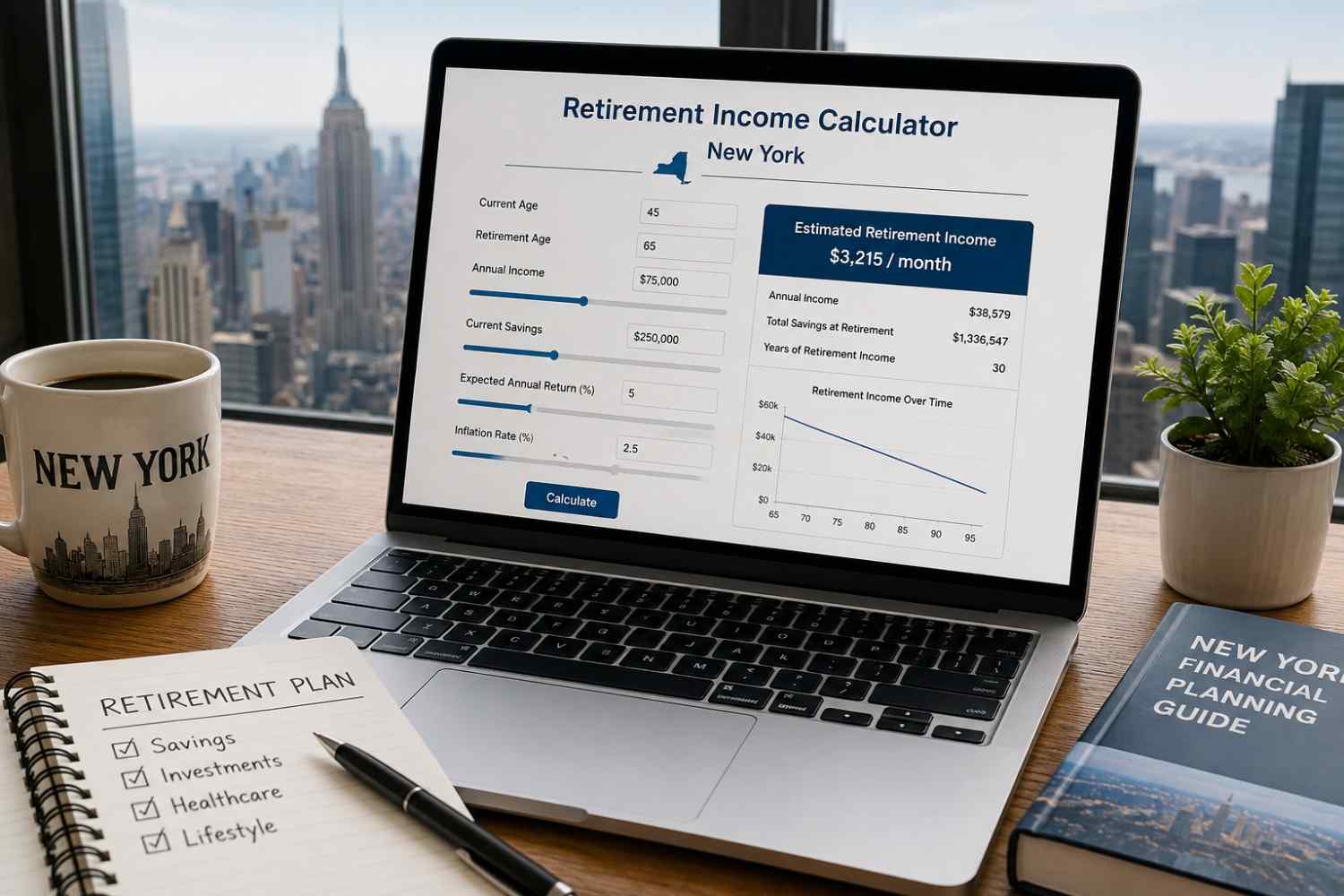
Planning for retirement in New York involves more than knowing how much money you have saved. Your actual retirement income depends on several factors, including Social Security benefits, pension payments, 401(k) withdrawals, IRA distributions, investment income, taxes, housing costs, healthcare expenses, and the age at which you stop working.
A retirement income estimate can help you understand whether your expected income will cover your lifestyle after leaving the workforce.
The Retirement Income Calculator New York on NewYorkCalculator.com is designed to help New York residents estimate their potential monthly and annual retirement income, compare recurring income with living expenses, and understand how retirement savings may support them over time.
Whether you are planning to retire in New York City, Long Island, Albany, Buffalo, Rochester, Syracuse, or another part of New York State, this guide explains the income sources, tax considerations, and retirement planning factors worth reviewing before making a decision.
Written by: Junaidul Islam
Website: NewYorkCalculator.com
Last reviewed: October 12, 2026
Use the New York Retirement Income Calculator
Use the calculator below to estimate your retirement income based on your savings, expected Social Security benefits, pension, retirement account withdrawals, other income, estimated taxes, and monthly expenses.
New York Retirement Income Calculator
Estimate your retirement income, monthly expenses, taxes and potential savings longevity.
Your Retirement Income Summary
Your personalized estimate
Monthly Income Breakdown
Income vs Monthly Expenses
Retirement Savings Longevity
Illustrative Future Savings Projection
| Year | Age | Annual Withdrawal | Estimated Ending Savings |
|---|
Important: This is an educational planning estimate, not an official tax, investment, or financial calculation. The tax figure uses the effective tax rate entered by you and is not a tax return calculation. It does not automatically apply New York pension exclusions, federal deductions, NYC or Yonkers tax brackets, Social Security taxation rules, Medicare IRMAA, or tax credits. The savings projection is a simplified model with a constant annual investment return and inflation-adjusted withdrawals. Actual market returns, taxes, fees, RMDs, account-specific withdrawal rules, and personal circumstances can change the outcome. Consult a qualified financial and tax professional.
The calculator provides an estimate based on the information you enter. Your actual retirement income and tax liability may differ because of tax rules, investment performance, withdrawal timing, benefit eligibility, and individual circumstances.
What Is a Retirement Income Calculator?
A retirement income calculator is a financial planning tool that estimates how much money you may receive after you retire.
Instead of looking only at your retirement savings balance, it considers the money you expect to receive from different sources.
For example, a retired New York resident might receive:
- Social Security retirement benefits.
- A monthly pension from a former employer.
- Withdrawals from a 401(k) account.
- Traditional IRA or Roth IRA distributions.
- Income from an annuity.
- Rental property income.
- Part-time employment or consulting income.
- Interest and other investment income.
Combining these sources provides a more useful picture of retirement cash flow than looking at one account independently.
A retirement income estimate can also help identify a potential monthly shortfall before you retire. That gives you time to consider changes to your savings, retirement date, spending, or withdrawal strategy.
How Much Retirement Income Do You Need in New York?
There is no single retirement income amount that works for everyone in New York.
A homeowner in a smaller Upstate community may have very different expenses from someone renting an apartment in Manhattan. Healthcare needs, housing costs, family responsibilities, debt, transportation, and personal spending also influence how much income a household needs.
Consider these illustrative monthly budgets:
| Monthly expense | Moderate-cost example | Higher-cost example |
|---|---|---|
| Housing | $1,000 | $2,500 |
| Utilities | $200 | $300 |
| Groceries | $450 | $650 |
| Healthcare | $400 | $600 |
| Transportation | $250 | $400 |
| Insurance | $150 | $250 |
| Personal and other costs | $350 | $500 |
| Total | $2,800 | $5,200 |
These are planning examples, not official New York cost-of-living averages. Actual expenses can be considerably different, particularly when mortgage payments, property taxes, long-term care, or high medical costs are involved.
For a useful estimate, calculate your own essential and discretionary expenses rather than relying on a statewide average.
Can You Retire in New York on $3,000 a Month?
It may be possible, depending on where you live and whether your housing costs are low.
A retiree who owns a home without a mortgage and receives Social Security and a modest pension may have a different financial situation from someone paying market rent in New York City.
Before deciding that $3,000 is enough, account for property taxes, maintenance, Medicare premiums, supplemental insurance, prescription costs, food, transportation, and unexpected expenses.
Is $4,000 a Month Enough to Retire in New York?
A $4,000 monthly retirement income may provide greater flexibility in a lower-cost area. However, it may be restrictive for a household with high housing costs or substantial healthcare expenses.
For couples, remember to calculate household expenses and combined retirement benefits. Two people do not necessarily spend twice as much as one person, but their healthcare and personal expenses can be significantly higher.
Is $1 Million Enough to Retire in New York?
A $1 million retirement portfolio can provide substantial financial support, but it does not automatically guarantee a comfortable retirement.
For illustration, a 4% initial withdrawal from $1 million equals $40,000 in the first year, or approximately $3,333 per month before taxes.
This is not a guaranteed income payment. Portfolio returns, inflation, investment fees, taxes, withdrawal timing, and the length of retirement all affect how long savings may last.
Social Security and pension benefits can supplement portfolio withdrawals.
Main Sources of Retirement Income in New York
A strong retirement plan usually considers several income sources rather than depending entirely on savings.
1. Social Security Retirement Benefits
Social Security is an important source of retirement income for many Americans.
Your benefit generally depends on your lifetime covered earnings and the age at which you claim benefits.
You can generally start receiving retirement benefits at age 62 if you meet the eligibility requirements. However, claiming before your full retirement age permanently reduces your monthly benefit compared with waiting until full retirement age.
For people born in 1960 or later, full retirement age is 67.
Waiting beyond full retirement age can increase benefits through delayed retirement credits, up to age 70.
For example, someone eligible for $2,000 per month at full retirement age could receive a lower amount by claiming early or a higher amount by delaying. The actual figures depend on the person’s Social Security record.
Use the Social Security Administration’s official tools to review your personalized estimate:
https://www.ssa.gov/benefits/calculators
New York tax consideration: New York State generally excludes Social Security benefits from New York State taxable income, even when some benefits are subject to federal income tax.
2. Pension Income
Pensions can provide predictable retirement income, particularly for former public employees and workers covered by traditional employer pension plans.
New York retirees may receive pension benefits from:
- New York State and local government retirement systems.
- Federal government retirement plans.
- Public school and education retirement systems.
- Private employer pension plans.
- Other qualified retirement arrangements.
Your actual monthly pension depends on factors such as salary history, years of service, retirement age, plan formula, and payment option.
If you are a New York State and Local Retirement System member, the New York State Comptroller provides pension estimation resources:
https://www.osc.ny.gov/retirement
Do not assume that every pension has the same tax treatment. The type of pension and your residency status matter.
3. 401(k) Retirement Income
A 401(k) plan allows employees to save for retirement through an employer-sponsored retirement account.
At retirement, you may be able to take distributions, roll over eligible assets, or use a withdrawal strategy to generate recurring income.
For example, a $500,000 401(k) balance with an illustrative 4% initial annual withdrawal equals:
- Annual withdrawal: $20,000.
- Monthly equivalent: approximately $1,667.
The calculation does not guarantee that the account will maintain its value or last throughout retirement.
Traditional 401(k) distributions are generally included in federal taxable income, subject to applicable rules. New York State may allow qualifying pension and annuity income exclusions, including certain eligible retirement plan distributions.
4. Traditional IRA Income
A Traditional IRA can provide another source of retirement income.
Withdrawals are generally taxable at the federal level to the extent they represent deductible contributions and earnings. New York tax treatment may differ because qualifying retirement income can be eligible for state exclusions.
The timing and amount of distributions matter.
If you have multiple retirement accounts, consider how withdrawals from each account affect your total taxable income and future retirement savings.
5. Roth IRA Income
A Roth IRA is different from a Traditional IRA.
Qualified Roth IRA distributions are generally free from federal income tax when the applicable requirements are satisfied. Qualified distributions are also generally excluded from New York State income tax.
This can make Roth assets useful when planning retirement cash flow.
However, not every Roth withdrawal is automatically tax-free. The five-year rule, age requirements, contribution history, conversions, and other IRS rules can affect the tax treatment.
6. Annuity Income
An annuity is a financial contract that may provide scheduled payments over a specified period or for life, depending on its terms.
Some retirees use annuities to create a predictable income stream alongside Social Security and pension payments.
Before purchasing an annuity, review:
- The insurer’s financial strength.
- Payment guarantees.
- Fees and surrender charges.
- Inflation protection.
- Survivor benefits.
- Whether payments are fixed or variable.
- The tax treatment of distributions.
An annuity is not automatically the best retirement income choice. Contract terms can differ substantially.
7. Part-Time and Rental Income
Some people continue working after retirement or earn income from rental properties.
Part-time income may reduce the amount that needs to be withdrawn from retirement accounts. However, employment income can affect federal and New York tax calculations.
Rental income should also be evaluated after expenses such as property maintenance, insurance, taxes, vacancies, and management costs.
Do not treat gross rental receipts as spendable retirement income.
New York Retirement Taxes: What Retirees Should Know
One of the most important parts of retirement planning in New York is understanding the difference between federal and state income taxes.
A source of income may be taxable federally but partially or fully excluded from New York State income tax.
The following overview is intended for planning purposes, not individual tax advice.
Is Social Security Taxable in New York?
Generally, no.
New York State allows eligible taxpayers to subtract Social Security benefits from New York adjusted gross income, including benefits that may be taxable for federal purposes.
This distinction is important because federal tax treatment and New York State tax treatment are not always identical.
Is Pension Income Taxable in New York?
Qualifying pension and annuity income may be excluded from New York State income up to $20,000 per eligible individual per tax year.
Generally, the individual must be at least 59½ during the relevant tax year and the income must meet New York’s qualifying requirements.
For married couples who both receive eligible pension income, each spouse may qualify for a separate exclusion of up to $20,000.
The exclusion is not an automatic exemption for every retirement payment. Income type, eligibility, timing, and the applicable tax return instructions matter.
Does New York Tax 401(k) Withdrawals?
New York State tax treatment can be more favorable than federal treatment.
Certain qualifying distributions from employer retirement plans may be eligible for the pension and annuity income exclusion.
However, distributions are not all treated identically. For example, contributions made after retirement and other nonqualifying amounts may not receive the same treatment.
Review the current New York instructions before applying an exclusion.
Does New York Tax Traditional IRA Withdrawals?
Traditional IRA distributions can be taxable federally.
Certain qualifying IRA distributions may also qualify for New York’s pension and annuity income exclusion, subject to the applicable requirements and limitations.
Do not automatically subtract every IRA withdrawal from New York taxable income.
Does New York Tax Roth IRA Withdrawals?
Qualified Roth IRA distributions are generally not included in federal taxable income and are generally not subject to New York State income tax.
Nonqualified distributions may receive different treatment.
What About NYC and Yonkers Retirement Taxes?
Living in New York State does not necessarily mean you owe New York City income tax.
New York City residents may be subject to an additional city personal income tax. Yonkers residents may also face a separate local income tax surcharge.
Your location and residency status therefore matter when estimating after-tax retirement income.
A person living in Buffalo, for example, should not automatically be assigned New York City resident tax.
For the most accurate result, distinguish between:
- New York State income tax.
- New York City resident income tax.
- Yonkers resident income tax.
- Federal income tax.
The calculator should not apply NYC or Yonkers tax to every New York resident.
Federal Taxes on Retirement Income
Even when New York excludes certain retirement income from state taxation, federal tax rules may still apply.
Traditional 401(k) withdrawals, Traditional IRA distributions, pension payments, and other taxable income may increase your federal taxable income.
Social Security benefits may also become federally taxable depending on your combined income.
For federal purposes, combined income generally includes adjusted gross income, tax-exempt interest, and one-half of Social Security benefits.
Depending on filing status and income, up to 85% of Social Security benefits may be included in federal taxable income. This does not mean an 85% tax rate; it means that up to 85% of the benefit may be taxable.
Retirees should also consider the effect of:
- Interest and dividends.
- Capital gains.
- Part-time employment.
- Required minimum distributions.
- Taxable annuity payments.
- Other household income.
For 2026, federal tax rules include updated standard deductions and other provisions under the federal tax law. Always use the applicable tax year when preparing an estimate.
Official information:
New York Retirement Income: Example Calculations
The following examples demonstrate how different retirement income sources can combine. They are hypothetical and are not estimates of actual tax liability.
Example 1: Single Retiree With Social Security and a Pension
Assume a New York retiree receives:
| Income source | Monthly amount |
|---|---|
| Social Security | $2,000 |
| Qualified pension | $1,200 |
| 401(k) withdrawals | $500 |
| Total gross monthly income | $3,700 |
Annual gross income is $44,400.
The next step is to identify which income is taxable federally, which income may qualify for New York exclusions, and whether local income taxes apply.
Example 2: Married Couple With Multiple Income Sources
Suppose a retired couple receives:
| Income source | Monthly amount |
|---|---|
| Spouse 1 Social Security | $2,100 |
| Spouse 2 Social Security | $1,500 |
| Combined pension income | $1,500 |
| Retirement account withdrawals | $1,000 |
| Total monthly income | $6,100 |
Their annual gross retirement income is $73,200.
They should consider both spouses’ tax eligibility, healthcare costs, housing, insurance, and how long their retirement savings may need to last.
Example 3: Retiree With $750,000 in Savings
Assume someone retires with $750,000 in eligible retirement savings and considers an illustrative 4% initial withdrawal.
- Starting portfolio: $750,000.
- Annual withdrawal: $30,000.
- Monthly equivalent: $2,500.
If the person also receives $2,000 in monthly Social Security, gross monthly retirement cash flow would be approximately $4,500 before taxes and other adjustments.
Actual withdrawals should be reviewed in light of investment performance, inflation, age, account type, and longevity.
How Inflation Affects Your Retirement Income
Inflation is one of the most overlooked factors in retirement planning.
The same amount of money generally buys fewer goods and services over time when prices increase.
For example, if you need $4,000 per month today and inflation averages 3% annually, the equivalent purchasing-power target after 10 years would be approximately $5,376 per month.
This does not mean every expense increases at exactly 3%. Healthcare, housing, insurance, and food may change at different rates.
A useful retirement calculator should allow you to change the inflation assumption and compare future purchasing power.
Consider running several scenarios:
- Lower inflation: 2%.
- Moderate inflation: 3%.
- Higher inflation: 4%.
These are illustrative planning assumptions, not forecasts.
How Long Will Your Retirement Savings Last?
The length of your retirement can significantly affect how much you can safely withdraw.
Someone retiring at 55 may need savings to last considerably longer than someone retiring at 70.
Your portfolio’s longevity depends on:
- Starting account balance.
- Annual withdrawals.
- Investment returns.
- Inflation.
- Fees.
- Tax treatment.
- Market volatility.
- Retirement duration.
A calculator can provide a simplified projection, but it cannot guarantee future investment performance.
Understanding the 4% Withdrawal Rule
The 4% rule is a commonly discussed retirement planning guideline.
It generally describes an initial withdrawal of 4% of a portfolio, followed by inflation-adjusted withdrawals in subsequent years under a historical planning framework.
It is not a universal safe withdrawal rate.
A retiree with a longer retirement horizon, high investment fees, a conservative portfolio, or poor early market returns may need a different strategy.
Compare 3%, 4%, and 5% withdrawal scenarios rather than assuming one percentage will work for everyone.
Retirement Planning in New York City vs Upstate New York
Where you live can have a substantial impact on your retirement budget.
New York City
New York City retirees may need to plan carefully for:
- Rent or mortgage payments.
- Co-op or condominium maintenance fees.
- Local income taxes.
- Transportation.
- Healthcare.
- Food and everyday services.
Some people benefit from not owning a car, while others face substantial housing expenses.
Long Island
Long Island retirement budgets may include:
- Property taxes.
- Home insurance.
- Maintenance and repairs.
- Transportation and vehicle costs.
- Healthcare expenses.
Homeownership costs can remain significant even after a mortgage is paid off.
Albany and Surrounding Areas
Retirees in the Albany region may have different housing and transportation costs from those in NYC.
However, property taxes, heating expenses, insurance, and healthcare still need to be considered.
Buffalo, Rochester and Syracuse
Some households may find housing more affordable in parts of these regions.
Nevertheless, winter heating, property maintenance, transportation, and local tax differences can affect the overall budget.
Do not assume that moving Upstate automatically makes retirement inexpensive. Calculate the complete household budget before relocating.
Healthcare and Medicare Costs After Retirement
Healthcare is a major retirement planning consideration.
Medicare eligibility generally begins at age 65 for eligible individuals, but Medicare does not mean that all healthcare costs disappear.
Depending on coverage and personal circumstances, retirees may pay for:
- Medicare Part B premiums.
- Part D prescription coverage.
- Medicare Advantage or Medigap coverage.
- Deductibles and coinsurance.
- Dental and vision services.
- Hearing services.
- Long-term care.
- Expenses not covered by insurance.
People retiring before age 65 may also need to arrange health insurance until Medicare eligibility.
If you retire early, include the cost of health coverage in your retirement income plan rather than assuming Medicare will be available immediately.
Official Medicare information:
Required Minimum Distributions and Retirement Planning
Required Minimum Distributions, commonly called RMDs, are mandatory withdrawals from certain tax-deferred retirement accounts.
Under current federal rules, RMDs generally begin at age 73 for people born between 1951 and 1959 and age 75 for those born in 1960 or later.
The applicable starting date can also depend on account type and other circumstances.
Traditional IRAs and many employer-sponsored retirement accounts are subject to RMD rules. Original owners of Roth IRAs generally do not have lifetime RMDs.
RMDs can affect your taxable income, Social Security taxation, Medicare-related income thresholds, and retirement cash flow.
It is worth including expected RMDs in a long-term retirement plan instead of treating withdrawals as completely optional.
Learn more:
https://www.irs.gov/retirement-plans
Common Retirement Planning Mistakes to Avoid
Even people with substantial retirement savings can underestimate the income they will need.
Here are some mistakes worth avoiding.
1. Calculating income without expenses
A $5,000 monthly income may sound sufficient, but the result depends on how much you spend.
2. Ignoring taxes
Gross income is not the same as spendable income. Federal, state, and local tax treatment should be considered separately.
3. Forgetting inflation
A retirement budget that works today may become restrictive over a long retirement.
4. Underestimating healthcare expenses
Medicare does not cover every healthcare cost.
5. Withdrawing too much too early
Large withdrawals can reduce the savings available for later years.
6. Ignoring market volatility
Investment returns are not guaranteed and do not arrive in a predictable sequence.
7. Assuming all pension income is tax-free
New York pension exclusions have eligibility requirements and limits.
8. Forgetting survivor income
A surviving spouse may receive a different combination of Social Security and pension income.
9. Overlooking RMDs
Mandatory withdrawals can affect taxes and spending plans.
10. Using another state’s retirement calculator
A calculator designed for Florida or Texas may not account for New York’s state and local tax rules.
How to Improve Your Retirement Income Before You Retire
You do not have to wait until retirement to improve your financial position.
Consider these practical steps:
- Review your Social Security earnings record.
- Estimate your benefit at different claiming ages.
- Check your pension statement.
- Review 401(k) and IRA balances.
- Calculate your expected monthly expenses.
- Identify debts that may continue into retirement.
- Review healthcare coverage.
- Build an emergency savings reserve.
- Compare different retirement dates.
- Review your tax situation with a qualified professional.
Small changes made several years before retirement may have a meaningful impact on your financial flexibility.
Frequently Asked Questions
1. What is the best retirement income calculator for New York?
A useful calculator should consider Social Security, pension payments, 401(k) and IRA withdrawals, estimated taxes, retirement expenses, inflation, and savings projections. A New York-focused calculator should also distinguish state taxes from NYC and Yonkers local taxes.
2. How much monthly income do I need to retire in New York?
It depends on housing, healthcare, household size, debt, transportation, and location. Create a personalized expense budget instead of relying on a single statewide retirement income target.
3. Can I retire in New York with $3,000 per month?
Possibly. It may be more manageable for someone with low housing expenses and limited debt. It may be challenging for someone paying high rent or supporting additional family members.
4. Is Social Security income taxable in New York State?
New York State generally exempts Social Security benefits from its personal income tax, even when some benefits are federally taxable.
5. Does New York tax pension income?
Eligible pension and annuity income may qualify for a New York State exclusion of up to $20,000 per eligible individual per tax year, subject to the applicable age and income requirements.
6. Does New York tax 401(k) withdrawals?
Certain qualifying 401(k) distributions may be eligible for New York’s pension and annuity income exclusion. Federal taxation may still apply.
7. Are Traditional IRA withdrawals taxable in New York?
Certain qualifying distributions can receive favorable New York State tax treatment. The federal and state rules should be evaluated separately.
8. Are Roth IRA withdrawals tax-free in New York?
Qualified Roth IRA distributions are generally tax-free for federal and New York State income tax purposes. Nonqualified distributions can have different tax consequences.
9. Do NYC retirees pay additional income tax?
New York City residents may be subject to NYC personal income tax. Yonkers residents may also be subject to a separate local surcharge. Other New York State residents should not automatically be assigned these local taxes.
10. What is the full retirement age for Social Security?
It depends on your birth year. For people born in 1960 or later, full retirement age is 67. You can generally claim as early as 62 or delay until age 70.
11. How much can I withdraw from $1 million in retirement savings?
An illustrative 4% initial withdrawal equals $40,000 per year, or about $3,333 per month before taxes. This is a planning example, not a guaranteed withdrawal amount.
12. How does inflation affect retirement income?
Inflation reduces purchasing power. A retirement plan should test different inflation assumptions and account for changing housing, healthcare, and everyday living expenses.
13. When do RMDs begin?
Under current federal rules, the applicable starting age is generally 73 for people born from 1951 through 1959 and 75 for people born in 1960 or later, subject to account-specific exceptions.
14. Should I include Medicare costs in my retirement budget?
Yes. Include premiums, deductibles, prescription coverage, supplemental insurance, and out-of-pocket healthcare expenses.
15. Can I use this calculator if I live outside New York?
You can use its general income and expense planning features, but its New York-specific tax estimates are intended for eligible New York residents. People living in another state should check their state’s tax rules.
Final Thoughts
Retirement planning in New York requires a clear understanding of both income and expenses. Social Security, pensions, 401(k) savings, IRA distributions, annuities, and other income can work together to support your retirement lifestyle.
However, the amount you receive before taxes is not necessarily the amount you can spend.
The most useful approach is to estimate your income sources, review federal and New York tax treatment, account for local living expenses, and test different retirement scenarios.
Use the Retirement Income Calculator on NewYorkCalculator.com to build an initial estimate, identify possible income gaps, and understand which areas of your retirement plan may need more attention.
A personalized estimate is a starting point for better planning—not a guarantee of future income.
Important Financial Disclaimer
This calculator and article are provided for educational and general informational purposes only. Results are estimates based on user-entered information and simplified assumptions. They are not financial, investment, legal, or tax advice. Tax laws and retirement rules can change, and individual circumstances may produce different results. Consult a qualified financial planner or tax professional before making retirement, investment, or tax decisions.
Author: Junaidul Islam
Publisher: NewYorkCalculator.com