
By Junaidul Islam
Last updated: October 10, 2026
Going through a separation or divorce in New York often raises one immediate financial question: how much spousal support might one spouse have to pay the other?
The answer depends on more than the difference between two salaries. New York has statutory maintenance guidelines, income limits, rules for cases involving child support, and separate considerations for temporary and post-divorce maintenance. A judge may also consider circumstances that a basic calculator cannot fully capture.
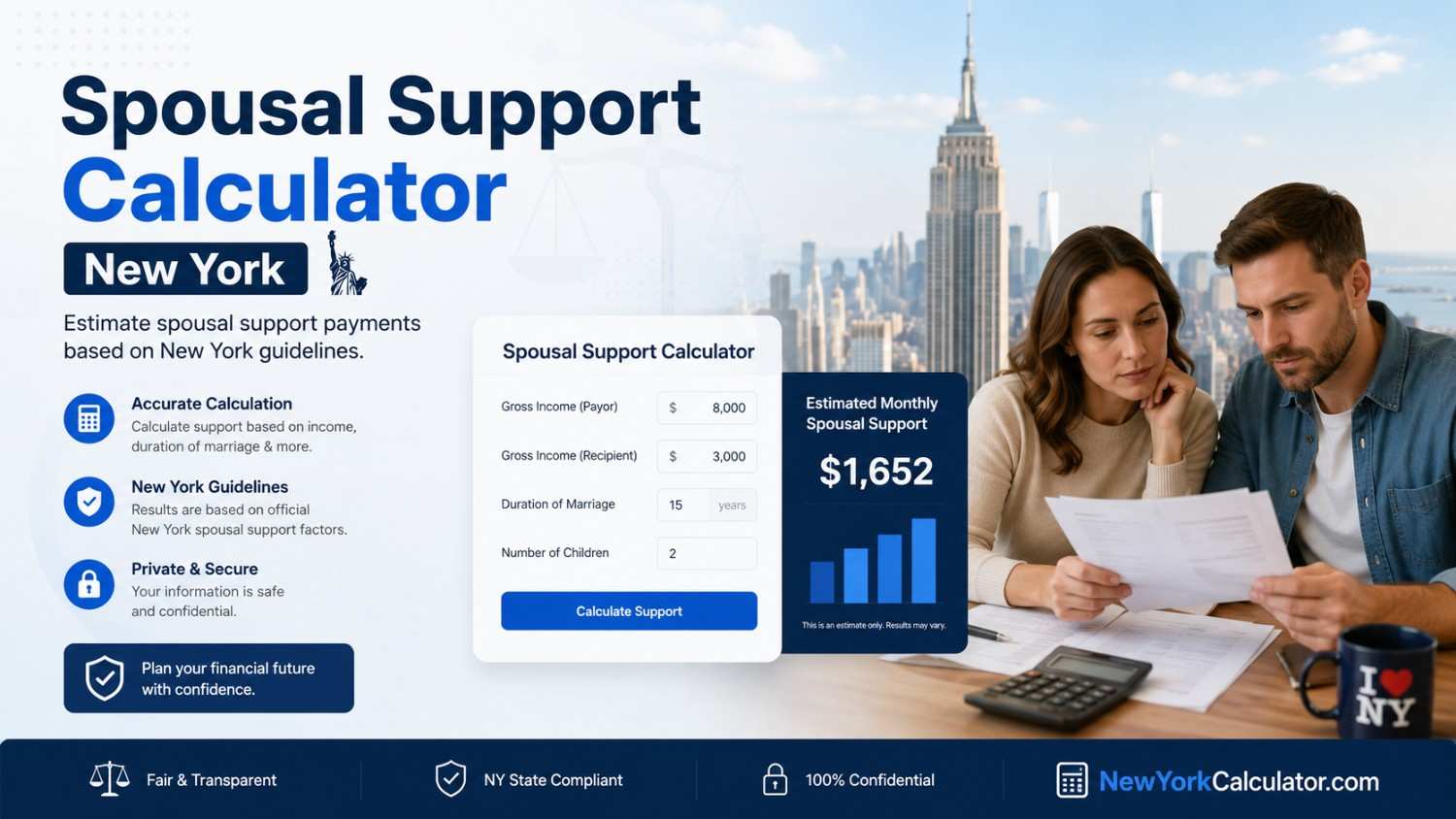
Our Spousal Support Calculator New York helps you estimate a possible guideline payment using the income figures you enter. You can compare the two statutory calculation methods, understand how child support affects the formula, and review the factors that may influence the final award.
The goal is to give you a practical starting point before you prepare a budget, discuss a proposed settlement, or speak with a New York family-law attorney.
Important: This is an educational estimate, not a court order or legal advice. For official calculations, consult the current New York Courts worksheets and instructions.
New York Spousal Support Calculator
Estimate guideline maintenance using the New York 2026 income cap.
Estimated Monthly Guideline Amount
Use the calculator above to enter the annual income figures for the higher-earning spouse (the potential payor) and the lower-earning spouse (the potential payee). Select whether the payor will also pay child support as the noncustodial parent. The tool compares the applicable guideline formulas and displays an estimated amount.
For a meaningful result, use income figures prepared according to New York’s applicable maintenance and Child Support Standards Act rules. Ordinary take-home pay is not necessarily the correct statutory income figure.
The estimate may differ from an actual award because a court can consider income adjustments, the self-support reserve, statutory factors, income above the guideline cap, and other circumstances.
What Is Spousal Support in New York?
Spousal support is financial assistance one spouse may be required to provide to the other. In New York, the legal term depends on the situation.
Spousal support commonly refers to support during a marriage, including proceedings in Family Court. Maintenance is the term used in New York’s divorce law for payments awarded or agreed upon in a matrimonial action. People also commonly use the word alimony when searching for this information.
These expressions are related, but the procedures and applicable rules are not identical.
For example, a person who needs financial assistance while still married may have a different legal route from someone seeking temporary maintenance during a pending divorce. A person seeking payments after the divorce is finalized may be subject to the post-divorce maintenance provisions of New York Domestic Relations Law § 236(B).
Before relying on a calculator, identify which situation applies to you. The correct procedure matters as much as the arithmetic.
How Does New York Calculate Spousal Maintenance?
New York’s statutory guidelines generally compare two calculations. The applicable formula depends partly on whether the higher-income spouse will also pay child support as the noncustodial parent.
For guideline maintenance within the applicable income cap, the calculations generally work as follows.
Method 1: When the maintenance payor also pays child support as the noncustodial parent
The first calculation is:
20% of the payor’s income − 25% of the payee’s income
The second calculation is:
40% of the combined income − the payee’s income
The guideline amount is generally the lower of the two results, subject to the statutory rules and adjustments.
Method 2: When the first child-support condition does not apply
The first calculation is:
30% of the payor’s income − 20% of the payee’s income
The second calculation remains:
40% of the combined income − the payee’s income
Again, the lower result generally determines the guideline amount, subject to applicable adjustments.
These calculations come from New York Domestic Relations Law § 236(B), which sets out separate provisions for temporary maintenance and post-divorce maintenance.
The formulas are similar, but a real case may require more than entering two gross salaries. Statutory income adjustments, the payor’s income cap, the self-support reserve, and the court’s authority to deviate from the guideline amount can all matter.
Example: Estimating a Monthly Maintenance Payment
Suppose a higher-earning spouse has annual statutory income of $120,000, while the lower-earning spouse has annual statutory income of $40,000.
Assume the higher-earning spouse will not pay child support as the noncustodial parent. For this illustration, use the 30%-minus-20% method.
Calculation 1
- 30% of $120,000 = $36,000
- 20% of $40,000 = $8,000
- Difference = $28,000 per year
Calculation 2
- Combined income = $160,000
- 40% of $160,000 = $64,000
- Subtract the payee’s $40,000 income = $24,000 per year
The lower result is $24,000 per year, equivalent to $2,000 per month.
This is a simplified illustration of the formula, not a prediction of what a judge will order. A proper case calculation must use the applicable statutory income figures and account for any relevant adjustments.
The example also shows why it is not enough to apply a percentage to the difference between two salaries. New York’s guideline method compares two separate results.
New York’s 2026 Maintenance Income Cap
As of March 1, 2026, the guideline income cap for the maintenance payor is $241,000 per year.
The cap is important because the statutory guideline formula generally applies to the payor’s income up to that limit. When the payor earns more, the court calculates the guideline amount using income up to the cap and may award additional maintenance on the excess income after considering the statutory factors.
The court must explain the reasons for an additional award or an applicable adjustment as required by law.
For example, a payor earning $300,000 does not automatically have all $300,000 included in the capped portion of the formula. The guideline calculation uses the applicable cap, and the treatment of income above that amount is a separate legal question.
Do not confuse the maintenance cap with the child-support income cap. New York’s combined parental income cap for child support was adjusted to $193,000 effective March 1, 2026. These are different limits serving different purposes.
Because the state periodically adjusts statutory figures, check the latest New York Courts maintenance worksheets before relying on a calculation for an actual case.
What Income Should You Enter?
One of the most common sources of error is entering the wrong income figure.
The income used for New York maintenance calculations is generally based on the applicable Child Support Standards Act definition, together with the deductions and adjustments permitted by law. It is not necessarily the amount shown as net pay on a bank statement.
Depending on the circumstances, relevant income information may include:
- Wages, salary, bonuses, and commissions
- Self-employment or business income
- Certain investment or other income
- Compensation that has been deferred
- Statutory deductions, including applicable Social Security and Medicare taxes actually paid
- Other adjustments required by the applicable worksheet or statute
The precise treatment of an item depends on the legal definition and the facts. Not every deduction on a paycheck is automatically deductible when calculating statutory income.
If you are self-employed, receive irregular bonuses, own a business, or have income from several sources, do not simply enter a convenient estimate without checking the applicable worksheet.
A useful preparation step is to gather recent pay stubs, tax returns, W-2 forms, and business-income records. These documents can help you and your attorney determine the appropriate figures.
Temporary Maintenance vs. Post-Divorce Maintenance
New York has different provisions for temporary and post-divorce maintenance.
Temporary maintenance
Temporary maintenance may be considered while a divorce action is pending. It can help address financial needs before the divorce is finalized.
The amount and duration depend on the applicable statute, the parties’ financial circumstances, and any court-ordered adjustments. Temporary maintenance generally ends no later than the divorce judgment or the death of either party, subject to the governing law and applicable orders.
Post-divorce maintenance
Post-divorce maintenance concerns support after the divorce. New York law provides a guideline amount and an advisory duration schedule, but the final award depends on the circumstances of the case and the court’s findings.
Do not assume that the amount or duration of temporary maintenance automatically continues unchanged after divorce. The legal stages and the applicable analysis are different.
If you already have a court order or a written settlement agreement, review its actual terms before using a general calculator to estimate future payments.
How Long Does Spousal Maintenance Last in New York?
There is no single duration that applies to every New York divorce.
For post-divorce maintenance, Domestic Relations Law § 236(B)(6) includes an advisory schedule that a court may use when determining duration. The schedule relates the recommended period to the length of the marriage.
The statutory advisory ranges are:
| Length of marriage | Advisory maintenance duration |
|---|---|
| Up to and including 15 years | 15%–30% of the marriage length |
| More than 15 years, up to and including 20 years | 30%–40% of the marriage length |
| More than 20 years | 35%–50% of the marriage length |
These are advisory ranges, not guaranteed awards. A court must consider the relevant statutory factors and explain its decision. New York law also allows non-durational maintenance in an appropriate case.
The length of the marriage is generally measured from the date of marriage to the commencement of the divorce action for purposes of the statutory guideline.
For example, if a marriage lasted 10 years by the relevant date, the advisory range would be 1.5 to 3 years. That does not mean the court must award maintenance for that period. The court may reach a different result based on the evidence and applicable law.
Temporary maintenance is different. Its duration is determined by considering the length of the marriage, and it generally cannot continue beyond the divorce judgment under the temporary-maintenance provision.
What Factors Can Change the Final Award?
A statutory guideline estimate is only one part of the picture. New York law allows the court to consider relevant factors when deciding whether the guideline amount or duration is unjust or inappropriate.
Depending on the case, these factors may include:
- Each spouse’s age and health
- Present and future earning capacity
- A history of limited participation in the workforce
- The need for education or professional training
- The marital standard of living
- The cost and availability of health insurance
- The care of children or other family members that affected earning capacity
- Career opportunities delayed or given up during the marriage
- The equitable distribution of marital property and the income from assets
- Tax consequences and other factors the court finds just and proper
For income above the maintenance cap, the court may consider the relevant statutory factors when deciding whether additional maintenance is appropriate.
This is why two couples with similar incomes may receive different outcomes. Their marriage length, earning capacity, health, financial resources, and other relevant circumstances may differ.
What Happens if the Payor Earns More Than $241,000?
The income cap does not automatically mean that maintenance stops at the amount produced by the formula.
Under New York law, the guideline calculation is generally performed using the payor’s income up to the applicable cap. The court may then consider additional maintenance on income above the cap, using the relevant statutory factors and explaining its decision as required by law.
The additional amount is not automatically calculated by applying the same percentage to every dollar above the cap.
If either spouse has substantially higher income, significant assets, business interests, or unusual financial circumstances, a basic calculator should be treated as an initial estimate only.
How Does Child Support Affect Maintenance?
Child support and maintenance can affect each other in New York.
The guideline maintenance formula uses a different calculation when the maintenance payor is also the noncustodial parent who will pay child support for children of the marriage. In that situation, the statutory 20%-minus-25% calculation is compared with the 40%-of-combined-income calculation.
In other situations, the 30%-minus-20% method generally applies.
Maintenance may also need to be calculated before child support because the maintenance payment can change the income attributed to each spouse for the child-support calculation. The exact sequence depends on the applicable statutory provisions and circumstances.
For that reason, a maintenance estimate should not be treated as a complete child-support estimate. If your case involves children, use the current New York Courts maintenance and child-support tools or obtain qualified legal assistance.
What Is the Self-Support Reserve?
New York law protects a minimum income level for a person who may be required to pay maintenance.
Effective March 1, 2026, the self-support reserve for a single person is $21,546. Under the applicable maintenance rules, if the guideline amount would reduce the payor’s income below the reserve, the amount may be limited to the difference between the payor’s income and the reserve. If the payor’s income is below the reserve, there is a rebuttable presumption that no guideline maintenance will be awarded.
The exact treatment depends on the applicable statute and case facts. This reserve is not a general living-expense deduction that users should subtract manually from every income figure before entering the calculator.
The reserve is one reason a simple percentage-based online tool may produce a different figure from a court worksheet.
Can Spousal Maintenance Be Changed Later?
In some circumstances, a maintenance order can be modified. Whether a change is available depends on the governing law, the terms of the order or agreement, and the facts supporting the request.
A substantial change in financial circumstances may be relevant, but it does not automatically guarantee a modification. Different rules may apply to a court order and to a negotiated agreement.
A person who loses a job, experiences a major change in income, retires, or faces another significant financial event should review the actual order and obtain legal advice before changing or stopping payments.
Do not assume that an online calculator can amend an existing order. Until a court order is properly changed or the governing agreement provides otherwise, the existing legal obligations may remain in effect.
What Documents Help You Estimate Maintenance More Accurately?
Before using a calculator or discussing a proposed settlement, organize the financial records relevant to your situation.
Useful documents may include:
- Recent pay stubs for both spouses
- Federal and New York state income tax returns
- W-2 forms and records of bonuses or commissions
- Business or self-employment income records
- Information about investment income and other relevant resources
- Health-insurance costs and other legally relevant expenses
- Existing child-support or maintenance orders
- A marriage date and the date the divorce action began, where applicable
- Any separation agreement, prenuptial agreement, or postnuptial agreement that may affect maintenance
The court may require financial disclosure and supporting documentation. Using accurate records helps reduce the chance of relying on a misleading estimate.
Why Your Calculator Result May Differ From a Court Decision
An online estimate cannot reproduce every issue a judge may need to decide.
Your actual result may differ because:
- The income figures entered do not match the statutory definition.
- A bonus, business income, or other compensation requires additional analysis.
- The payor’s income exceeds the statutory guideline cap.
- The self-support reserve or another statutory adjustment applies.
- The case involves child support and requires a specific calculation sequence.
- A judge finds the guideline amount or duration unjust or inappropriate.
- A valid written agreement sets different terms.
- The court determines that additional maintenance is appropriate or that the guideline amount needs adjustment.
The calculator is most useful as a starting point for understanding the guideline. It should not be used as proof of what a judge will order or as a substitute for an attorney’s review of financial records.
Frequently Asked Questions
1. Is there an official New York spousal support calculator?
Yes. New York Courts publishes maintenance and child-support worksheets and calculator tools. The official tools should be consulted for a court-related calculation. The calculator on this page is an independent educational estimate.
2. What is the New York maintenance income cap in 2026?
The maintenance payor-income cap is $241,000, effective March 1, 2026. Income above the cap may be considered separately by the court under the applicable statutory factors.
3. Is alimony the same as spousal maintenance in New York?
People often use the terms interchangeably in everyday conversation. New York law generally uses maintenance for payments under its divorce-maintenance provisions, while spousal support may refer to support during an ongoing marriage. The correct legal procedure depends on the situation.
4. Does the higher-earning spouse always have to pay maintenance?
No. The guideline calculation is not the only issue in every case. Eligibility, statutory income, the parties’ circumstances, agreements, and the applicable legal factors all matter.
5. Does New York maintenance automatically last for half the marriage?
No. The advisory duration schedule varies with marriage length and provides a range, not a universal half-the-marriage rule. A court may determine a different duration based on the statutory factors.
6. What if both spouses earn similar amounts?
A smaller income difference may produce a low or zero guideline result under the formula, but the outcome depends on the applicable statutory figures and circumstances. Do not assume that similar salaries alone settle the legal question.
7. Can the court award maintenance above the income cap?
Yes, the court may award additional maintenance on income above the cap after considering the relevant statutory factors. The amount is not automatic and should not be estimated by blindly applying the same formula to all excess income.
8. Is child support included in the maintenance amount?
No. Maintenance and child support are separate obligations, although their calculations can interact. A maintenance estimate should not be mistaken for the total amount a parent may owe.
9. Can an existing maintenance order be changed?
A modification may be possible under the applicable law and order or agreement. A change in income does not automatically change the required payment. Review the governing documents and obtain legal advice before acting.
10. Is this calculator legal advice?
No. It provides an educational estimate based on the information entered. It does not determine eligibility, interpret a settlement agreement, or predict a judge’s final decision.
Official New York Resources
For the most reliable information, consult these primary sources:
- New York Courts — Maintenance and Child Support Tools
- New York Courts — What’s New in Matrimonial Legislation, Court Rules, and Forms
- New York Domestic Relations Law § 236
- New York Family Court Act § 412 — Spousal Support
Always check the latest official worksheet before using an estimate for a legal filing, negotiation, or court appearance.
Final Thoughts
A New York spousal support estimate is most useful when you understand both the number and the rules behind it. The applicable formula, statutory income, child-support relationship, income cap, self-support reserve, marriage length, and circumstances of each spouse can all influence the result.
Use the calculator as a first step, gather reliable financial records, and compare the result with the current New York Courts worksheet. If your situation involves high income, business ownership, children, an existing order, or a disputed agreement, a New York family-law attorney can help you assess the issues that a general online calculator cannot resolve.
Editorial note: This article provides general educational information and is not legal advice. New York law and court forms can change; confirm the current rules and obtain professional advice for your circumstances.