
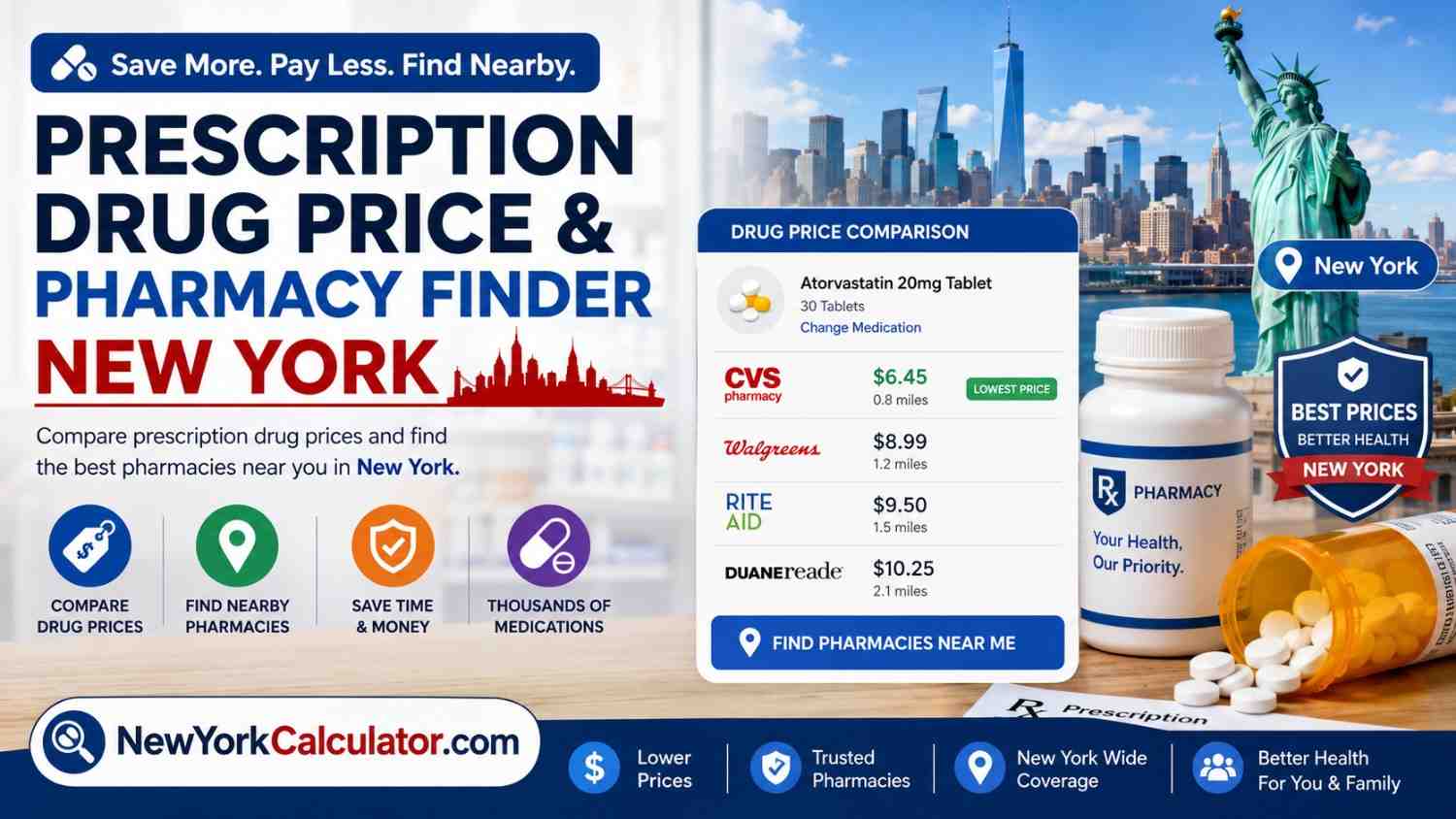
By Junaidul Islam Prescription medication costs can be confusing, even when you have health insurance. The same prescription may have a different out-of-pocket cost depending on your insurance plan, pharmacy network, medication strength, quantity, and available discount programs. A price advertised online may also differ from the amount you are asked to pay at the pharmacy counter.
If you live in New York, you do not have to rely on a single price quote. You can compare available prices, check whether a pharmacy works with your insurance, explore legitimate prescription assistance programs, and confirm the final cost before making a trip.
This guide explains how to compare prescription drug prices in New York, find pharmacies by ZIP code, understand insurance and discount-card pricing, and estimate potential savings using our Prescription Drug Price & Pharmacy Finder.
Important: This page does not provide live, verified prescription prices or confirm pharmacy inventory. Use the calculator to compare prices you enter yourself, then verify medication prices, coverage, and availability with the pharmacy or your insurance plan.
Prescription Drug Price & Pharmacy Finder
Use the calculator below to organize your prescription details, compare two quoted prices, estimate potential savings, and find external resources for pharmacies and prescription discounts.
Prescription Drug Price & Pharmacy Finder
Compare quoted prescription costs, estimate potential savings, and find pharmacy resources in New York.
Free comparison tool · No account required · No live price feed
1. Enter Your Prescription Details
Enter only the information needed for your search. Do not enter your prescription number, insurance ID, or other sensitive information.
Pharmacy Search Resources
These links open external websites. Search results do not guarantee insurance acceptance, current prices, opening hours, or medication availability.
2. Compare Two Quoted Prices
Use prices for the same medication, strength, form, and quantity. Select the applicable payment method for each quote.
Use 1 for a single fill. Repeated-fill estimates assume the quoted prices remain unchanged.
Your Price Comparison
3. Prescription Price Lookup Websites
Use these services to research possible prices and discounts. Confirm every quote with the participating pharmacy.
4. Official New York and Medicare Resources
5. Pharmacy Visit Checklist
Check these items before travelling to the pharmacy.
Disclaimer: This tool is for general informational purposes only. It is not a medical service, pharmacy, insurance quotation system, or substitute for professional advice. Prices and program rules can change. Verify current information with your pharmacist, insurer, prescriber, or the relevant official program.
The calculator is a planning aid, not a pharmacy ordering system or a medical recommendation. It does not independently retrieve current drug prices, verify insurance coverage, or confirm that a medicine is in stock.
How to Compare Prescription Drug Prices in New York
A useful price comparison starts with the exact prescription rather than the drug name alone. Two listings may appear to describe the same medicine but refer to different strengths, dosage forms, quantities, or pricing conditions.
Follow these steps before choosing a pharmacy.
1. Confirm the Exact Medication
Check the prescription label or ask your pharmacist to confirm the following details:
- Medication name, including whether the prescription specifies a brand-name product or allows a generic equivalent.
- Strength, such as the number of milligrams per tablet or capsule.
- Dosage form, such as a tablet, capsule, liquid, cream, or inhaler.
- Quantity prescribed, such as 30 tablets or a specified volume.
- Whether the quoted price covers the complete prescribed quantity.
Do not compare a price for 30 tablets with a price for 90 tablets without adjusting for the quantity. Likewise, a lower price for a different strength is not necessarily a better deal.
If you are considering a generic alternative, ask your prescriber or pharmacist whether it is appropriate for your prescription. Do not change the medication, strength, or dosage on your own.
2. Compare More Than One Price Source
Prescription discount websites can help you find potential savings, but the displayed price is not necessarily the price you will pay at every pharmacy.
Start with these resources:
- GoodRx: Visit GoodRx to search for medication prices and available discount coupons.
- SingleCare: Use the SingleCare Drug Price Lookup to check its available prescription savings information.
- WellRx: Visit ScriptSave WellRx for medication savings and pharmacy lookup options.
- RxSaver: Visit RxSaver to explore prescription discount information.
- Your insurance plan: Check the member portal or call the customer service number on your insurance card to obtain your plan-specific cost.
These resources serve different purposes, and their prices or participating pharmacies may differ. A displayed coupon price should be treated as a quote to verify, not a guarantee.
Before travelling to a pharmacy, ask whether the quoted price is valid for your exact medication, strength, quantity, and prescription.
3. Compare the Final Out-of-Pocket Cost
The lowest advertised price does not always mean the lowest final cost for your circumstances.
For example, imagine that you receive two hypothetical quotes for the same 30-tablet prescription:
| Price option | Quoted cost |
|---|---|
| Pharmacy A, insurance copay | $18 |
| Pharmacy B, discount coupon | $12 |
| Difference | $6 |
In this example, the coupon quote is $6 lower. However, you must confirm that the prices apply to the same prescription and that you are eligible to use the coupon.
A discount coupon may not be combined with insurance for the same transaction. If you use a cash discount instead of your insurance benefit, the purchase may not count toward your insurance deductible or out-of-pocket limit. Ask your insurer how that purchase will be treated before deciding.
For Medicare Part D beneficiaries, the rules are particularly important because eligible prescription spending is tracked under the plan's benefit structure.
Prescription Drug Prices: Cash Price vs. Insurance Copay vs. Discount Card
These three prices can look similar, but they are not interchangeable.
Cash Price
The cash price is the amount a pharmacy quotes when the prescription is purchased without using an insurance benefit or a separate discount arrangement. The actual amount varies by medication and pharmacy.
Ask whether the quote includes all applicable charges and whether it applies to the full prescribed quantity.
Insurance Copay or Coinsurance
A copay is a fixed amount you pay for a covered prescription. Coinsurance is a percentage of the applicable cost.
Your insurance price may depend on your deductible, formulary tier, coverage restrictions, pharmacy network, and benefit stage. A pharmacy that is in-network for one plan may not be in-network for another.
To obtain a meaningful estimate, use your insurer's own cost lookup or contact the plan directly.
Prescription Discount Card
A discount card or coupon may reduce the price charged for an eligible prescription at a participating pharmacy.
Before using one, ask:
- Is this discount valid at this exact pharmacy?
- Does it apply to my medication, strength, and quantity?
- What is the final price after applying the discount?
- Can I use this discount with my insurance, or must I choose one method?
- Will this purchase count toward my deductible or annual out-of-pocket limit?
Do not assume that a discount advertised online is automatically the best option. Compare the actual price you would pay under each eligible arrangement.
How to Find a Pharmacy Near You in New York
New York includes large cities, suburban communities, and rural areas. A pharmacy that is convenient for someone in Manhattan may not be practical for someone in Buffalo, Albany, Rochester, Syracuse, or a smaller community.
Start by identifying your ZIP code and the distance you are willing to travel. Then check pharmacy directories and individual pharmacy websites.
Search by ZIP Code
You can begin with these resources:
- CVS Pharmacy — look for nearby stores and pharmacy services.
- Walgreens — search locations and check available pharmacy services.
- Walmart Pharmacy — review pharmacy services at eligible locations.
- Costco Pharmacy — check pharmacy information and applicable access requirements.
- Google Maps pharmacy search — locate pharmacies in your area, then contact the specific location.
Use your actual ZIP code in the relevant search tool to narrow the results.
A location appearing in a directory does not establish that it accepts your insurance, stocks your medicine, or offers the lowest price. Call the pharmacy before travelling, particularly when the prescription is urgent or difficult to obtain.
Questions to Ask Before Visiting
When you contact a pharmacy, have the prescription details available and ask:
- What is the current price for my exact medication, strength, dosage form, and quantity?
- Does that price use my insurance, a discount coupon, or cash payment?
- Do you accept my particular insurance plan?
- Is the prescribed quantity currently available?
- If the medicine is unavailable, when might it be available?
- Can the prescription be transferred from my current pharmacy, if permitted?
- Are there any additional charges or conditions I should know about?
Do not share your full prescription details, insurance member number, or other sensitive information on an unfamiliar website just to obtain a general estimate.
New York Prescription Assistance Programs You Should Know About
Some New York residents may qualify for assistance through government programs or their insurance coverage. Eligibility depends on individual circumstances, and program rules can change.
New York Medicaid and the NYRx Pharmacy Program
New York's NYRx program provides Medicaid pharmacy benefits for eligible members. The state provides information about covered medications, pharmacy resources, prior authorization, and program requirements through its official website.
Start with the New York State NYRx Pharmacy Program.
If you have Medicaid, confirm your current pharmacy benefit and coverage before paying out of pocket. A medication may be covered subject to program requirements, and certain prescriptions may require prior authorization or other approval.
Do not assume that every Medicaid-related insurance arrangement follows the same pharmacy rules. If you are enrolled in a special or managed care arrangement, verify the instructions that apply to your specific coverage.
Medicare Part D and Pharmacy Networks
Medicare beneficiaries should compare both the prescription plan and the pharmacy.
A pharmacy may be in-network for one Part D plan but not another. Some plans also designate preferred in-network pharmacies, where eligible members may pay less for certain covered prescriptions.
Use the official Medicare Plan Finder to review available plans and estimated drug costs for your ZIP code.
For 2026, the Medicare Part D annual out-of-pocket threshold for covered Part D drugs is $2,100 under the applicable benefit rules. This is a limit on qualifying out-of-pocket spending for covered Part D drugs, not a universal cap on every medicine or every healthcare expense.
Review the official Medicare drug coverage cost guidance for details. The amount and treatment of individual payments depend on the program's rules and your coverage.
Medicare Prescription Payment Plan
If you are enrolled in Medicare Part D, the Medicare Prescription Payment Plan may allow you to spread eligible out-of-pocket prescription costs across monthly payments rather than paying the entire amount at the pharmacy.
This is a payment option, not a discount. It does not make your prescriptions less expensive overall, and participation rules apply.
Learn more through the Centers for Medicare & Medicaid Services.
New York EPIC Program
New York's Elderly Pharmaceutical Insurance Coverage program, commonly called EPIC, helps eligible older adults with prescription costs.
According to New York's 2026 program information, eligibility income limits are up to $75,000 for a single person and $100,000 for a married couple. Members must also be enrolled in a Medicare Part D drug plan to receive EPIC benefits.
Eligible benefits and costs depend on the program rules and the member's circumstances. Income limits alone do not guarantee eligibility.
Review the official New York EPIC 2026 Program Highlights or contact EPIC directly for current application and eligibility details.
Manufacturer Assistance and Other Programs
Some pharmaceutical manufacturers offer assistance programs for eligible patients. Nonprofit organizations may also offer support for specific conditions or circumstances.
Eligibility may depend on income, insurance status, diagnosis, medication, and other program requirements.
Start with your medication manufacturer's official website or ask your pharmacist, prescriber, or insurer for reputable assistance resources. Verify that a program is legitimate before submitting personal or financial information.
How to Calculate Prescription Savings
A price comparison is more useful when you know how much you could save over the full quantity prescribed.
Use this formula:
Potential savings = Higher quoted price − Lower quoted price
For example, if one eligible quote is $42 and another eligible quote is $29 for the same prescription, the difference is $13.
Potential savings percentage = (Savings ÷ Higher quoted price) × 100
Using the same example:
- Higher quote: $42
- Lower quote: $29
- Difference: $13
- Potential savings: approximately 31%
These figures are illustrative, not current prices for a real medication.
The comparison is meaningful only when both prices cover the same prescription and comparable payment conditions. A cash coupon price and an insurance copay may have different implications for your coverage.
Compare Monthly and Annual Costs Carefully
For a medication you refill regularly, it can be useful to estimate the difference over several refills.
Suppose a valid comparison shows a $5 difference per refill. If you fill the prescription once each month for 12 months, the arithmetic difference would be $60.
That estimate assumes the same price difference continues for every refill. Actual prices, eligibility, insurance benefits, and prescription quantities can change, so it should not be treated as a guaranteed annual saving.
Do not change the prescribed refill schedule or quantity to obtain a lower price without consulting your pharmacist or prescriber.
Why Prescription Prices Can Differ Between Pharmacies
There is no single retail price that applies to every prescription at every pharmacy.
Several factors can explain different quotes.
Medication and strength: Different products and strengths have different costs. A generic equivalent may have a different price from a brand-name product.
Quantity and dosage form: A 30-tablet supply and a 90-tablet supply are not directly comparable unless the quantity is accounted for.
Insurance formulary: Your plan may place medications into different cost-sharing tiers and apply different coverage conditions.
Pharmacy network: Network status and preferred pharmacy arrangements can affect your eligible out-of-pocket cost.
Discount eligibility: A coupon may apply only to certain pharmacies, quantities, products, or transactions.
Location and availability: Individual pharmacies may quote different prices, and availability can change over time.
Additional requirements: Prior authorization, coverage restrictions, or prescription-specific requirements may affect whether a claim is covered.
The practical lesson is simple: compare the final price for the exact prescription under the payment method you intend to use.
What to Do If Your Prescription Is Too Expensive
If a pharmacy quotes a price you cannot afford, consider the following steps.
- Ask your pharmacist whether a legitimate discount or another eligible payment option is available.
- Contact your insurance plan to confirm the medication's coverage, tier, and applicable restrictions.
- Ask your prescriber whether a clinically appropriate, lower-cost alternative exists. Do not make the change yourself.
- Check whether you may qualify for a government, manufacturer, or nonprofit assistance program.
- Compare another pharmacy, but confirm network status and availability before transferring or travelling.
- If you cannot obtain an essential medication, contact your prescriber or pharmacist promptly to discuss safe next steps.
Never stop a prescribed medication, change its dose, split a tablet, or substitute another product solely because of price without appropriate professional guidance.
How to Use This Prescription Price Calculator Safely
Our calculator is designed to make basic price comparisons easier. It lets you enter quoted prices, calculate the difference, estimate potential savings, and open external resources to continue your search.
To get a useful result:
- Enter the medication name and relevant prescription details.
- Use the same quantity for both prices.
- Enter actual quotes obtained from pharmacies, insurers, or discount services.
- Select the correct payment conditions when comparing prices.
- Verify the final amount with the pharmacy before purchasing.
The calculator does not connect to pharmacy inventory databases or insurance claims. Its arithmetic results are based on the values you provide.
For privacy, avoid entering unnecessary medical details, prescription numbers, insurance member IDs, or other sensitive personal information.
Frequently Asked Questions
How can I find the cheapest pharmacy in New York?
Search for your exact medication and prescription details through reputable price comparison services, then check the pharmacy's own quote. Compare eligible insurance and discount options, and confirm the final price before visiting. The cheapest option may vary by prescription and payment method.
Are prescription discount cards better than insurance?
Not always. A discount card may offer a lower price for a particular prescription, while insurance may provide coverage benefits that a cash discount does not. Compare the actual amount you would pay and ask your insurer whether the transaction counts toward your deductible or out-of-pocket limit.
Can I use a discount coupon with Medicare?
Discount coupons generally are not combined with Medicare Part D coverage for the same prescription transaction. If you choose a separate cash discount, that purchase generally will not count as covered Part D spending. Confirm the rules with your plan and pharmacist before deciding.
Does this calculator show live prescription prices?
No. The calculator compares prices that you enter. It does not retrieve live pharmacy prices, verify a coupon, check insurance claims, or confirm medication stock.
Can I find a pharmacy using my New York ZIP code?
Yes. You can use pharmacy locator websites, official directories, and map searches to identify nearby locations. Always verify that the pharmacy accepts your plan and has the prescribed medication available.
What if my Medicare prescription costs are still too high?
Review your Part D coverage, pharmacy network, and eligible assistance options. You can also investigate the Medicare Prescription Payment Plan, Extra Help, and New York's EPIC program if you meet the applicable requirements. These programs have different eligibility and payment rules.
Does New York Medicaid cover prescription drugs?
New York's NYRx program provides pharmacy benefits for eligible Medicaid members, subject to coverage rules and other requirements. Check the official NYRx resources or contact your program representative to confirm whether a specific medication is covered.
Should I switch to a generic medicine to save money?
Ask your prescriber or pharmacist whether a generic equivalent is appropriate and available for your prescription. Do not change your medicine or dosage on your own.
How often should I recheck a prescription price?
Recheck whenever your prescription changes, your insurance plan changes, a coupon expires, or you receive a different quote. For recurring prescriptions, confirm the price and availability before each refill when the cost matters to your budget.
Final Thoughts
Finding a more affordable prescription in New York takes more than looking for the lowest number on a website. You need to compare the exact medication and quantity, understand the payment method, check your insurance network, and confirm that the pharmacy can fill the prescription.
Use our Prescription Drug Price & Pharmacy Finder to organize quotes and estimate potential savings, then verify the details through the pharmacy or your health plan. If you qualify, programs such as NYRx, Medicare assistance, or New York EPIC may provide additional support.
A few minutes of careful comparison can help you make a better-informed decision without compromising the safety of your treatment.
Disclaimer: This article is for general informational and educational purposes only. It does not provide medical, insurance, legal, or financial advice and is not a substitute for professional guidance. Prices, coverage, eligibility, and pharmacy availability can change. Verify current details with the relevant pharmacy, insurer, prescriber, or official program before making a decision.