
By Junaidul Islam
Last reviewed: October 9, 2026
Finding the right public school is an important step when raising a family in New York City. Whether you are moving to Brooklyn, renting an apartment in Queens, buying a home in the Bronx, or preparing your child for kindergarten in Manhattan, one question matters: Which public school is zoned for your home address?
A School Zoning Checker for New York can help you understand where to start. In New York City, many elementary and middle school students have a zoned school based on their residential address. However, school zones, admission priorities, and application requirements can differ by grade and school type.
This guide explains how to check a NYC school zone by address, understand the results, verify current information, and avoid common mistakes before making a housing or enrollment decision.
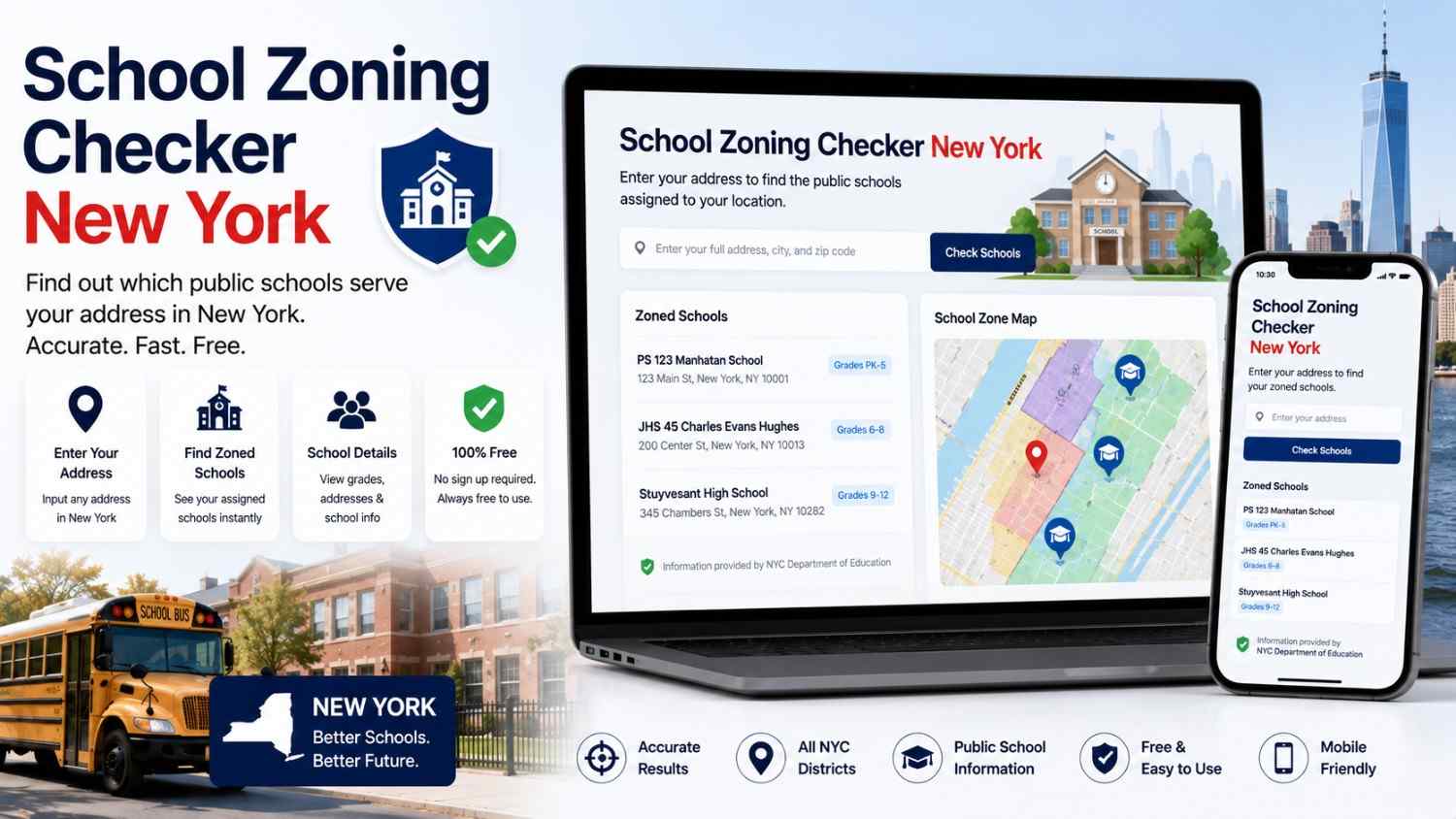
NYC School Zoning Checker
Use the address lookup assistant below to begin checking your New York City school zone. It will help you identify the information you need and direct you to the official NYC Public Schools school finder.
NewYorkCalculator.com
NYC School Zoning Checker
Start your school-zone search by home address, borough, and grade. Verify the final result with NYC Public Schools.
Your school-zone search is ready
The official school finder will open in a new tab. Enter your address there and select the same grade and borough to review available school-zone information.
Open Official NYC School Finder ↗Before making a decision: Contact the school to verify the current zone, grade eligibility, and enrollment requirements.
This assistant does not independently determine school assignments or retrieve live boundary data. It is an informational starting point, not an official NYC Public Schools service. School-zone information may change. Confirm the result with the school or NYC Public Schools.
Important: This website’s lookup assistant is not an official school assignment service. Confirm any potential zoned school through NYC Public Schools before relying on the result.
How to Find Your Zoned School in New York City
The most reliable starting point is the official NYC Public Schools Find a School service. It allows families to search using an address or school name and refine results using grade and borough.
Follow these steps:
- Open the official NYC Public Schools Find a School tool.
- Enter your complete home address in the search field.
- Select your child’s grade.
- Choose the borough where you live.
- Submit the search and review the results, including any schools identified as currently zoned.
- Contact the school to confirm the applicable zone, grade eligibility, enrollment process, and requirements for the school year in which your child will attend.
NYC311 also provides official school-zone instructions. The city advises families to confirm their zoned school directly because zoning information can change for an upcoming school year.
What Is a School Zone in New York City?
A school zone is a geographic area associated with a particular school. For NYC public schools that use attendance zones, a student’s home address can affect admission priority.
School zones are particularly relevant when families are looking for elementary school options. Many middle schools also have zoned admission priorities, although the middle school admissions process includes additional programs and application rules.
A school zone does not necessarily mean that a student is automatically enrolled. Families may still need to contact the school, provide documentation, complete enrollment steps, or participate in a separate admissions process.
It is also important to distinguish a school zone from a school district. A district is a broader administrative area, while a zone is associated with school attendance boundaries. A single district may contain multiple schools and attendance zones.
Elementary School Zones in NYC
Elementary school zoning is especially important for families with young children.
In New York City, children generally enter kindergarten in September of the calendar year in which they turn five. Many kindergarten and elementary school families use their residential address to identify a zoned school.
If you are moving to a new neighborhood, check the address rather than relying only on a building name, ZIP code, or nearby landmark. A short distance between two homes can sometimes make a difference when they fall on opposite sides of a school boundary.
Once you identify a potential zoned elementary school, contact the school to confirm its current enrollment process. If your address does not appear to have a zoned school, NYC Public Schools can provide additional guidance.
Official information: NYC kindergarten admissions.
Middle School Zoning and Admissions
Middle school admissions require more careful checking because not every placement decision depends only on a residential zone.
Many NYC middle schools have zoned priorities, but families also apply to school programs through the city’s admissions process. The options available to a student can depend on grade, district, school program, and the applicable application rules.
For Fall 2027 admissions, NYC Public Schools lists October 14, 2026, as the opening date for the middle school application and December 11, 2026, as the closing date. These dates apply to the published admissions timeline and should be rechecked against official announcements before you act.
Families should consider both their zoned school, if applicable, and other programs for which their child may be eligible.
For the latest instructions, visit the official NYC middle school admissions page.
Are NYC High Schools Zoned by Home Address?
Do not assume that the elementary-school zoning process works the same way for high school.
NYC high school admissions generally involve an application process in which students apply to programs and receive offers according to the applicable admissions rules. Specialized high schools and certain other programs have additional requirements.
A school locator may show high schools near an address, but proximity does not establish that a student is eligible to attend a particular school or will receive an offer.
If your child is entering ninth grade, use the official NYC high school admissions information and review the current application timeline.
School Zone vs. School District: What’s the Difference?
These terms are related, but they should not be used interchangeably.
School zone: A boundary associated with a school that uses zoned admissions. An address inside the zone may receive an admissions priority under the applicable rules.
School district: A larger administrative area that helps organize schools and education services. District boundaries can matter for some admissions processes, but a district number alone does not identify a student’s zoned school.
School attendance boundary: The geographic line used to identify which addresses fall within a particular attendance area. The relevant boundary depends on the school and the official data used for that school year.
Nearby school: A school located close to an address. It may not be the zoned school, and distance alone does not guarantee admission.
To identify a district, use the official NYC311 School District service. To identify a zoned school, use the separate Find a School service.
What If Your Address Has No Zoned School?
Not every address will produce an obvious zoned-school result. You might have entered an incomplete address, selected the wrong borough, searched for a school instead of a residential address, or encountered a genuine situation in which the address does not have a zoned school for the relevant grade.
Try the following:
- Check the house number, street name, apartment information, and borough.
- Repeat the search using the official school finder.
- Verify the grade selected for the search.
- Contact the school district or NYC Public Schools for clarification.
- If you are new to NYC schools or cannot identify a zoned school, contact a Family Welcome Center for enrollment assistance.
Do not assume that the nearest school is automatically your assigned school. Similarly, do not conclude that your child has no public-school options just because a third-party website does not return a match.
How to Verify a School Zone Before Renting or Buying a Home
School access can be one of several factors in a housing decision. However, a school-zone result should be treated as an initial research step rather than a guarantee.
Before signing a lease or purchasing a property, consider this checklist:
- Search the exact residential address, not just the ZIP code.
- Confirm the school and grade with NYC Public Schools.
- Ask whether the zone or enrollment rules are expected to change for the school year you need.
- Verify the school’s grade range and whether it serves the grade your child will enter.
- Review the school’s official website and contact information.
- Understand that a zoned-school result does not guarantee a seat in every special program.
- Recheck the address if you move, change apartments, or use a different entrance or building address in your search.
Families relocating from outside New York City should also confirm whether their intended address falls within the NYC public school system. New York State has many school districts outside the five boroughs, and their attendance boundaries and enrollment policies may be different.
Why School-Zone Information Can Change
School boundaries, admissions priorities, and enrollment procedures are not necessarily permanent. A result that was correct for a previous year may not be sufficient for a future enrollment decision.
NYC311 specifically advises families to confirm the zoned school with the school because zoning may change for an upcoming school year. Its guidance says the zone list is updated every July.
Third-party maps can be useful for understanding neighborhood boundaries, but they may rely on data from an earlier school year. For example, the independent NYC School Zones map publishes notes about its data sources and the dates associated with the available boundary information.
When comparing results, check the source, the data’s school year, and the last update date. A website’s publication date is not necessarily the date its underlying school-boundary dataset was updated.
What Information Should a School Zoning Checker Show?
A useful school-zone tool should make its limitations clear instead of simply returning a school name.
Ideally, an address-based checker should provide:
- A clear residential-address input.
- Borough and grade selection.
- The name and address of a school when supported by verified data.
- A distinction between zoned schools, nearby schools, and district information.
- The school year associated with the result.
- A link to the official school finder or boundary source.
- A direct way to verify the result with the school.
- A helpful message when the address cannot be matched.
If the tool does not connect to an authoritative, current dataset, it should direct users to the official lookup rather than imply that it has independently verified their school assignment.
These details help families make informed decisions and reduce the risk of relying on incomplete or outdated information.
Frequently Asked Questions
How do I find my zoned school in NYC by address?
Visit the official NYC Public Schools Find a School tool, enter your home address, select the grade and borough, and review the current zoned-school results. Contact the school to confirm eligibility and enrollment requirements.
Is the nearest NYC public school automatically my zoned school?
No. A nearby school is not necessarily the zoned school for your address. Attendance boundaries and admissions priorities determine the applicable result, not distance alone.
Can I use my ZIP code to find my school zone?
A ZIP code can help identify a general location, but it is not precise enough to establish a school-zone assignment. Use the complete residential address and verify the result with NYC Public Schools.
Do all NYC middle schools use attendance zones?
No. Many middle schools have zoned priorities, but middle school admissions also involve applications to programs and other eligibility rules. Review the official admissions guidance for your child’s grade.
Are NYC high schools assigned by home address?
NYC high school admissions generally use an application and offer process rather than the same address-based zoning approach used by many elementary schools. Check the current official high school admissions rules for program-specific requirements.
What should I do if the school finder shows no zoned school?
Check your address, borough, and grade, then repeat the search on the official school finder. If no applicable school appears, contact NYC Public Schools or a Family Welcome Center for help.
Does a school-zone checker guarantee admission?
No. A lookup result is not a guarantee of enrollment or placement in every program. School eligibility, documentation, grade availability, and current admissions rules may still apply.
Can a school zone change after I move into a home?
School-zone information and admissions rules can change. Confirm the applicable school and enrollment requirements for the school year your child will attend, even if you previously checked the address.
How often should I check school-zone information?
Check when you are moving, preparing to enroll, applying for a new grade, or planning for an upcoming school year. Always verify the latest information through official NYC Public Schools channels.
Official Resources for NYC Families
- NYC Public Schools — Find a School
- NYC311 — School Zones
- NYC Public Schools — Kindergarten Admissions
- NYC Public Schools — Middle School Admissions
- NYC Public Schools — High School Admissions
- NYC Public Schools — Enrollment Help
Final Thoughts
Finding the right school in New York City starts with the exact home address, the child’s grade, and the applicable admissions rules. An online school zoning checker can make the research process easier, but official verification remains essential.
Use NewYorkCalculator.com’s school-zone lookup assistant to get started, then confirm the result with NYC Public Schools before making a housing or enrollment decision. That extra step can help you avoid confusion and prepare more confidently for your child’s next school year.
Editorial note: This guide is independently written for informational purposes. NewYorkCalculator.com is not affiliated with or endorsed by NYC Public Schools or the City of New York. Official school information and admissions policies take precedence over this guide.