
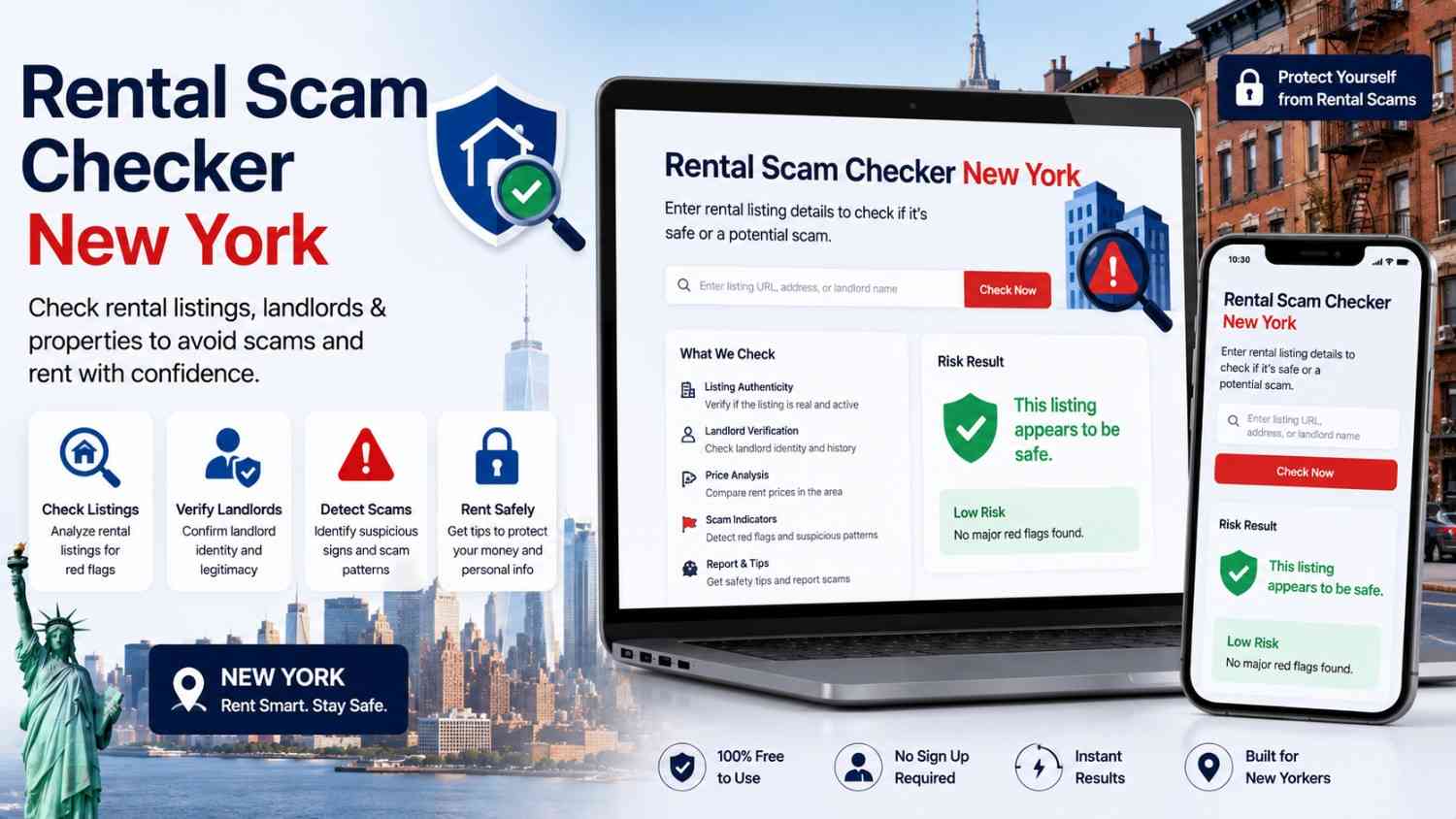
By Junaidul Islam Finding an apartment in New York can be stressful. Between high rents, competitive listings, application fees, security deposits, and pressure to move quickly, it is easy to overlook a warning sign. A rental listing may look professional, the photos may appear genuine, and the person answering your messages may sound convincing. None of those things, by themselves, proves that the apartment is legitimate.
A rental scam can involve a completely fake property, a real apartment advertised by someone who does not control it, a copied listing with a different phone number, or an attempt to collect money and personal information before you discover the truth.
This Rental Scam Checker New York helps you review common warning signs before sending a deposit, paying a fee, signing a lease, or sharing sensitive documents. It also explains how to verify a landlord or real estate agent, recognize questionable rental charges, and respond if you think you have encountered a scam.
The goal is not to label every unusual listing as fraudulent. It is to help you make a more informed decision using evidence, New York rental rules, and practical verification steps.
Rental Scam Checker New York
Use the calculator below to review the circumstances surrounding a rental. Answer the questions honestly, then read the recommended actions before committing money or personal information.
Rental Scam Checker New York
Review potential rental red flags before paying a deposit, signing a lease, or sharing personal information.
Warning signs to review
Recommended next steps
The result is a preliminary risk assessment, not a criminal investigation or a guarantee that a landlord is legitimate. The checker cannot independently confirm property ownership, inspect live rental databases, or determine whether a specific listing is genuine.
How Does a Rental Scam Work in New York?
Rental scams commonly follow a recognizable pattern. Someone advertises a desirable apartment, creates urgency, requests money or sensitive information, and avoids the checks that would establish whether they have authority to rent the property.
Some scammers copy the photographs, descriptions, and even virtual tours from legitimate listings. They replace the contact details with their own and direct interested renters to a different phone number, email address, or payment account.
Other scammers advertise properties that are not actually available for rent. They may claim that the owner is overseas, the keys are held by a third party, or a deposit is required to arrange a viewing.
The Federal Trade Commission (FTC) warns that these schemes can lead to financial losses and identity theft. Its official rental listing scam guide explains how fake advertisements operate and what renters can do to protect themselves.
A convincing website, social media profile, business card, or set of apartment photographs is not sufficient proof. Verify the property and the person offering it independently.
10 Rental Scam Red Flags to Check Before Paying
1. The landlord refuses a reasonable property viewing
A landlord or agent may have a legitimate reason to arrange a viewing later, but repeated excuses deserve attention. Be especially cautious if someone demands a deposit before allowing you, a trusted representative, or another suitable person to verify the apartment.
If an in-person viewing is impossible, ask for a live video tour and independently verify the building, unit, and person’s authority to rent it. A video call alone is not proof of ownership.
2. The rent is far below comparable apartments
An unusually low price can be a tactic to attract many applicants quickly. Compare the asking rent with several similar apartments in the same neighborhood, considering bedroom count, condition, amenities, lease terms, and location.
Do not assume a low price proves fraud. Rent can legitimately differ because of building condition, regulated rent, lease restrictions, or other circumstances. Treat a large unexplained difference as a reason to investigate further.
3. You are pressured to pay immediately
Phrases such as “send the deposit in the next 30 minutes” or “there are five other applicants, so pay now” are reasons to slow down.
A genuine apartment can still have competing applicants, but pressure should not replace verification. Do not let an artificial deadline prevent you from checking the address, reviewing the lease, confirming the recipient, and understanding every fee.
4. The person insists on an irreversible payment method
Be particularly wary if someone insists on gift cards, cryptocurrency, or a wire transfer to an unrelated individual. These methods can be difficult or impossible to reverse.
Payment applications also differ in their protections. A payment app is not automatically fraudulent, but you should not treat every transfer as recoverable. Review the provider’s protections, confirm the recipient independently, and keep written records.
Do not send money simply because someone promises to return it if the deal fails.
5. The same apartment appears under different names
Search the complete street address and distinctive phrases from the listing. Compare photographs, rental prices, contact details, and descriptions across multiple sites.
If the same unit appears with different landlords, conflicting phone numbers, or different payment instructions, investigate before proceeding.
A legitimate agent may advertise a property on several platforms. The concern is an unexplained conflict about who controls the listing or receives the money.
6. The landlord or agent’s identity cannot be verified
Ask for the person’s full name, the brokerage’s name if applicable, and written confirmation of their authority to offer the apartment.
For real estate brokers and salespersons, use New York State’s official eAccessNY public license search. Check the name, license type, status, and expiration information where available.
A matching license does not prove that the person controls a particular apartment. Contact the brokerage through independently obtained contact information and confirm the specific listing.
7. You are asked for sensitive information too early
Rental applications may legitimately require financial and identity information at the appropriate stage. The danger is sharing sensitive information with an unverified person or through an unexplained third-party website.
Be cautious about requests for your Social Security number, driver’s license image, bank login, payment-card details, or a screenshot of your credit score before you have established who is collecting the information and why.
Never share passwords, one-time security codes, or bank login credentials with a prospective landlord.
The FTC also warns about rental scams that direct applicants to credit-check websites offering a low initial charge that may enroll them in recurring paid services.
8. The lease or payment recipient does not match the story
Before paying, confirm the legal name of the landlord or property management company, the apartment address, the lease dates, the amount due, and the recipient’s relationship to the property.
A different payment recipient is not automatically proof of fraud. Property managers and authorized representatives may collect payments. However, unexplained changes in bank details, last-minute instructions to pay a different person, or refusal to provide written documentation warrant further verification.
9. Extra fees are vague or appear at the last minute
Ask for a written breakdown of the application fee, credit-check fee, security deposit, first month’s rent, broker fee, and any other required payment.
New York has specific rules governing security deposits and screening fees. New York City also has separate broker-fee requirements under the Fairness in Apartment Rental Expenses (FARE) Act.
Do not assume every fee is illegal, and do not assume a fee is legitimate just because it appears on an invoice. Check the applicable rule and who is legally responsible for the charge.
10. The person will not let you verify anything independently
A particularly concerning pattern is a person who discourages you from contacting the brokerage, building management, property owner, or official licensing authority.
Do not rely exclusively on a phone number, website, or email address supplied by the person whose claims you are checking. Locate the company’s contact information independently and ask whether the apartment and representative are genuine.
New York Security Deposit Rules: What Renters Should Know
New York’s general residential security deposit limit is no more than one month’s rent, subject to the applicable law and specific exceptions. A landlord generally cannot require both a security deposit and an additional advance payment for the last month’s rent.
For example, if your monthly rent is $2,400, a requested $4,800 security deposit is a reason to stop and investigate before paying. It exceeds the ordinary one-month limit.
This does not mean that every total move-in bill equal to twice the monthly rent is unlawful. First month’s rent and a lawful security deposit are separate items. Other lawful charges may also apply depending on the circumstances.
Before signing a lease, New York law generally limits a landlord’s charge for a credit or background check to $20, with required documentation. An applicant may be able to provide their own qualifying report, performed within the preceding 30 days, instead of paying for another check.
Read the current New York Attorney General’s Residential Tenants’ Rights Guide before making a decision. The rules applicable to a specific tenancy can depend on the housing arrangement and relevant exceptions.
A calculator can flag an amount that deserves review, but it cannot decide every legal question from the rent and deposit alone.
NYC Broker Fees: What Changed Under the FARE Act?
New York City renters should pay particular attention to broker fees.
The Fairness in Apartment Rental Expenses (FARE) Act took effect on June 11, 2025. Under the city’s published guidance, brokers representing landlords—including listing agents publishing listings with the landlord’s permission—cannot charge their broker fees to prospective tenants.
The law also requires applicable rental listings to disclose fees that prospective tenants must pay, and landlords or their agents must provide an itemized written fee disclosure before the rental agreement is signed.
There is an important distinction: renters can choose to hire their own broker and agree to pay that broker. The law does not prohibit every possible broker fee in every situation.
If a New York City listing demands a broker fee, ask:
- Who hired the broker?
- Is the fee for a broker you independently chose to hire?
- Was the fee disclosed in the listing and written documentation?
- Does the charge comply with the current FARE Act rules?
You can read the city’s official FARE Act FAQ. If you believe a broker or landlord is charging an unlawful fee, the New York City Department of Consumer and Worker Protection provides information about filing a complaint.
These NYC-specific provisions should not automatically be applied to every rental elsewhere in New York State.
How to Verify a New York Apartment Before Paying
Use this practical checklist before sending a deposit or signing a lease.
Step 1: Verify the address. Search the full street address and apartment number. Confirm that the building exists and that the advertised unit is consistent with the information you can independently establish.
Step 2: Check the original listing. Search a distinctive sentence or reverse-search the listing photographs. Look for duplicate advertisements, conflicting contact details, or a different advertised price.
Step 3: Confirm the person’s authority. Ask the owner, management company, or brokerage—using independently obtained contact details—to confirm that the person is authorized to rent the unit.
Step 4: Verify a real estate license where applicable. Use New York’s official license search. Check the name and current status, then confirm the particular listing with the brokerage. Not every property owner is required to be a real estate salesperson or broker, so a missing broker license alone does not prove a scam.
Step 5: Review the lease. Confirm the address, names of the parties, rent, lease dates, deposit, included utilities, required fees, and payment terms. Do not sign a document with unexplained blanks or inconsistent details.
Step 6: Request a complete move-in cost breakdown. Ask for each payment to be identified in writing. Compare any deposit or screening fee with New York’s applicable requirements.
Step 7: Keep evidence. Save the listing URL, screenshots, messages, emails, lease drafts, receipts, and payment instructions. These records can be useful if the listing is removed or a dispute arises.
What If You Already Paid a Rental Scammer?
If you think you have been scammed, act quickly. You do not need to wait until every detail is proven.
- Contact your bank or payment provider immediately. Explain that you suspect a fraudulent rental transaction and ask whether the payment can be stopped, recalled, disputed, or otherwise recovered. Recovery is not guaranteed.
- Preserve the evidence. Keep the listing, messages, emails, transaction records, account details, and any lease or receipt you received.
- Report the listing to the platform. Use the website or social media service where the advertisement appeared so its safety team can investigate.
- Report the suspected fraud. File a report with the Federal Trade Commission and contact the appropriate local law enforcement agency when necessary.
- Protect your identity. If you disclosed your Social Security number or other sensitive information, follow the relevant steps at IdentityTheft.gov.
- Watch for recovery scams. Someone may claim they can recover your money for an upfront fee. Verify such offers independently and do not send additional money to an unverified recovery service.
If the issue involves a landlord-tenant dispute, security deposit, or an unlawful fee, consult the relevant New York State or New York City consumer protection resource. A suspected scam and an ordinary lease dispute are not necessarily the same legal matter.
Rental Scam Checker vs. Manual Verification
A risk checker can organize warning signs, but it cannot replace independent verification.
| Check | What it can tell you | What it cannot prove |
|---|---|---|
| Rental scam risk score | Whether several warning signs are present | Whether the person committed fraud |
| Deposit comparison | Whether the amount exceeds the ordinary one-month limit | Whether every part of the move-in bill is unlawful |
| License lookup | Whether a matching license record appears | Whether the licensee controls the advertised unit |
| Reverse-image search | Whether similar images appear elsewhere | Whether the original listing is fraudulent |
| Lease review | Whether key details appear inconsistent or missing | Whether the contract is legally enforceable in every circumstance |
| Official complaint search | Whether relevant public information is available | That no complaint means the landlord is trustworthy |
The best approach is to combine the checker with official records, written documentation, and direct verification.
Frequently Asked Questions
Is there a free Rental Scam Checker for New York?
This page provides a preliminary rental scam risk assessment tool. It helps identify warning signs based on the information you enter. It does not independently verify a listing against every property record or fraud database.
How can I tell if a New York apartment listing is fake?
Look for duplicated photos, inconsistent contact details, unusually low rent, pressure to pay immediately, refusal to arrange a reasonable viewing, and payment instructions that cannot be independently verified. Check the address and confirm the person’s authority to rent the unit.
Can a New York landlord charge two months’ rent as a security deposit?
New York’s general residential security deposit limit is one month’s rent, subject to applicable exceptions. A request for two months as a security deposit should be checked against the current law before payment. First month’s rent and a lawful security deposit are separate charges.
Is a broker fee legal in New York City in 2026?
NYC’s FARE Act took effect June 11, 2025. Under the city’s published rules, a broker representing a landlord cannot pass that broker’s fee to the prospective tenant. A renter may still choose to hire their own broker. Review the official city guidance for the details applicable to your situation.
Should I pay a deposit before viewing an apartment?
Avoid paying before you have independently verified the property and the person collecting the money. If an in-person viewing is not possible, seek alternative verification, such as a live video tour and confirmation through independently obtained management or brokerage contact information.
What payment methods are safest for a rental deposit?
No payment method guarantees safety. Use a legitimate, documented payment channel and confirm the recipient before sending money. Be especially cautious when someone insists on gift cards, cryptocurrency, or a wire transfer to an unverified individual.
How do I verify a New York real estate agent?
Use New York State’s official eAccessNY public license search to look up the person’s name or license details. Confirm the specific apartment with the brokerage using contact information you find independently. A license record alone does not authenticate an individual listing.
Where should I report a rental scam?
Report the advertisement to the platform where it appeared, notify your bank or payment provider if money was sent, and submit a report to the FTC. Contact local law enforcement when appropriate. For NYC broker-fee complaints, consult the Department of Consumer and Worker Protection.
Final Checklist Before You Rent
Before paying, make sure you can answer these questions:
- Have I verified that the apartment exists and is available?
- Have I confirmed the landlord’s or agent’s authority independently?
- Have I compared the rent with similar properties?
- Have I reviewed the lease and itemized fees?
- Does the security deposit comply with the applicable New York rules?
- If the apartment is in NYC, have I checked the FARE Act requirements?
- Do I understand who receives my money and how the payment is documented?
- Have I avoided sharing sensitive personal information with an unverified person?
If several answers are no, pause the transaction and investigate further.
A few minutes of verification can help you avoid losing a deposit, exposing your identity, or signing an agreement based on misleading information. Use the Rental Scam Checker as an initial screening step, confirm important details through official sources, and never allow pressure to replace due diligence.
About the author: Junaidul Islam writes practical online guides and calculators designed to help users understand everyday decisions. This guide is for general informational purposes and is not a substitute for individualized legal advice.
Sources and further reading
- Federal Trade Commission — Rental Listing Scams
- New York Attorney General — Residential Tenants’ Rights Guide
- NYC Department of Consumer and Worker Protection — FARE Act
- New York State Department of State — Public License Search
- Federal Trade Commission — Report Fraud
Last reviewed: October 9, 2026. Rental laws, complaint procedures, and official guidance can change. Check the linked government sources before relying on a rule for a specific transaction.