
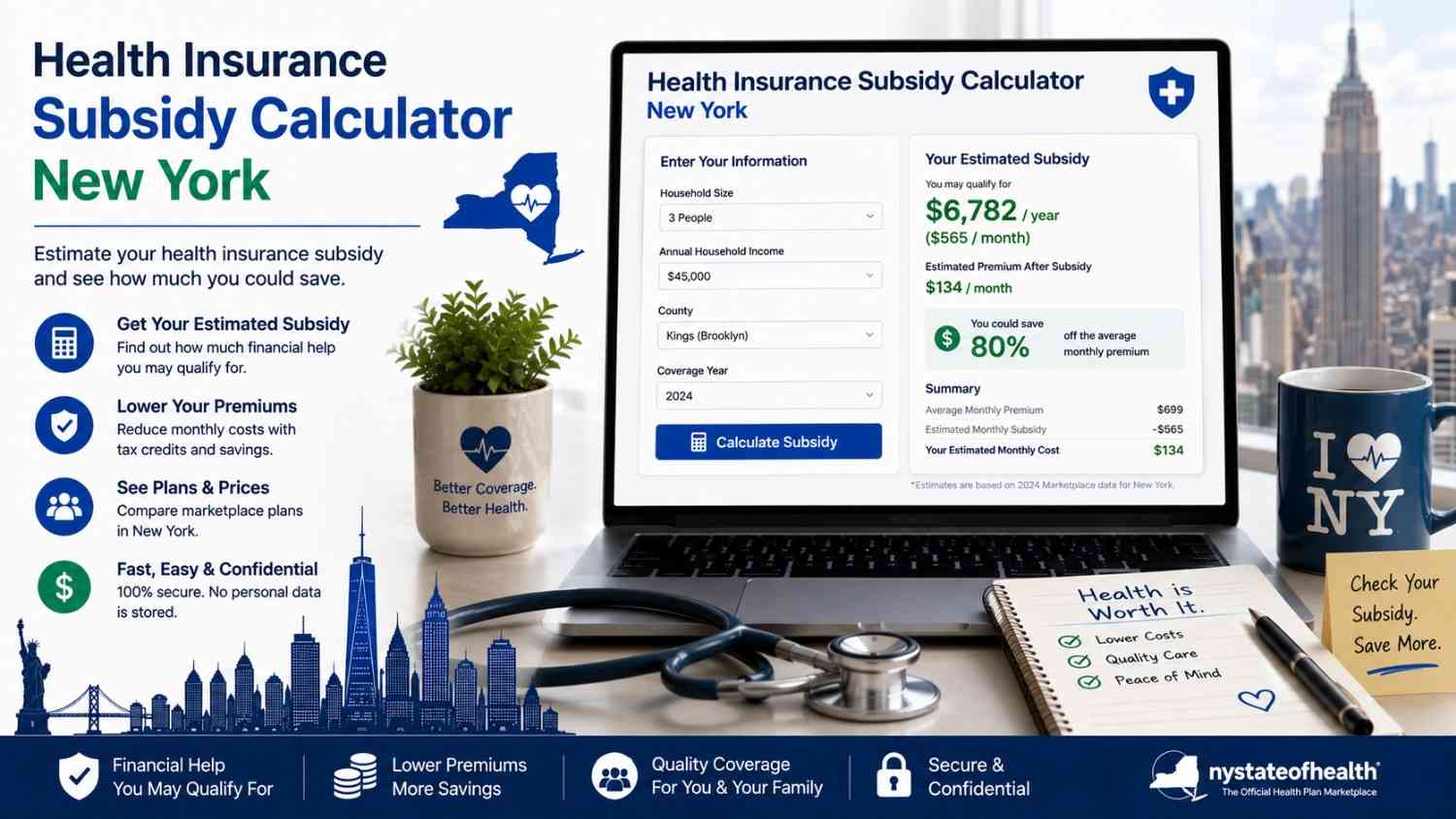
Author: Junaidul Islam If you buy your own health insurance in New York, the monthly premium you see on a plan can be very different from what you may actually have to pay after financial assistance. Your household income, tax filing situation, access to employer coverage, and the plans available where you live can all affect your costs.
The challenge is that New York has several coverage options, and they do not all follow the same eligibility rules. A person who qualifies for Medicaid may not need a Marketplace subsidy, while someone who no longer qualifies for the Essential Plan may need to compare Qualified Health Plans and available premium tax credits.
This Health Insurance Subsidy Calculator New York helps you organize the key numbers, understand how financial assistance works, and estimate your potential costs using the information you provide. It also explains the important 2026 policy changes that New Yorkers should understand before choosing coverage.
The result is a planning estimate, not an official eligibility decision or a quote from an insurance company.
New York Health Insurance Subsidy Calculator
Estimate your 2026 household income level and potential Marketplace premium assistance.
Your Preliminary Estimate
This is a simplified planning estimate for 2026, not an official eligibility determination. It uses illustrative federal poverty guideline values and the 2026 applicable contribution percentage schedule. It does not verify citizenship or immigration requirements, tax filing status, employer-plan affordability, Medicaid or Essential Plan eligibility, actual plan availability, or local premium data. The benchmark premium must be supplied and verified by the user. Actual tax-credit eligibility and amounts may differ.
Use the calculator to review your estimated annual household income, family size, and potential Marketplace premium costs. For a more useful estimate, enter the applicable benchmark Silver plan premium for your area if you have verified it.
If you do not know your local premium yet, you can still use the calculator to understand your household income relative to the federal poverty guidelines and identify the questions you need to check with NY State of Health.
What Is a Health Insurance Subsidy?
A health insurance subsidy is financial assistance that may help eligible people afford health coverage or reduce certain medical expenses. The type of assistance you receive depends on your circumstances and the program for which you qualify.
For people buying qualifying individual health insurance through the Marketplace, two terms are especially important.
1. Premium Tax Credit
The Premium Tax Credit, often called PTC, can reduce the monthly premium of an eligible Marketplace plan. If you qualify for advance payments, the credit can be sent directly to your insurance company so that you pay less each month.
The amount is not the same for everyone. It depends on factors such as household income, family size, the applicable tax-credit rules, and the cost of the benchmark Silver plan in your area.
For 2026, the enhanced federal premium tax credits that applied through 2025 expired under the law then in effect. The regular Premium Tax Credit rules therefore matter again, including the general 400% federal poverty level income ceiling and the applicable contribution percentages. Certain exceptions may apply, so people with unusual tax or immigration circumstances should verify their eligibility with the official Marketplace or a qualified tax professional.
Official reference: IRS — Premium Tax Credit.
2. Cost-Sharing Reductions
Cost-sharing reductions, or CSRs, help eligible people pay less when they use covered medical services. Depending on eligibility, they can reduce deductibles, copayments, coinsurance, and out-of-pocket maximums.
These reductions are generally associated with eligible Silver Marketplace plans. A person should compare both the monthly premium and the cost of using the plan rather than choosing insurance based on the premium alone.
For example, a lower-premium plan may have a higher deductible. If you expect regular specialist visits, prescriptions, or other treatment, a plan with a higher premium but lower cost-sharing could be worth considering.
You can review New York's official coverage options through NY State of Health.
Important New York Health Insurance Changes in 2026
One of the most important changes for New Yorkers took effect on July 1, 2026.
New York transitioned its Essential Plan back to Basic Health Program authority after changes in federal funding. According to the New York State Department of Health, approximately 450,000 people became ineligible for the Essential Plan under the previous expanded eligibility rules and may instead be eligible for Qualified Health Plans.
The state said the transition preserves Essential Plan coverage for approximately 1.3 million enrollees with incomes below 200% of the federal poverty level.
This means that a person who used to qualify for the Essential Plan under the expanded 250% income limit should not assume that the same limit still applies.
If your income is above the current Essential Plan limit, you may need to explore Marketplace coverage and determine whether you qualify for a Premium Tax Credit or other assistance. The outcome depends on your complete circumstances, not income alone.
Official source: New York State Department of Health — Essential Plan update.
Who should review their coverage?
You should carefully review your options if:
- You were enrolled in the Essential Plan and received a notice about a change in eligibility.
- Your household income is near the current program limit.
- You have recently lost employer-sponsored insurance.
- Your household income has changed significantly during the year.
- You are comparing a Marketplace plan with Medicaid or another coverage option.
Do not cancel existing coverage based only on an online estimate. Confirm your new eligibility and effective date before making a change.
How Much Can You Earn and Still Qualify for a Subsidy?
There is no single income limit that answers every health insurance question in New York. Different programs have different eligibility rules, and household size changes the income thresholds.
For 2026 Marketplace Premium Tax Credit purposes, the federal poverty guidelines used for the coverage year include $15,650 for a one-person household and $32,150 for a four-person household in the contiguous United States.
The general Premium Tax Credit income range for 2026 is 100% through 400% of the applicable federal poverty level, subject to additional eligibility requirements and exceptions. The income range is not the only test: access to qualifying employer coverage, enrollment in other government coverage, tax filing status, and other rules may affect eligibility.
The Essential Plan has a different income test. After the July 2026 change, the general income limit returned to 200% of the federal poverty level for the applicable group, but other program requirements also apply.
These thresholds are not interchangeable. A household may be outside the Essential Plan income range but still need to evaluate Marketplace financial assistance.
Use the calculator as a starting point, then verify the rules that apply to your coverage year.
How to Calculate Your Expected Health Insurance Cost
A useful estimate starts with the premium before financial assistance, the expected household contribution under the applicable rules, and the available premium tax credit.
For an eligible household, the basic relationship is:
Estimated monthly premium after tax credit = Monthly plan premium − Monthly advance Premium Tax Credit
The maximum available credit is generally tied to the applicable benchmark Silver plan premium and the household's required contribution. The lowest-cost Bronze plan price does not automatically determine the amount of the credit.
Consider a hypothetical example.
Suppose a household finds that its applicable benchmark Silver premium is $700 per month. After reviewing the applicable income and tax-credit rules, assume the estimated required contribution is $300 per month.
The preliminary credit calculation would be:
- Benchmark Silver premium: $700 per month
- Estimated required contribution: $300 per month
- Potential monthly tax credit: $400
- Potential annual tax credit: $4,800
These figures are illustrative only. They are not a New York rate quote, a prediction for a particular household, or a guarantee of eligibility. Actual results can differ because of plan prices, tax household details, eligibility requirements, and the information accepted by the Marketplace.
If you enter an actual benchmark premium into the calculator, make sure it corresponds to your coverage year and location. A premium from another county or an older year can produce a misleading result.
What Counts as Household Income?
For Premium Tax Credit calculations, household income generally uses Modified Adjusted Gross Income, or MAGI, under the tax rules. It is not necessarily the same as your take-home pay or the amount deposited into your bank account.
Depending on your circumstances, relevant income can include:
- Wages and salaries.
- Net income from self-employment.
- Taxable interest and dividends.
- Certain Social Security benefits.
- Other income included under the applicable tax rules.
MAGI can include adjustments to adjusted gross income, such as certain nontaxable Social Security benefits, tax-exempt interest, and excluded foreign income.
If you are self-employed, have seasonal work, or expect your income to change, estimate your total annual household income as carefully as possible. Use the official Marketplace instructions when determining which income sources to include.
Your estimate should reflect the year for which you want coverage, not automatically the previous year's income.
Reference: KFF — Health Insurance Marketplace Calculator.
Does Employer-Sponsored Insurance Affect Your Subsidy?
Yes. An offer of health insurance through your job, or through a spouse's employer, can affect your eligibility for Marketplace premium tax credits.
However, having an employer offer does not automatically settle the question in every situation. The affordability and minimum-value rules, along with which family members have access to coverage, can matter.
If your employer offers coverage, review the employee contribution for the relevant plan and ask the employer whether the plan meets the minimum-value standard. Family members may be assessed differently depending on the applicable rules.
Do not simply mark employer coverage as unavailable because you prefer a Marketplace plan. Answer the calculator's questions based on your actual circumstances and confirm the final determination through the Marketplace.
Does Your New York ZIP Code Matter?
Yes. The ZIP code and county where you live can affect which plans are available and how much they cost.
Premium tax credits are linked to the applicable benchmark Silver premium in your area. Two households with similar incomes and family sizes may receive different estimates because they live in different places or have different household circumstances.
New York also has a state-specific rule that prohibits individual and small-group health insurers from varying premiums based on age. This makes New York different from many states, where older adults can face substantially higher premiums than younger adults.
Nevertheless, your ZIP code remains useful when comparing local plans. Make sure the provider network, prescription coverage, and plan availability fit your needs.
Premium Is Not the Same as Total Healthcare Cost
The monthly premium is only one part of the cost of health insurance.
Before selecting a plan, compare these terms:
Premium: The recurring amount you pay to keep the policy active.
Deductible: The amount you generally pay for covered services subject to the deductible before the plan starts paying under the applicable cost-sharing rules.
Copayment: A fixed amount you pay for a covered service, such as a doctor visit.
Coinsurance: A percentage of the allowed cost that you pay for a covered service.
Out-of-pocket maximum: The plan's limit on qualifying out-of-pocket spending for covered in-network essential health benefits under the applicable rules. Premiums and certain other expenses do not count toward this limit.
Also check the plan's provider network and prescription formulary. A low premium may be less attractive if your preferred doctor is out of network or your regular medication is not covered as expected.
If you qualify for cost-sharing reductions, compare eligible Silver plans carefully. The savings from reduced deductibles and other cost-sharing can make a meaningful difference for people who use medical services regularly.
How to Apply for Health Insurance Financial Assistance in New York
The official New York Marketplace is the place to confirm eligibility and enroll in coverage.
- Visit NY State of Health.
- Gather your household details, expected annual income, tax filing information, and any employer coverage information.
- Complete the official application with accurate information.
- Review the eligibility determination for Marketplace financial assistance and other available programs.
- Compare the actual plans, premiums, deductibles, provider networks, and prescription coverage.
- Check the effective date before ending any existing coverage.
You can also call NY State of Health at 1-855-355-5777 to ask about enrollment and eligibility. The state can direct you to free enrollment assistance.
When can you enroll?
As of October 10, 2026, the next annual Marketplace Open Enrollment period is approaching. Federal Marketplace guidance states that Open Enrollment for 2027 coverage starts November 1, 2026. Check NY State of Health for New York's current dates, deadlines, and enrollment instructions.
Outside Open Enrollment, a person may be able to enroll or change coverage after a qualifying life event, such as losing other coverage, moving, getting married, or having a baby. The rules and deadlines depend on the event and the individual's circumstances.
Medicaid and certain other public coverage programs may allow enrollment throughout the year. You should not assume you must wait for Open Enrollment before checking those options.
A Note About Advance Premium Tax Credits and Taxes
If you choose to have an advance Premium Tax Credit paid toward your insurance premium, the Marketplace uses the information available to estimate your credit.
Your final credit is reconciled on your federal income tax return using Form 8962 when required. If your actual eligibility differs from the amount advanced during the year, you may have to repay excess advance payments under the applicable rules.
For tax years beginning after December 31, 2025, federal law removed the previous repayment caps for excess advance Premium Tax Credit payments. That makes accurate income estimates and timely reporting of changes especially important.
If your income increases, your household changes, or you receive a new employer coverage offer, update your Marketplace application promptly. If you are uncertain how the changes affect your tax return, seek help from a qualified tax professional.
Reference: IRS — Eligibility for the Premium Tax Credit.
Frequently Asked Questions
Is the Health Insurance Subsidy Calculator New York free to use?
The calculator on this page is designed as a free planning tool. You can use it to organize your household information and understand potential financial assistance. Official eligibility and enrollment decisions must come from NY State of Health or the relevant government program.
Can I get a $0 monthly premium in New York?
Some eligible people may qualify for coverage with no monthly premium, depending on the program, plan, and circumstances. A $0 premium does not necessarily mean that every medical service is free. Check deductibles, copayments, coinsurance, provider networks, and drug coverage before enrolling.
Can I qualify for a subsidy if I work full-time?
Possibly. Your work status alone does not determine eligibility. Household income, access to employer-sponsored coverage, affordability rules, tax status, and other eligibility requirements matter.
What if my income changes during the year?
Update your Marketplace application when your circumstances change. This can help keep your advance tax credit closer to the amount you are actually eligible to receive and reduce the risk of a tax-time repayment.
Does the calculator guarantee that I qualify?
No. The calculator provides a preliminary estimate based on the information entered and the assumptions used. Only the official eligibility process can determine your actual assistance.
What if I no longer qualify for the Essential Plan?
Review your options through NY State of Health. You may need to compare Qualified Health Plans and determine whether you qualify for a Premium Tax Credit or another program. Do not assume you are ineligible for all financial assistance simply because the Essential Plan is no longer available to you.
Can I use the calculator for 2027 coverage?
The calculator must use the correct rules and premium data for the selected coverage year. For 2027 coverage, revisit the tool after updated income guidelines, plan premiums, and applicable rules are available. Do not treat a 2026 estimate as a verified 2027 quote.
Where can I get free help choosing a plan?
Start with NY State of Health or call 1-855-355-5777. Ask about free enrollment assistance and make sure you understand your eligibility determination before choosing coverage.
Final Thoughts
Estimating a New York health insurance subsidy involves more than entering an annual salary. Your tax household, local benchmark premium, employer coverage, program eligibility, and the rules for your coverage year can all affect the result.
The 2026 Essential Plan changes make it particularly important for New Yorkers to check current information rather than rely on an older income chart. Use this calculator to organize your figures, compare the potential costs, and prepare for the official application.
For the most accurate result, verify your eligibility and plan prices through NY State of Health before enrolling. A clear estimate can help you ask better questions, compare plans more confidently, and avoid choosing coverage based on the monthly premium alone.
Sources and further reading
- NY State of Health — Official New York health insurance marketplace
- New York State Department of Health — Essential Plan changes in 2026
- IRS — Premium Tax Credit overview
- IRS — 2026 Premium Tax Credit applicable percentages
- KFF — Health Insurance Marketplace Calculator
- HealthCare.gov — Enrollment guidance
This article is for educational purposes and does not provide insurance, legal, or tax advice. Rules and eligibility can change; verify your individual circumstances with official sources.