
Author: Junaidul Islam
Last reviewed: October 10, 2026
New York City building owners face an important question under Local Law 97: How much could their property owe if annual greenhouse gas emissions exceed the legal limit?
The answer depends on more than a building’s size. Its applicable emissions limit, reported greenhouse gas emissions, property use, compliance pathway, and any qualifying adjustment can all affect the result. A building that appears similar to another property may have a different compliance obligation.
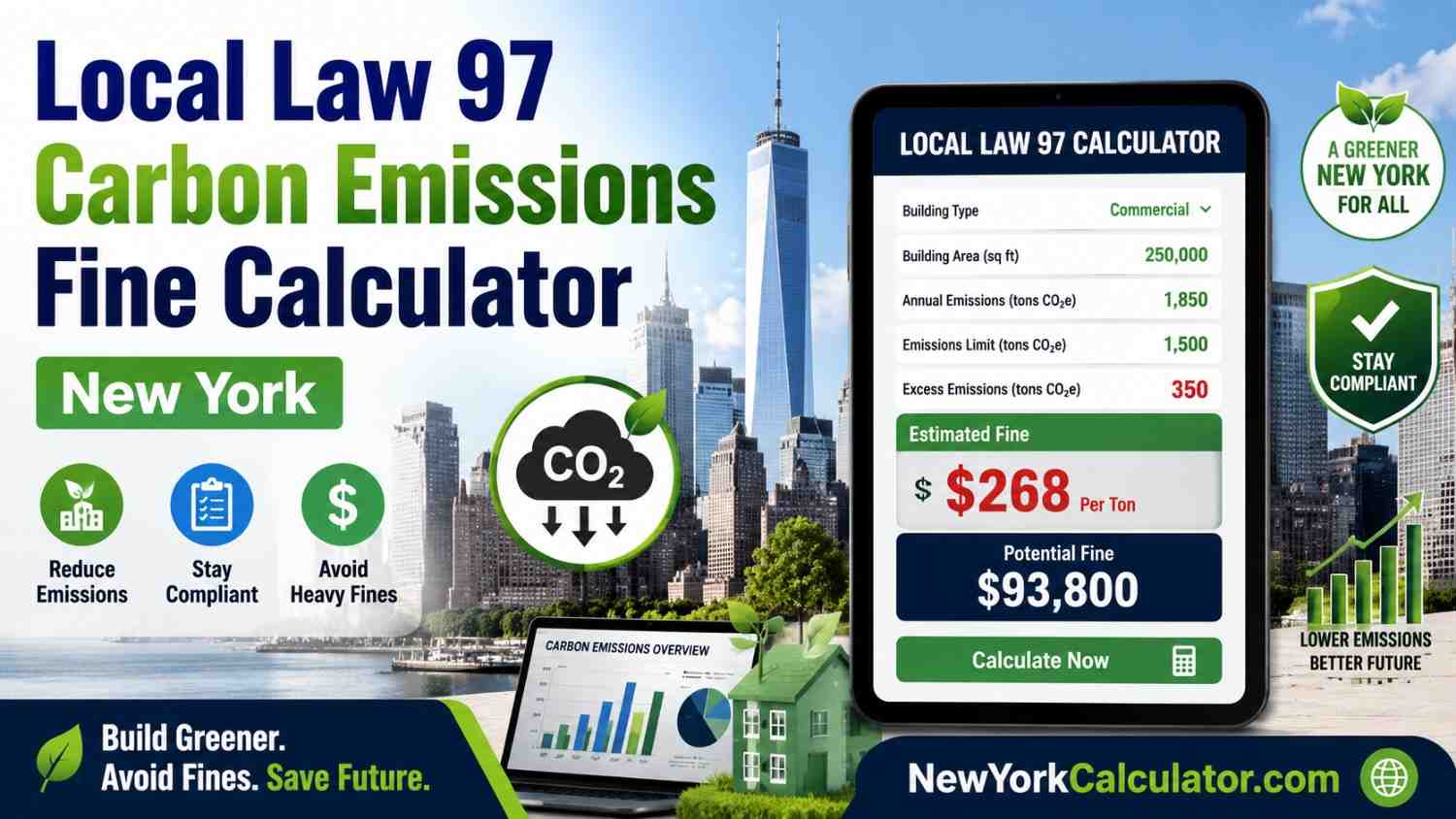
The Local Law 97 Carbon Emissions Fine Calculator for New York on this page helps estimate the annual emissions penalty under Article 320 using your building’s reported emissions and applicable emissions limit. It also provides a separate, simplified estimate of potential late-reporting exposure.
Local Law 97 Carbon Emissions Fine Calculator
Estimate potential NYC building emissions penalties using your verified annual emissions and applicable emissions limit.
Enter the figures from your building records. For Article 320, the calculator estimates the emissions penalty at the statutory rate of up to $268 per metric ton above the applicable limit.
Your Estimated Results
This is an independent estimate, not an official DOB assessment. The $268 calculation is the Article 320 statutory maximum-rate estimate. The reporting estimate uses floor area × $0.50 × entered months and does not evaluate the statutory 60-day provision, the precise legal chargeable period, or other exceptions. The combined figure is not a determination of total legal liability. Article 321 penalties are not calculated by the Article 320 emissions formula.
Use the calculator as an initial planning tool, not as an official determination of a violation or the amount the New York City Department of Buildings (DOB) will assess.
What Is New York City Local Law 97?
Local Law 97 of 2019 is part of New York City’s effort to reduce greenhouse gas emissions from buildings. It establishes emissions limits and reporting requirements for many large buildings, with stricter limits introduced for later compliance periods.
According to the NYC Department of Buildings, the law generally covers:
- A building exceeding 25,000 gross square feet.
- Two or more buildings on the same tax lot whose combined gross floor area exceeds 50,000 square feet.
- Certain condominium buildings governed by the same board of managers whose combined gross floor area exceeds 50,000 square feet.
Coverage depends on the building and its circumstances. A building’s tax-lot records, building identification number, ownership structure, exemptions, and applicable compliance pathway may matter.
Do not assume that a property is exempt simply because an individual building is smaller than 25,000 square feet. Buildings grouped under the same tax lot or qualifying condominium arrangement may still be covered.
Before making a compliance decision, check the official NYC Department of Buildings Local Law 97 guidance and the current Covered Buildings List.
How Does the Local Law 97 Carbon Emissions Fine Work?
For buildings subject to Article 320, the statutory emissions-penalty calculation is based on the difference between actual reported emissions and the applicable annual emissions limit.
The law provides for a civil penalty of up to $268 multiplied by each metric ton of carbon dioxide equivalent (CO₂e) above the applicable limit.
The basic estimate is:
Estimated annual emissions penalty = max(0, actual emissions − applicable emissions limit) × $268
Both emissions figures must use the same unit: metric tons of CO₂e per year.
For example, suppose a covered building has an applicable annual limit of 100 metric tons of CO₂e and reports 130 metric tons.
- Actual emissions: 130 metric tons.
- Applicable limit: 100 metric tons.
- Emissions above the limit: 30 metric tons.
- Maximum-rate estimate: 30 × $268 = $8,040 per year.
This is an illustrative calculation, not a prediction of the final penalty in a particular enforcement case. The law allows consideration of relevant aggravating and mitigating factors, and the amount imposed may depend on the applicable rules and circumstances.
If actual emissions are below the limit, this basic formula produces no emissions-exceedance penalty. That does not automatically establish that every other reporting or compliance obligation has been satisfied.
Local Law 97 Calculator: What Information Do You Need?
For the most useful estimate, collect the following information before calculating.
1. Gross floor area
Use the appropriate gross floor area from the relevant New York City records. Do not automatically substitute rentable space, usable apartment area, or a marketing figure from a property listing.
2. Actual annual greenhouse gas emissions
Use the building’s verified emissions data for the relevant calendar year. Energy usage and emissions figures are not interchangeable. If you only have utility bills, additional calculations using the applicable fuel and electricity emissions coefficients may be necessary.
3. Applicable emissions limit
Obtain the limit that applies to the building’s property type, floor area, reporting year, and compliance pathway. Do not use a limit from a different property classification or compliance period.
4. Compliance pathway
Determine whether the building is subject to Article 320, Article 321, or a special provision. These pathways can have different requirements and penalties.
5. Reporting status
Confirm whether the annual report was filed, whether it was filed on time, and whether the building has an unresolved covered-building or classification issue.
The calculator below allows you to enter the emissions and limit directly. This avoids presenting a guessed limit as if it were an official building-specific result.
2024–2029 vs. 2030–2034: Why the Compliance Period Matters
Local Law 97 uses different emissions limits for different periods. A building that stays below its earlier limit may face a more difficult target as the rules become stricter.
For calendar years 2024 and 2025, certain buildings could use either the applicable NYC Building Code occupancy-group limits or the revised Energy Star Portfolio Manager (ESPM) property-type limits, subject to the city's rules and eligibility conditions.
Beginning with calendar year 2026, covered buildings must use the ESPM property-type methodology for their emissions limits. Owners should not continue using an earlier occupancy-group method merely because it was used for a previous report.
The revised limits are intended to reflect how different building types actually use energy. A multifamily residential building, office, hotel, hospital, and school can have different emissions limits even when their gross floor areas are similar.
For this reason, there is no single universal Local Law 97 limit per square foot that should be applied to every New York property.
To obtain the correct limit, review the DOB's official Local Law 97 emissions-limit tables.
Example: Comparing Two Buildings
Consider two hypothetical Article 320 buildings. The numbers below are examples only; they are not official limits for either property type.
| Calculation | Building A | Building B |
|---|---|---|
| Annual emissions | 180 metric tons | 180 metric tons |
| Applicable annual limit | 200 metric tons | 150 metric tons |
| Emissions above limit | 0 metric tons | 30 metric tons |
| Estimated annual penalty at $268/ton | $0 | $8,040 |
Both buildings report the same annual emissions. However, their hypothetical applicable limits differ, so the resulting estimates are different.
This is why a calculator that asks only for a building's square footage cannot reliably determine the actual penalty unless it also has the correct property classification, reporting year, and applicable emissions-limit rules.
Local Law 97 Emissions Penalty vs. Late-Filing Penalty
These are separate issues, and property owners should not combine them into a single unexplained fine.
Article 320 emissions penalty
For a building that exceeds its annual emissions limit, the basic statutory calculation is the number of metric tons above the limit multiplied by $268.
Article 320 failure-to-report penalty
The statute separately provides for a penalty based on gross floor area multiplied by $0.50 for each month the reporting violation remains uncorrected, subject to the law's conditions and exceptions. The statute includes a provision protecting certain reports demonstrating compliance when filed within 60 days of the due date.
The simplified late-filing estimate in this calculator does not determine whether an exception applies, establish the precise number of legally chargeable months, or predict a final assessment.
Article 321 requirements
Some buildings follow Article 321's prescriptive compliance pathway rather than the ordinary Article 320 emissions-limit pathway. DOB identifies separate $10,000 penalties for specified failures to submit the required compliance report or demonstrate compliance under Article 321.
Do not apply the Article 320 emissions formula automatically to an Article 321 building.
Check the current NYC DOB Local Law 97 violation and penalty guidance before estimating the total financial exposure of a building.
What If Your Building Does Not Have Its Emissions Data?
Start with the records rather than guessing.
The U.S. Environmental Protection Agency's ENERGY STAR Portfolio Manager is commonly used for building energy benchmarking. Owners and their service providers can review the building's energy records and reported greenhouse gas emissions there.
If you manage the property, gather the relevant electricity, natural gas, steam, fuel-oil, and other applicable energy records. Confirm that the records cover the correct calendar year and the correct building boundaries.
Be careful with shared meters, tenant energy use, campus-style electricity, cogeneration systems, and buildings with multiple uses. Depending on the circumstances, these can affect how energy consumption and emissions must be determined.
If you only know the annual utility cost, you do not yet have enough information to calculate an accurate emissions penalty. Energy prices vary, and a dollar amount cannot be converted reliably into CO₂e without the necessary usage data and conversion factors.
A qualified registered design professional can help determine the correct reporting approach and verify the calculation.
Can a Building Owner Reduce a Local Law 97 Penalty?
Reducing emissions before a building exceeds its limit is generally a more useful strategy than waiting for a penalty assessment.
Depending on the property, potential measures may include:
- Improving heating-system efficiency and controls.
- Optimizing boilers, domestic hot-water systems, and distribution equipment.
- Improving insulation, air sealing, and building-envelope performance where appropriate.
- Upgrading lighting and controls.
- Reviewing electrification options and the associated electrical infrastructure.
- Improving heating, ventilation, and air-conditioning schedules.
- Evaluating eligible adjustments, deductions, or other compliance options under the applicable rules.
No single retrofit is right for every building. A measure that works well in a small multifamily building may be unsuitable for a hospital, a high-rise office, or a property with unusual operating requirements.
Before spending money, establish the baseline emissions, identify the applicable limit, and model the expected emissions reduction. Ask a qualified professional to verify the projected savings and confirm whether a proposed adjustment or deduction is permitted under the current rules.
Owners can also consult NYC Accelerator for assistance understanding building improvements, service providers, and potential financing options.
Special Cases That Can Change the Result
A straightforward emissions calculation may not reflect the full legal position of a property.
Mixed-use buildings: Different portions of a building may have different ESPM property types. Their floor areas and applicable limits may need to be handled according to the official methodology. A single guessed property type can produce a misleading result.
Multiple buildings on one tax lot: A covered tax lot may contain multiple building identification numbers. Confirm which buildings are included and what compliance requirements apply to each one.
Affordable housing and other special circumstances: Certain buildings may qualify for special provisions, different compliance dates, or particular pathways. Do not assume that every residential building has the same obligations.
Physical conditions or other legal requirements: Some owners may be able to apply for an adjustment to an emissions limit where the applicable legal criteria are satisfied. An adjustment is not automatic; it requires the appropriate application and supporting information.
Incorrect city records: If the Covered Buildings List shows the wrong building characteristics or compliance pathway, follow DOB's current dispute process. Do not silently substitute your own assumptions for the city's records.
The official DOB Local Law 97 page provides the current reporting guidance and links to relevant special-circumstance resources.
A Practical Local Law 97 Compliance Checklist
Before relying on a penalty estimate, work through this checklist:
- Confirm that the building is covered and identify the applicable compliance pathway.
- Verify the building identification number, tax lot, and gross floor area.
- Confirm the relevant calendar year and reporting requirements.
- Obtain the correct ESPM property type and official emissions limit.
- Verify the reported annual greenhouse gas emissions.
- Calculate the emissions above the limit, if any.
- Review report-filing status and any separate violations.
- Check whether a qualifying adjustment or other permitted provision applies.
- Keep the records, calculations, professional attestations, and submission confirmations.
- Verify current deadlines and requirements directly with NYC DOB before filing.
This process is particularly important when preparing reports for a building with multiple uses, shared energy systems, unusual occupancy, or an unresolved compliance classification.
Frequently Asked Questions
How much is the Local Law 97 carbon emissions fine in NYC?
For Article 320, the statutory formula provides for a civil penalty of up to $268 for each metric ton of CO₂e above the applicable annual emissions limit. The final amount depends on the applicable rules and circumstances.
Does every building in New York City have to comply with Local Law 97?
No. The law covers specified categories of buildings, generally including individual buildings over 25,000 gross square feet and certain groups of buildings exceeding 50,000 gross square feet. Exceptions and alternative compliance pathways may apply.
What is the difference between Article 320 and Article 321?
Article 320 generally involves annual emissions limits and reporting. Article 321 provides an alternative prescriptive pathway for certain qualifying buildings. Their obligations and penalties differ, so the correct pathway must be confirmed first.
Can I calculate my penalty using only square footage?
No. Square footage alone is insufficient for an emissions-penalty calculation. You also need the building's actual annual emissions and the correct applicable emissions limit. Floor area is relevant to certain separate reporting penalties.
Are the 2030 emissions limits the same as the 2024–2029 limits?
No. The limits become more stringent in the later period. Owners should use the official limits for the relevant reporting year and property type rather than carry forward a previous period's limit.
Is this calculator an official NYC Department of Buildings tool?
No. It is an independent educational calculator provided by NewYorkCalculator.com. It does not access DOB records, submit reports, verify exemptions, or determine an official penalty.
Where can I verify the current Local Law 97 rules?
Start with the NYC Department of Buildings' official Local Law 97 guidance, emissions-limit tables, and violation information. For building-specific questions, consult an appropriately qualified professional or contact the DOB sustainability team through its official channels.
Final Thoughts
A Local Law 97 penalty estimate is only as reliable as the emissions data, applicable limit, and compliance assumptions behind it. New York building owners should verify these details before using a calculation to make financial or legal decisions.
Use the calculator on this page to understand the potential scale of an emissions exceedance, then confirm the building-specific requirements with the official NYC Department of Buildings guidance and a qualified professional.
Disclaimer: This article is for general educational purposes and does not provide legal, engineering, tax, or compliance advice. Laws, regulations, deadlines, and emissions limits can change. The calculator provides estimates only and should not be treated as an official determination of liability.