
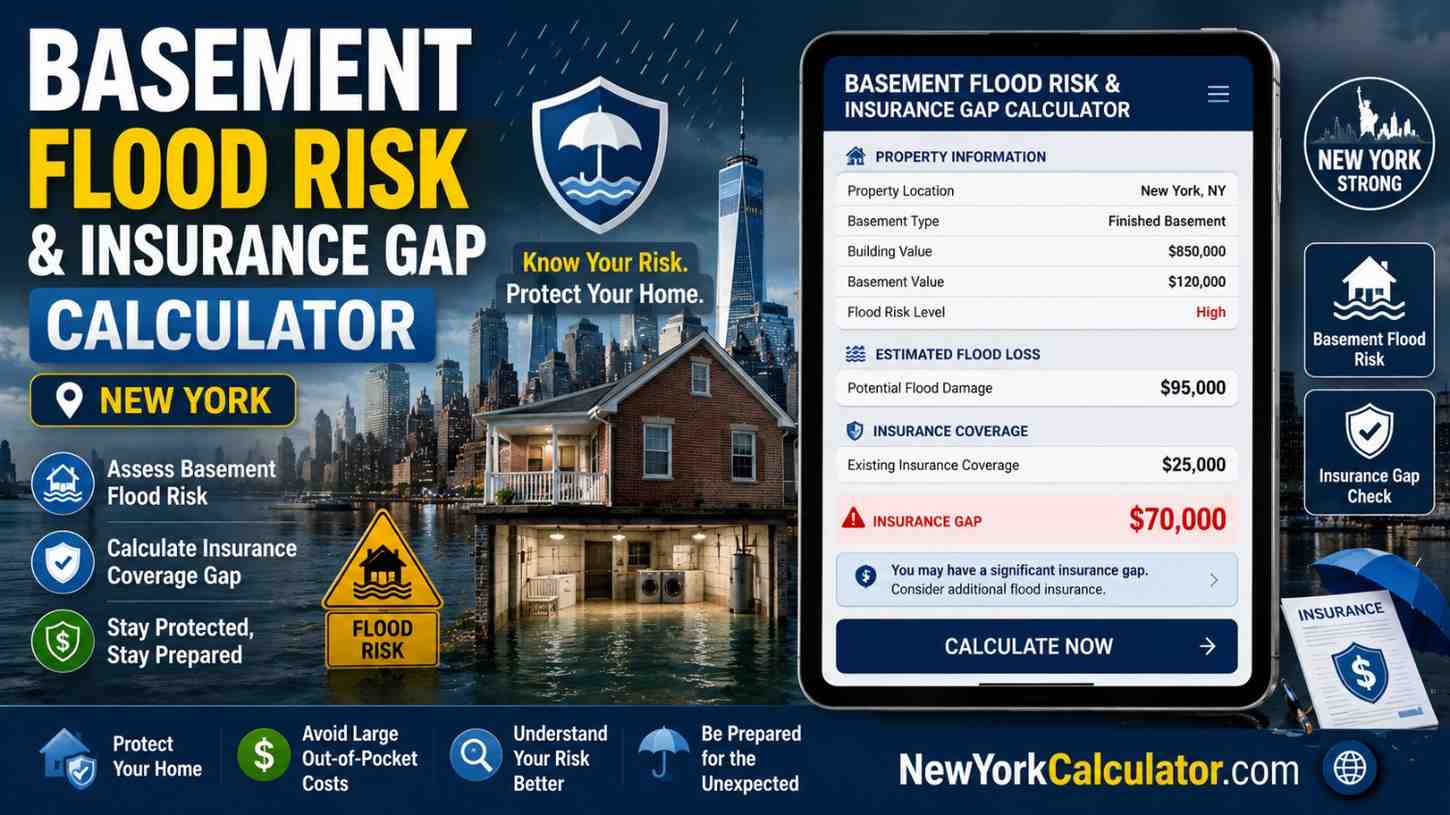
By Junaidul Islam A basement can be useful extra space in a New York home. It may serve as a family room, laundry area, storage space, home office, or rental apartment. But when water enters that space, the financial consequences can be much greater than the cost of removing the water.
The difficult part is that two different questions need to be answered: How exposed is the basement to flooding, and how much of the resulting damage would insurance actually cover?
Our Basement Flood Risk & Insurance Gap Calculator for New York helps you organize these questions in one place. You can enter information about your property, previous flooding, basement contents, estimated damage, and insurance limits to calculate a preliminary flood-risk indicator and an estimated financial coverage gap.
The results are planning estimates, not official flood-zone determinations, predictions of when a flood will occur, insurance quotes, or guarantees of claim payment.
Use the Basement Flood Risk & Insurance Gap Calculator
Basement Flood Risk & Insurance Gap Calculator
Estimate basement flood-risk indicators, potential damage and a preliminary insurance coverage gap for New York properties.
Your Preliminary Results
Calculation Breakdown
| Potentially eligible building loss | $0 |
|---|---|
| Potentially eligible contents loss | $0 |
| Excluded / uncertain loss and other costs | $0 |
| Before-deductible estimated eligible amount | $0 |
| Deductible applied in this model | $0 |
| Estimated payout under entered assumptions | $0 |
| Estimated loss remaining | $0 |
Enter your property details and estimated costs carefully. If you do not know whether a particular expense is covered by your policy, do not automatically classify it as insured. Check your policy documents or ask your insurance agent before relying on a coverage estimate.
Why Basement Flood Risk Matters in New York
Flood risk in New York is not limited to homes immediately beside a river or the ocean. Depending on the location and property, water can enter a basement because of coastal flooding, intense rainfall, surface runoff, drainage problems, or sewer backup.
New York City has a particular challenge: it is a coastal city with low-lying neighborhoods, extensive paved surfaces, and properties that can experience different types of flooding. The city’s official flood-risk resources distinguish between coastal flood exposure and rainfall-related risk.
A property may therefore need more than one kind of assessment. A federal flood map is important for understanding mapped flood hazards and insurance requirements, but it should not be treated as a complete prediction of every possible water-entry problem.
For example, a homeowner might live outside a mapped high-risk flood zone but still experience water entering through a basement window during intense rain. Another property might be more exposed to coastal storm surge. A third might have a recurring sewer-backup problem.
These situations are different, and the insurance response may be different too.
For an initial assessment, consult the NYC Flood Maps website and the NYC Interim Flood Risk Mapper. For properties elsewhere in New York State, consult the New York State Department of Environmental Conservation’s floodplain management resources.
What Does a Basement Flood Risk Assessment Measure?
A useful basement assessment should consider several indicators rather than relying on a ZIP code alone.
1. Official flood-zone information
Start by checking whether the property’s exact location falls within a mapped flood-hazard area. FEMA Flood Insurance Rate Maps identify areas with different flood hazards and provide information used in certain flood-insurance and mortgage decisions.
In commonly used FEMA terminology, a 1% annual-chance flood has a one-in-100 chance of occurring in any particular year. This does not mean a flood happens only once every 100 years. The risk can occur in consecutive years, and a larger flood is possible.
A mapped zone is not a guarantee that flooding will or will not happen at a particular building.
2. Previous flooding
Previous basement flooding is a useful warning sign. Consider whether water has entered the property before, how it entered, how deep it became, and whether the same conditions still exist.
A previous incident could indicate an ongoing drainage issue, a low entry point, a sump-pump problem, or exposure to a broader flood event.
Past flooding does not establish an exact probability of future flooding. However, it is important information to consider when planning improvements and reviewing insurance.
3. Heavy rainfall and surface runoff
During intense rainfall, water can accumulate faster than nearby drains or other drainage systems can handle it. Sloping driveways, window wells, low entrances, clogged gutters, and poorly directed downspouts can make a basement more vulnerable.
Look for places where water collects around the foundation. Check whether downspouts direct water away from the building and whether basement windows or exterior doors sit below the surrounding ground.
These observations can identify practical problems even when an official map does not show a high flood hazard at the property.
4. Sewer backup and sump-pump failure
Water entering through a sewer line or a failed sump pump is not automatically treated the same way as surface or coastal flooding under an insurance policy.
New York’s Department of Financial Services explains that some insurers offer water-backup endorsements that may cover specified sewer-backup or sump-pump losses. Terms, exclusions, and limits vary.
Review this issue separately instead of assuming that ordinary homeowners insurance or a flood policy covers every backup event.
5. Basement construction and elevation
A basement’s layout matters. A below-ground apartment, a walkout basement, a partially below-grade room, and a finished lower level may have different physical exposure and insurance treatment.
Under the National Flood Insurance Program’s definition, a basement generally has a floor below ground level on all sides. The label used in a rental listing is not necessarily enough to establish how an insurance policy classifies the space.
If you are buying or renting a basement apartment, confirm its legal status, relevant building requirements, and insurance arrangements instead of assuming that a flood-risk score answers those questions.
How to Use This Calculator
The calculator combines a simple screening indicator with an itemized estimate of potential financial loss.
Step 1: Describe the property. Select the applicable location and property details. A ZIP code helps describe the general area, but it does not establish the exact flood zone.
Step 2: Identify possible flood exposures. Indicate whether the property has a known flood-zone concern, previous flooding, rainwater entry, or sewer-backup concerns. Also consider whether a working sump pump is installed.
Step 3: Estimate potential damage. Enter reasonable replacement or repair estimates for building-related items, eligible contents, and items that may not be covered. Do not enter the same expense in more than one category.
Step 4: Enter insurance details. If you have a flood policy, use its actual limits and deductible. If you do not have one, the calculator will not assume that standard homeowners or renters insurance automatically covers flood damage.
Step 5: Review the results. Compare estimated potential loss with the estimated amount that may be covered under the assumptions you entered. The result is a preliminary planning figure, not a claim settlement calculation.
If you are uncertain about the policy treatment of a particular item, the safest next step is to verify it rather than treating an estimate as confirmed coverage.
What Does Flood Insurance Cover in a Basement?
This is one of the most important questions to investigate before a flood occurs.
Flood insurance can provide building coverage and, when purchased, contents coverage. However, the National Flood Insurance Program has specific restrictions for basements and areas below the lowest elevated floor.
Under applicable NFIP rules, certain installed building equipment may be eligible for coverage. Examples can include furnaces, water heaters, electrical junction and circuit-breaker boxes, sump pumps, and other specified equipment, subject to the policy’s terms.
Contents coverage also has restrictions. Certain appliances, such as washers, dryers, window air conditioners, and freezers, may qualify when the applicable requirements are met.
This does not mean every item in a basement is covered simply because the owner has purchased flood insurance.
The official FloodSmart basement-claim guidance explains that coverage depends on the policy and the type of property involved.
What may not be covered?
Under standard NFIP basement restrictions, finished walls, floors, ceilings, and many personal belongings stored in a basement may be excluded. Furniture, televisions, photographs, and other personal possessions should not automatically be counted as insured items.
The exact policy language matters. Different private flood policies may have different terms, so do not assume that all private policies follow every NFIP rule.
When estimating your potential loss, separate the total replacement cost of your belongings from the portion you have verified as potentially covered.
Homeowners Insurance vs. Flood Insurance in New York
A common and expensive misunderstanding is assuming that a standard homeowners or renters policy automatically covers flood damage.
The New York State Department of Financial Services explains that flood losses are generally excluded from standard homeowners and tenants policies. Separate flood insurance may be available through the NFIP or private insurers.
A water-backup endorsement may cover certain losses caused by sewer or sump-pump backup, but its protection depends on the wording and limits of the endorsement. It should not be treated as a substitute for all flood coverage.
Consider the following distinctions:
| Situation | What to verify |
|---|---|
| Coastal storm surge | Flood policy, applicable exclusions, and limits |
| Heavy rainfall causing surface flooding | Flood definition and policy requirements |
| Sewer line backs up | Water-backup endorsement and cause of loss |
| Sump pump stops working | Equipment failure exclusions and backup coverage |
| Rain enters through a damaged window | Whether the damage is classified as wind-driven rain or flooding |
| Basement furniture is destroyed | Specific basement contents restrictions |
The cause of water entry can be decisive. When damage occurs, document the circumstances and ask the insurer how the loss is classified.
Official guidance is available from the New York State Department of Financial Services and its disaster and flood recovery FAQ.
How to Calculate Your Potential Basement Flood Insurance Gap
Your insurance gap is the estimated portion of potential loss that may remain your responsibility after applicable insurance payments.
A simple planning formula is:
Estimated insurance gap = Estimated total loss − Estimated insurance payout
For example, suppose a basement has the following estimated damage:
| Expense category | Estimated amount |
|---|---|
| Building equipment and other potentially eligible repairs | $12,000 |
| Contents potentially eligible under the applicable policy | $3,000 |
| Finished surfaces and belongings that may be excluded | $15,000 |
| Total estimated loss | $30,000 |
Assume, purely for illustration, that the policy and claim circumstances support an estimated payment of $8,000. The potential financial gap would be $22,000.
This is an example, not an estimate of what any particular insurer would pay. A real payment depends on covered causes of loss, eligible items, policy limits, deductibles, sublimits, exclusions, and the facts of the claim.
The example also shows why the total value of a basement is not the same as its insured value.
Building coverage and contents coverage are separate
A building limit does not necessarily protect personal belongings, and a contents limit does not necessarily protect building repairs.
Under the NFIP, the standard maximum coverage amounts for many single-family residential properties are generally $250,000 for the building and $100,000 for contents. Eligibility, policy form, property type, and applicable rules must be checked before using these figures for a real property.
Renters may need to focus on their own belongings rather than the building structure. Property owners may need to examine both building and contents coverage.
The calculator therefore treats building-related loss, potentially eligible contents, and excluded or uncertain loss separately. This makes its result more useful than subtracting a single coverage limit from the total cost of everything in the basement.
Special Considerations for New York Basement Apartment Renters
Renters should not assume that the landlord’s building insurance protects their furniture, computers, clothing, documents, or other personal belongings.
Before renting a basement apartment, consider these questions:
- Is the apartment legally approved for its intended residential use?
- Has water entered the unit during heavy rainfall or a previous storm?
- Are there visible signs of moisture, water stains, damaged baseboards, or recurring mold?
- Is there a clear exit route if the basement becomes unsafe?
- Who is responsible for maintaining the sump pump and other drainage equipment?
- Does the tenant have contents or flood insurance that applies to the property?
- Does the policy restrict coverage for belongings kept below ground level?
A landlord’s building policy, a tenant’s renters policy, and a separate flood policy are not interchangeable. Ask the relevant insurer or licensed insurance professional to explain what each policy actually protects.
If the basement is flooding, personal safety comes first. Do not enter standing water where electrical equipment or outlets may be submerged.
How to Check Official Flood Maps for a New York Property
Use official sources instead of relying on a neighborhood description or an address-based risk score alone.
For New York City: Start with the NYC Flood Maps portal. The city’s resources help users understand mapped flood zones and related flood-risk information.
For rainfall-related exposure: The NYC Interim Flood Risk Mapper displays rainfall-related and coastal risk information for its stated planning purpose. The city specifically cautions that this interim map is not the authoritative determination for federal flood-insurance purchase requirements.
For federal flood-zone information: Use FEMA’s Flood Map Service Center. Search the property location and review the applicable map information. If the result affects a mortgage or insurance decision, confirm it with the lender, insurer, or appropriate local official.
For other New York communities: Consult the New York State Department of Environmental Conservation and your local floodplain-management office.
Keep the distinction clear: a map can help identify mapped hazards, but it cannot guarantee that a basement will remain dry during every rainfall or drainage event.
Ways to Reduce Potential Basement Flood Damage
No single improvement eliminates every flood risk, but sensible preparation can reduce avoidable damage.
Keep water away from the foundation. Clear gutters and direct downspouts away from the building in accordance with local requirements. Address visible drainage problems before the next heavy storm.
Inspect basement openings. Check window wells, exterior doors, foundation openings, and other low entry points. Ask a qualified contractor about appropriate flood-resistant improvements for your property.
Maintain a sump pump where appropriate. Test it according to the manufacturer’s instructions. Consider whether a water alarm or suitable backup power system is appropriate for the property.
Raise vulnerable belongings. Store important documents, electronics, photographs, and valuable possessions above likely water levels rather than directly on the basement floor.
Record your belongings. Maintain an inventory with photographs, purchase records, serial numbers, and approximate replacement costs. Keep copies somewhere accessible outside the basement.
Review insurance before a storm. Check the policy’s effective date, exclusions, deductible, building limit, contents limit, and any water-backup endorsement. NFIP policies generally have a 30-day waiting period, subject to exceptions, and do not cover losses already in progress when coverage begins.
Plan for electrical and health hazards. Never walk into a flooded basement where electrical hazards may be present. Do not use generators or fuel-burning equipment indoors. Follow local emergency instructions and seek qualified assistance when needed.
For additional preparation guidance, visit FloodSmart’s damage-prevention guide and the New York State storm-preparedness resource.
What to Do If Your Basement Has Already Flooded
If water has already entered your basement, do not rely on the calculator to decide whether the building is safe or whether an insurance claim will be accepted.
First, stay away from standing water where electrical hazards may exist. Contact emergency services if anyone is in immediate danger. Follow instructions from local authorities and qualified utility personnel.
Once it is safe, notify your insurer promptly and document the damage with photographs or video. Record the time, apparent source of water, affected rooms, damaged items, and any emergency expenses.
Keep receipts and copies of communications with your insurer. Ask before permanently discarding damaged property or making non-emergency repairs, unless immediate action is needed to protect health or safety or prevent further damage.
The FloodSmart claims guide provides further guidance on documenting losses and starting a claim.
Frequently Asked Questions
Can a basement flood if my New York property is outside a high-risk flood zone?
Yes. Mapped flood zones do not capture every localized drainage, surface-water, or sewer-backup problem. A lower mapped risk should not be interpreted as zero flood risk.
Does homeowners insurance cover basement flooding?
Standard homeowners insurance generally excludes flood damage. Some policies may cover particular types of water damage or sewer backup under specified terms or endorsements. Confirm the cause-of-loss rules in your own policy.
Does NFIP flood insurance cover basement furniture?
Standard NFIP basement restrictions generally exclude many personal belongings, including furniture. Specific eligible appliances and other listed items may receive coverage when policy requirements are met.
Is basement flood risk the same as flood insurance risk?
No. Physical flood exposure and insurance coverage are related but different questions. A property can face a meaningful flood hazard while having limited coverage for particular basement items.
Can this calculator tell me my exact flood probability?
No. It provides a screening indicator based on the information you enter. It does not calculate an official annual flood probability or replace an authoritative flood map or engineering assessment.
Can this calculator tell me exactly how much my insurer will pay?
No. It estimates a potential financial gap using the assumptions and amounts supplied by the user. Actual claim payments depend on policy wording, the cause of loss, eligible property, limits, deductibles, exclusions, and the insurer’s claim determination.
How long is the NFIP waiting period?
The general waiting period is 30 days after application and payment, with exceptions for certain situations. A new policy should not be assumed to provide immediate coverage for an approaching storm.
Should renters in a New York basement apartment consider flood insurance?
Renters should assess their belongings and the specific coverage available to them. A landlord’s building policy does not automatically protect a tenant’s personal property. Confirm the policy’s basement restrictions before relying on it.
Where can I check my property’s official flood zone?
Use FEMA’s Flood Map Service Center and the relevant New York or NYC flood-map resources. For decisions involving mortgages, insurance requirements, or construction, confirm the result with the appropriate official or professional.
Final Thoughts
Basement flood preparation involves more than checking a map or buying a policy. New York residents need to understand how water could enter their property, which belongings and building components are most vulnerable, and what their insurance actually covers.
The Basement Flood Risk & Insurance Gap Calculator provides a starting point by organizing those questions and showing how a potential financial gap can develop.
Use the result as a planning tool. Verify the property’s official flood-zone information, review the exact policy wording, and address practical drainage and safety concerns before the next storm.
Author: Junaidul Islam
Disclaimer: This calculator and article are provided for general educational and planning purposes. They do not constitute insurance, legal, engineering, or financial advice. Risk indicators are not official flood predictions, and calculated amounts are not quotes or guarantees of insurance coverage or claim payment. Confirm important decisions with the appropriate authorities and qualified professionals.