

Last fact-checked: November 9, 2026
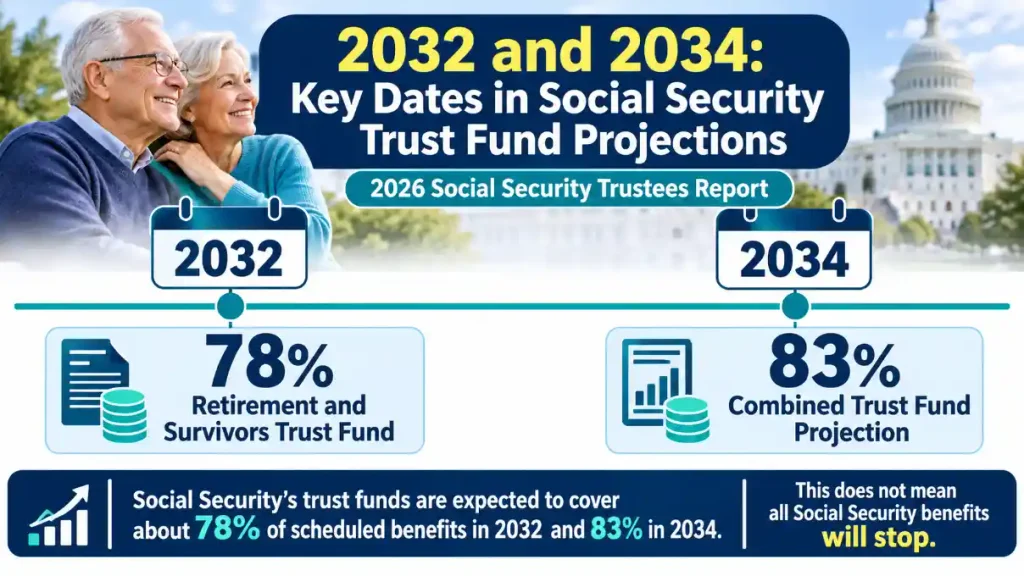
Social Security benefit cuts in 2032 are a serious concern for retirees, future retirees, and families across New York. According to the Social Security Administration’s 2026 Trustees Report, the Old-Age and Survivors Insurance (OASI) Trust Fund is projected to run out of its reserves in the fourth quarter of 2032. If lawmakers do not change the program’s financing before then, ongoing income would be sufficient to pay approximately 78% of scheduled benefits from that fund.
That does not mean Social Security payments are scheduled to stop in 2032. It means the government’s current projection shows that the retirement and survivors fund may no longer have enough reserves to pay every scheduled dollar. The separate Disability Insurance Trust Fund has a different outlook, and the combined retirement and disability trust funds are projected to have sufficient reserves until 2034.
For New Yorkers who depend on Social Security to cover rent, groceries, utilities, medical expenses, and other household costs, understanding the difference between these projections is essential. This guide explains what the latest figures mean, how a potential reduction could affect a monthly payment, what remains uncertain, and where to find reliable information.
Key takeaway: The 2026 Trustees Report projects that the retirement and survivors trust fund could be depleted in late 2032, when ongoing income would cover 78% of scheduled benefits. This is a forecast under current-law assumptions, not a confirmed benefit cut already scheduled by law.
What Are the Social Security Benefit Cuts Projected for 2032?
The phrase “Social Security benefit cuts in 2032” refers to a potential shortfall between scheduled retirement and survivors benefits and the money available to pay them if the OASI Trust Fund’s reserves are depleted.
Social Security is funded primarily through payroll taxes, along with other program income. The trust funds also hold reserves that help cover benefit payments when annual income is insufficient to cover all costs.
According to the 2026 Social Security Trustees Report, the OASI Trust Fund is projected to have enough reserves to pay 100% of scheduled benefits until the fourth quarter of 2032. After those reserves are depleted, continuing income would cover approximately 78% of scheduled OASI benefits under the report’s intermediate assumptions.
The difference is important. A projection of 78% payable benefits does not mean the program would have no money. It means projected incoming revenue would not cover the full amount scheduled under current law.
The report is based on assumptions about future economic conditions, wages, employment, demographics, and program costs. Actual results may change, and Congress can enact legislation to address the financing shortfall.
What does the 22% figure mean?
The often-reported figure of 22% comes from the difference between 100% of scheduled OASI benefits and the projected 78% payable after reserve depletion.
It is a useful way to explain the size of the potential shortfall, but it should not be presented as a guaranteed reduction for every beneficiary. The projection depends on future conditions and on whether lawmakers change the law before the reserves are depleted.
Social Security 2032 vs. 2034: What Is the Difference?
One reason readers encounter different dates in news coverage is that Social Security has legally separate trust funds.
The Old-Age and Survivors Insurance Trust Fund pays retirement and eligible survivors benefits. The Disability Insurance Trust Fund pays benefits under the separate disability program.
The 2026 Trustees Report provides two important projections:
| Trust fund | Projected reserve depletion | Estimated benefits payable at depletion |
|---|---|---|
| Old-Age and Survivors Insurance (OASI) | Fourth quarter of 2032 | 78% of scheduled benefits |
| Disability Insurance (DI) | No depletion projected through 2100 | 100% of scheduled benefits throughout the projection period |
| Combined OASI and DI funds, shown hypothetically together | Third quarter of 2034 | 83% of scheduled benefits |
Source: Social Security Trustees Report Summary, 2026.
These figures should not be mixed together. The 2032 date concerns the retirement and survivors fund considered separately. The 2034 date concerns the hypothetical combined position of the retirement and disability funds.
The funds are legally separate, so the combined projection should not be interpreted as an automatic transfer of reserves from one fund to the other.
For New York readers, the practical point is straightforward: the widely discussed 2032 forecast concerns retirement and survivors benefits, while disability benefits have a different funding outlook.
How Much Could a Social Security Benefit Be Reduced?
The financial effect would depend on the benefit amount a person is scheduled to receive and the actual percentage payable if the projection were to occur without a legislative solution.
The following examples illustrate the arithmetic using the 78% payable projection for the OASI Trust Fund. They are not individual benefit forecasts or official Social Security benefit estimates.
| Current scheduled monthly benefit | Illustrative amount at 78% | Illustrative monthly difference |
|---|---|---|
| $1,000 | $780 | $220 |
| $1,500 | $1,170 | $330 |
| $2,000 | $1,560 | $440 |
| $2,500 | $1,950 | $550 |
| $3,000 | $2,340 | $660 |
Calculation method: scheduled monthly benefit × 0.78. The difference is the scheduled amount minus the illustrative payable amount.
These examples assume the same 78% factor applies to the full monthly amount. Actual outcomes would depend on future law and program finances, so no reader should treat the table as a prediction of their personal check.
Example: A New York retiree receiving $2,000 per month
Suppose a New York retiree currently receives a scheduled Social Security retirement benefit of $2,000 per month.
Under the report’s illustrative 78% payable scenario:
- Scheduled monthly benefit: $2,000
- Illustrative payable amount: $2,000 × 0.78 = $1,560
- Illustrative monthly difference: $2,000 − $1,560 = $440
- Illustrative annual difference over 12 months: $440 × 12 = $5,280
This example helps explain why the financing issue matters to household budgets. It does not mean this retiree will definitely lose $440 per month in 2032. The forecast could change, and legislative action could alter the outcome.
Why Is the Social Security Trust Fund Facing a Shortfall?
Social Security’s long-term financing challenge has several causes. The Trustees evaluate these factors together rather than attributing the entire problem to one event.
1. More people are reaching retirement age
As large groups of workers retire, the number of people receiving retirement benefits changes relative to the number of workers paying Social Security taxes. This affects the balance between incoming revenue and program costs.
2. People are living longer
Retirement benefits may be paid over longer periods when people live longer. Longer benefit periods affect the program’s long-term cost projections.
3. Birth rates and workforce growth affect future revenue
The number of future workers influences the payroll tax revenue available to finance benefits. Changes in birth rates, immigration, labor-force participation, and employment can affect long-range projections.
4. Benefit costs exceed income under current projections
The 2026 Trustees Report projects that total Social Security costs will exceed total income, including interest, beginning in 2026 and continuing under the report’s intermediate assumptions. Reserves help cover the gap, but they are projected to decline.
For detailed figures and the Trustees’ assumptions, consult the official 2026 report.
These are long-term financing issues. They do not establish that Social Security will stop paying all benefits in 2032.
Will Everyone on Social Security Be Affected in New York?
New York residents receive benefits under the same federal Social Security program that applies nationwide. There is no separate New York State Social Security retirement trust fund with its own 2032 depletion date.
The effect of any future financing change would depend on the law enacted and the benefit category involved.
Retirement benefits
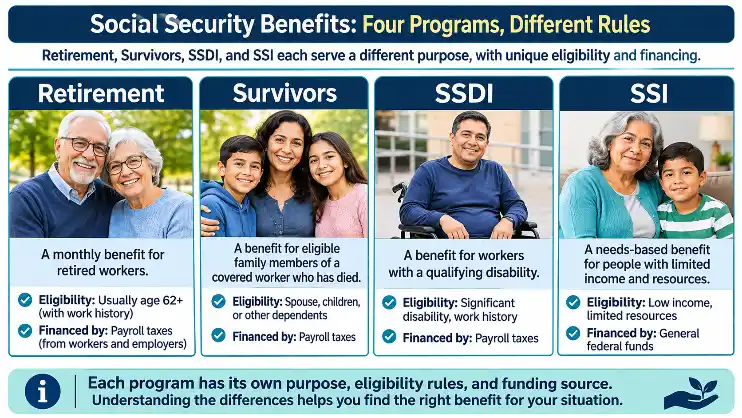
Retired workers and eligible family members receiving benefits based on a retired worker’s record are part of the retirement program covered by the OASI Trust Fund.
Survivors benefits
Eligible surviving spouses, children, and other qualifying family members may receive survivors benefits under federal rules. The OASI funding projection is relevant to this program as well.
Social Security Disability Insurance (SSDI)
SSDI is financed through the separate Disability Insurance Trust Fund. The 2026 Trustees Report projects that this fund can pay full scheduled benefits throughout the 75-year projection period ending in 2100.
That does not mean every disability-related program has the same rules or funding source. Supplemental Security Income (SSI), for example, is a separate needs-based federal program financed from general revenues rather than the Social Security trust funds.
Supplemental Security Income (SSI)
SSI should not be confused with retirement benefits or SSDI. Its eligibility rules, financial limits, and payment calculations are different. The 2032 OASI projection should not be described as a direct forecast of an identical SSI reduction.
Readers can review the Social Security Administration’s official website to identify the program that applies to their situation.
What Could This Mean for New York Retirees?
New York households face different living costs depending on whether they live in New York City, Long Island, the Hudson Valley, upstate cities, or rural communities. Rent, property expenses, utilities, transportation, food, and health-related costs can all affect how much retirement income a household needs.
A possible reduction in future Social Security payments could make budgeting more difficult for people who depend heavily on those payments. However, the financial impact is individual: two people receiving the same benefit may have very different housing costs, savings, pensions, and family responsibilities.
New York City and high-cost areas
People paying high monthly rent or condominium fees may have less room in their budgets to absorb a decline in income. Reviewing essential expenses and housing costs can help households identify where their budgets are most vulnerable.
Homeowners and upstate residents
Homeowners may face property taxes, heating bills, insurance, repairs, and transportation costs. These expenses vary widely by location and household circumstances.
Retirees supporting family members
Some retirees help adult children, grandchildren, or other relatives. A change in retirement income could affect both the beneficiary’s budget and the assistance they provide to family members.
No statewide estimate can reliably describe every New York household. Readers should evaluate their own income, expenses, and benefits rather than assume that a single average applies to everyone.
How New Yorkers Can Prepare for a Potential Social Security Shortfall
The projected shortfall is a reason to review a retirement plan, not a reason to panic or make rushed financial decisions.
1. Review your official Social Security record
Use the my Social Security account to review your earnings record and benefit estimates. An earnings-record error can affect a benefit calculation, so check that your work history is accurate.
Remember that an estimate based on current rules is not a guarantee of future payments or a prediction of the exact amount that might be payable after trust fund depletion.
2. Build a realistic monthly retirement budget
List essential costs first:
- Housing, rent, mortgage payments, and property expenses
- Groceries and household supplies
- Electricity, heating, water, and phone service
- Transportation and vehicle expenses
- Health insurance, prescriptions, and out-of-pocket medical costs
- Debt payments and support for family members
Compare these expenses with reliable income sources, including Social Security, pensions, savings, and any employment income.
3. Consider more than one future scenario
A useful household budget can compare a current-benefit scenario with an illustrative lower-income scenario. The table earlier in this article demonstrates the arithmetic at 78%, but readers should not assume that factor will become their personal payment rate.
Testing a few scenarios can help identify whether a household would need to reduce spending, increase savings where feasible, or seek qualified financial guidance.
4. Understand your full benefit picture
Retirement benefits, survivors benefits, SSDI, SSI, pensions, and private retirement accounts do not all operate under the same rules. Identify which sources you rely on and verify each program’s eligibility and payment requirements.
Do not make an early-claiming decision, transfer savings, or purchase a financial product solely because of a headline about 2032. Such decisions depend on personal circumstances and may have long-term consequences.
5. Check for official updates before acting
The Trustees issue periodic reports, and Congress may consider legislation to address Social Security financing. Future reports can change as assumptions and laws change.
For current information, check:
- Social Security Administration
- 2026 Trustees Report
- Social Security Trustees Report Summary
- Congressional Budget Office
Avoid making financial decisions based on social media posts or headlines that do not link to the underlying evidence.

Could Congress Prevent the Projected Benefit Cuts?
Yes. Lawmakers can consider legislative changes to Social Security financing before the projected reserve depletion date. The exact outcome would depend on which legislation, if any, is enacted.
Potential approaches discussed in public policy include changes to payroll tax revenue, changes affecting benefits, adjustments to eligibility or program rules, and combinations of measures. Each option can have different effects on workers, retirees, employers, and future beneficiaries.
There is no single outcome that should be presented as certain before legislation is enacted. A projection based on current law is not a statement that Congress will take no action.
Readers can follow official reports and legislative information to distinguish enacted changes from proposals and political statements.
Important Notes: What the 2032 Forecast Does and Does Not Say
What the forecast says
- The OASI Trust Fund is projected to deplete its reserves in the fourth quarter of 2032.
- Continuing income would cover approximately 78% of scheduled OASI benefits at that time under the Trustees’ intermediate assumptions.
- The combined OASI and DI trust funds are projected to deplete reserves in 2034, with 83% of scheduled benefits payable from continuing income under the combined projection.
What the forecast does not say
- It does not say Social Security payments will stop completely in 2032.
- It does not establish that every beneficiary will experience an identical dollar reduction.
- It does not mean the 2032 outcome is inevitable regardless of future legislation.
- It does not establish that SSI will face the same trust fund depletion as OASI.
- It does not provide a personalized forecast for every New York resident.
For clarity, these figures are taken from the 2026 Trustees Report and should be checked again when a new report or relevant legislation becomes available.
Frequently Asked Questions
Will Social Security benefits be cut in 2032?
The 2026 Trustees Report projects that the OASI Trust Fund will deplete its reserves in the fourth quarter of 2032. If the law and financing remain unchanged, ongoing income would cover about 78% of scheduled benefits from that fund. A cut is not yet a guaranteed future outcome because lawmakers can change the program’s financing.
Is the 22% Social Security benefit cut confirmed?
No. The 22% figure describes the difference between 100% of scheduled OASI benefits and the 78% that the Trustees project would be payable from ongoing income after reserve depletion. It is a projection, not a confirmed across-the-board reduction already scheduled to take effect.
Will Social Security run out of money completely?
The 2032 projection does not mean all Social Security income disappears. Payroll taxes and other continuing income would still be available to pay a portion of scheduled benefits. The projected problem is that this income would not cover the full scheduled amount under current-law assumptions.
Why do some reports say 2032 and others say 2034?
The 2032 date refers to the OASI retirement and survivors fund considered separately. The 2034 date refers to the hypothetical combined OASI and DI trust funds. The funds are legally separate, and their projections should not be confused.
Will New York retirees be affected?
New York residents receive Social Security under the federal program. The OASI funding shortfall is a national issue, not a separate New York State trust fund problem. The effect on an individual would depend on future law, benefit category, and personal circumstances.
Will SSDI benefits be cut in 2032?
The 2026 Trustees Report projects that the separate Disability Insurance Trust Fund can pay full scheduled benefits throughout the 75-year projection period ending in 2100. This is a projection under the report’s assumptions, not a guarantee that every future policy or individual benefit will remain unchanged.
Does the 2032 projection apply to SSI?
The OASI trust fund projection should not be applied directly to Supplemental Security Income. SSI is a separate needs-based federal program financed from general revenues. Its eligibility and payment rules differ from Social Security retirement and SSDI.
How can I check my estimated Social Security retirement benefit?
Visit the official my Social Security portal to access your record and available estimates. Review your earnings history and understand that estimates can change with future earnings, claiming decisions, and changes in law.
Should I claim Social Security early because of the 2032 forecast?
Not solely because of the forecast. Claiming decisions can affect monthly benefits over many years and depend on age, work history, health, household circumstances, and other income. Consider reviewing your official estimates and seeking qualified advice if you need help comparing options.
Where can I find reliable Social Security updates?
Start with the Social Security Administration, the official Trustees Report, and the Congressional Budget Office. Check the publication date and distinguish official projections from proposals and commentary.
Final Thoughts
The Social Security benefit cuts projected for 2032 deserve attention, particularly for New York residents who rely on monthly benefits to cover essential expenses. The key fact is that the 2026 Trustees Report projects the retirement and survivors trust fund will deplete its reserves in late 2032, with ongoing income covering about 78% of scheduled benefits at that point if current-law financing remains unchanged.
That is a significant funding warning, but it is not a prediction that all Social Security payments will disappear or that every person will lose the same amount. The combined retirement and disability funds have a separate 2034 projection, and the disability trust fund has a different long-term outlook.
The most practical response is to review your official benefit record, understand your household budget, monitor credible updates, and avoid making major financial decisions based on headlines alone. Future legislation and new projections may change the outlook.
Article Review & Fact-Checking
This article explains the Social Security benefit shortfall projections using the Social Security Administration’s 2026 Trustees Report and other authoritative public sources.
The article distinguishes the Old-Age and Survivors Insurance (OASI) Trust Fund’s projected 2032 depletion date from the combined OASI and Disability Insurance trust funds’ projected 2034 depletion date.
The illustrative payment examples are mathematical explanations, not personalized benefit estimates. Future outcomes may change if legislation, economic conditions, or official projections change.
Primary source: 2026 Social Security Trustees Report
Fact-check status: Prepared using the official report and sources linked in the article. Recheck official sources before republishing or updating time-sensitive figures.

About the Publisher
Junaidul Islam
CEO, NewYorkCalculator.com
Junaidul Islam oversees NewYorkCalculator.com, a website focused on practical calculators, financial information, and helpful guides for readers. The website aims to make complex topics easier to understand through clear explanations, transparent calculations, and links to authoritative sources.
Contact the Publisher