
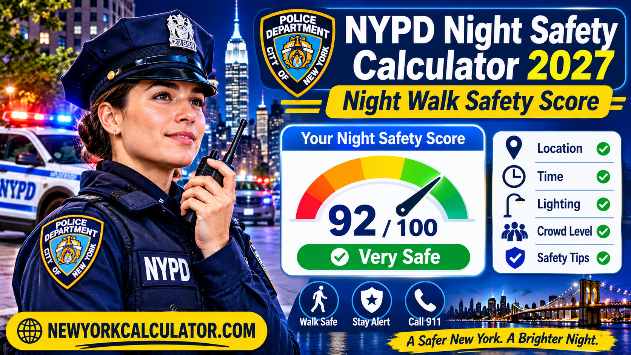
NYPD Night Safety Calculator 2027: Night Walk Safety Score
Walking home after dark is something millions of New Yorkers do every week. Most trips end without incident, and a few simple habits make them safer still. This calculator scores how well prepared your night trip is, then tells you which habits to fix first.
How to use this calculator
- Think of the actual trip you plan to make tonight, not a general one.
- Answer each question honestly. The best answer is the first one in each list.
- Enter how many minutes you will spend walking.
- Press Calculate. Your score and the habits worth changing appear after you press the button.
How the score is built
| Factor | Points available |
|---|---|
| Route: lit, busy streets and no shortcuts | 25 |
| Company or a friend tracking your trip | 15 |
| Awareness: phone away, ears free | 15 |
| Valuables out of sight | 10 |
| Safer waiting for rides and transit | 10 |
| Walking time: 10 minutes or less earns the most | 10 |
| Knowing open places to duck into | 5 |
| Keys ready at your door | 5 |
| Phone charged | 5 |
The weights follow the advice the NYPD’s crime prevention program repeats most often: use well-lit, populated routes, stay aware of your surroundings, travel with others when you can, and keep devices out of sight. A score of 85 or more means your plan is strong. A score under 40 means you have several easy changes available.
Two worked examples
Example one: 91 out of 100. Priya leaves a late shift and walks 12 minutes home. She takes the main avenue, which is lit and has open shops (25 points). She walks alone but has texted her sister her route (10). Her phone is in her coat and she keeps one earbud out (15). Valuables stay hidden (10), she needs no ride (10), and she knows two delis on the way (5). Her keys are ready (5), her phone is charged (5), and the 12-minute walk earns 6. Total: 91. Her only lost points come from the length of the walk.
Example two: 33 out of 100. Marcus takes a route with some dim blocks (12). He walks alone and tells nobody (0), checks his phone now and then (8), and has some items showing (5). He waits for a ride on the curb with his phone out (0), walks 25 minutes (3), has not noted any open shops (0) and searches for his keys at the door (0). His phone is charged (5). Total: 33. Three changes would lift this score sharply: texting a friend, waiting indoors for the ride and having keys ready.
A two-minute checklist before you leave
- Know your route and a brighter alternative.
- Tell someone when you expect to arrive.
- Check that your phone has battery, and put it where you can reach it without taking out valuables.
- Decide where you would go if you needed help: an open shop, a lit lobby or a busy corner.
- Have your keys ready before you reach your door.
What the score cannot tell you
A high score does not mean a place is safe, and a low score does not mean something will happen. Crime depends on many things you cannot control. The calculator only measures your own choices. Treat it as a checklist that turns into a number, and use the number to decide what to change.
Routes: lit, busy and predictable
The advice from NYPD tip sheets on strolling and walking is consistent. Plan the route before you leave, stick to well-lit, well-traveled streets, and skip shortcuts through parks, parking lots and alleys, especially after dark. The longer, brighter way home is usually the better choice. Walking time matters too. The more minutes you spend on foot late at night, the more chances there are for something to go wrong, which is why short walks earn more points in the calculator.
Phones and headphones
NYPD tip sheets say the snatching of phones and other electronics has been rising in the city, and that victims are often distracted when it happens. In many cases the thief follows from behind, sometimes on a bicycle or moped, and grabs the device straight from a hand. The practical steps are simple. Keep your phone in an inside pocket when you are not using it, do not walk and text, and keep one ear free if you listen to music. Walk with your head up, because a person who is paying attention is a harder target.
Valuables, bags and pickpockets
Carry your bag close to your body and closed. Keep a wallet in a front pocket or inside coat pocket, not in a back pocket or the front compartment of a backpack. The NYPD has noted that pickpocketing reports rise in late summer and autumn, when many people are back in school and work. Pickpockets often work in teams of two or three. A common trick at subway turnstiles is for one person to block you while another bumps you from behind. Standing with your bag in front of you in a crowded train is a small habit that helps a lot.
Buses and subways at night
- Plan your trip before you leave and check for service changes.
- On the subway, board the car with the conductor and stay a few steps back from the platform edge. Standing with your back against a wall or column means nobody can come up behind you.
- If you need help on a platform, use the intercom or find an MTA employee. In an emergency, call 911.
- On late-night buses you can ask the driver to let you off between stops, along the route.
- Use busy, well-lit stops, and consider waiting inside a nearby shop while you track the bus on MTA BusTime.
- If you get off at a quiet stop, ask someone to meet you there.
Rideshare safety
The same tip sheets give rideshare advice that is easy to follow. Wait indoors until the car is close, so you are not standing outside with your phone out. When it arrives, check the make, model, color and license plate against the app, and confirm the driver’s name and photo. Ask “What’s my name?” and do not get in unless the driver says it correctly without prompting. Sit in the back seat, follow your route on your own map and use the app’s feature to share your trip with a friend.
If you think someone is following you
Change direction or cross the street. If the person is still behind you, move quickly toward an open store or restaurant and ask staff to call 911. Do not be afraid to shout for help. Stay away from empty blocks and head for places with people. If you are being driven home, ask the driver to wait until you are inside.
If someone tries to rob you
NYPD guidance is blunt: give up your property, because your life matters more than a phone or wallet. Call 911 as soon as you can and tell the operator where you are and what the attacker looked like. Your report can help protect the next person.
Getting home
Have your keys in your hand before you reach the door and look behind you before you go inside. In an apartment building, close the lobby door behind you and do not hold it open for someone you do not know. Make delivery workers and visitors use the buzzer.
Joggers and late exercise
Run with a partner when you can, in lit, open places, and avoid bushes and alcoves where someone could hide. Vary your route so no one learns your schedule, carry ID, keep your phone out of sight and wear bright clothing so drivers can see you.
Where to find real crime data
The NYPD publishes crime information through its website, including CompStat, and each precinct has a Crime Prevention Officer who also serves as the Older Adult Liaison. You can contact yours by phone or email through the NYPD’s crime prevention page. When you read crime data, check the date on it, because published figures lag behind the present. Remember too that numbers describe the past and say little about any single person’s walk home. A precinct officer can tell you what residents have reported recently and what programs exist in your area.
Common mistakes the calculator will catch
- Choosing a shortcut because it saves two minutes.
- Looking at your phone while crossing the street or on a platform.
- Waiting for a ride on the curb with the screen glowing.
- Telling nobody where you are going.
- Digging for keys while standing at the door.
Frequently asked questions
Does this calculator measure crime in my neighborhood?
No. It scores your preparation for a night trip. For local crime information, use the NYPD’s published data or contact your precinct’s Crime Prevention Officer.
Is this an official NYPD tool?
No. It is an independent calculator based on public NYPD crime prevention advice.
What is a good score?
A score of 85 or more means your plan covers the main points. Between 65 and 84 means you are mostly prepared. Lower scores show habits you can change quickly.
Should I avoid walking at night altogether?
Not necessarily. Many people walk at night safely. The aim is to make good choices about route, company and attention.
What should I do first if I feel unsafe?
Move toward people and open businesses, and call 911 if you feel threatened.
Who can I ask about safety in my area?
Your local precinct’s Crime Prevention Officer. The NYPD’s crime prevention page lists how to reach them.
Does the score save my answers?
No. The calculation happens in your browser and nothing is sent anywhere.
Sources and update note
The advice here follows the NYPD’s published crime prevention and safety tip sheets, including topics on walking, phone safety, pickpocketing, transit and rideshare use. The scoring weights are the author’s own way of turning that advice into a checklist and are not an official rating. Check the NYPD’s website for the latest guidance.

Junaidul builds the calculators on this site so everyday decisions become clear numbers. Every tool is based on public sources and checked before it goes live.
Contact Junaidul on Facebook