
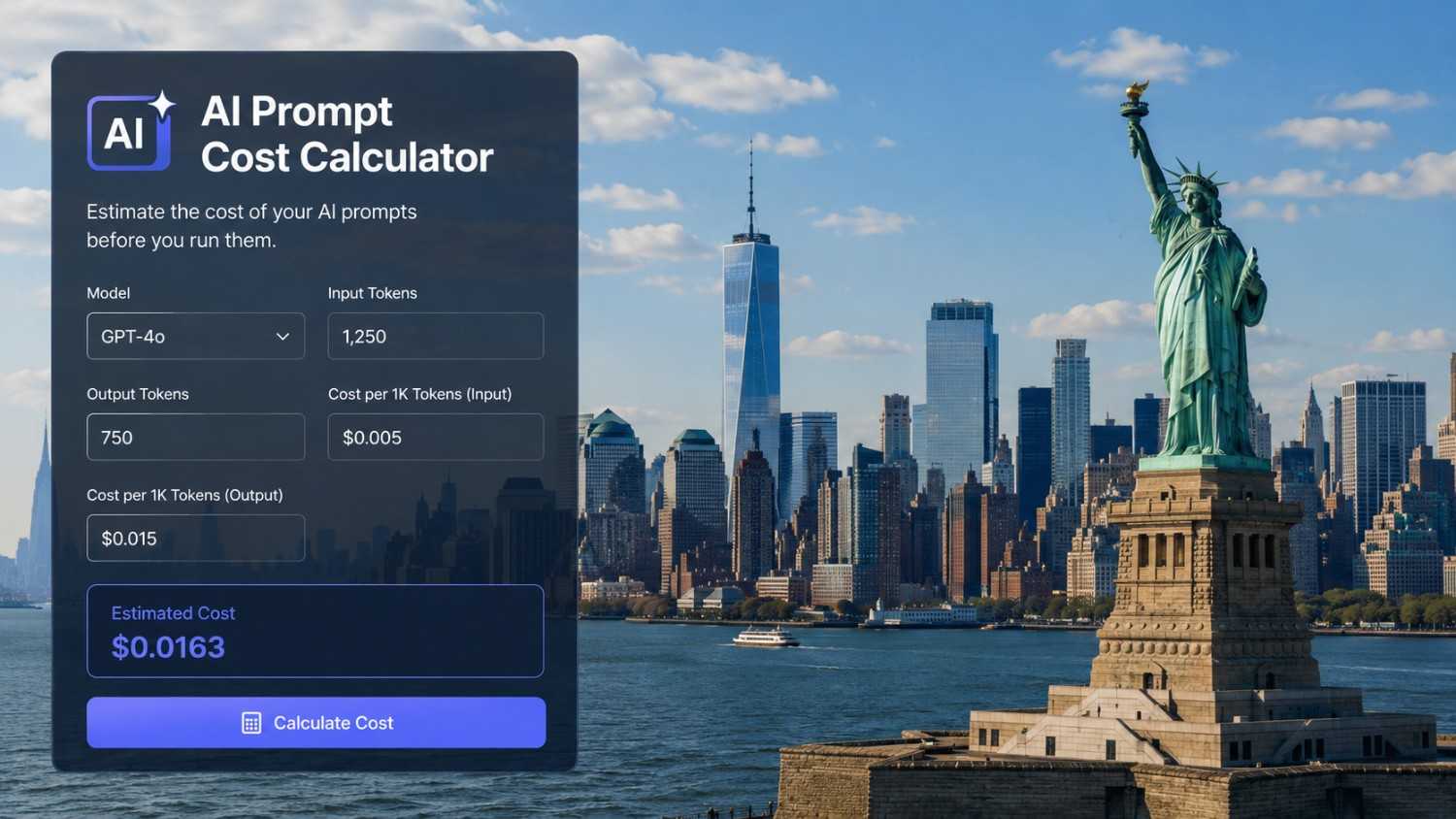
AI Prompt Cost Calculator New York
Estimate your exact API costs for AI prompts across every major model — compare with New York human labor rates to see what you are really saving.
Estimated AI Prompt Costs
—What This Means For You
—
What Exactly Is the AI Prompt Cost Calculator New York?
This calculator gives New York-based freelancers, agencies, startups, and businesses a precise estimate of what they are spending — or would spend — on AI API calls broken down to the individual prompt level. It goes beyond the per-million-token pricing that AI providers publish on their websites and translates those numbers into the metrics that actually matter for budgeting: cost per prompt, cost per day, cost per month, and cost per year based on your specific usage patterns.
The calculator covers every major AI model currently in widespread commercial use: the full OpenAI GPT family (GPT-4o, GPT-4o Mini, GPT-4 Turbo, GPT-4, and GPT-3.5 Turbo), Anthropic’s Claude family (Claude 3.5 Sonnet, Claude 3 Opus, and Claude 3 Haiku), Google’s Gemini models (1.5 Pro and 1.5 Flash), and image generation models (DALL-E 3 and Midjourney). Each model has a dramatically different pricing structure — GPT-4o Mini costs roughly 1/17th per token of what GPT-4 Turbo costs, and Claude 3 Haiku is even cheaper — and the calculator makes these differences immediately visible so you can make informed model-selection decisions based on actual cost rather than vague impressions.
What makes this calculator specifically relevant to New York users is the human labor comparison. New York has some of the highest labor costs in the United States — freelance writers in Manhattan charge $75-$200 per hour, junior developers cost $60-$120 per hour, and even entry-level customer service representatives in the city cost $35-$50 per hour when you factor in benefits, workspace, and overhead. The calculator estimates what it would cost to produce the same output using New York-based human workers and shows you the dollar difference. This is not a theoretical exercise — it is the calculation that every New York business owner and freelancer needs to make when deciding whether to use AI, hire a human, or combine both approaches.
Why Calculating AI Prompt Costs Matters for New York Businesses
New York City is the largest and most concentrated professional services market in the United States. More advertising agencies, marketing firms, law offices, financial services companies, media organizations, consulting firms, and tech startups are packed into the five boroughs than in any other comparable geographic area in the country. These industries are exactly the ones being most aggressively disrupted by AI — and they are also the ones where labor costs are highest, which means the financial impact of AI adoption (or failure to adopt) is most extreme.
Model Selection Saves Real Money
Using GPT-4 for a task that GPT-4o Mini can handle just as well is like taking a taxi when the subway gets you there in the same time for one-twentieth the cost. The calculator shows you exactly how much each model costs for your specific use case.
NYC Labor Rates as Benchmark
Knowing your API cost is $68/month is abstract. Knowing that same output would cost $15,000/month with New York freelancers makes the value immediately tangible. This comparison drives better business decisions.
Token Awareness Prevents Waste
Most users have no idea how many tokens their prompts actually consume. A 10,000-token context window that you are filling with 2,000 tokens of relevant data and 8,000 tokens of irrelevant context is wasting 80% of your spend on every call.
Scale Planning for Growth
What costs $50/month at 50 prompts per day costs $500/month at 500 prompts per day. The calculator helps agencies and startups forecast costs as they scale AI usage across more clients, projects, or team members.
There is also a competitive dimension. New York’s agency world is brutally competitive, and margins are under constant pressure. An agency that can produce client deliverables at 5% of the traditional cost has an enormous pricing advantage — they can either undercut competitors on price, maintain the same price and pocket dramatically higher margins, or invest the savings into better talent and tools that further widen the gap. The agencies that understand their per-prompt costs and optimize their AI stack accordingly are the ones that will thrive. The ones that treat AI as a magic box with no visible cost structure will eventually find their margins evaporating as they scale usage without monitoring spend.
For individual New York freelancers, the calculation is personal. If you are a copywriter charging $100/hour and AI can produce a first draft in 30 seconds for $0.003, the question is not whether AI is cheaper — it is whether you can use AI to produce more, better, faster work and thus earn more per hour, or whether AI will simply replace the lower end of your service offering. Understanding the exact cost per prompt is the foundation for making that strategic decision with real numbers instead of fear or hype.
How to Use This AI Prompt Cost Calculator (Takes 15 Seconds)
Select Your AI Model
Choose the model you are using or considering. If you are unsure, run the calculation for multiple models to compare — the difference between GPT-4o and GPT-4 Turbo might surprise you.
Set Your Usage Volume
Enter how many prompts you run per day and how many days per month. Be honest — most people underestimate their usage by 2-3x when they first start tracking it.
Estimate Token Lengths
Select your average input and output token counts. If you do not know, use the “Standard” defaults — 1,500 input and 1,000 output covers most typical use cases.
Review and Compare
Hit calculate to see per-prompt, daily, monthly, and annual costs. If you enabled the NYC labor comparison, you will also see what human workers would cost for the same output volume.
AI Model Pricing Comparison (Per 1 Million Tokens)
The table below shows the published pricing for each model as of 2024-2025. Prices change frequently — verify current rates on each provider’s official website before making purchasing decisions.
| Model | Provider | Input Cost | Output Cost | Relative Cost Index |
|---|---|---|---|---|
| GPT-4o Mini | OpenAI | $0.15 | $0.60 | 1x (cheapest text) |
| Gemini 1.5 Flash | $0.075 | $0.30 | 0.5x | |
| Claude 3 Haiku | Anthropic | $0.25 | $1.25 | 2x |
| GPT-3.5 Turbo | OpenAI | $0.50 | $1.50 | 2.5x |
| Gemini 1.5 Pro | $1.25 | $5.00 | 8x | |
| GPT-4o | OpenAI | $2.50 | $10.00 | 17x |
| Claude 3.5 Sonnet | Anthropic | $3.00 | $15.00 | 25x |
| GPT-4 Turbo | OpenAI | $10.00 | $30.00 | 50x |
| GPT-4 | OpenAI | $30.00 | $60.00 | 100x |
| Claude 3 Opus | Anthropic | $15.00 | $75.00 | 125x |
| DALL-E 3 | OpenAI | $0.040/image (standard) — $0.080/image (HD) | N/A (per image) | |
| Midjourney | Midjourney | ~$0.03–$0.10/image (varies by plan tier) | N/A (per image) | |
The “Relative Cost Index” shows how each model compares to GPT-4o Mini at the baseline. A model with a 50x index costs fifty times more per token than the cheapest option. This does not mean cheaper models are always better — Claude 3.5 Sonnet at 25x the cost of GPT-4o Mini produces meaningfully better output for many writing tasks, and GPT-4 at 100x still outperforms all other models on certain complex reasoning tasks. The right model is the one that produces acceptable quality for your specific use case at the lowest cost — and that is exactly what this calculator helps you determine.
How AI Prompt Costs Intersect With New York’s Economy
New York’s position as a global professional services hub creates a unique intersection with AI costs that does not exist in most other markets. The math is different here because the human baseline is so expensive.
- NYC freelance rates make AI savings enormous: A content writer in Manhattan charges $75-$200 per hour. A skilled copywriter at a New York agency costs the agency $50-$80 per hour including overhead. At those rates, even expensive AI models like GPT-4 Turbo ($10/1M input tokens, $30/1M output tokens) are staggeringly cheap by comparison. A single GPT-4 Turbo call that produces a 2,000-token article draft costs approximately $0.08. A human writer producing the same draft at $100/hour and taking 2 hours costs $200. That is a 2,500x cost difference. Even when you account for the fact that AI output requires human editing (adding perhaps 30 minutes at $100/hour = $50), the total cost of the AI-assisted approach ($50.08) is still 4x cheaper than the pure-human approach ($200). At New York labor rates, the economics of AI adoption are not marginal — they are transformative.
- Agency margin structures are being rewritten: New York advertising and marketing agencies have historically operated on 15-30% profit margins, with labor being their single largest cost — typically 50-65% of revenue. AI tools that can reduce labor costs by 30-50% on common deliverables (first drafts, social media posts, email sequences, ad copy variations, research summaries) can push agency margins from 20% to 35-45% overnight — if the agency captures the savings rather than passing them to clients through lower prices. In the hyper-competitive New York agency world, this creates a strategic fork: capture the margin improvement to boost profitability, or pass some savings to clients to win market share. Most agencies are trying to do both, which is why understanding per-prompt costs at a granular level has become a core competency for agency operations directors.
- NYC tech startups are API-cost-sensitive at scale: A New York-based SaaS startup with 10,000 users who each generate 20 AI prompts per day is running 200,000 prompts daily — 6 million per month. At GPT-4o pricing with standard token lengths, that is roughly $20,000-$40,000/month in API costs. For an early-stage startup burning through venture capital, that is a meaningful line item that requires careful modeling and optimization. Many NYC startups are learning that switching from GPT-4o to Claude 3 Haiku for the 70% of prompts that do not require top-tier quality can reduce their API bill by 80-90% with minimal quality degradation. The calculator makes these trade-offs visible in seconds.
- The creative class disruption is centered in New York: More writers, designers, strategists, researchers, and other creative professionals work in New York than in any other American city. AI is not replacing all of them — but it is absolutely compressing the market for entry-level and mid-level creative work. Tasks that used to be assigned to a $65,000/year junior copywriter are now being handled by a $50/month API subscription and a senior editor who catches the mistakes. The junior copywriter position is not disappearing everywhere, but it is disappearing in New York first because the cost savings are largest here. For individual practitioners, this means the path forward is moving up the value chain — from producing first drafts (which AI does adequately) to providing strategic thinking, client relationship management, and quality assurance (which AI cannot do).
- NYC-based AI companies are driving pricing down: New York is home to a growing ecosystem of AI companies — OpenAI itself has a significant New York office, Anthropic has presence in the city, and dozens of smaller AI startups are based here. This local concentration means that New York businesses often have early access to new models, beta pricing, and enterprise discounts that are not available elsewhere. It also means that the competitive pressure on AI pricing is partially driven by New York-based companies competing for New York-based enterprise clients, which benefits the entire market.
- Legal and compliance costs add a New York-specific layer: New York-based businesses in regulated industries — financial services, healthcare, legal — face additional costs when using AI that businesses in other states may not. Compliance review of AI outputs, audit trails, data residency requirements, and the potential forthcoming New York City AI employment regulations (Local Law 144 already requires bias audits for automated employment decision tools) all add cost layers on top of the raw API price. A financial services firm in Midtown using AI for research summaries may spend as much on compliance and oversight as they do on the actual API calls. The calculator shows the raw API cost — your total cost of using AI in a regulated New York industry will be higher.
Choosing the Right AI Model — Cost vs. Quality Trade-Offs
Every AI model sits on a cost-quality spectrum. The right choice depends on what you are asking the model to do, how much the output quality matters, and how much you are willing to spend. Here is an honest assessment of where each major model fits.
- GPT-4o Mini — Best for: High-volume, low-stakes tasks. At $0.15/$0.60 per million tokens, this is the cheapest text model from a major provider. It handles simple questions, basic summarization, classification, and straightforward content generation well. Where it struggles: complex reasoning, nuanced writing, long-context consistency, and tasks that require deep domain expertise. For a New York agency using AI to generate 50 social media captions per day, GPT-4o Mini is the right call — the quality is adequate for social media, and using GPT-4o instead would cost 17x more for marginally better captions that no social media audience would notice. Cost optimization tip: If 80% of your prompts are simple and 20% are complex, route the simple ones to GPT-4o Mini and the complex ones to GPT-4o. This “model routing” approach can reduce total API costs by 60-80% with minimal quality impact.
- GPT-4o — Best for: General-purpose high-quality output. The current flagship model from OpenAI offers an excellent balance of quality and cost. At $2.50/$10.00 per million tokens, it is 17x more expensive than GPT-4o Mini but produces noticeably better output for writing tasks, coding tasks, and anything requiring nuance. For a New York freelancer using AI to draft client deliverables that will be reviewed by discerning clients, GPT-4o is usually the right choice — the quality difference between GPT-4o and GPT-4o Mini is visible to clients who care about writing quality, and the cost is still trivial compared to human labor. Cost optimization tip: Use GPT-4o for first drafts and GPT-4o Mini for rephrasing, formatting, and other mechanical tasks within the same workflow.
- Claude 3.5 Sonnet — Best for: Writing quality and long-form content. Many writers and editors consider Claude 3.5 Sonnet the best model for prose quality as of 2024-2025. It produces more natural, less “AI-sounding” text than GPT-4o for many writing tasks. At $3.00/$15.00 per million tokens, it is slightly more expensive than GPT-4o for input but 50% more expensive for output. For New York agencies producing high-end content where writing quality directly affects client retention, the premium is usually worth it. Cost optimization tip: Claude excels with longer, more detailed prompts. Use a single comprehensive prompt rather than multiple back-and-forth calls — each call has a minimum token cost even for short exchanges.
- Claude 3 Opus — Best for: Complex analysis where quality is paramount. At $15.00/$75.00 per million tokens, this is one of the most expensive models available. It is genuinely better than cheaper models for complex reasoning, multi-step analysis, and tasks where getting the wrong answer is costly (legal analysis, financial modeling, medical content review). For a New York law firm using AI to analyze contracts, the cost difference between Claude 3 Opus and GPT-4o Mini is irrelevant — the cost of an error is orders of magnitude larger than the API savings. Cost optimization tip: Reserve Claude 3 Opus for your highest-stakes prompts only. Use Claude 3 Haiku ($0.25/$1.25) for everything else.
- Gemini 1.5 Flash — Best for: Ultra-cheap, high-volume processing. At $0.075/$0.30 per million tokens, Gemini Flash is the cheapest model from a major provider — even cheaper than GPT-4o Mini. It also offers a 1 million token context window, which means you can feed it entire documents, books, or codebases in a single prompt. For New York financial firms processing large documents, researchers analyzing lengthy reports, or agencies doing bulk content classification, Gemini Flash offers extraordinary value. Cost optimization tip: The large context window means you can batch multiple small tasks into a single prompt, reducing the number of API calls and the fixed overhead per call.
What This Calculator Cannot Tell You — And How To Fill Those Gaps
AI pricing is more complex than a simple per-token calculation suggests. Here are the factors this calculator does not capture and how you should account for them separately.
- Pricing changes frequently: AI providers adjust their pricing regularly — sometimes with significant reductions (GPT-4’s price dropped roughly 90% between its launch in March 2023 and the introduction of GPT-4o in May 2024). The prices in this calculator reflect the most recent published rates as of 2024-2025, but by the time you read this, some may have changed. Always verify current pricing on the provider’s official website.
- It does not include platform fees: If you access AI models through a platform like ChatGPT Plus ($20/month), Claude Pro ($20/month), or an AI-powered tool like Jasper, Copy.ai, or Writer, you are paying a subscription fee on top of (or instead of) direct API costs. These subscription fees may include a certain number of included prompts or tokens, after which additional usage costs apply. The calculator shows raw API costs — your actual costs through a platform may be higher or lower depending on the subscription structure.
- Token counting is imprecise: The token counts in the calculator are estimates you select from presets. Actual token counts depend on the specific text, the tokenizer used by each provider (OpenAI, Anthropic, and Google all use different tokenizers), and whether your prompts include special characters, code, or non-English text that may tokenize differently. For precise tracking, use the token counting tools provided by each API (OpenAI’s tokenizer, Anthropic’s token counter) on your actual prompts.
- It does not account for failed or retried prompts: In practice, not every API call produces a useful response. Rate limits, timeouts, content filters, and model hallucinations can all cause you to retry a prompt — sometimes multiple times. Budget an additional 10-20% above the calculator’s estimate to account for wasted calls. At GPT-4o pricing, this is trivial; at GPT-4 pricing, it can add up.
- Human equivalent costs are estimates: The NYC labor comparison uses average rates for common professional roles. Your actual human costs may be higher or lower depending on the specific professionals you hire, their experience level, whether they are employees or contractors, and the full cost including benefits, workspace, equipment, and management overhead. The calculator shows a reasonable midpoint — use it as a starting point for your own more detailed analysis.
- Image generation pricing varies by plan: DALL-E 3 has straightforward per-image pricing through the API, but Midjourney operates on subscription plans ($10-$60/month) with varying image generation limits. The calculator uses an estimated per-image cost for Midjourney based on common plan tiers, but your actual cost depends on which plan you choose and how many images you generate relative to your plan’s limits.
- It does not include infrastructure costs: If you are building an AI-powered product, your costs include not just API calls but also hosting, database storage for prompt/response logs, monitoring and observability tools, and engineering time to build and maintain the AI integration. These “wrapper” costs often exceed the raw API costs for small-to-mid-scale applications.
What Happens With Your Information
Nothing — your AI model selection, use case, prompt volume, token counts, usage context, and comparison preferences are processed entirely in your browser. No data is sent to any server. No business, technical, or financial information is stored, logged, or transmitted. No cookies track your calculation. The moment you close this tab, your data ceases to exist on your device. In an era where AI usage patterns are themselves valuable data, this tool treats your usage information as private by design.
Frequently Asked Questions
A token is the basic unit that AI models use to process text. For English text, one token is approximately 0.75 words — or roughly 4 characters. This means 1,000 tokens is about 750 words, or roughly 1.5 pages of single-spaced text. However, the exact ratio varies: common short words like “the” are single tokens, while longer or less common words may be split into multiple tokens. Code, non-English text, and special characters tokenize differently and often use more tokens per word. As a practical rule of thumb for English content: multiply your word count by 1.3 to get a rough token estimate. If your prompt is 1,000 words, it is approximately 1,300 tokens. The calculator uses the token counts you select directly — if you know your actual word counts, use the 1.3x multiplier to estimate tokens.
It depends entirely on your use case. For simple classification, basic Q&A, short social media posts, and straightforward summarization, GPT-4o Mini is often good enough and the 17x cost difference is not justified. For nuanced writing, complex analysis, multi-step reasoning, coding tasks, and any deliverable that will be seen by clients or customers, GPT-4o’s quality improvement is usually worth the premium — because even at 17x the cost of GPT-4o Mini, GPT-4o is still extraordinarily cheap compared to human labor. A GPT-4o call that produces a high-quality 1,000-word article draft costs about $0.011. A GPT-4o Mini call for the same task costs about $0.0007. The difference is $0.010 — less than a penny. When the human alternative is $100-$200, arguing over a penny difference between models is usually not the right frame. The right question is: “Is the quality difference between the two models visible to my end user?” If yes, pay the penny. If no, use the cheaper model.
Each major AI provider offers a usage dashboard. OpenAI’s platform dashboard at platform.openai.com/usage shows your daily and monthly token consumption and costs broken down by model. Anthropic’s console at console.anthropic.com provides similar usage analytics. Google AI Studio shows Gemini usage and costs. If you are accessing models through a third-party platform (Jasper, Writer, etc.), check their billing or usage analytics pages. For precise per-prompt tracking, log the token counts returned in each API response — every API call returns both the input and output token counts used, which you can log to a spreadsheet or database for analysis. Many New York agencies build simple internal dashboards that aggregate this data across their team to monitor total AI spend in real time.
This is one of the most debated strategic questions in the New York agency world right now, and there is no universal answer. The argument for keeping the savings: your clients are paying for the output, not the process. If AI helps you produce the same quality output in less time, that is your operational efficiency gain — your client’s fee should reflect the value of the deliverable, not your cost of production. The argument for passing savings: clients are not naive. They know AI exists, they know it is cheap, and increasingly they are asking agencies directly how they are using AI and whether the pricing reflects AI-assisted production. Agencies that are transparent about AI usage and price fairly tend to build stronger long-term client relationships, even if the per-project margin is lower. Many NYC agencies are finding a middle ground: reduce prices modestly (10-20%), disclose AI usage, and invest the margin improvement into higher-quality human oversight that actually improves the final product.
Model routing is the practice of automatically directing different prompts to different AI models based on the complexity or importance of the task. A simple implementation: send all classification and simple Q&A prompts to GPT-4o Mini ($0.15/$0.60 per million tokens), send standard content generation to GPT-4o ($2.50/$10.00), and send only your most complex, high-stakes prompts to Claude 3 Opus ($15.00/$75.00). For a typical New York agency workload where 60% of prompts are simple, 30% are standard, and 10% are complex, model routing can reduce total API costs by 50-75% compared to using a single premium model for everything. Implementing model routing requires a classification layer that assesses prompt complexity before routing — this can be as simple as a rule-based system (if prompt is under 200 tokens, route to Mini; if over 2,000 tokens, route to Opus) or as sophisticated as a lightweight model that classifies prompts before routing. Several New York startups are building exactly this kind of routing infrastructure as a product.
Yes, several. First, data storage: if you are storing prompt/response logs for quality control, compliance, or training purposes, cloud storage costs apply — at scale, this can be $50-$500/month depending on volume. Second, latency and timeout costs: if your application makes API calls synchronously (user waits for the response), slow responses from high-quality models like Claude 3 Opus can affect user experience and may require architectural workarounds (async processing, caching) that add engineering cost. Third, rate limit costs: if you hit rate limits, you either need to implement queuing and retry logic (engineering cost) or purchase higher rate limit tiers from the provider (direct cost — OpenAI’s Tier 5, for example, requires $1,000 in cumulative spend). Fourth, compliance costs: for New York financial services, healthcare, and legal companies, AI output review, audit trails, and regulatory compliance add overhead that can double or triple the effective cost of each AI-generated deliverable. The calculator shows raw API costs — your total cost of ownership will be higher.
Prompt engineering has a direct and often underappreciated impact on cost. A poorly engineered prompt that includes irrelevant context, redundant instructions, or excessive examples can easily use 3-5x more input tokens than a well-crafted prompt that produces the same or better output. If your standard prompt is 5,000 tokens but a refined version could accomplish the same thing in 1,500 tokens, you are wasting 3,500 tokens on every call. At GPT-4o pricing, that is $0.00875 per wasted call — trivial for one call, but at 100,000 calls per month, that is $875/month in wasted input tokens alone. Good prompt engineering practices include: providing only the context the model actually needs, using clear and concise instructions, avoiding repetition, and structuring prompts so the model does not need to regenerate or clarify. For high-volume users in New York, investing in prompt optimization is one of the highest-ROI activities available — a one-time engineering effort that reduces costs permanently.
No. Your AI model selection, use case, prompt volume, token counts, usage context, and comparison preferences are processed in your browser and never leave your device. No server receives this data, no history is stored, no cookies are created. Close the tab and it is completely gone. Note: this privacy statement applies to this calculator tool only — when you actually use AI APIs (OpenAI, Anthropic, Google), each provider has its own data usage and privacy policies that you should review separately. Most providers offer enterprise plans with data processing agreements that prevent your prompts from being used for model training.