BMI Calculator Australia 2027: Check Your Body Mass Index in Seconds
Enter your height and weight to see your BMI, your category on the Australian adult scale, and the weight range that matches a healthy BMI for your height. It works in kilograms and centimetres, or pounds and feet, and it includes an Asia-Pacific option.
This tool is for general information only. It is not a diagnosis. Please speak to a GP or an Accredited Practising Dietitian about your own health.
How to Use This BMI Calculator
- Pick your units. Most Australians use kilograms and centimetres, so metric is the default. Switch to imperial if you know your numbers in pounds, feet and inches.
- Enter your age. The tool is built for adults aged 18 and over. If you enter an age under 18, it will point you to child-specific guidance instead.
- Enter height and weight. Weigh yourself in the morning, before eating, in light clothes. Measure height without shoes.
- Choose a scale. Use the standard scale unless you have Asian heritage and your doctor has suggested the Asia-Pacific cut-offs.
- Add your waist (optional). Measure halfway between the bottom of your ribs and the top of your hip bone, after breathing out normally.
- Press Calculate. You will see your BMI, your category, your healthy weight range and how far you are from it.
What Is BMI and Why Do Australians Use It?
Body Mass Index, or BMI, is a single number that compares your weight with your height. Doctors, dietitians and public health bodies use it as a quick screening step because it is cheap, fast and needs no equipment beyond a scale and a tape measure. It does not measure body fat directly, and it cannot tell you whether you are healthy on its own. Think of it as a starting point for a conversation, not a verdict.
Australian health information, including material from Healthdirect, the Heart Foundation and state health departments, follows the World Health Organization categories for adults. That is why the same cut-off numbers appear on almost every Australian BMI page you will find.
The BMI Formula
The metric formula is simple: BMI = weight in kilograms ÷ (height in metres × height in metres).
For imperial units the formula is BMI = 703 × weight in pounds ÷ (height in inches)².
Worked example
Take someone who is 170 cm tall and weighs 70 kg. Height in metres is 1.70, and 1.70 × 1.70 = 2.89. Then 70 ÷ 2.89 = 24.2. That sits at the upper end of the healthy range.
Now take someone 160 cm tall who weighs 82 kg. Height squared is 2.56, and 82 ÷ 2.56 = 32.0. That falls in the obese class on the standard scale.
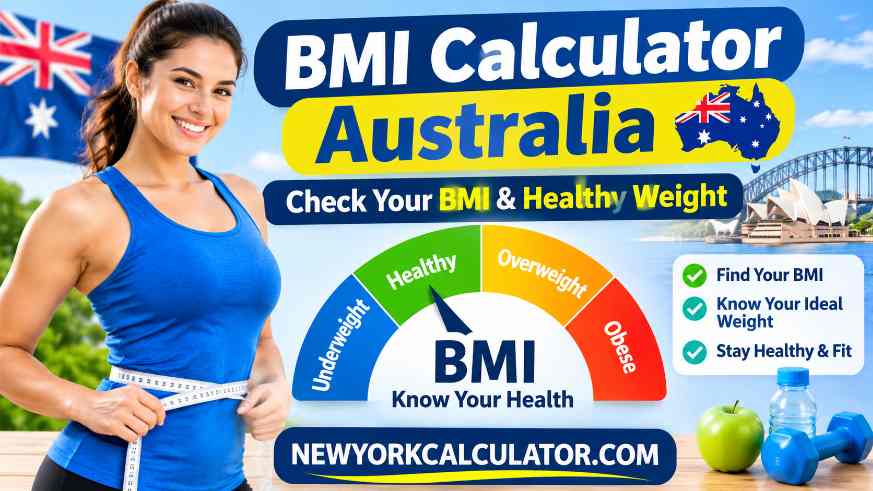
BMI Categories for Adults in Australia
| BMI | Category |
|---|---|
| Below 18.5 | Underweight |
| 18.5 to 24.9 | Healthy weight |
| 25.0 to 29.9 | Overweight |
| 30.0 and above | Obese |
As of November 2026, these are the ranges used across Australian public health sources, and no change has been announced for 2027. Because guidelines can be reviewed, it is worth checking the Healthdirect or Better Health Channel pages if you are making an important decision.
Some sources, including the Victorian Better Health Channel, describe a healthy adult BMI as roughly 20 to 25. The two descriptions overlap, and the wider 18.5 to 24.9 band is the one most commonly used for classification.
Healthy Weight Range by Height
A BMI between 18.5 and 24.9 translates into a weight range that depends on how tall you are. The table below applies the formula to common heights, using the standard adult scale.
| Height | Healthy weight range |
|---|---|
| 150 cm | 41.6 kg to 56.0 kg |
| 160 cm | 47.4 kg to 63.7 kg |
| 170 cm | 53.5 kg to 72.0 kg |
| 180 cm | 59.9 kg to 80.7 kg |
| 190 cm | 66.8 kg to 89.9 kg |
Notice how wide each range is. Two people of the same height can both be in the healthy band while weighing more than ten kilograms apart. Frame size, muscle and age all play a part.
Why BMI Is Not the Whole Story
The Better Health Channel makes the key point plainly: BMI does not separate body fat from muscle. That creates several well-known blind spots.
Muscle can push BMI up
A rugby player or a regular weightlifter may land in the overweight category with very little body fat. Muscle is denser than fat, so the number climbs even though health may be excellent.
Low muscle can hide extra fat
Someone with little muscle can have a BMI in the healthy band and still carry a lot of fat around the middle. This is sometimes called being “normal weight but metabolically unhealthy”, and it is one reason waist measurement matters.
Age changes the picture
Older Australians naturally lose muscle. The Better Health Channel notes that for people over 74, general health can matter more than being mildly overweight. If you are in that group, ask your GP what a good target looks like for you rather than chasing a number.
Pregnancy and breastfeeding
Standard BMI categories are not designed for pregnancy. Your midwife or obstetrician will use a pre-pregnancy BMI and tailored weight-gain guidance instead.
Children and teenagers
Adult cut-offs do not apply under 18. Children are assessed against growth charts that account for age and sex. The Better Health Channel offers a separate calculator for young people, and your GP or child health nurse can read the charts with you.
Waist Circumference: A Useful Second Check
Fat stored around the abdomen carries more health risk than fat stored on the hips and thighs. That is why Australian health advice often pairs BMI with a waist measurement. The commonly quoted thresholds are:
| Group | Increased risk | High risk |
|---|---|---|
| Men | 94 cm or more | 102 cm or more |
| Women | 80 cm or more | 88 cm or more |
Our calculator compares the waist number you enter with these thresholds, so you get both checks in one place. Measure with a flexible tape, keep it level, and do not pull it tight.
Asia-Pacific BMI Cut-offs
Research has shown that people of Asian descent can face higher risks of type 2 diabetes and heart disease at lower BMI values than people of European descent. For that reason, the Asia-Pacific classification treats a BMI of 23 to 24.9 as overweight and 25 or above as obese. The Australian Institute of Health and Welfare acknowledges that these lower thresholds may be more appropriate for some people of Asian background.
Australia has a large and diverse population, so this matters to many readers. Our tool lets you switch scales so you can see both results. Whether the Asia-Pacific scale applies to you is a question for your doctor, because ethnicity is not a simple category and individual risk depends on family history, blood tests and lifestyle.
What to Do With Your Result
If your BMI is in the healthy range
Good news, but keep the habits that got you here. The Australian physical activity guidelines suggest adults aim for roughly 150 to 300 minutes of moderate activity each week, along with muscle-strengthening work on at least two days. Eating plenty of vegetables, fruit, wholegrains and lean protein, in line with the Australian Dietary Guidelines, is a sound base.
If your BMI is above 25
Do not panic and do not start a crash diet. Rapid weight loss often returns, and it can cost you muscle. A realistic first goal is a modest loss of about five to ten percent of your body weight, which research links to meaningful improvements in blood pressure, blood sugar and cholesterol. Ask your GP about a health check, and consider seeing an Accredited Practising Dietitian for a plan that suits your culture, budget and schedule.
If your BMI is below 18.5
Being underweight can also carry risks, including low bone density, fatigue and weaker immunity. If you are losing weight without trying, or you feel anxious about food, see a GP promptly. If you are struggling with eating or body image, support is available through your doctor and through Australian eating disorder services.
Practical Ways to Support a Healthy Weight
Whatever your number says, small, repeatable habits do more than short bursts of effort. These are the changes that tend to be easiest to keep over months and years.
Build movement into the week
You do not need a gym membership. A brisk walk along the beach, a bike ride to work, a game of footy with friends or a swim all count. Break the weekly total into chunks that fit your life, such as thirty minutes on most days. Add two short strength sessions using bodyweight, resistance bands or weights, because keeping muscle protects your metabolism and your joints as you age.
Improve what is on the plate
Focus on adding rather than banning. More vegetables, legumes, fish, eggs, nuts and wholegrains usually crowd out highly processed snacks without a fight. Sugary drinks are one of the simplest swaps: water, sparkling water or unsweetened tea cuts a surprising amount of energy without changing a single meal.
Sleep and stress count too
Poor sleep and constant stress can raise appetite and make healthy choices harder. Aim for a regular bedtime, limit screens late at night, and look for stress outlets that do not involve food. These habits rarely appear in a BMI calculation, yet they shape the number over time.
Set goals that are about behaviour
“Walk after dinner four nights a week” is easier to act on than “lose ten kilos”. Behaviour goals give you something to do today, and the weight change follows more gradually. Celebrate non-scale wins such as better sleep, more energy, easier stairs or lower blood pressure readings.
When to See a Doctor Instead of Relying on a Calculator
A calculator can raise a flag, but it cannot examine you. Book a GP visit if any of the following apply.
- Your BMI is 30 or above, or your waist measurement is in the high-risk range.
- You have lost or gained weight quickly without a clear reason.
- You have a family history of type 2 diabetes, heart disease or high blood pressure.
- You feel constantly tired, very thirsty, short of breath on light exercise or unusually low in mood.
- You are planning a pregnancy, starting a new exercise program after a long break or managing a long-term condition.
- Thinking about food, weight or your body has started to feel stressful or controlling.
Your GP can arrange blood pressure checks, blood tests and, where suitable, referrals to dietitians, exercise physiologists or psychologists. Many of these services have Medicare support in certain situations, so it is worth asking what applies to you.
How BMI Compares With Other Health Measures
BMI is popular because it is easy, but it sits alongside several other measures that give a fuller picture. Understanding how they differ helps you decide which numbers matter most for you.
Waist-to-height ratio
Some clinicians prefer comparing your waist with your height. A common rule of thumb is to keep your waist below half your height. For someone 170 cm tall, that means a waist under 85 cm. It is quick, needs only a tape measure and works across different heights and body shapes.
Body fat percentage
Body fat can be estimated with skinfold callipers, bioimpedance scales or a DEXA scan. Consumer scales vary in accuracy and are affected by hydration, so treat home readings as rough trends. A DEXA scan is more precise but is usually done for a specific medical or sports reason.
Blood pressure, cholesterol and blood sugar
These tests show what is happening inside your body. A person with a BMI of 27 and normal results may carry less immediate risk than a person with a BMI of 23 and high blood pressure. Regular check-ups matter more than any single calculator result.
Fitness and strength
How easily you climb stairs, carry shopping or keep up on a walk is a practical sign of health. Improving fitness lowers risk even when the scales barely move, which is why fitness goals can be more motivating than weight goals.
The best approach is to use BMI as the first filter, add your waist measurement, and then let your doctor decide which further tests make sense. Together they tell a far more useful story than any one number.
Common BMI Mistakes to Avoid
- Mixing units. Entering pounds while the tool is set to kilograms gives a wildly wrong result. Check the unit label before you press Calculate.
- Guessing your height. Many adults have lost a centimetre or two with age. A wrong height by just 3 cm can shift BMI by roughly one point.
- Treating the number as a grade. A BMI of 25.3 is not meaningfully different from 24.8. Categories are screening lines, not cliffs.
- Ignoring waist, fitness and blood tests. BMI is one measure among many. Blood pressure, cholesterol, blood sugar and fitness all tell you more about your real risk.
- Using it for children. Adult BMI should not be used to judge a child or teenager.
BMI in Australia: The Bigger Picture
The Australian Institute of Health and Welfare regularly reports on how BMI is distributed among adults, and the headline finding has been consistent for years: a majority of Australian adults fall in the overweight or obese categories. That is why BMI screening features in so many health programs, from GP check-ups to workplace wellbeing schemes.
Context still matters. National figures describe populations, not individuals. Your own number is useful only when it is read alongside your waist size, your family history, your activity level and how you feel day to day.
Frequently Asked Questions
What is a healthy BMI for adults in Australia?
A BMI from 18.5 to 24.9 is classed as a healthy weight for most adults. Some Australian sources describe a healthy BMI as around 20 to 25, and older adults may have different targets.
Does Australia use kilograms or pounds?
Australia uses the metric system, so health professionals measure weight in kilograms and height in centimetres. Our calculator also accepts pounds, feet and inches for convenience.
Is BMI accurate for athletes?
Not always. BMI cannot tell muscle from fat, so very muscular people may be labelled overweight even when their body fat is low.
Is the BMI calculator suitable for children?
No. This tool is for adults aged 18 and over. Children and teenagers are assessed using growth charts, so ask your GP or use a child-specific calculator.
Do the BMI categories change in 2027?
As of November 2026, no change to the adult categories has been announced. We update this page if official guidance changes.
What is the Asia-Pacific BMI scale?
It uses lower cut-offs, with overweight starting at 23 and obese at 25, because some Asian populations face higher health risks at lower BMI levels.
Should I also measure my waist?
Yes, if you can. Waist measurement helps show abdominal fat. Common thresholds for increased risk are 94 cm for men and 80 cm for women.
Can BMI replace a doctor’s advice?
No. BMI is a screening number only. A GP can look at your blood pressure, blood tests, history and lifestyle to give advice that fits you.
How often should I check my BMI?
Once a month is plenty for most people. Checking weekly at the same time of day can help if you are working on a goal.

Junaidul Islam, CEO
Junaidul Islam leads New York Calculator and builds free, easy-to-read calculators for readers around the world. He designed this BMI tool to use clear units, plain-language results and sources you can verify. Have a question or a tool request? Get in touch.
Contact the CEODisclaimer: This page offers general information only and is not medical advice. Always consult a qualified health professional about your own situation.