
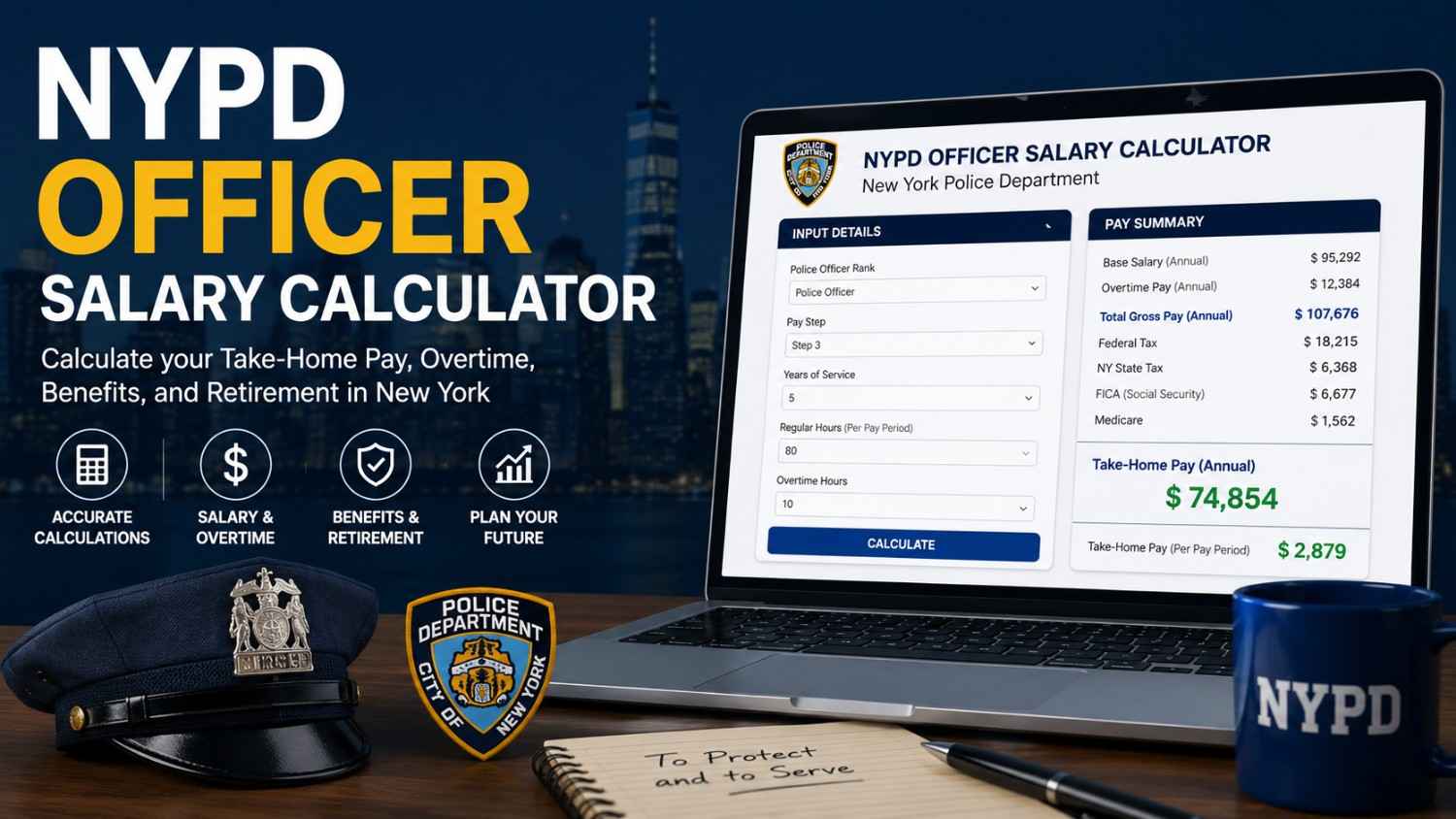
NYPD Officer Salary Calculator 2027: Gross Pay, Overtime and Take-Home
Enter your pay step, overtime and tax details to see what a New York City police officer earns before and after tax: per year, month, paycheck, week and hour.
Estimated take-home per year
–Per paycheck (bi-weekly)
–Per month
–| Total gross pay / year | – |
| Overtime included | – |
| Federal income tax | – |
| Social Security + Medicare | – |
| State + city tax (estimate) | – |
| Gross hourly (base only) | – |
| Gross weekly | – |
| Share of gross kept | – |
How to use this calculator
- Enter your salary. Type the annual figure from your pay stub, or tap a button to load the published starting pay or the 5.5-year figure.
- Add overtime. Put in the overtime hours you expect in a year. The tool turns your salary into an hourly rate, then multiplies it by the overtime rate (1.5 by default).
- Add other pay. Use the “other pay” box for night differential, longevity, holiday pay or an uniform allowance. Tick the neighborhood policing box only if your figure does not already include it.
- Pick your tax setup. Choose the tax year, filing status and where you live. Add deferred-compensation savings and children if they apply.
- Read the results. The right side updates as you type: yearly take-home, bi-weekly check, monthly pay, tax split and the colored bar.
What an NYPD officer earns in 2027
If you search for NYPD pay, you will find three or four different answers within a minute. One site says an officer starts at $42,500. Another says top pay is $85,292. A third says $131,500. They are not all lying. They are describing different years, different contracts and, in some cases, different things: base salary in one place, total pay with extras in another.
The most direct source is the NYPD’s own recruitment website. It states a starting salary of $60,884 and, after five and a half years of service, a total salary of $126,410. It also lists paid vacation, unlimited sick leave with full pay, medical, prescription, dental and vision coverage, an annuity fund, a deferred compensation plan, and optional retirement at half salary after 20 years of service. Those lines are the backbone of the calculator on this page.
Notice the wording “total salary.” The recruitment page does not say “base pay,” and it does not break the number into pieces. That matters, because a police paycheck in New York is built from several parts. Treat the published figure as the scheduled salary for the step and your real annual income as that number plus whatever you earn on top.
Why the numbers online disagree
NYPD salaries are set by contract between the City of New York and the Police Benevolent Association (PBA), and the contract has been rewritten more than once in the last decade. Old pages never disappear from the internet, so outdated figures keep circulating.
Here is how the common numbers fit together:
| Figure you may see | Where it comes from | Status |
|---|---|---|
| $42,500 start, $85,292 at 5.5 years | Older city and law-firm pages from the pre-2023 salary schedule | Outdated |
| $58,580 start, $121,589 at 5.5 years | An earlier version of the city’s own officer salary page | Earlier schedule |
| $60,884 start, $126,410 at 5.5 years | The NYPD recruitment site | Latest official figure found |
| $131,500 top pay | A 2023 city press release projecting pay as of August 2024, counting every differential, longevity, holiday pay and uniform allowance | A projection, not a salary step |
The gap between $58,580 and $60,884 is about four percent, and the gap between $121,589 and $126,410 is also close to four percent. That is the size of the largest raise in the last contract, so the newer numbers look like a scheduled raise landing on top of the older ones. Still, the city has not published a single plain table for every step on the pages we checked, so use the calculator’s salary box to type in the figure from your own pay stub.
One more thing about the $131,500 figure: it came from a city announcement about the tentative contract and described what a five-and-a-half-year officer could receive once all extras were counted. It is a useful ceiling for thinking about total compensation, but it should not be confused with the salary step itself.
The academy years and the step schedule
Pay begins on the first day at the Police Academy. Recruitment materials state that full salary and benefits are available from day one of academy training. A recruit does not wait for graduation to be on the payroll or to be covered by health insurance.
After the academy, an officer climbs through a fixed series of steps. Pay rises on a schedule tied to time on the job, and the top of the patrol officer scale is reached after five and a half years. That quick climb is one reason NYPD pay looks so steep on paper. Compared with departments where reaching the top takes ten years or more, the NYPD gets there fast.
Older versions of the recruitment pages listed steps at roughly the 1.5, 2.5, 3.5 and 4.5-year marks, and a note on a related city page for correction officers uses that same rhythm. We could not confirm the exact current dollar amount at every middle step from an official table, so this page does not invent them. If you are somewhere in the middle of the ladder, enter your current annual salary into the first box of the calculator and everything else will follow from it.
Where the PBA contract stands
The last contract between the city and the PBA covered August 2017 through July 31, 2025. It was a voluntary agreement, only the third in about thirty years, and it paid raises between 2.25 and 4 percent over its life, retroactive to 2017. It also added money to lift starting salaries, created a neighborhood policing differential of 2.25 percent of base pay, and set up a pilot allowing 10- and 12-hour tours.
That contract has expired. In July 2026 the PBA described itself as having been out of contract for nearly a year, and the union was pushing for raises that would bring NYPD salaries closer to those of New York State Troopers, who also work in the city. The union’s newsroom also referred to a step by the state’s Public Employment Relations Board in the process. In other words, the pay schedule you read today may change, and any raise that is eventually agreed could be paid retroactively.
What does this mean for you? If you are planning a career move around a specific number, treat it as the pay on the schedule now, not a promise for 2027. If a new deal is reached, the calculator is easy to update: change the salary box and the other fields stay the same.
Overtime and extra pay
For many officers, overtime is the biggest lever after the salary step. The city’s own recruitment text says that a five-and-a-half-year officer who also works night differential and overtime may earn over $126,531 on an older version of the page, and the same pattern holds today: scheduled pay is the floor, not the ceiling.
The calculator handles overtime in a simple way. It divides your annual salary by your paid hours (2,080 by default, which is 40 hours for 52 weeks), then multiplies that hourly rate by the overtime multiplier (1.5 by default) and by the number of overtime hours you enter. So at a $126,410 salary the hourly rate is about $60.77, and each overtime hour at time and a half is worth about $91.16 before tax.
Real overtime rules can differ. Some overtime is paid in cash and some is taken as time off, and the way hours are counted can differ from a straight 2,080-hour year. Treat the result as a planning number, then compare it with a real pay stub after a few months on the job.
Other parts of a police paycheck
- Neighborhood policing differential: 2.25 percent of base pay under the last contract. Tick the box in the calculator only if your salary figure does not already include it.
- Longevity, holiday pay and uniform allowance: The recruitment site lists longevity pay, holiday pay and uniform allowance among the extras. Amounts vary, so use the “other pay” box.
- Night differential: paid for working certain evening and overnight hours. Put your own annual total in the “other pay” box.
What take-home pay looks like
Gross pay is only half of the picture. Here are three simple examples from the calculator, using the 2027 federal brackets, a $0 overtime assumption, Social Security and Medicare turned on, and a rough state and city rate. They are meant to show the shape of the numbers, not to replace your own pay stub.
| Situation | Gross / year | Take-home / year | Bi-weekly check |
|---|---|---|---|
| Starting salary, single, NYC resident (about 8% state and city) | $60,884 | about $46,300 | about $1,780 |
| 5.5-year salary, single, NYC resident | $126,410 | about $87,900 | about $3,380 |
| 5.5-year salary, married filing jointly, outside NYC (about 4.8%) | $126,410 | about $100,000 | about $3,850 |
Three things move these numbers. First, filing status: the joint standard deduction for 2027 is $33,200 against $16,600 for a single filer, and the brackets are twice as wide. Second, where you live: New York City residents pay a city income tax on top of the state tax, while an officer who lives in Nassau, Suffolk or Westchester pays state tax only. Third, pre-tax savings: money you put into a deferred compensation plan reduces your federal and state taxable income, though not your Social Security and Medicare withholding.
The tax rates are the part to double-check. Federal numbers in the tool come from the IRS inflation adjustments for 2027, announced in November 2026. The state and city rate is a rounded estimate you can replace with the custom field. One assumption to watch: the calculator caps Social Security at the 2026 wage base of $184,500 for both years, because the 2027 base was not part of the sources used here. That cap does not affect anyone under that income.
Benefits that do not show up on the paycheck
A big reason officers stay is the package around the salary. The recruitment site lists these items:
- 27 paid vacation days beginning in the seventh year of service
- Unlimited sick leave with full pay
- A selection of medical benefit packages, with prescription, dental and vision coverage
- An annuity fund, a deferred compensation plan, a 401(k) option and an IRA option
- Optional retirement at one-half salary after 20 years of service
- An annual $12,000 Variable Supplement Fund payment after retirement
- Veterans can use GI Bill benefits in addition to salary during the first two years, and can buy back up to three years of military time toward retirement
Older pages say retirement at half salary comes after 22 years. The current recruitment page says 20, so check the date on any page you read. Pension rules can also depend on the year an officer was hired, so confirm the details with the pension fund or the union before making a retirement plan.
None of those benefits are in the calculator, because they are not cash in your paycheck. But if you are comparing the NYPD with a job that pays a little more up front, put a dollar value on the health coverage and the pension before you decide.
Promotion and pay above patrol
Patrol officer is the starting rank, not the end of the pay ladder. The recruitment site lists the education needed for promotion: sergeant requires two years of college work (64 credits) or an associate degree, lieutenant requires three years (96 credits), and captain requires a bachelor’s degree. Credits earned in the academy can count toward those requirements, and the department says promotion rules can change.
On pay, a spring 2025 agreement with the Sergeants Benevolent Association reportedly set the top sergeant base salary at $134,819. For a patrol officer who tops out around $126,410 in scheduled pay, that is a step up, though overtime can narrow or erase the difference between ranks in a given year. You can test this yourself: type $134,819 into the salary box and compare the result with the patrol figure.
Requirements before the pay starts
The salary is not the hardest part of getting hired. The NYPD requires either 60 college credits with a minimum 2.0 GPA or two years of active military service. You must be a United States citizen with a valid New York driver license, and you must live in one of the five boroughs or in Nassau, Suffolk, Rockland, Westchester, Putnam or Orange County within 30 days of being hired. Drug use, including marijuana, is prohibited for NYPD employees.
Recruits also buy their own uniforms and training equipment. An older version of the hiring FAQ put that at about $2,504 across the academy, split into three payments. Treat it as a rough guide and ask for the current list when you apply.
NYPD pay compared with a nearby department
A fair comparison is the Port Authority Police Department, which patrols the region’s airports, bridges, tunnels and transit. A 2026 recruitment flyer lists a starting salary of $46,954 that rises to $61,270 after one year, with a top annual base of $131,703.52. It also lists family health and dental coverage and a pension after 20 years.
The two jobs are built differently. The Port Authority starts lower but its stated top base is slightly higher than the NYPD’s scheduled figure, while the NYPD gets to its top step within five and a half years. If you are weighing both, run each salary through the same calculator by typing it into the box, then compare take-home, not gross.
How the calculator does the math
Knowing the steps behind a result makes it easier to trust, so here is the order the tool follows. It starts with your annual salary and adds overtime, any other pay you enter, and the 2.25 percent differential if you ticked that box. The sum is your gross pay. Next it removes any pre-tax savings you entered, because deferred compensation lowers the income that federal and state tax are based on.
Federal income tax comes next. The tool subtracts the standard deduction for your filing status, runs the rest through the seven federal brackets for the year you picked, and then subtracts the child tax credit for each child you list ($2,300 per child in 2027 and $2,200 in 2026). Social Security is 6.2 percent of gross pay up to the wage base, and Medicare is 1.45 percent of all gross pay. State and city tax is your selected rate applied to pay after savings. Whatever remains is take-home, which is then divided by 26 for a bi-weekly check and by 12 for a monthly figure.
Because the tool is a planning aid, it leaves out items that depend on your personal file: itemized deductions, retirement contributions you make after tax, union dues, and tax credits other than the child credit. If you use those, your real take-home will differ by some amount.
Who gets the most from this calculator
People use an NYPD pay estimate for very different reasons, and the same tool serves each of them. A candidate waiting on exam results can compare the starting salary with a job in another field. A family member can see whether a new officer’s pay covers rent in a given borough. A current officer can test how much an extra overtime tour changes a year, or how a raise from a new contract would change a bi-weekly check. A person weighing a move from another department can enter both salaries and compare take-home pay side by side instead of arguing over gross figures.
How to read your own number
A few habits will keep your estimate honest:
- Start from your pay stub. If you are already an officer, use your current annual salary, not a website figure.
- Be realistic about overtime. A busy summer of 12-hour tours is not the same as a full year. Try the calculator with a low, middle and high overtime number.
- Do not double-count. The $126,410 figure is described as total salary, so adding every extra on top can overstate your income.
- Think in bi-weekly checks. City employees are paid every two weeks, which is why the tool shows a 26-paycheck figure.
- Check the cost side. A high salary in New York goes through high rent. If you live outside the city, a commute and parking cost belong in your budget too.
The bottom line
An NYPD officer starts at about $60,884 and reaches $126,410 in scheduled salary after five and a half years, according to the department’s own recruitment site, with overtime, differentials and benefits making the full package larger. The contract behind those numbers has expired and is being negotiated, so expect the schedule to move. Use the calculator at the top of this page with your own salary, overtime and tax details, and keep your latest pay stub next to it for a final check.
Frequently asked questions
How much does an NYPD officer make?
The NYPD recruitment site lists a starting salary of $60,884 and a total salary of $126,410 after five and a half years of service. Overtime and other pay come on top of those figures.
How long does it take to reach top pay?
Five and a half years of service. Pay rises through scheduled steps until then.
Do recruits get paid in the Police Academy?
Yes. Recruitment materials say full salary and benefits begin on the first day of academy training.
Why do some websites say $85,292 or $42,500?
Those numbers come from an older salary schedule. They keep appearing on websites that were never updated.
Is the PBA contract still in effect?
The last contract ran through July 31, 2025. In mid-2026 the PBA said it had been out of contract for nearly a year, so the schedule can change and raises may be paid retroactively.
How much overtime can an officer earn?
It depends on assignment, unit and the year. The calculator lets you try any number of hours, and uses time and a half by default.
What is the neighborhood policing differential?
It is a 2.25 percent addition to base pay created by the last contract. Tick the box in the calculator only if your salary figure does not already include it.
When can an NYPD officer retire?
The current recruitment site lists optional retirement at one-half salary after 20 years of service. Older pages say 22 years, so confirm your own rules with the pension fund.
How much is take-home pay for a 5.5-year officer?
With the 2027 federal brackets, no overtime and a rough 8 percent state and city rate, a single NYC resident at $126,410 keeps about $87,900 a year, around $3,380 per bi-weekly check. Your result will differ.
Does the calculator include pension or union dues?
No. It covers federal tax, Social Security, Medicare, a rough state and city rate, and optional pre-tax savings. Pension contributions and dues vary, so check your pay stub.
Can a sergeant earn more than an officer?
Reports on the 2025 sergeants agreement put top sergeant base pay at $134,819. Overtime can narrow the gap in a given year.
Do I need to live in New York City?
No, but you must live in one of the five boroughs or in Nassau, Suffolk, Rockland, Westchester, Putnam or Orange County within 30 days of being hired.

Junaidul Islam
Junaidul builds free online calculators and tools for New York Calculator. This NYPD Officer Salary Calculator was designed so job seekers, families and officers can see gross pay, overtime and take-home in one place, using published figures and clear assumptions. If you spot a number that needs updating, he wants to hear about it.
Contact on Facebook