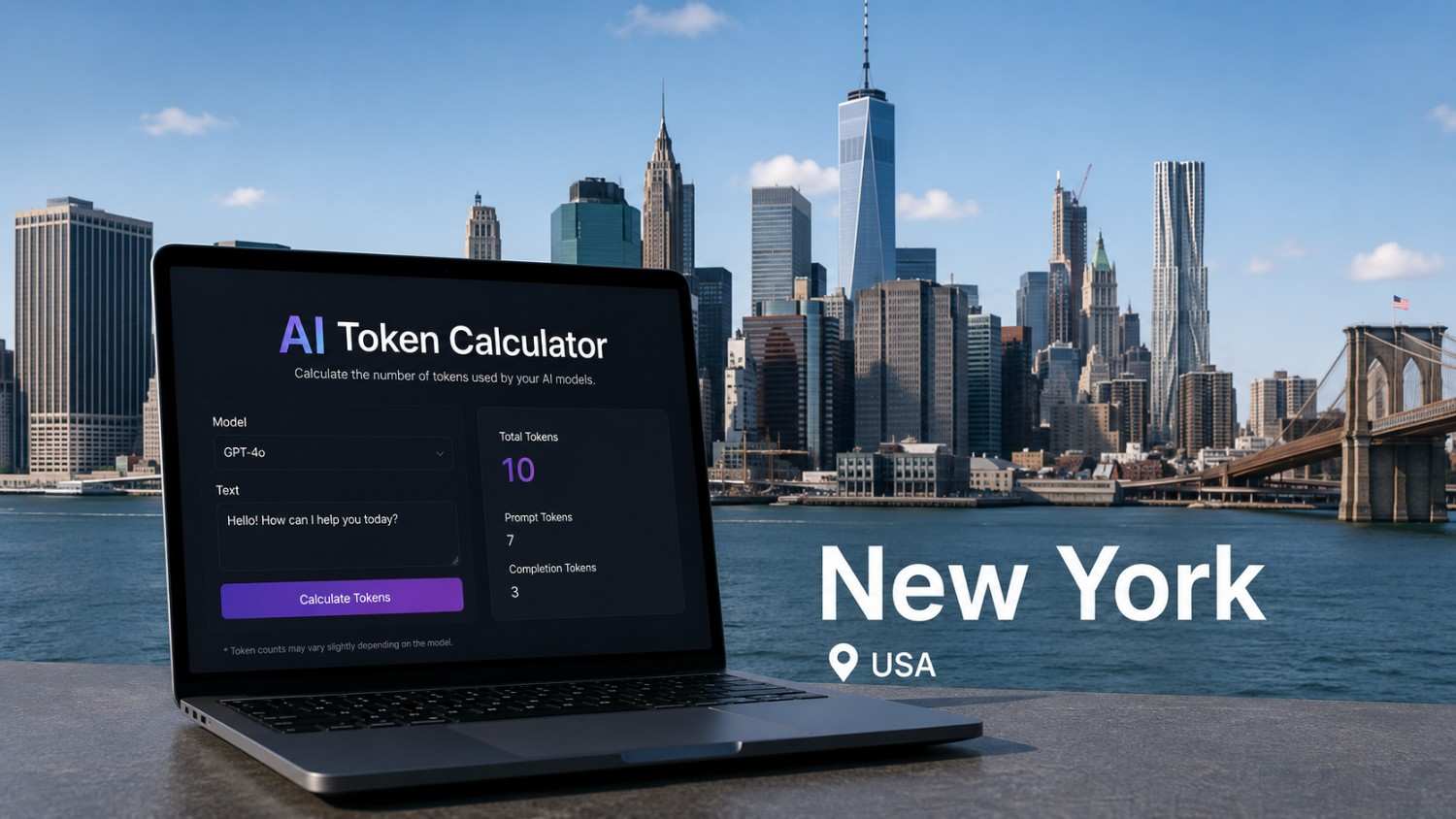
AI Token Calculator New York
Calculate your AI token investment outcomes — tokens received, staking yields, gas costs, NY tax estimates, and downside scenarios in one place.
AI Token Investment Analysis
—What This Means For You
—
What Exactly Is the AI Token Calculator New York?
This calculator gives New York-based crypto investors a full breakdown of an AI token investment starting from a dollar amount and token price. It calculates exact tokens received after gas fees, models staking yield over your chosen hold period, applies price scenarios from bear to moon case, and estimates the New York State and New York City capital gains taxes you would owe on profits. No other calculator combines all of these elements with New York-specific tax rates and regulatory context in a single tool.
The AI token space has expanded dramatically since 2023, with hundreds of projects launching tokens tied to decentralized AI compute networks, GPU marketplaces, AI agent platforms, data labeling protocols, and various other AI-related use cases. Total AI token market capitalization has fluctuated between $10 billion and $40 billion, with individual tokens ranging from $2 million micro-caps to established tokens exceeding $10 billion. For New York investors, this space presents a unique combination of opportunity and regulatory complexity that generic crypto calculators completely ignore.
Standard crypto calculators show you how many tokens you get and what they might be worth at a different price. That is necessary but wildly insufficient. Gas fees on Ethereum can consume 1-3% of a small investment. Staking yields that look attractive often carry impermanent loss, lock-up risk, or token inflation that silently erodes your nominal return. And New York’s combined federal plus state plus city income tax rate on short-term crypto gains can reach 47-50% for high-income residents — meaning a $10,000 gain might leave you with only $5,000 after taxes. Without modeling these factors, you are making decisions with a dangerously incomplete picture.
Why AI Token Investors in New York Need Their Own Calculator
New York is not like other states when it comes to cryptocurrency. The regulatory environment, the tax burden, and the available trading infrastructure all differ from what most online tools assume. Using a generic crypto calculator that ignores New York-specific factors will systematically understate your costs and overstate your net returns.
NY Tax Reality Check
New York City residents pay up to 50% combined tax on short-term crypto gains. This calculator applies the correct federal, NYS, and NYC rates so you see your actual net return.
Gas Fee Accuracy by Chain
Ethereum gas fees are drastically different from Solana or Base costs. This calculator uses chain-specific estimates so your small investment does not get the same gas treatment as a large trade.
Staking Yield Realism
High APY numbers in AI token staking often come with hidden risks: token inflation, impermanent loss, and smart contract vulnerability. The calculator flags yield levels that correlate with higher risk.
Regulatory Awareness
New York’s BitLicense requirements mean some tokens and platforms are simply unavailable to NY residents. Results include context about which investments may face regulatory hurdles.
There is also a structural problem with how most people evaluate AI token investments: they look at the potential upside in isolation. A 10x return sounds extraordinary until you consider that the probability of a 10x return on a micro-cap AI token is perhaps 5-10%, while the probability of a 90% loss is 40-50%. The expected value may actually be negative even though the upside story sounds compelling. By showing you the full range from bear to moon case, this calculator forces you to acknowledge that the downside exists and is statistically more likely than the upside for most AI tokens in most market conditions.
How to Use This AI Token Calculator (Takes 20 Seconds)
Select Token Category
Choose the AI token subsector — compute, infrastructure, agents, LLMs, data, social, gaming, DeFi, or broad index.
Enter Investment Details
Input your dollar amount, token price, and market cap tier. Market cap affects scenario ranges — micro-caps swing wider than mega-caps.
Set Staking and Chain
Choose staking yield, hold period, price scenario, blockchain, transaction count, and NY tax filing status.
Review Full Analysis
See tokens, gas costs, staking yield, value ranges, NY tax estimate, net after-tax value, and risk-adjusted return.
AI Token Categories — Risk, Yield, and New York Access
| Category | Typical Yield | Volatility | Regulatory Risk | NY Exchange Access |
|---|---|---|---|---|
| AI Compute (GPU) | 8–25% APY | High | Medium | Limited — Many DEXs only |
| AI Infrastructure | 5–18% APY | Medium–High | Low–Medium | Moderate — Some on Coinbase |
| AI Agent Tokens | 15–60% APY | Very High | High | Very Limited |
| LLM Tokens | 10–40% APY | Very High | High | Very Limited |
| AI Data / Training | 8–30% APY | High | Medium | Limited |
| AI Social / Content | 20–80% APY | Extreme | Very High | Very Limited |
| AI Gaming | 15–50% APY | Extreme | High | Limited |
| AI DeFi / Trading | 10–35% APY | Very High | Very High | Very Limited |
| Broad AI Index | 3–12% APY | Medium | Low | Good — Major exchanges |
NY Exchange Access reflects the practical reality that New York’s BitLicense requirements have driven many crypto platforms to block New York residents entirely. Binance, Bybit, and numerous DeFi protocols restrict NY access. Coinbase, Gemini, and a few others operate with proper licensing. For AI tokens specifically the restricted access problem is even more acute because many launch on decentralized exchanges that do not serve New York.
How New York’s Crypto Regulations and Tax Laws Shape AI Token Investing
New York’s approach to cryptocurrency is the most restrictive of any U.S. state, and it creates a distinct investment environment that generic crypto tools do not account for.
- The BitLicense wall: Since 2015, any company engaged in virtual currency business with New York residents must obtain a BitLicense from NY DFS. Only about 30 have been granted in nearly a decade. The practical consequence is that the vast majority of crypto exchanges and DeFi platforms either block New York IP addresses or do not offer services here. AI tokens are not illegal to own in New York — but accessing them through compliant channels can be challenging.
- Combined NY tax rate on crypto gains: New York is one of few jurisdictions where crypto investors pay three layers: federal (up to 37% for short-term gains), New York State (up to 10.9%), and New York City (3.876%). For a high-income NYC resident the combined top marginal rate on short-term crypto gains reaches approximately 50.8%. Even long-term gains carry 28-33% combined. This means a significant portion of your AI token gains will go to taxes.
- NY DFS coin listing approvals: The DFS maintains a Greenlist of approved cryptocurrencies. Very few AI tokens are on it. Even on licensed exchanges like Coinbase, you may not find the specific AI token you want, forcing you toward decentralized exchanges with potential access restrictions from New York.
- Securities law intersection: The SEC has taken the position that many crypto tokens may constitute securities. For AI tokens this risk is elevated because many are sold as investment vehicles with profit expectations derived from others’ efforts. If deemed a security, implications include resale restrictions and potential delisting. New York investors are in the SEC’s backyard — enforcement actions from the NY Regional Office are common.
- NY Attorney General enforcement: The NY AG has aggressively pursued crypto companies serving residents without authorization, sending cease-and-desist letters and filing litigation. Platforms you use to access AI tokens could face legal action, potentially freezing your assets.
Risks and Rewards Across AI Token Investment Approaches
- Established AI Tokens on Licensed Exchanges — Pros: Legally accessible from New York, regulatory compliance handled, adequate liquidity for positions under $50,000, basic staking available, easy tax tracking. Cons: Very few AI tokens available this way, limited to largest projects that have already priced in narrative premium, returns correlate more with broad crypto than AI-specific developments.
- Tokens via Decentralized Exchanges — Pros: Access to the full AI token universe, no KYC on the DEX itself, more diverse staking options with higher APYs, early-stage access. Cons: Many DEXs restrict NY IPs, thin liquidity on small tokens can move price 10-20% against you on a $5,000 sell, smart contract risk, impermanent loss in liquidity pools, complex tax tracking.
- Staking and Yield Farming — Pros: Generates passive yield, can significantly enhance returns in flat or rising markets, aligns incentives with network success. Cons: High APY often signals token inflation diluting holdings, impermanent loss, lock-up periods prevent selling during downturns, many protocols are unaudited, yield tokens may be illiquid.
- Token Launch Participation — Pros: Lowest entry price, potential for 5x-50x returns, early access to networks that may become valuable. Cons: Extreme failure rate, vesting schedules prevent immediate selling, many launches are outright scams or rug pulls, due diligence on pre-launch projects is nearly impossible, limited legal recourse for NY residents.
What This Calculator Cannot Do
- This is not financial advice: Nothing produced here constitutes investment advice or a recommendation. The estimates are based on models and historical analysis — they describe ranges of possibility, not predictions.
- Price scenarios are illustrative: The bear/bull/moon ranges are based on historical volatility data for each market cap tier, but individual tokens can and do exceed these ranges in both directions. Actual outcomes depend entirely on the specific project.
- Tax estimates assume full taxability: The calculator assumes all gains are taxable at your marginal rate. Actual tax liability depends on your total income, other gains and losses, deductions, and specific circumstances. Consult a New York-licensed tax professional for precise estimates.
- Staking yield does not account for token price change: The yield calculation shows additional tokens earned but does not adjust for price changes during the staking period. If the token price drops 50%, a 30% APY in tokens still results in a net loss in dollar terms.
- Gas fees are estimates: Actual gas costs vary by network congestion, transaction complexity, and gas price at the time of execution. Ethereum gas in particular can spike to $50-$100+ during peak periods.
- Regulatory status is not verified: This calculator does not check whether any specific token is available on NY-licensed exchanges or whether it has been classified as a security. You are responsible for verifying the regulatory status of any token you consider.
What Happens With Your Information
Nothing — your token category, investment amount, token price, market cap tier, staking option, hold period, scenario, blockchain, transaction count, and tax filing status are processed entirely in your browser. No data is sent to any server. No investment amounts, token holdings, or financial information is stored, logged, or transmitted. No cookies track your calculation. Close this tab and your data ceases to exist on your device.
Frequently Asked Questions
Owning cryptocurrency tokens is legal for New York residents. The restriction applies to the exchanges and platforms, not the tokens themselves. The challenge is that many platforms where AI tokens trade have not obtained BitLicenses and therefore block New York users. You can legally own any token you can legally acquire — but the method of acquisition matters. Using a VPN to circumvent geo-restrictions exists in a legal gray area that has not been tested in New York courts, and the NY AG has suggested that platforms serving NY residents without a license are violating state law regardless of how users access them.
The IRS treats staking rewards as ordinary income at the fair market value of the tokens at the time you receive them. For New York, this means the reward value is added to your federal, state, and city taxable income in the year received. When you later sell the staked tokens, you pay capital gains tax on any appreciation from the time you received them — not from the time you originally bought the base tokens. This creates a complex tax situation with multiple taxable events that many investors fail to track properly. For example, staking $5,000 worth of tokens for a year at 25% APY generates roughly $1,250 in additional tokens that are taxable as income when received, even if you have not sold anything.
Coinbase and Gemini are the two most prominent NY-licensed exchanges that list any AI-related tokens. However, their AI token selections are limited compared to what is available on Binance, Kraken (which exited NY), or decentralized exchanges. As of 2024-2025, you may find a handful of the largest AI tokens on Coinbase — typically those with market caps above $500 million that have been added to the NY DFS Greenlist. For the majority of AI tokens, especially those under $100 million market cap, NY residents face significant access barriers. Always verify that the exchange holds a valid BitLicense before depositing funds.
Short-term capital gains apply to crypto held for one year or less and are taxed at your ordinary income rate. For a high-income NYC resident this can reach approximately 50.8% combined (37% federal + 10.9% NYS + 3.876% NYC). Long-term capital gains apply to crypto held for more than one year and are taxed at 0%, 15%, or 20% federally depending on income, plus NYS and NYC income tax on the full gain amount. The combined long-term rate for a high-income NYC resident is approximately 28-33%. The difference between holding 364 days and 366 days can mean paying 50% tax versus 30% tax on the same gain — a powerful incentive to track your purchase dates precisely.
Yes, and this is one of the biggest risks in the AI token space. The SEC applies the Howey test: if investors put money into a common enterprise with the expectation of profit derived primarily from the efforts of others, it is likely a security. Many AI token projects — especially those that raise funds through token sales, promise future utility tied to platform development, or market themselves as investment opportunities — fit this description. If the SEC classifies an AI token as a security, the consequences include delisting from exchanges, trading restrictions, potential registration requirements, and the possibility that the token becomes effectively untradeable. The SEC’s New York Regional Office has been particularly active in crypto securities enforcement.
As of 2024-2025, typical gas costs per transaction are: Ethereum — $3-$50+ depending on network congestion (average around $8-$15 for a simple token swap), Solana — $0.01-$0.05, BNB Chain — $0.10-$0.30, Arbitrum/Optimism — $0.10-$0.50, Base — $0.05-$0.20. For a $500 investment on Ethereum, gas could consume 1-3% of your capital. For the same $500 on Solana, gas is negligible. This calculator uses chain-specific estimates to reflect this reality. If you are making multiple transactions (buy, stake, claim rewards, sell), gas costs multiply accordingly.
Delisting means the token is removed from an exchange’s trading interface. You still own the tokens — they sit in your wallet or exchange account — but you can no longer trade them on that particular platform. For tokens delisted from a centralized exchange, you would need to transfer them to a wallet and find another exchange or DEX that still lists them, which may not exist. For New York residents this is especially problematic because alternative platforms may not serve NY. If a token is delisted due to regulatory action (SEC enforcement, NY DFS order), recovery options are extremely limited. This is one of the key risks the calculator flags through the regulatory risk assessment tied to your chosen token category.
No — in fact, very high APYs are often a red flag. Yields above 40% in crypto typically come from one or more of these sources: token inflation (the protocol mints new tokens to pay yield, diluting existing holders), impermanent loss (in liquidity pools, the value of your deposited tokens can decrease relative to holding them outside the pool), or simply high risk (the protocol is new, unaudited, or the token has low liquidity). A 100% APY on a token that loses 70% of its value during the staking period leaves you significantly worse off than a 5% APY on a stable token. Always evaluate the source of the yield, not just the number.
Yes. Cryptocurrency losses are treated as capital losses for tax purposes and can offset capital gains dollar for dollar. If your total capital losses exceed your gains, you can deduct up to $3,000 per year against ordinary income (federal) and carry forward remaining losses to future years. New York State and New York City also allow capital loss deductions, though the rules and carryforward provisions may differ slightly from federal rules. This means that if your AI token investment loses $5,000, you can use that loss to reduce taxes on other investment gains. Proper tracking of cost basis and sale proceeds for every transaction is essential to claim these deductions — which is another reason why active trading of AI tokens on DEXs creates tax complexity that many investors underestimate.
No. Your token category, investment amount, token price, market cap tier, staking option, hold period, scenario, blockchain, transaction count, and tax filing status are processed entirely in your browser. No server receives this data, no history is stored, no cookies are created. Close the tab and it is completely gone.