Wisconsin Bonus Tax Calculator 2026
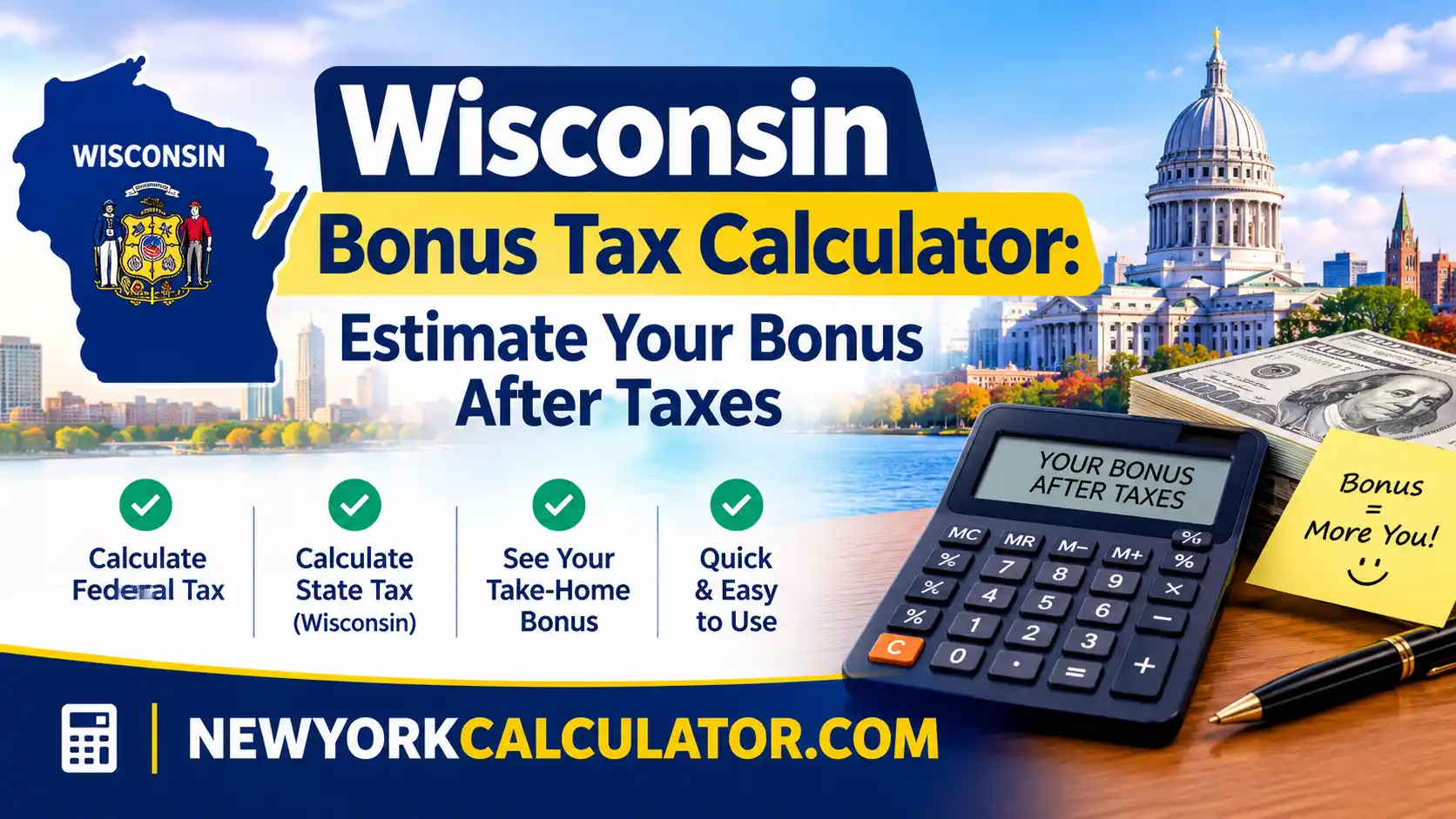
Estimate how much of your work bonus you may keep after federal income tax, Wisconsin state income tax, Social Security, and Medicare. Enter your annual salary and bonus amount to calculate an estimated after-tax bonus using 2026 tax rules.
Calculate Your Bonus Tax
Enter your income information below to estimate your take-home bonus.
| Gross Bonus | $0.00 |
| Estimated Federal Income Tax | $0.00 |
| Estimated Wisconsin Income Tax | $0.00 |
| Social Security Tax | $0.00 |
| Medicare Tax | $0.00 |
| Additional Medicare Tax | $0.00 |
| Total Estimated Taxes | $0.00 |
| Effective Tax Rate | 0% |
How to Use the Wisconsin Bonus Tax Calculator
Type the full bonus amount before taxes or payroll deductions.
Use your regular yearly salary, excluding the bonus being calculated.
Choose the federal filing status you expect to use on your tax return.
This helps estimate whether any of your bonus remains subject to Social Security tax under the annual wage limit.
Your estimated take-home bonus and individual tax components will appear below the button.
Wisconsin Bonus Tax Calculator: Complete 2026 Guide
Receiving a bonus can be a welcome financial boost, especially when you have been working toward a professional goal or completing a demanding project. However, the amount deposited into your bank account may be noticeably lower than the bonus shown in your employer’s compensation statement. The difference comes from payroll withholding and applicable taxes.
If you work in Wisconsin, understanding how federal and state income taxes affect supplemental wages can help you plan your finances more confidently. A Wisconsin bonus tax calculator provides an estimate of the taxes associated with an additional payment and shows how much money you might have left after those taxes.
What Is a Bonus Tax?
A bonus is generally considered supplemental wages rather than ordinary salary paid for a regular work period. Supplemental wages can include performance bonuses, annual incentives, commissions, awards, and certain other employment payments.
For federal tax purposes, separately identified supplemental wages may qualify for a special withholding method. Under the applicable IRS rules, employers can generally use a 22% flat federal withholding rate for qualifying separately identified supplemental wages, subject to the applicable conditions. The rate increases to 37% for supplemental wages exceeding $1 million during the calendar year.
It is important to understand that withholding is not necessarily the same as your final income tax rate. Your actual federal income tax liability is determined by your complete annual taxable income, deductions, credits, and filing status.
How Federal Income Tax Affects a Wisconsin Bonus
Wisconsin employees are subject to federal income tax rules just like employees in other states. Your bonus is generally included in your taxable compensation, even when your employer withholds federal income tax using the supplemental wage method.
The United States uses a progressive income tax system. This means different portions of taxable income are taxed at different rates. A bonus does not automatically make all your annual earnings subject to a higher tax rate.
For example, if your annual taxable income is within the 22% federal bracket, an additional portion of income may be taxed at 22%, provided it remains within that bracket. If the bonus moves part of your income into a higher bracket, only the amount within the higher bracket is subject to that higher marginal rate.
For 2026, federal tax brackets range from 10% to 37%. The standard deduction is $16,100 for single filers and married individuals filing separately, $24,150 for heads of household, and $32,200 for married couples filing jointly.
Wisconsin State Income Tax on Bonuses
Wisconsin has its own individual income tax system. If you are a Wisconsin resident receiving a taxable employment bonus, that compensation is generally included in Wisconsin income.
Wisconsin uses progressive tax brackets. For 2026, the rates for single filers and heads of household are:
- 3.50% on taxable income up to $15,110.
- 4.40% on taxable income over $15,110 up to $51,950.
- 5.30% on taxable income over $51,950 up to $332,720.
- 7.65% on taxable income above $332,720.
For married couples filing jointly, the corresponding thresholds are $20,150, $69,260, and $443,630. The applicable rates are 3.50%, 4.40%, 5.30%, and 7.65%.
These are marginal tax rates applied to taxable income, not flat percentages applied to the entire bonus. Your final Wisconsin liability can also be affected by deductions, exemptions, credits, and other tax-return details.
Social Security Tax on Your Bonus
Social Security tax is another important part of bonus taxation. In 2026, the employee Social Security tax rate is 6.2% on covered wages up to the annual wage base of $184,500.
This means that if your year-to-date Social Security wages are already close to the annual limit, only part of your bonus may be subject to Social Security tax. If you have already reached the limit with your regular wages, additional covered wages generally will not have employee Social Security tax withheld for that year.
For example, consider an employee with $180,000 in Social Security wages before receiving a $10,000 bonus. Only $4,500 of the bonus remains within the 2026 wage base. The estimated employee Social Security tax on that portion is $279.
Medicare Tax and Additional Medicare Tax
Medicare tax generally applies to covered wages without an annual wage cap. The employee rate is 1.45% in 2026.
Some higher-income employees may also owe Additional Medicare Tax at 0.9%. The applicable threshold depends on filing status:
- $200,000 for single filers and heads of household.
- $250,000 for married couples filing jointly.
- $125,000 for married individuals filing separately.
Employers generally begin withholding Additional Medicare Tax when an employee’s wages paid by that employer exceed $200,000 in a calendar year, regardless of the employee’s eventual filing status. The final liability is determined on the individual’s tax return.
Example: Calculating a $5,000 Bonus in Wisconsin
Imagine a Wisconsin employee receives a $5,000 annual performance bonus and earns $65,000 in regular annual salary. The employee is single and has not yet reached the Social Security wage limit.
The employee’s bonus may be affected by several tax components:
- Federal income tax based on the employee’s taxable annual income.
- Wisconsin income tax based on Wisconsin taxable income.
- Social Security tax at the applicable 6.2% rate.
- Medicare tax at 1.45%.
The actual take-home amount depends on the employee’s complete tax circumstances. Entering these details into the calculator provides an estimate of the incremental taxes associated with the bonus.
Why Your Bonus Paycheck May Look Different
One common source of confusion is the difference between the tax withheld from a bonus paycheck and the final tax owed for the year. An employer may use the federal supplemental wage withholding method or combine the bonus with regular wages when calculating withholding.
Wisconsin payroll withholding can also differ from your final Wisconsin income tax liability. Your employer uses applicable payroll withholding procedures, while your annual return considers your complete income and tax circumstances.
Other deductions may also reduce the amount deposited into your account. Retirement contributions, health insurance premiums, benefit deductions, and other payroll adjustments can change your actual paycheck.
Ways to Plan for Your Bonus
A bonus is a good opportunity to review your financial priorities. Before spending the entire amount, consider setting aside money for any additional tax liability that may arise when you file your return.
You may also consider using part of the payment to build an emergency fund, pay down high-interest debt, increase retirement contributions where appropriate, or save toward a major purchase.
Keeping your latest pay statements and reviewing your year-to-date income can make tax planning more accurate. If your compensation includes substantial commissions, multiple bonuses, stock compensation, or other income, a qualified tax professional can help assess your complete situation.
Final Thoughts
Understanding how bonus taxes work in Wisconsin helps you avoid confusing payroll withholding with your final tax bill. Federal income tax, Wisconsin state income tax, Social Security, and Medicare can all affect the amount you take home.
Use this 2026 Wisconsin Bonus Tax Calculator as a starting point for estimating your bonus after taxes. For an accurate final calculation, consider your full-year income, applicable deductions, credits, employer withholding, and personal tax circumstances.
Frequently Asked Questions
How much tax will I pay on a bonus in Wisconsin?
Your bonus may be subject to federal income tax, Wisconsin income tax, Social Security tax, and Medicare tax. The total depends on your annual income, filing status, Social Security wage limit, and other tax circumstances.
Is a bonus taxed at 22% in Wisconsin?
Not necessarily. The 22% rate is a federal withholding method that may apply to qualifying separately identified supplemental wages. It is not a universal final tax rate. Wisconsin state income tax and payroll taxes may also apply.
Does Wisconsin have a separate bonus tax rate?
Wisconsin generally includes taxable employment bonuses in income subject to its individual income tax rules. There is no separate universal Wisconsin bonus income tax rate.
What is the Wisconsin income tax rate for 2026?
Wisconsin’s 2026 individual income tax rates are 3.50%, 4.40%, 5.30%, and 7.65%. The applicable bracket depends on filing status and taxable income.
Is Social Security tax deducted from a bonus?
Generally, yes. Covered bonus wages are subject to employee Social Security tax at 6.2% until the 2026 annual wage base of $184,500 is reached.
Does Medicare tax apply to Wisconsin bonuses?
Yes. Employee Medicare tax generally applies at 1.45% without an annual wage cap. Higher-income employees may also owe Additional Medicare Tax.
Why is my bonus paycheck smaller than expected?
Your employer may withhold federal and state income taxes, Social Security, Medicare, and other payroll deductions from your bonus. This reduces the amount deposited into your account.
Can I use this calculator for a 2025 bonus?
This calculator is designed for 2026 tax-year estimates. The tax brackets, deductions, and wage limits may differ for 2025, so use the appropriate year’s rules when estimating a previous-year bonus.
Is bonus withholding the same as final tax?
No. Payroll withholding is a payment toward your expected tax liability. Your final tax is calculated when you file your annual federal and Wisconsin income tax returns.
Does this calculator show my exact bonus paycheck?
No. It estimates incremental taxes using simplified annual-income assumptions. Employer withholding methods, benefit deductions, retirement contributions, tax credits, and other circumstances can change your actual payment.
About the CEO

Junaidul Islam
CEO – New York CalculatorFocused on making financial calculations easier to understand, Junaidul Islam supports the development of practical online tools that help users make informed financial decisions. The Wisconsin Bonus Tax Calculator is designed to explain the different tax components that may affect an employee’s bonus, including federal income tax, Wisconsin state tax, Social Security, and Medicare.
Contact the CEO →Tax Information & Sources
Tax rates and payroll information are based on published government guidance. Refer to the official sources for current requirements and individual tax situations.
For educational and informational purposes only. This calculator does not provide tax, legal, or financial advice.